The Big Question
What happens when AI processing moves from distant cloud servers to the very edge of the network? What if a surveillance camera could run complex AI models at 80 ms per image while consuming just 3.57 mAh, or a mobile robot could offload heavy tasks to a nearby edge server for instant processing?
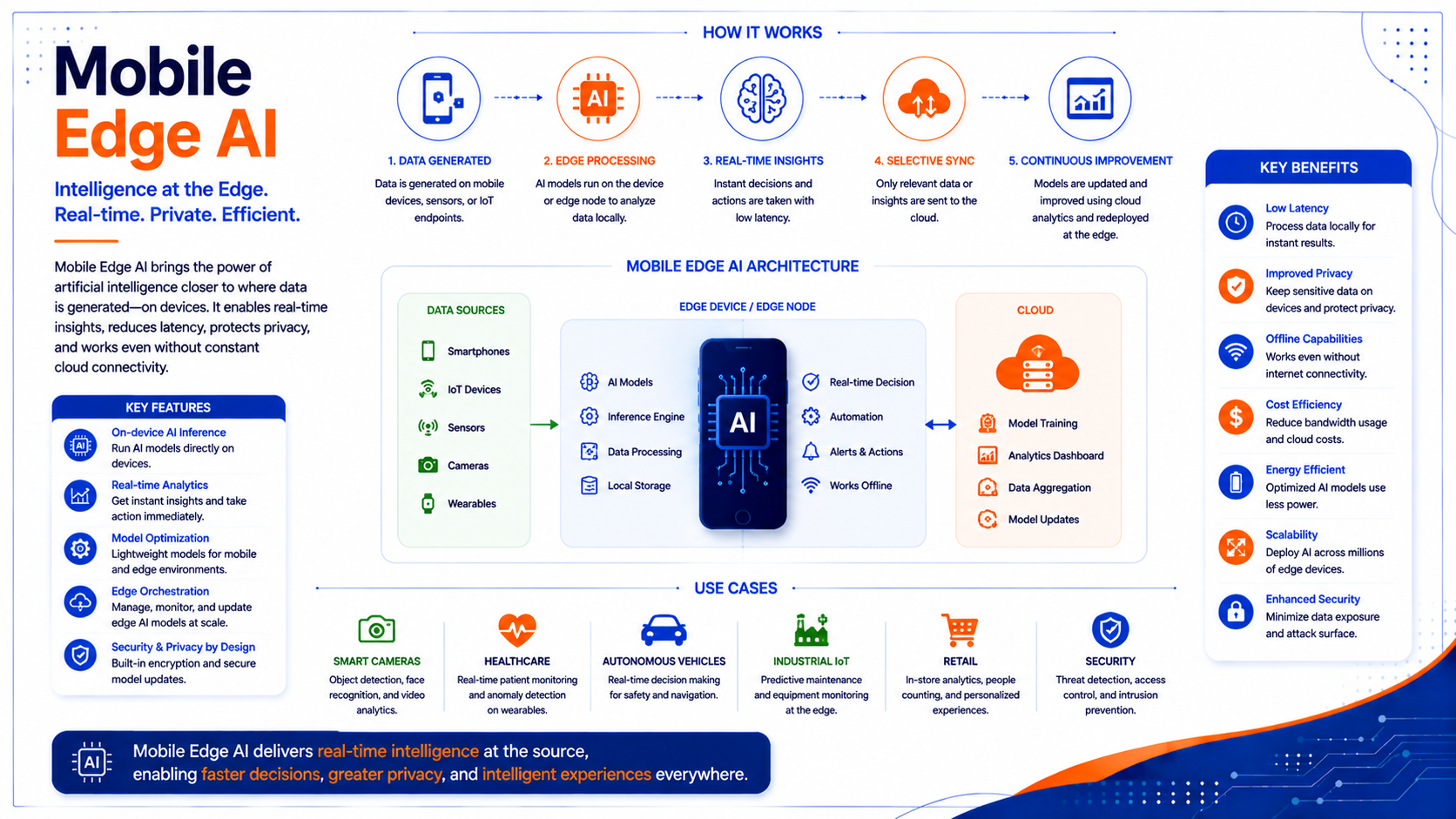
Mobile Edge Computing (MEC) is the pivotal technology that makes this possible. By bringing cloud capabilities closer to the user, it delivers ultra-low latency, reliable resource allocation, and the handling of massive data volumes, which are vital for next-generation services like AR/VR and autonomous driving . Mobile Edge Intelligence (MEI) combines this infrastructure with AI to overcome the limitations of cloud-centric models, offering high computational efficiency, low bandwidth consumption, and enhanced privacy through localized data processing .
The Architecture of Mobile Edge Intelligence
From Cloud to Edge
The transition from centralized cloud to distributed edge intelligence is a fundamental restructuring of the computing ecosystem. In traditional architectures, data from IoT devices is sent to a distant cloud for processing, introducing latency, consuming bandwidth, and creating potential privacy risks.
The MEI architecture reverses this flow, performing AI computations where data is generated. This is enabled by a combination of advances:
| Technology | Role in MEI |
|---|---|
| 5G/6G Networks | Provide the high-bandwidth, low-latency connectivity required for real-time edge AI. 6G's ultra-reliability and massive data handling capabilities are particularly significant |
| Lightweight AI Models | Architectures like MobileNets, ShuffleNets, and MobileVLM are designed for resource-constrained hardware, enabling inference on devices with limited processing power |
| Federated Learning | Enables distributed model training across edge devices without centralizing data, preserving privacy while building collective intelligence |
| AI-RAN | Integrates AI capabilities directly into the Radio Access Network, enabling dynamic resource allocation and network optimization |
The Hierarchical Edge-Fog-Cloud Continuum
A key architectural concept is the hierarchical distribution of computing across edge, fog, and cloud layers. Research on AIoT-based architectures demonstrates that model formats like NCNN offer the best energy efficiency and processing speed at the edge layer, processing up to 219 frames in real-time with just 3.57 mAh and 80 ms per image .
This layered approach allows for dynamic offloading of tasks. For example, a mobile robot could run simple models locally, but, as demonstrated by a SoftBank and Ericsson trial, it can dynamically offload AI workloads to nearby MEC infrastructure when additional computing power is required, enabling more advanced tasks without being limited by onboard hardware .
How It Works: The Workflow
A practical illustration of Mobile Edge AI comes from research on cloud-edge collaborative intelligence for tasks like multimodal entity linking . The workflow is a powerful example of "intelligent offloading" and demonstrates the principle that the whole can be far greater than the sum of its parts:
-
Local Perception and Decision: A mobile device (the Edge Client) captures a user's query and a live camera stream. It uses compact feature extractors (for both text and vision) to generate lightweight representations. A local intelligence module then assesses a
local solvability scoreto decide if the query can be handled on-device or needs cloud offloading . -
Compact Offloading: If offloading is required, only the essential features not the raw data are sent in a compact payload to the cloud server. This drastically minimizes latency and bandwidth consumption .
-
Cloud-Based Reasoning: The powerful cloud reasoning engine, leveraging a Multimodal Large Model, performs the heavy lifting definitive entity disambiguation and knowledge-grounded question answering .
This dynamic, task-driven approach represents a significant evolution from static or all-or-nothing offloading. It creates a collaborative intelligence where the edge is the intelligent first responder, and the cloud acts as the powerful knowledge worker.
The Future: 6G and Intelligent Network Orchestration
Looking ahead, the vision for Mobile Edge AI extends to a fully distributed, self-aware network. The EU-funded DRIVE project aims to establish distributed network intelligence as a cornerstone of 6G mobile edge systems . This envisions a network where:
-
Collective Intelligence: Distributed machine learning algorithms at end-user terminals harness collective intelligence from vast data sources for real-time management .
-
Fast Convergence: Novel methods, like personalized federated learning, are designed to ensure the rapid convergence of distributed model training to enable timely decision-making in dynamic user environments .
-
Interpretability and Operability: The fusion of network communication theory and distributed machine learning will advance both, enabling a more interpretable and operable network intelligence .
Implementation Roadmap
Phase 1: Assessment and Use Case Selection (Weeks 1-4)
-
Identify Your Pain Point: Where could real-time intelligence at the edge add the most value? Is it reducing latency in an augmented reality application, improving efficiency in a manufacturing line, or enhancing privacy in video surveillance?
-
Evaluate Your Environment: Assess the current capabilities of your edge devices. What are their compute, memory, and energy constraints?
-
Choose a Starting Point: Select a specific, bounded use case for your first pilot. A robot arm with a simple computer vision task is often a good starting point.
Phase 2: Build and Pilot (Weeks 5-8)
-
Select Your Toolkit: Choose the right lightweight model format (e.g., NCNN, TensorFlow Lite, ONNX) for your hardware. This choice significantly impacts processing speed and energy efficiency .
-
Configure Dynamic Offloading: Implement a mechanism that allows tasks to be dynamically offloaded to a fog or cloud layer based on their complexity and current network conditions.
-
Pilot in a Real-World Setting: Test the system in an environment that mimics actual operational conditions. Deploy your system on a small scale to validate its performance.
Phase 3: Scale and Optimize (Weeks 9-12+)
-
Expand the Use Case: Once the pilot is stable, expand to more devices and more complex tasks.
-
Monitor Performance: Track latency, energy consumption, and model accuracy. Use these metrics to optimize your architecture .
-
Consider Distributed Learning: As you scale, evaluate whether techniques like Federated Learning can be used to improve your models without centralizing sensitive data.
Frequently Asked Questions
Q1: What is Mobile Edge Intelligence (MEI)?
It is a paradigm that combines edge computing with AI to enable real-time data processing with low latency at the network edge. It offers high computational efficiency, reduced bandwidth use, and enhanced data privacy .
Q2: What are the key technologies enabling MEI?
Key technologies include 5G/6G networks for connectivity, lightweight AI models (like MobileNets) for on-device processing, federated learning for privacy-preserving model training, and AI-RAN for network integration .
Q3: What is the advantage of a hierarchical edge-fog-cloud architecture?
It allows for a spectrum of compute capabilities, enabling dynamic offloading. Simple tasks stay at the energy-efficient edge, while complex tasks are handled by more powerful fog or cloud layers, creating a balance of speed, energy, and cost .
Q4: Is Mobile Edge AI secure and private?
Yes, one of its main advantages is enhanced privacy. By keeping data processing local and only sending compact features to the cloud when necessary, data exposure is limited .
Q5: How can Innovative AI Solutions help?
We help organizations design, build, and operationalize Mobile Edge AI strategies from use case identification and hardware selection to implementing dynamic offloading mechanisms and performance monitoring. Based in Delhi, serving clients across India.
Why Delhi is a Great Hub for Mobile Edge AI
Delhi is an emerging hub for both IT services and industrial innovation. With India's rapidly expanding mobile and 5G networks, the conditions are ripe for deploying MEI solutions across sectors like manufacturing (smart factories), logistics (autonomous fleet management), and agriculture (precision farming). The region's deep pool of talent in AI, embedded systems, and networking makes it a natural epicenter for this next wave of intelligent computing.
What We Offer at Innovative AI Solutions
-
MEI Strategy: We help you identify high-value edge AI use cases and design a technical roadmap.
-
Architecture Design: We design hierarchical edge-fog-cloud architectures tailored to your specific latency, bandwidth, and cost requirements.
-
Implementation: We help you integrate lightweight AI models, dynamic offloading, and performance monitoring into your systems.
Final Thought
The shift is clear: from centralized, cloud-centric AI to a distributed, intelligent edge. Mobile Edge Intelligence is the engine of this transition. By bringing the power of AI directly to the point of action, MEI is enabling a new generation of applications that are faster, more private, and more responsive. The organizations that invest in this technology now will be the ones to lead in the real-time, AI-driven era of Industry 4.0 and 6G .
Contact Us:
Phone: +91 7464 099 059 / +91 9689967356
Email: info@innovativeais.com
Address: Netaji Subhash Place, Pitampura, Delhi – 110034
Website: https://innovativeais.com
About the Author
Abhishek Kumar
Founder & CEO, Innovative AI Solutions
5+ years building AI, cloud, and enterprise systems. Based in Delhi, serving clients across India.
Related services: to apply this in your business, explore our AI development services and mobile app development.