The Big Question
Should you build a monolith or a modular system?
It's the architecture question every growing business eventually confronts. And it's usually framed as a binary choice as if you must pick one or the other.
That framing is wrong.
The real question isn't "monolith or modular?" It's "what level of modularity does my business actually need right now and what will it need in two years? "
Choose too little modularity, and you'll be stuck with a system that can't scale, can't change fast enough, and can't adopt new capabilities without a full rewrite. Choose too much modularity too early, and you'll drown in distributed system complexity service discovery, network latency, data consistency, and operational overhead before you have the team or the traffic to justify it.
Both mistakes are expensive. Both are common.
This guide breaks down the trade-offs that actually matter, the real costs of each approach, and the pragmatic middle ground that most businesses should start with.
What Monolithic Architecture Actually Is
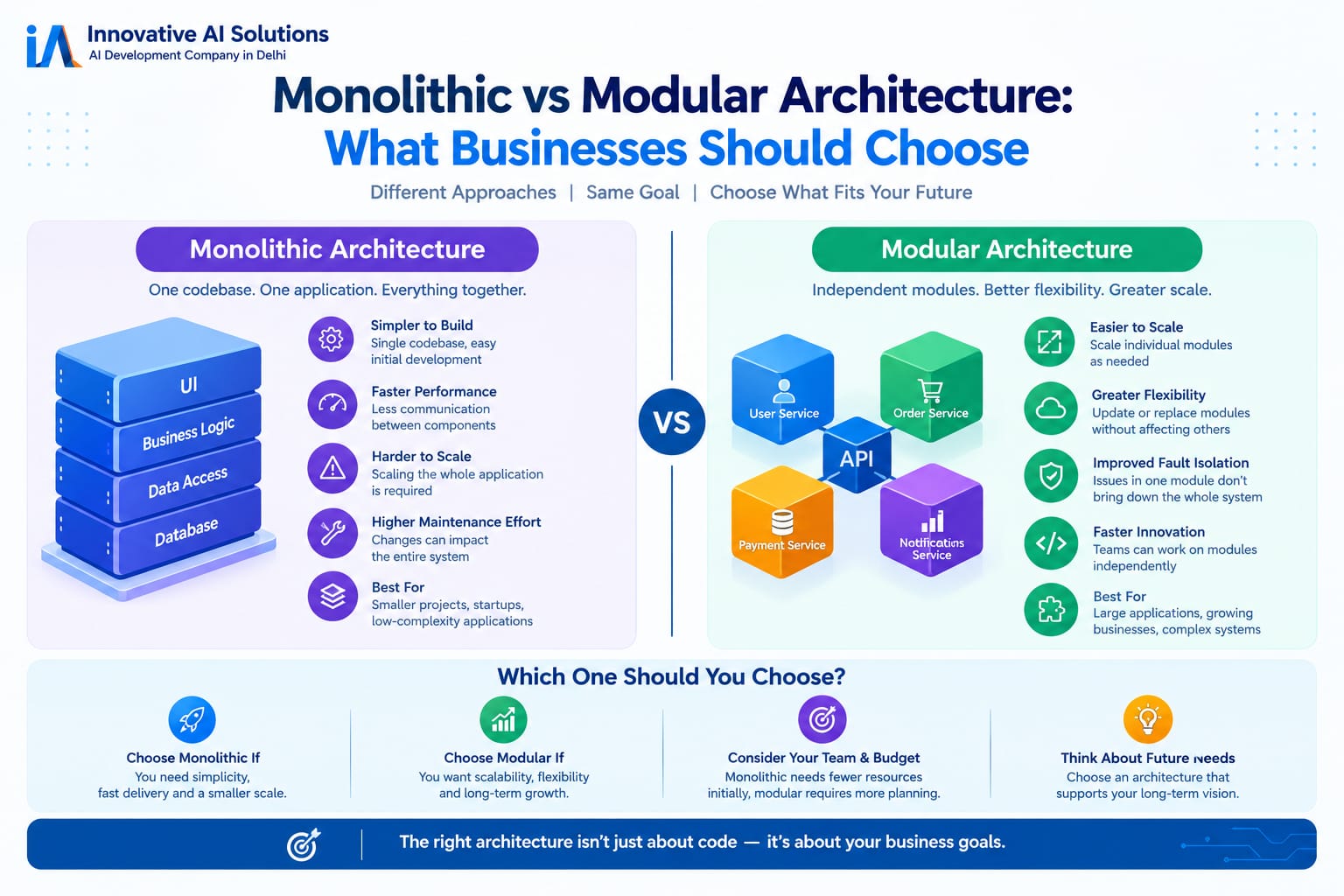
A monolithic architecture is a single deployment unit. All functionality—user interface, business logic, data access—lives in one codebase and runs as one application.
The characteristics:
-
Single codebase. All code lives in one repository.
-
Single deployment. The entire application is deployed as one unit.
-
Shared memory. Components communicate through in-process function calls, not network calls.
-
Single database. Typically one database shared by all components.
Why businesses start here:
Monoliths are simple to build. One codebase. One deployment pipeline. One team can understand the whole system. For startups and early-stage products, this simplicity is an advantage. You can move fast without coordinating across services.
Where it breaks down:
As the codebase grows, complexity compounds. A change to one module risks breaking another. Testing requires running the whole system. Deployment requires coordinating across teams. Scaling means replicating the entire application even if only one function is under load.
The classic symptom: a feature that took a week to build now takes a month. Every change breaks something else. Developers become afraid to touch the code.
What Modular Architecture Actually Is
A modular architecture is built from independent, interchangeable components that communicate through well-defined interfaces.
The characteristics:
-
Multiple modules. Each module is self-contained and focused on a single responsibility.
-
Well-defined interfaces. Modules communicate through APIs or contracts, not shared memory.
-
Independent deployment. Modules can be updated and deployed without redeploying the whole system.
-
Loose coupling. Changes in one module don't cascade to others.
Why businesses move here:
Modularity enables independent scaling, faster deployment, technology flexibility, and team autonomy. Each module can be owned by a separate team. Changes stay contained. Failures don't cascade.
Where it introduces complexity:
Modular systems especially microservices introduce distributed system challenges. Network latency. Service discovery. Data consistency across modules. Distributed tracing. Operational overhead. These challenges are real and require operational maturity to manage.
The Spectrum: It's Not Binary
The monolith-versus-modular debate misses the middle ground. In reality, architecture exists on a spectrum.
Traditional Monolith
One codebase. One deployment. Everything connected to everything. Simple to start, hard to scale. Suitable for very early-stage products with small teams.
Modular Monolith
One deployment unit, but internally organized into well-defined modules with clear boundaries. Modules communicate through interfaces, not direct references. This is the pragmatic starting point for most growing businesses.
Microservices
Independent services communicating over a network. Each service can be deployed, scaled, and updated independently. Maximum flexibility, maximum operational complexity. Suitable for large organizations with mature DevOps practices.
Composable Architecture
Packaged business capabilities (PBCs) assembled into solutions. The most advanced form. Gartner predicts that by 2027, 80% of AI-generated business applications will be 80% composable.
Most businesses should start at modular monolith and evolve toward microservices or composable architecture only when scale demands it.
The Trade-Offs That Actually Matter
Here's where the two approaches genuinely differ.
Deployment Speed
Monolith: Slow. A change to any part requires testing and deploying the whole system. Deployment windows are narrow.
Modular: Fast. Each module can be deployed independently. Teams can ship multiple times per day.
Scaling
Monolith: Inefficient. Scaling means replicating the entire application, even if only one function is under load.
Modular: Efficient. Scale only the modules that need it.
Technology Flexibility
Monolith: Locked in. The entire application uses the same language, framework, and infrastructure.
Modular: Flexible. Each module can use the best tool for its job.
Team Autonomy
Monolith: Low. Every team touches the same codebase. Changes require coordination.
Modular: High. Each module has a clear owner. Teams make decisions independently.
Operational Complexity
Monolith: Low. One deployment. One log stream. One place to debug.
Modular: High. Service discovery, distributed tracing, network latency, data consistency. Requires DevOps maturity.
Fault Isolation
Monolith: None. A bug in one component can crash the entire application.
Modular: High. If one module fails, others keep running.
Cost
Monolith: Low initial cost. Higher long-term cost as complexity compounds.
Modular: Higher initial cost. Lower long-term cost as the system scales.
The Cost Comparison
Let's talk numbers.
Building a Monolith
Initial build: $20,000 to $150,000 depending on scope.
Ongoing maintenance: 15-20% of build cost annually.
Scaling costs: High. You replicate the entire application, not just the bottleneck.
Cost of change: Increases over time as dependencies compound.
Building a Modular Monolith
Initial build: $40,000 to $250,000—higher than a monolith because you invest in module boundaries.
Ongoing maintenance: 15-20% of build cost annually.
Scaling costs: Lower. You scale only what needs scaling.
Cost of change: Stable. Changes stay contained within modules.
Building Microservices
Initial build: $100,000 to $500,000+—significantly higher due to distributed system complexity.
Ongoing maintenance: 20-30% of build cost annually.
Scaling costs: Lowest. Independent scaling of each service.
Cost of change: Low, but operational overhead is high.
The Bottom Line
Microservices cost 2-5x more to build and operate than monoliths. For most businesses, that's not justified until scale demands it.
When to Choose What
The decision depends on your context.
Choose a Traditional Monolith When:
-
You're building an MVP or early-stage product.
-
Your team is small (fewer than 10 developers).
-
You need to move fast and validate the product.
-
You don't yet know what the system needs to do.
Choose a Modular Monolith When:
-
You have product-market fit and are scaling.
-
Your team is growing (10-50 developers).
-
You need faster deployment and independent scaling.
-
You want modularity without distributed system complexity.
Choose Microservices When:
-
You have multiple teams that need autonomy.
-
Different components have different scaling requirements.
-
You have mature DevOps practices (CI/CD, monitoring, observability).
-
You can afford the operational overhead.
Choose Composable Architecture When:
-
You're building an enterprise platform.
-
You need to assemble solutions from interchangeable capabilities.
-
You want vendor flexibility and AI readiness.
The AI Factor
AI adoption has made this decision more urgent.
Legacy monolithic systems are not suitable for AI acceleration. If data cannot be trusted or accessed, AI remains advisory rather than operational. Organizations pursuing AI transformation frequently discover that outdated applications become the biggest obstacle to innovation.
Modular architecture enables AI in three ways:
AI-Ready Data Access. Modular systems have well-defined interfaces and documented APIs. AI agents can access the data they need without custom integration work.
Incremental AI Integration. AI capabilities can be added module by module. A recommendation agent can be added to the product module. A forecasting agent can be added to inventory.
Agent Orchestration. AI agents operate across modules. An agent that qualifies leads needs access to CRM, email, and calendar modules. Modular systems make this coordination possible.
If your roadmap includes AI, modularity is not optional. It's the foundation.
What This Means for Your Business
For startups:
Start with a modular monolith. Organize your code into clearly separated modules with defined boundaries. This gives you the benefits of modularity independent testing, clear ownership without the operational complexity of distributed systems. You can evolve to microservices when scale demands it.
For growing businesses:
If you're still running a traditional monolith, start planning your modularization. Identify the modules that need to be separated first. Use the strangler fig pattern to modernize incrementally. Don't attempt a full rewrite.
For enterprises:
Adopt composable architecture. Build your capabilities as packaged business capabilities (PBCs) that can be assembled into solutions. This enables faster adaptation, vendor flexibility, and AI integration.
For everyone:
Measure what matters. Track deployment frequency, change failure rate, mean time to recovery, and lead time for changes. These DORA metrics reveal whether your architecture is enabling or constraining your business.
Frequently Asked Questions
Q1: What is the difference between monolithic and modular architecture?
A monolithic architecture is a single deployment unit where all functionality lives in one codebase. A modular architecture is built from independent, interchangeable components that communicate through well-defined interfaces. Monoliths are simpler to start. Modular systems scale better.
Q2: Which is better, monolith or microservices?
Neither is universally better. Monoliths are better for early-stage products and small teams. Microservices are better for large organizations with multiple teams and mature DevOps practices. Most businesses should start with a modular monolith.
Q3: What is a modular monolith?
A single deployment unit internally organized into well-defined modules with clear boundaries. It offers many benefits of modularity separation of concerns, independent testing without the operational complexity of distributed systems. It's the pragmatic starting point for most growing businesses.
Q4: When should I move from monolith to microservices?
When your team has grown beyond what a single codebase can support. When deployment coordination becomes a bottleneck. When different modules have different scaling requirements. When your operational maturity can handle distributed systems. Not before.
Q5: What are the challenges of microservices?
Network latency, service discovery, data consistency across modules, distributed tracing, and operational overhead. These challenges are real and require operational maturity to manage.
Q6: What is composable architecture?
The most advanced form of modular architecture. Packaged business capabilities (PBCs) are assembled into solutions. Gartner predicts that by 2027, 80% of AI-generated business applications will be 80% composable.
Q7: How much does it cost to build a monolith vs microservices?
Monolith: $20,000-$150,000. Modular monolith: $40,000-$250,000. Microservices: $100,000-$500,000+. Microservices cost 2-5x more to build and operate.
Q8: How does architecture affect AI adoption?
Legacy monolithic systems are not suitable for AI acceleration. Modular systems have well-defined interfaces and documented APIs, enabling AI agents to access data without custom integration work. If your roadmap includes AI, modularity is not optional.
Q9: What is the strangler fig pattern?
A gradual replacement approach where you route existing functionality to a new module, validate it, and retire the old code only after the new one stabilizes. This reduces modernization risk and delivers value incrementally.
Q10: What metrics measure architecture success?
Deployment frequency, change failure rate, mean time to recovery, and lead time for changes. These DORA metrics reveal whether your architecture is enabling or constraining your business.
Frequently Asked Questions (Continued)
Q11: Can I start with a monolith and migrate later?
Yes. This is the recommended path for most businesses. Start with a modular monolith. Evolve to microservices when scale demands it. The key is to maintain clear module boundaries from the beginning.
Q12: What is the biggest mistake in architecture decisions?
Premature microservices. Building distributed systems before you have the operational maturity to run them. Start simple. Evolve when scale demands it.
Q13: How does modular architecture reduce technical debt?
By containing change. When modules are independent, a change to one module does not cascade through others. Testing is scoped. Deployment is independent. Technical debt stops compounding.
Q14: What is the role of DevOps in modular architecture?
DevOps maturity is essential for microservices. CI/CD pipelines, monitoring, observability, and automated testing are prerequisites. Without them, distributed system complexity becomes unmanageable.
Q15: Why should I choose Innovative AI Solutions?
Because we build architectures designed to scale with your business. Because we understand that architecture is a business decision, not just a technical one. Because we've delivered 100+ projects. Because your code is always yours.
Contact Us
Phone:
+91 7464 099 059
+91 9689967356
Email:
info@innovativeais.com
Address:
9th Floor, Pearls Best Heights-I,
Head Office: 904, Netaji Subhash Place,
Delhi – 110034