The Big Question
Why would anyone build a system with multiple AI agents when one good model can do the job?
I hear this question constantly. And it's a fair one. Large language models are incredibly capable. GPT-4 can reason. Claude can analyze. Gemini can handle complex instructions. Why complicate things with multiple agents?
Here's the answer: because one model can't do everything well at once.
Think about your own business. You don't have one person who handles sales, support, accounting, and strategy simultaneously. You have specialists. Each person focuses on what they do best. They coordinate. They hand off work. They collaborate.
Multi-agent AI systems work the same way.
A single monolithic model—what researchers call an "LLM wrapper"—has fundamental limits. It lacks persistent memory beyond a single context window. It struggles with multi-step planning. It offers little modularity or oversight . Ask it to handle a complex workflow and watch it lose track halfway through.
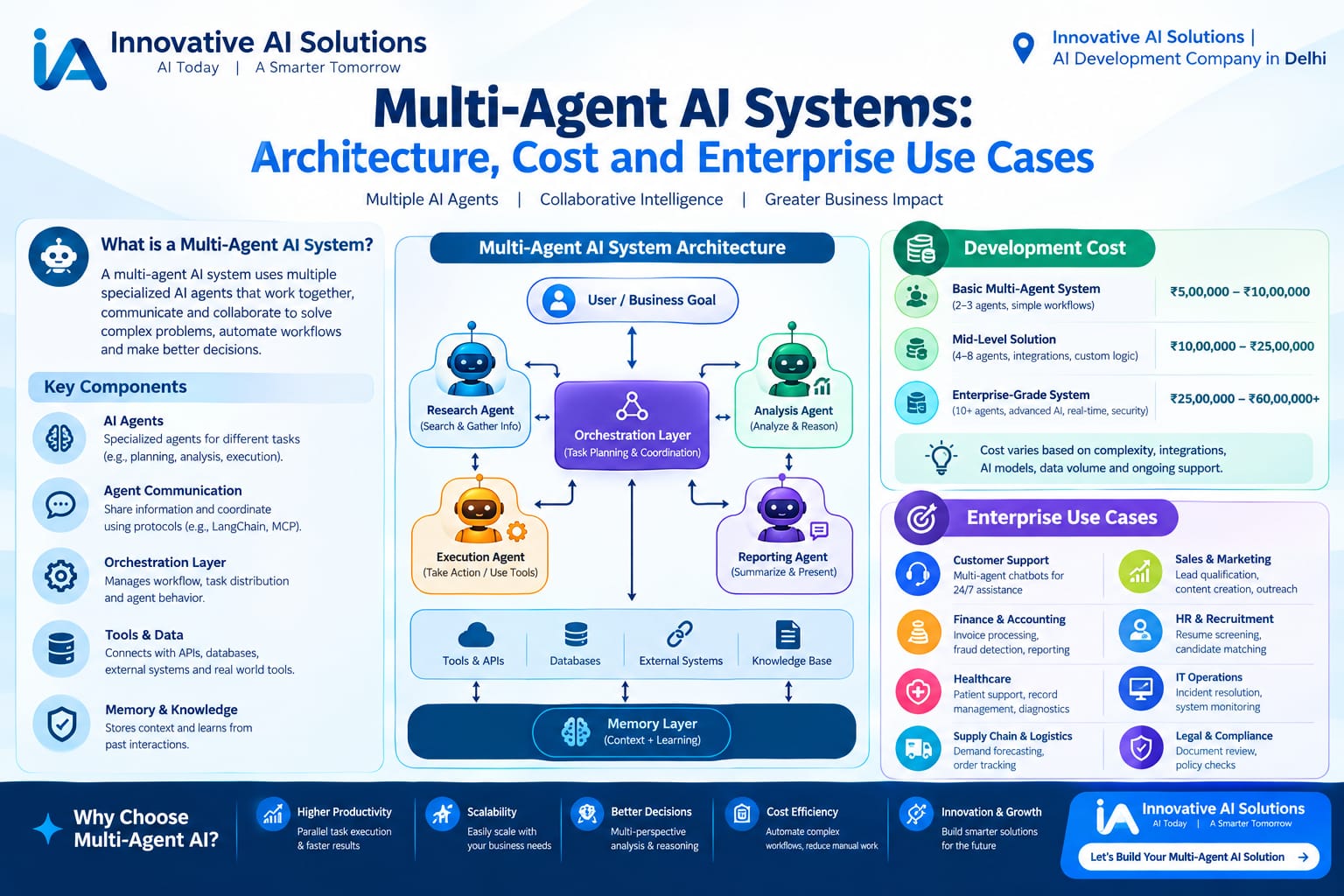
Multi-agent systems break the problem into pieces. Each agent specializes. A research agent gathers information. An analysis agent processes it. A writer agent drafts the output. A reviewer agent checks for errors. Together, they produce something none could achieve alone.
The results are measurable. A 2026 IEEE study found that heterogeneous multi-model architectures achieved 38.8–41.8% end-to-end latency reduction and 32.0–41.0% operational cost reduction versus single-model baselines, with task success rates improving from 91.2% to 96.8% .
Gartner reports a 1,445% surge in multi-agent system inquiries from Q1 2024 to Q2 2025 . This isn't a niche experiment. It's the direction enterprise AI is heading.
But here's the nuance: you don't need a hundred agents. You need the right ones.
Cost Based on System Complexity
Let's talk numbers. What does it actually cost to build a multi-agent system in 2026?
The answer depends on scope. Here's a realistic breakdown for Indian businesses.
Pilot System (Single Workflow, 2–3 Agents)
Think: a lead qualification pipeline. A research agent gathers company data. An analysis agent scores the lead. A notification agent alerts sales. Features include: basic orchestration, one or two integrations, limited memory.
Typical cost: ₹8,00,000 to ₹20,00,000. Timeline: 6–10 weeks. Monthly running cost: ₹15,000–₹40,000 for hosting, APIs, and maintenance .
Production System (Multi-System, 4–6 Agents)
Think: customer support automation with escalation. A triage agent categorizes queries. A knowledge agent retrieves answers. A resolution agent drafts responses. A compliance agent checks policy. A human handoff agent manages escalations. Features include: governance, audit trails, multiple integrations.
Typical cost: ₹25,00,000 to ₹60,00,000. Timeline: 12–20 weeks. Monthly running cost: ₹40,000–₹1,00,000 .
Enterprise Multi-Agent Program (Cross-Department, 8+ Agents)
Think: end-to-end business process automation. Multiple agents coordinating across CRM, ERP, support, and analytics. Features include: custom orchestration, on-premise deployment, SSO, advanced security, dedicated support.
Typical cost: ₹60,00,000 to ₹1,00,00,000+. Timeline: 4–8 months. Monthly running cost: ₹1,00,000+ .
What Affects Your Cost
The biggest factors are: integration complexity (connecting to CRM, ERP, ticketing systems), governance requirements (approval workflows, audit trails, policy controls), memory architecture (stateless vs. persistent memory), number of agents (each adds coordination overhead), and ongoing maintenance (typically 15–20% of development cost annually) .
A dedicated AI agent cost calculator shows similar ranges: multi-agent workflows start at $140,000–$200,000 for custom builds, with each additional integration adding $5,000–$12,000 .
The key insight: start with one workflow. Prove value. Then expand.
Breakdown by Developer Type (2020–2026 Rates)
Multi-agent AI development talent costs have evolved significantly. Here's the historical context.
2020–2021: The Pre-Agent Era
AI developers built single models. Multi-agent systems were academic curiosities. Frameworks were immature. Freelance AI engineers charged ₹2,500–₹4,000 per hour. Most businesses couldn't justify the investment.
2022–2023: The Chatbot Wave
Businesses wanted conversational AI. Demand surged. Rates climbed to ₹3,500–₹5,500 per hour for freelancers. But multi-agent systems remained rare—reserved for research labs and well-funded startups.
2024–2025: The Agentic Awakening
Frameworks matured. LangChain, AutoGen, and CrewAI made multi-agent orchestration accessible. The term "agentic AI" entered the mainstream. Development accelerated. Rates stabilized around ₹2,500–₹5,000 per hour for mid-level AI engineers with agent experience.
2026: The Enterprise Adoption Phase
Today, multi-agent systems are moving from experiments to production. Here's what you should expect to pay:
Freelance AI Developers: Mid-level rates run $20–$45 per hour. Senior specialists with services multi-agent experience command $45–$70 per hour. But freelancers struggle with complex orchestration projects—coordination overhead kills momentum.
Dedicated Teams (Offshore): A dedicated team through a vetted firm runs $30–$55 per hour per person. You get a project manager, AI engineers, backend developers, and DevOps. For multi-agent projects, this model works best—you need sustained collaboration.
Full-Time Salaries in India: Junior AI engineers (0–2 years) earn ₹4–7 LPA. Mid-level AI/ML engineers earn ₹8–15 LPA. Senior AI architects with agent services experience can command ₹20–40 LPA.
The Global Comparison
India-based AI teams deliver the same multi-agent systems for 65–75% less than US equivalents. For a $150,000 US project, an India-based dedicated team delivers the same system for **$50,000–$70,000** .
Why Prices Changed in 2026
Multi-agent system costs have shifted. Here's why.
Reason 1: Orchestration Frameworks Matured
Building multi-agent systems in 2023 meant writing everything from scratch. Today, frameworks like LangGraph, AutoGen, CrewAI, and Microsoft Agent Framework provide production-ready scaffolding . Development time dropped by 50–60%.
Reason 2: Specialized Models Emerged
The IEEE Multi-Model Agentic Systems Taxonomy (MMAS-T) now formally characterizes six model classes: General-Purpose LLMs, Mixture-of-Experts (MoE), Vision-Language Models (VLMs), Large Reasoning Models (LRMs), Small Language Models (SLMs), and Large Action Models (LAMs) . You can match the right model to the right task—using expensive models only where needed.
Reason 3: Cloud Costs Dropped
Serverless architectures and spot instances have reduced infrastructure costs. Multi-agent systems that cost ₹1,00,000 per month to run in 2024 cost ₹40,000 today.
Reason 4: The Market Matured
In 2023, every vendor claimed to do "AI agents." In 2026, buyers ask for production references. They want audit trails. They want governance. Competition has forced vendors to compete on outcomes, not buzzwords.
Reason 5: Open Source Models
Models like Llama 3, Mistral, and Qwen can be hosted locally. For businesses with data privacy concerns, this eliminates API dependency and reduces long-term costs. You own the model. You control the data.
Reason 6: Gartner's Prediction Is Materializing
Gartner predicts that by 2027, 70% of multi-agent systems will use narrowly specialized agents . The industry is converging on specialization over generalization. This drives efficiency and reduces cost.
Pro Tips to Save Money in 2026
After building multi-agent systems, here's what actually saves money.
Tip 1: Start with One Workflow, Not Ten
Don't build a system that automates everything. Pick one high-impact workflow—lead triage, customer support, document processing. Prove it works. Then expand. "Prioritize one workflow where automation impact is measurable" .
Tip 2: Choose the Right Framework for Your Team
LangGraph offers maximum control for complex conditional routing. AutoGen simplifies multi-agent conversation. CrewAI provides intuitive role-based orchestration . Choose based on your team's expertise, not hype. "Framework selection balances technical factors and organizational factors" .
Tip 3: Use Smaller Models for Simpler Tasks
Not every agent needs GPT-4. For intent recognition, slot filling, and basic routing, smaller models like GPT-4o-mini or open-source alternatives work perfectly at a fraction of the cost. Use the big models only when reasoning is required.
Tip 4: Implement Human-in-the-Loop from Day One
AI makes mistakes. Build fallback mechanisms. If an agent can't handle a request, route it to a human. This reduces risk and builds trust. It also lets you launch faster—you don't need 100% accuracy before going live.
Tip 5: Plan for Token Efficiency
Different frameworks have dramatically different token costs. A 2026 benchmark found that LangGraph (optimized) costs ~$12–18/day** for structured workflows, **CrewAI costs ~$18–28/day for role-based pipelines, and AutoGen costs ~$25–40/day for conversational multi-agent tasks . At scale, framework choice matters.
Tip 6: Budget for Observability
Multi-agent systems are harder to debug than single models. You need tracing, logging, and monitoring. Budget for observability tools from day one. "All three frameworks require external observability to be production-worthy" .
Tip 7: Own Your Code and Data
Always. Any vendor who refuses IP transfer isn't worth working with. Your orchestration logic is valuable. Don't let a vendor lock you out of it.
Questions to Ask Before Hiring
Before you hire a multi-agent AI development partner, ask these questions. The answers will tell you everything.
1. "Can you show me a production multi-agent system you've built?"
Not a demo. Not a prototype. A live system handling real workflows. If they can't show you, walk away.
2. "How do you handle agent coordination and error recovery?"
Good vendors have thought about retries, fallbacks, and escalation paths. Vague answers signal trouble.
3. "What orchestration framework do you recommend, and why?"
Look for LangGraph for control, AutoGen for conversation, CrewAI for role-based tasks. But the "why" matters more than the "what."
4. "Who owns the code and IP?"
You do. Full transfer. No exceptions.
5. "How do you measure success?"
Look for task completion rate, latency, cost per task, and human escalation rate. If they can't define metrics, they can't optimize.
6. "What's your testing process for multi-agent systems?"
Multi-agent systems have emergent behaviors. Good vendors test edge cases, failure modes, and agent interactions. They simulate real-world scenarios.
7. "How long until we see a working prototype?"
For a pilot system, 4–8 weeks. For production, 12–20 weeks. If the timeline is longer, ask why.
8. "Can I speak with your existing clients?"
References matter. Ask for named contacts. Ask about the good and the bad.
9. "What's your track record on budget and timeline?"
Multi-agent projects are complex. Ask how your partner plans to avoid scope creep and cost overruns.
10. "What happens after the project is delivered?"
Multi-agent systems need ongoing tuning. Agent prompts drift. Integrations change. Budget for maintenance.
Why Delhi is a Great Hub for AI Development
I run an AI company in Delhi. I'm biased. But there are real reasons why Delhi NCR is a powerhouse for multi-agent AI development.
Talent Density
Delhi-NCR is second only to Bengaluru in tech talent concentration. IIT Delhi, DTU, and NSIT produce thousands of graduates annually. Many specialize in AI, ML, and distributed systems.
Cost Advantage
Delhi offers a 20–30% cost advantage over Bengaluru and Mumbai. Office rents are lower. Salaries are competitive. You get the same quality at lower cost.
Enterprise Client Base
Delhi is India's administrative and corporate capital. Government agencies, PSUs, and large enterprises are here. For multi-agent systems serving regulated industries, proximity matters.
Time Zone Advantage
IST overlaps with US, UK, and Southeast Asian business hours. Real-time communication is possible without overnight shifts.
Ecosystem Maturity
Delhi NCR has a mature ecosystem of AI providers, cloud infrastructure, and consulting firms. AWS, Azure, and GCP all have strong presence.
What We Offer
At Innovative AI Solutions, we've spent five years building AI systems that actually work. Not hype. Not buzzwords. Results.
Multi-Agent System Development
We design, build, and deploy multi-agent architectures using LangGraph, AutoGen, CrewAI, and Microsoft Agent Framework. From pilot to production.
AI Agent Orchestration
We handle the coordination layer—agent communication, task routing, memory management, and error recovery.
RAG Pipelines for Agents
We build retrieval-augmented generation systems that give your agents access to business knowledge.
Enterprise Integrations
We connect agents to CRM, ERP, ticketing systems, and custom APIs. API-first architecture. Documented patterns.
Governance and Observability
We implement audit trails, approval workflows, and monitoring so you can trust your agents.
Ongoing Support
Multi-agent systems need tuning. We offer flexible support packages to keep your agents performing.
What Sets Us Apart
We focus on Small AI. Practical solutions. Affordable pricing. Fast delivery. And a team that actually cares about your success.
Frequently Asked Questions
Q1: What is a multi-agent AI system?
A multi-agent AI system is a software architecture where multiple specialized AI agents work together to solve a complex task. Each agent focuses on a specific role—research, analysis, writing, review—and coordinates with others through an orchestration layer.
Q2: How much does it cost to build a multi-agent system in India?
Pilot systems start at ₹8,00,000. Production systems with multiple integrations range from ₹25,00,000 to ₹60,00,000. Enterprise programs cost ₹60,00,000 to ₹1,00,00,000+ .
Q3: How long does it take to build a multi-agent system?
Pilot systems take 6–10 weeks. Production systems take 12–20 weeks. Enterprise programs take 4–8 months. Timeline depends on integration complexity and governance requirements.
Q4: What are the business benefits of multi-agent systems?
Higher task success rates through specialization. Lower latency through parallel processing. Reduced operational costs through efficient resource allocation. Better scalability through modular design. And improved reliability through redundant agents and fallback mechanisms.
Q5: Which orchestration framework should I use?
LangGraph for complex conditional routing and regulatory audit trails. AutoGen for collaborative reasoning and debate. CrewAI for role-based task delegation . The right choice depends on your workflow.
Q6: How do agents communicate with each other?
Through message buses, shared memory stores, or direct API calls. The orchestration layer manages routing, context sharing, and state. Modern frameworks handle this automatically.
Q7: What happens if an agent fails?
Good systems have fallback mechanisms. If an agent can't complete a task, the orchestrator retries, routes to a different agent, or escalates to a human. We implement logging and monitoring to catch issues quickly.
Q8: Can multi-agent systems work with my existing CRM or ERP?
Yes. Integration is the biggest cost driver. We connect agents to Salesforce, HubSpot, SAP, custom APIs, and more. "The biggest cost factor is integration complexity" .
Q9: How do you ensure data privacy and compliance?
We use encryption, secure APIs, and comply with data protection regulations. For healthcare clients, we ensure HIPAA compliance. For Indian businesses, we comply with DPDP Act requirements.
Q10: What's the ROI of a multi-agent system?
It depends on the workflow. A lead triage system that reduces manual qualification time by 70% could recover costs in 4–6 months. A customer support system that handles 60% of queries automatically could see ROI even faster.
Frequently Asked Questions (Continued)
Q11: Can multi-agent systems handle multiple languages?
Yes. Modern LLMs support multiple languages. We can build agents that converse in English, Hindi, and regional languages. Multilingual adds ~15–25% to running cost .
Q12: What's the difference between a multi-agent system and a single AI agent?
A single agent has one role. A multi-agent system has specialized agents working together. Multi-agent systems handle complex, multi-step workflows that single agents struggle with .
Q13: What happens after the project is delivered?
We provide ongoing support and maintenance. Agent prompts drift. Integrations change. We offer flexible support packages to keep your system performing.
Q14: Can I start with a small project and scale later?
Absolutely. That's exactly what we recommend. Start with one workflow and 2–3 agents. Prove value. Then add agents and expand to new workflows.
Q15: Why should I choose Innovative AI Solutions?
Because we focus on results, not hype. Because we've delivered 100+ projects. Because we offer enterprise-grade solutions at startup-friendly prices. Because your code is always yours.
Contact Us
Ready to explore what multi-agent AI can do for your business? Let's talk.
Phone:
+91 7464 099 059
+91 9689967356
Email:
info@innovativeais.com
Address:
9th Floor, Pearls Best Heights-I,
Head Office: 904, Netaji Subhash Place,
Delhi – 110034