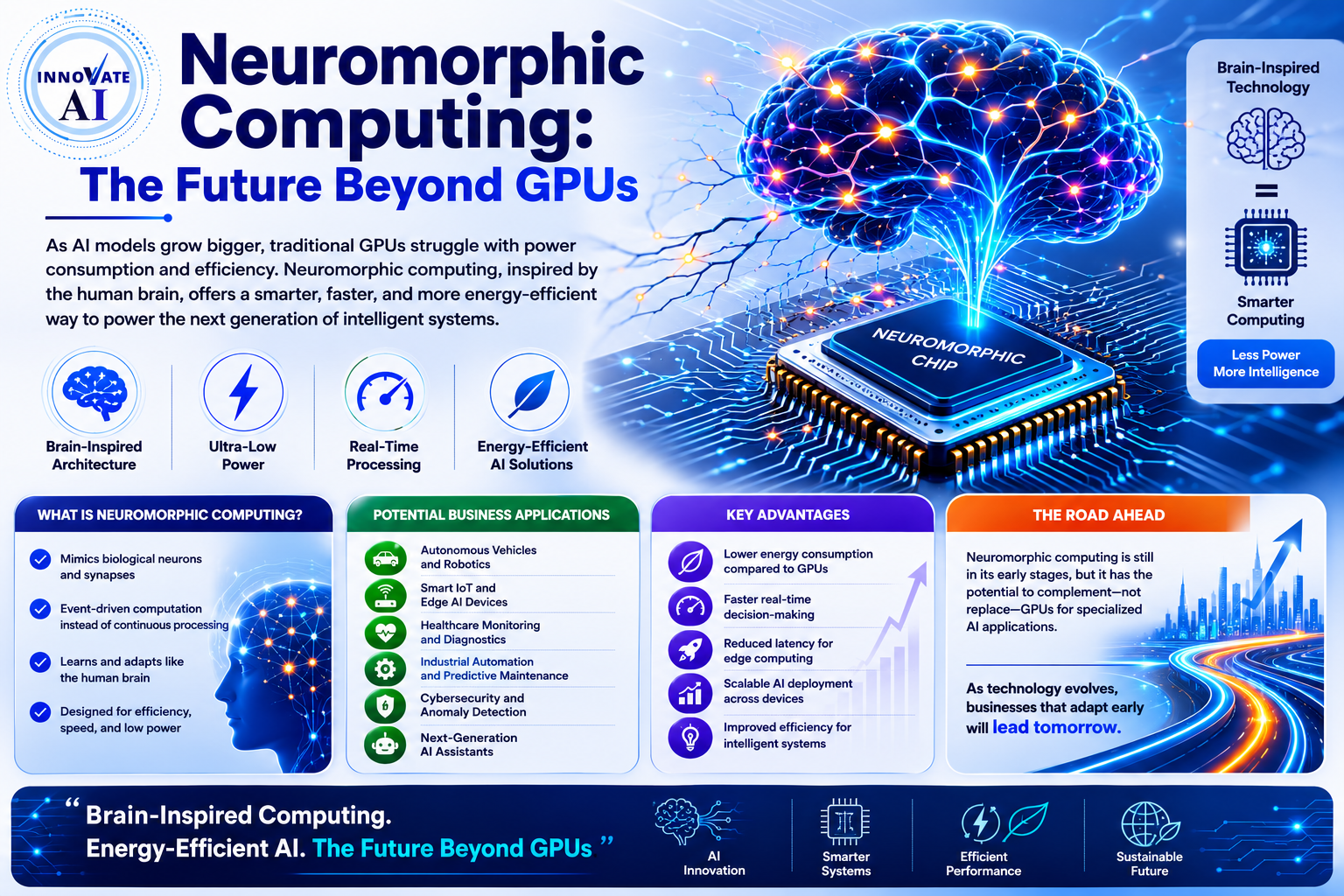
The Big Question
Let me start with a question that every technology leader must answer in 2026.
"GPUs are getting more powerful, but power consumption is becoming a major bottleneck. Edge devices need low-power AI. Is there a fundamentally different way to build AI hardware?"
The honest answer:
Yes. Neuromorphic computing offers a radically different approach—but it is a complement, not a replacement.
Here is the truth:
Neuromorphic computing is being explored as a possible alternative architectural direction. By using event-driven operation, sparse computation and closer integration of memory and compute, neuromorphic systems aim to address the inefficiencies exposed in today's AI stack. While unlikely to replace GPUs in data centers, they offer a parallel approach driven by the same pressures now confronting AI hardware at scale .
Step 3: What Is Neuromorphic Computing? (No Jargon)
The Fundamental Difference
Traditional computers use von Neumann architecture: separate CPU and memory, with data shuttling back and forth. This creates the "memory wall"—data movement consumes far more energy than computation itself.
Neuromorphic systems instead integrate memory and processing, much like biological brains. They use networks of artificial neurons and synapses that communicate through spikes (events) rather than continuous signals .
| Traditional Computing | Neuromorphic Computing |
|---|---|
| Separate memory and processing | Integrated memory and processing |
| Clock-driven, synchronous | Event-driven, asynchronous |
| Constant power draw | Power only when neurons fire |
| Linear, sequential processing | Massively parallel |
| Designed for throughput | Designed for efficiency and adaptability |
The Spiking Neural Network (SNN)
At the core of neuromorphic computing is the spiking neural network. Unlike traditional neural networks that process continuous values, SNNs use spikes—brief electrical pulses that travel between neurons. In a neuromorphic chip, nothing happens by default; only spike events trigger computation . If there are no input events, no neuron updates occur and no power is spent on switching activity .
Step 4: The Energy Efficiency Advantage
The Numbers Are Compelling
| Study | Comparison | Improvement |
|---|---|---|
| Intel Loihi 2 | CPU for inference tasks | 100x energy savings |
| Intel Loihi 2 | GPU for inference tasks | 30x energy savings |
| 2025 study | Nvidia GTX 1080 | 99.5% reduction in energy consumption |
| 2025 study | Nvidia GTX 1080 | 76.7% reduction in inference time |
| Human Brain Project | Deep learning models on standard hardware | 2-3x more energy-efficient |
Source:
A neuromorphic architecture has achieved 0.12 pJ per operation, compared to much higher energy costs for traditional accelerators, with power usage scaling linearly with input sparsity . A 128-neuron neuromorphic system achieved per-neuron per-inference energy of 1.64 µJ at 200 Hz and 0.29 µJ at 10 kHz .
Why It's So Efficient
The efficiency comes from three key features :
-
Event-driven computation: No input events, no neuron updates, no power consumption
-
Distributed memory: Synaptic weight memory is distributed throughout the chip, avoiding energy-intensive data movement
-
Sparse computation: Only active neurons consume power
Step 5: Where Neuromorphic Computing Could Deliver the Biggest Impact
Edge AI and IoT
Neuromorphic chips are ideal for smart sensors, drones, autonomous vehicles, and robotics—any system that needs to make decisions locally with minimal power draw . They can enable drones to recognize obstacles and adjust flight paths in real time without draining battery life.
Healthcare
These chips could be used in portable diagnostic devices, wearable ECG monitors that flag irregular heart rhythms, and adaptive prosthetics that respond to neural signals . Researchers are also exploring neuromorphic processors as the backbone of brain-computer interfaces .
Financial Services
Neuromorphic computing could enable ultra-low-latency financial decision systems. A 2026 IEEE study proposed a hybrid framework combining AI-based risk assessment with neuromorphic computing for real-time financial risk forecasting, including volatility detection, credit risk assessment, and anomaly detection in high-frequency trading .
Cybersecurity
Since neuromorphic systems excel at detecting subtle patterns and anomalies, they are well-suited for identifying unusual behavior in data traffic that may signal a cyberattack .
6G Networks
A 2026 Nature paper introduced Neuro6G-Agent, a hierarchical neuromorphic agentic intelligence framework for 6G resource optimization. Results showed a 34.7% reduction in energy consumption, 28.3% decrease in end-to-end latency, and 95.6% security threat detection accuracy .
Smart Grids
A neuromorphic active inference framework for microgrid management achieved a projected 31.99% reduction in annualized operational expenditure and a theoretical 2.9-year extension of battery lifespan .
Step 6: The Ecosystem—Who's Building Neuromorphic Chips
Pure-Play Neuromorphic Companies
BrainChip Holdings (BRCHF) is the purest publicly traded neuromorphic play. Its Akida chip is designed for ultra-low-power edge AI and is already being used in smart sensors and defense applications. The company holds IP licensing and development agreements with Renesas, MegaChips, Mercedes, NASA, and Raytheon .
IBM pioneered the field with TrueNorth and remains a powerhouse in brain-inspired computing, neurosynaptic research, and AI infrastructure .
Intel's Loihi project is one of the most advanced neuromorphic research platforms. While not yet a commercial product, Intel has the resources, IP, and foundry capacity to scale if demand accelerates .
Emerging Players
Light-emitting artificial neurons—memristive devices that emit light pulses when activated—have been demonstrated by researchers from Hong Kong University of Science and Technology, ETH Zurich, and Université de Bourgogne. In tests, a 3D spiking neural network achieved 91.5% accuracy on speech classification and 92.3% on handwritten digit recognition .
UT Dallas researchers have built a small-scale neuromorphic prototype using magnetic tunnel junctions (MTJs) that learns patterns and makes predictions with fewer training computations and less power . The prototype was described in the journal Communications Engineering .
Potential Supplier Plays
The neuromorphic supply chain includes:
| Company | Role |
|---|---|
| Analog Devices (ADI) | Analog signal processing and mixed-signal semiconductors |
| Lattice Semiconductor (LSCC) | Low-power FPGAs for edge applications |
| Cadence (CDNS) | Electronic design automation (EDA) tools for designing neuromorphic chips |
| Synopsys (SNPS) | EDA tools and simulation software |
| Micron (MU) | Specialty memory (resistive RAM, phase-change memory) |
Step 7: The Barriers to Adoption
The Software Gap
Modern AI has been driven by software frameworks, powerful libraries, and a large developer community. But programming a neuromorphic system feels like stepping back decades. There is virtually no unified, mature framework that's as accessible as PyTorch .
Training Algorithms
The entire deep learning ecosystem is built on gradient backpropagation and end-to-end differentiability. Spiking neural networks lack well-established learning rules that can match the versatility of gradient descent. Unsupervised rules such as spike-timing-dependent plasticity have not produced state-of-the-art results on large-scale problems .
Demonstrating Value
According to Bill Dally, chief scientist at Nvidia, spiking systems struggle to demonstrate clear, repeatable performance gains on the workloads and benchmarks that define commercial AI . The analog neuromorphic-style compute pays a system-level penalty once conversion, storage, and communication are included.
The Verdict from Experts
TechTarget's analysis suggests neuromorphic computing will remain a niche complement rather than a wholesale replacement for near- to mid-term, especially for edge AI . The technology might never dethrone the GPU in data centers, but it doesn't have to in order to be considered a success. Its strategic value might lie in ensuring that, as an industry, we don't hit a dead end on the AI efficiency curve .
Step 8: The NeuroAI Convergence
A 2025 PNAS article highlights the convergence of neuroscience and AI—the "neuromorphic renaissance" . Researchers successfully implemented a biologically grounded neocortical microcircuit (soft Winner-Take-All) on IBM's TrueNorth chip, boosting out-of-distribution generalization in Vision Transformers .
The key insight: Biological fidelity is a computational necessity. Inhibitory interneuron subtypes—Parvalbumin (PV), Somatostatin (SST), Vasoactive Intestinal Peptide (VIP), and LAMP5—are not mere anatomical detail but discrete, essential computational primitives that significantly enhance performance and robustness .
Step 9: Implementation Roadmap
Phase 1: Exploration (2026-2027)
| Action | Output |
|---|---|
| Evaluate neuromorphic platforms for edge AI use cases | Proof-of-concept |
| Partner with neuromorphic vendors | Ecosystem relationships |
| Identify bounded applications (e.g., sensor fusion, anomaly detection) | Use case pipeline |
Phase 2: Pilot (2027-2028)
| Action | Output |
|---|---|
| Deploy neuromorphic systems in pilot deployments | Measured results |
| Compare energy and latency against GPU baselines | Performance data |
| Build internal expertise | Skilled team |
Phase 3: Scale (2028-2030)
| Action | Output |
|---|---|
| Scale to production edge AI deployments | Production systems |
| Integrate with hybrid architectures | Full deployment |
| Continuous optimization | Ongoing improvement |
Step 10: Frequently Asked Questions
Q1: Will neuromorphic computing replace GPUs?
No. The evidence suggests neuromorphic computing will remain a niche complement rather than a wholesale replacement, especially for edge AI. It might never dethrone the GPU in data centers, but it doesn't have to in order to be considered a success .
Q2: How much energy can neuromorphic chips save?
Intel's Loihi 2 has demonstrated 100x energy savings over CPUs and 30x over GPUs for inference tasks . One study showed a 99.5% reduction in energy consumption and 76.7% reduction in inference time compared to an Nvidia GTX 1080 .
Q3: What is the biggest barrier to adoption?
The software gap. There is virtually no unified, mature framework that's as accessible as PyTorch. Each neuromorphic platform has its own SDK or research-oriented tools, and programming them feels like stepping back decades .
Q4: When will neuromorphic chips be commercially viable?
The technology is already commercially available for bounded edge AI applications. The broader ecosystem—software frameworks, training algorithms, developer tools—is expected to mature over the next 3-5 years.
Q5: What is the "neuromorphic renaissance"?
A 2025 PNAS article coined the term to describe the convergence of neuroscience and AI, where biologically grounded neural circuits are being mapped directly onto neuromorphic hardware to boost AI performance and robustness .
Q6: How can Innovative AI Solutions help?
We help organizations understand the neuromorphic landscape, identify use cases where brain-inspired computing could provide a competitive advantage, and build hybrid AI architectures that combine GPUs, CPUs, and neuromorphic processors.
Step 11: Final Tagline
"AI hardware is approaching an inflection point due to constraints on energy, scalability and deployment. Neuromorphic computing offers a fundamentally different scaling path, enabling more robust parallel computing with dramatically lower power consumption. While unlikely to replace GPUs in data centers, these brain-inspired systems offer a parallel approach to the same pressures confronting AI hardware at scale. The next decade should reveal whether it remains an intriguing niche or whether it has the capacity to shift the paradigm of AI hardware" .
Short version:
Neuromorphic computing—the future beyond GPUs. Brain-inspired AI hardware, energy efficiency, real-world applications, and barriers to adoption in 2026.
Hashtags:
#NeuromorphicComputing #AIHardware #BeyondGPUs #BrainInspiredAI #EdgeAI #EnergyEfficientAI #InnovativeAISolutions
Contact Us
Phone: +91 7464 099 059 / +91 96899 67356
Email: info@innovativeais.com
Address: Netaji Subhash Place, Pitampura, Delhi – 110034
Website: https://innovativeais.com
About the Author
Abhishek Kumar
Founder & CEO, Innovative AI Solutions
5+ years building AI systems and advising on emerging technology. Based in Delhi, serving clients across India.
Related services: to apply this in your business, explore our AI development services and machine learning and predictive analytics.