The Big Question
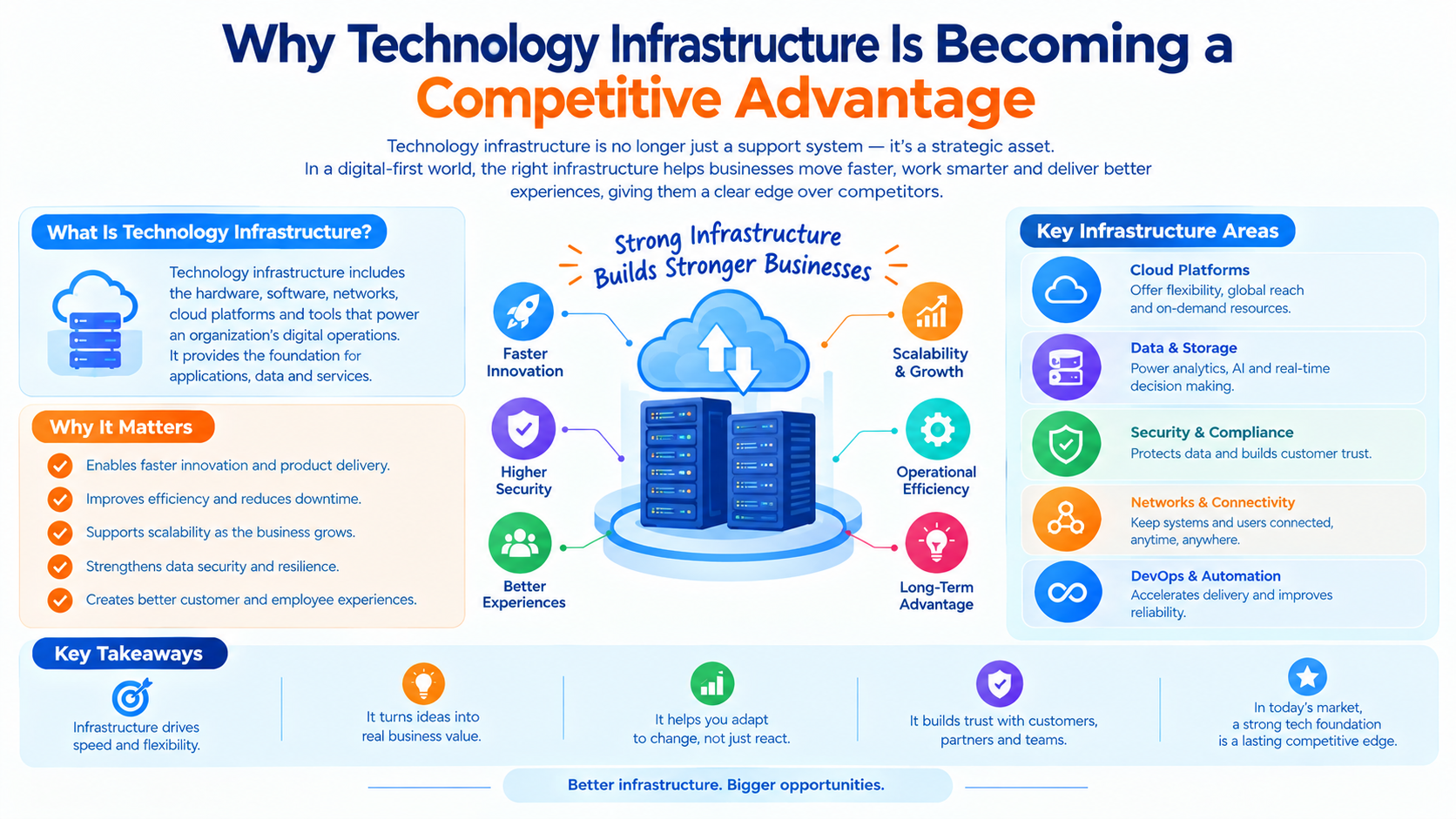
What happens when two companies sell the same product at the same price, but one can ship a new feature in days while the other takes months? When one can absorb a demand spike without degradation while the other's systems buckle? When one can deploy AI capabilities in weeks while the other spends quarters on data plumbing?
The difference is rarely the product. It is the infrastructure underneath it.
How Infrastructure Became Strategic
Infrastructure used to be invisible. Servers, networks, and storage were purchased, racked, and forgotten. The competitive fight happened at the product layer.
Several shifts changed that.
Software Became the Product
When software was a supporting function, infrastructure was supporting too. Now software is the product in most industries banking, retail, logistics, healthcare, media. The infrastructure that runs it determines what the product can do.
Speed Became a Competitive Variable
The ability to ship changes quickly is now a competitive requirement rather than a nice-to-have. That ability depends on delivery infrastructure: pipelines, environments, testing, and deployment automation.
Scale Became Cheap to Reach
Cloud infrastructure means an organization can serve millions of users without owning millions of dollars of hardware. But capturing that advantage requires infrastructure designed for it.
AI Raised the Stakes
AI workloads demand specialised infrastructure: GPUs, high-throughput storage, low-latency networking, and data platforms capable of feeding models continuously. Organizations without this infrastructure cannot adopt AI at the pace competitors can.
Infrastructure Costs Became Visible
Cloud spending made infrastructure costs explicit in a way that data centre capital expenditure never was. This forced organizations to think about infrastructure as a managed investment rather than a fixed cost.
The Ways Infrastructure Creates Advantage
Infrastructure advantage is not one thing. It appears in several distinct forms.
Speed of Delivery
The ability to ship changes quickly and safely is a function of infrastructure: CI/CD pipelines, automated testing, deployment automation, and environment management.
The advantage: Organizations that can ship weekly outperform those that ship quarterly, because they learn faster and respond faster.
Reliability
The ability to remain available and consistent is a function of infrastructure: redundancy, failover, observability, and tested recovery.
The advantage: Customers notice reliability. Outages cost revenue, trust, and sometimes contracts.
Scalability
The ability to absorb demand without degradation is a function of infrastructure: elastic capacity, load distribution, and capacity planning.
The advantage: Organizations that scale gracefully capture demand spikes. Those that do not lose customers at the moment of highest intent.
Cost Efficiency
The ability to deliver capability at lower cost is a function of infrastructure: efficient utilisation, right-sizing, and workload placement.
The advantage: Lower cost per transaction, per user, or per unit of work compounds over time.
AI Readiness
The ability to adopt AI capabilities is a function of infrastructure: compute, storage, networking, data pipelines, and model operations.
The advantage: Organizations with AI-ready infrastructure adopt new capabilities in weeks. Those without spend quarters building the foundation.
Data Advantage
The ability to use data for decisions is a function of infrastructure: pipelines, storage, governance, and access.
The advantage: Organizations that can access and act on their data make better decisions faster.
Why Infrastructure Advantage Compounds
Infrastructure advantage is not static. It compounds.
Faster delivery produces more learning. Teams that ship frequently learn what works faster, which improves the product faster.
Better reliability produces more trust. Customers who experience consistent service deepen their relationship with the provider.
Lower cost produces more investment capacity. Savings can be reinvested in product or infrastructure.
AI readiness produces faster adoption. Each new AI capability can be adopted quickly, widening the gap with competitors.
Data advantage produces better decisions. Better decisions produce better outcomes, which produce more data.
Each advantage reinforces the others. Organizations that build infrastructure advantage pull ahead; those that neglect it fall behind.
What Infrastructure Advantage Requires
Building infrastructure advantage is not a matter of buying the right products.
Treating Infrastructure as a Product
Infrastructure must be managed with the same discipline as a product: owners, roadmaps, users, and feedback loops.
The practice: Internal platform teams treat developers as customers and measure their experience.
Investing Ahead of Demand
Infrastructure that is built only in response to demand is always behind. Advantage requires building ahead.
The practice: Capacity planning that anticipates growth, not just reacts to it.
Standardising Where It Matters
Standardisation reduces cost and increases speed. It should be applied where it creates advantage, not everywhere.
The practice: Standardised deployment patterns, security controls, and observability.
Automating What Is Repetitive
Automation converts one-time effort into reusable capability.
The practice: Infrastructure as code, automated pipelines, and self-service provisioning.
Measuring What Matters
Infrastructure must be measured in terms that connect to business outcomes.
The practice: Track deployment frequency, mean time to recovery, cost per unit of work, and AI adoption velocity.
Building Skills, Not Just Systems
Infrastructure advantage depends on people who can operate it.
The practice: Invest in platform engineering, SRE, and cloud architecture capability.
The Organisational Implications
Infrastructure advantage requires organisational changes.
From cost centre to capability. Infrastructure teams are measured by the capability they enable, not by the cost they contain.
From projects to platforms. Infrastructure is built as an ongoing platform, not as a series of projects.
From tickets to self-service. Developers should be able to provision what they need without waiting.
From silos to shared ownership. Infrastructure and application teams share responsibility for outcomes.
The Cost Question
Infrastructure investment must be justified. The justification is not cost reduction alone.
The framing: Infrastructure investment should be evaluated on the capability it enables speed, reliability, scalability, AI readiness not only on the cost it removes.
The practice: Build business cases that connect infrastructure to revenue, customer experience, and competitive position, not just to cost.
Implementation Roadmap
Phase 1: Assess (Weeks 1-4)
-
Benchmark current capability. How fast do you ship? How reliable are you? How quickly can you adopt AI?
-
Identify gaps. Where is infrastructure constraining what the business can do?
-
Prioritise by business impact. Which gaps cost the most?
-
Assess organisational readiness. Do you have the skills and structure?
Phase 2: Build (Weeks 5-16)
-
Establish platform ownership. Treat infrastructure as a product.
-
Invest in delivery capability CI/CD, testing, deployment.
-
Invest in reliability redundancy, observability, recovery.
-
Build AI readiness compute, storage, networking, data pipelines.
-
Automate repetitive work.
-
Measure capability, not just cost.
Phase 3: Sustain (Weeks 17+)
-
Review capability quarterly. Where is the gap closing? Where is it widening?
-
Invest ahead of demand.
-
Build skills continuously.
-
Connect infrastructure metrics to business outcomes.
Frequently Asked Questions
Q1: Why is infrastructure becoming a competitive advantage?
Because software is now the product in most industries, and infrastructure determines what that software can do how fast it ships, how reliably it runs, how well it scales, and how quickly it can adopt AI.
Q2: Is this just about cloud?
Cloud is a major part, but the principle applies to all infrastructure: delivery pipelines, data platforms, security controls, and the organisational capability to operate them.
Q3: How do I justify infrastructure investment?
Connect it to business outcomes speed, reliability, scalability, AI readiness not just cost reduction. Infrastructure investment buys capability, not just efficiency.
Q4: What is the biggest mistake organizations make?
Treating infrastructure as a cost centre to be minimised. Minimising infrastructure cost minimises the capability it enables.
Q5: How long does it take to build infrastructure advantage?
Months to years. The advantage compounds, so early investment pays disproportionately over time.
Q6: How can Innovative AI Solutions help?
We help organizations assess infrastructure capability, build platform foundations, and connect infrastructure investment to business outcomes. Explore our services to see how we approach platform and infrastructure engineering. Based in Delhi, serving clients across India.
Why Delhi is a Great Hub for Infrastructure Engineering
Delhi is emerging as a hub for cloud and platform engineering, backed by a thriving IT services ecosystem and a large base of organizations modernising their infrastructure. As Indian enterprises scale digital products and adopt AI, infrastructure capability becomes the foundation on which competitive advantage is built.
What We Offer at Innovative AI Solutions
-
Infrastructure Assessment: We benchmark delivery speed, reliability, scalability, and AI readiness.
-
Platform Engineering: We help build infrastructure as a product with clear ownership.
-
Delivery Capability: We implement CI/CD, testing, and deployment automation.
-
AI Readiness: We build compute, storage, networking, and data foundations for AI.
-
Measurement: We connect infrastructure metrics to business outcomes.
Final Thought
The shift is clear: from infrastructure as cost centre to infrastructure as competitive advantage. Software determines what organizations can do; infrastructure determines how fast, how reliably, and how economically they can do it. Organizations that treat infrastructure as a strategic investment will build capability that compounds. Those that treat it as a cost to minimise will find themselves unable to keep pace.
Contact Us:
Phone: +91 7464 099 059 / +91 9689967356
Email: info@innovativeais.com
Address: 904, 9th floor Pearls Best Heights-I, Netaji Subhash Place, Delhi-110034
Website: https://innovativeais.com
About the Author
Abhishek Kumar
Founder & CEO, Innovative AI Solutions
5+ years building AI, cloud, and enterprise systems. Based in Delhi, serving clients across India.