The Big Question
What happens when your organization completes a three-year digital transformation program, declares success, and discovers eighteen months later that the technology landscape has moved on entirely? When the systems you modernized are now legacy, and the capabilities you built are now table stakes?
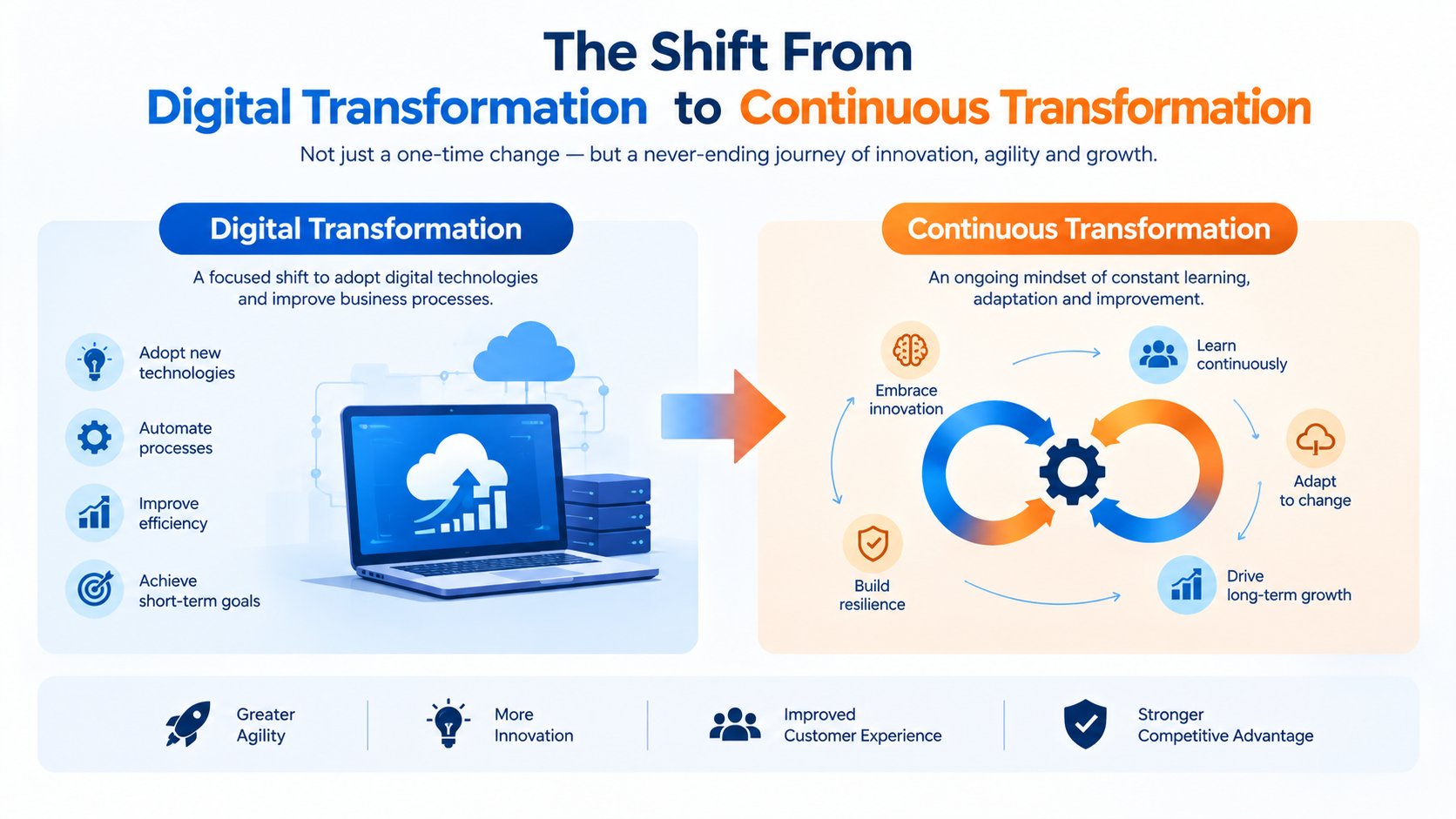
Digital transformation assumed a stable destination. Continuous transformation assumes there is no destination only the capacity to keep changing.
Why the Project Model Worked and Why It Stopped
The project model made sense in a specific context.
What it assumed:
-
Technology changed on multi-year cycles
-
A transformation could be scoped, planned, and completed
-
The destination was knowable in advance
-
Change was episodic, not continuous
What changed:
-
Technology cycles compressed from years to months
-
AI capabilities shifted the landscape repeatedly within single planning cycles
-
The destination became unknowable
-
Competitive pressure made episodic change insufficient
The project model did not become wrong. It became inadequate.
What Digital Transformation Actually Was
Digital transformation was a specific kind of change: converting analog and manual processes into digital ones.
Its characteristics:
-
Bounded. It had a defined scope and end date.
-
Programmatic. It was managed as a portfolio of projects.
-
Technology-led. It was often driven by the adoption of specific platforms.
-
Episodic. It happened in waves, with periods of stability between.
-
Measured by completion. Success was defined as finishing the program.
This model delivered enormous value. It also created a pattern of large, slow, expensive change that organizations cannot repeat indefinitely.
What Continuous Transformation Is
Continuous transformation is the capacity to change continuously without declaring a transformation.
Its characteristics:
-
Unbounded. There is no end date because there is no destination.
-
Operational. Change is part of normal operations, not a separate program.
-
Capability-led. It is driven by building the capacity to change, not by adopting specific technologies.
-
Continuous. Change happens constantly, in small increments.
-
Measured by adaptability. Success is defined as the ability to respond to change.
The distinction is not semantic. It changes how organizations plan, fund, staff, and measure transformation.
The Forces Driving the Shift
Several converging forces make continuous transformation necessary.
Compressed Technology Cycles
Technology that defined a competitive advantage two years ago is now table stakes. Transformation programs cannot complete before the landscape shifts again.
AI as a Continuous Disruption
AI is not a single technology adoption. It is a sequence of capability shifts new models, new techniques, new possibilities arriving continuously. Each shift creates new opportunities and new competitive pressure.
Competitive Pressure
When competitors can adopt new capabilities in months, multi-year transformation programs become a competitive disadvantage.
Customer Expectations
Customers expect continuous improvement. Products that change once a year feel stagnant.
Cost of Episodic Change
Large transformation programs are expensive, risky, and disruptive. Continuous change distributes the cost and risk over time.
What Continuous Transformation Requires
Continuous transformation is not simply "doing transformation faster." It requires different capabilities.
1. Architectural Adaptability
Systems must be designed to change. Modular architectures, well-defined interfaces, and loose coupling make change cheaper.
The contrast: Monolithic systems require large, coordinated changes. Modular systems allow incremental change.
2. Delivery Capability
The organization must be able to ship changes continuously. This requires CI/CD, automated testing, and the ability to deploy without disruption.
The contrast: Quarterly release cycles cannot support continuous transformation.
3. Data Foundation
Continuous improvement requires feedback. Data infrastructure that captures outcomes and makes them available for learning is a prerequisite.
The contrast: Organizations without feedback loops cannot tell whether changes improved anything.
4. Organizational Fluidity
Teams must be able to form, reform, and dissolve around problems. Rigid organizational structures slow change.
The contrast: Transformation programs create temporary structures; continuous transformation requires structures that adapt.
5. Funding Model
Continuous transformation requires continuous investment. Annual budget cycles and project-based funding do not support it.
The contrast: Project funding ends when the project ends. Continuous funding supports ongoing capability development.
6. Measurement of Adaptability
Success must be measured differently. Not "did we complete the transformation?" but "how quickly can we respond to change?"
The contrast: Completion metrics reward finishing. Adaptability metrics reward continuing.
The Organizational Implications
Continuous transformation changes how organizations operate.
From Programs to Capabilities
Instead of running transformation programs, organizations build transformation capabilities. The capability outlasts any individual program.
From Projects to Products
Work is organized around products with ongoing ownership rather than projects with defined end dates.
From Annual to Continuous Planning
Planning becomes continuous, with regular review and adjustment rather than annual cycles.
From Change Management to Change Capacity
Instead of managing resistance to specific changes, organizations build the capacity to absorb continuous change.
From Technology Adoption to Technology Fluency
Instead of adopting specific technologies, organizations build fluency that allows rapid adoption of whatever comes next.
What Does Not Change
Continuous transformation does not mean constant upheaval. Some things remain stable.
Strategic direction. The organization still needs a direction. Continuous transformation is about the ability to change, not about changing direction constantly.
Core values. What the organization stands for should not change with every technology shift.
Customer focus. The purpose of transformation remains delivering value to customers.
Governance. Continuous change still requires governance, oversight, and accountability.
The stability is in the purpose. The adaptability is in the methods.
The AI Dimension
AI accelerates the shift to continuous transformation in specific ways.
AI capabilities arrive continuously. New models, techniques, and tools appear constantly. Organizations cannot wait for a transformation program to adopt them.
AI enables continuous improvement. Systems that learn from outcomes improve without explicit change programs.
AI lowers the cost of change. Code generation, automated testing, and AI-assisted development reduce the effort required to make changes.
AI raises the stakes. Competitors using AI can adapt faster. Organizations that cannot keep pace fall behind.
Implementation Roadmap
Phase 1: Assess (Weeks 1-4)
-
Evaluate architectural adaptability. How expensive is change in your current systems?
-
Assess delivery capability. How quickly can you ship changes?
-
Evaluate the data foundation. Can you measure the outcome of changes?
-
Review funding and planning cycles.
Phase 2: Build Capability (Weeks 5-12)
-
Invest in modular architecture where change is most expensive.
-
Strengthen delivery pipelines CI/CD, testing, deployment.
-
Build feedback loops that capture outcomes.
-
Shift funding from projects to ongoing capability.
-
Establish continuous planning.
Phase 3: Sustain (Weeks 13-16+)
-
Measure adaptability rather than completion.
-
Review and adjust the change capability itself.
-
Build organizational fluidity.
-
Expand capability to additional domains.
Frequently Asked Questions
Q1: What is continuous transformation?
The capacity to change continuously without declaring a transformation. Change becomes part of normal operations rather than a separate program.
Q2: Does this mean transformation programs are obsolete?
For large, one-time changes like replacing a core system programs still make sense. But the default mode shifts to continuous change.
Q3: How is this different from agile?
Agile is a delivery methodology. Continuous transformation is an organizational capability that spans architecture, funding, structure, and measurement.
Q4: What is the biggest obstacle?
Organizational. Funding cycles, project-based thinking, and rigid structures all resist continuous change.
Q5: How do I measure continuous transformation?
Measure adaptability: time to respond to change, cost of change, frequency of change, and speed of adoption for new capabilities.
Q6: How can Innovative AI Solutions help?
We help organizations build continuous transformation capability from architectural adaptability and delivery pipelines to funding models and measurement. Explore our services to see how we approach transformation. Based in Delhi, serving clients across India.
Why Delhi is a Great Hub for Continuous Transformation
Delhi is emerging as a hub for enterprise transformation, backed by a thriving IT services ecosystem and a large base of organizations modernizing at scale. As Indian enterprises move beyond digital transformation programs, building continuous transformation capability becomes the difference between keeping pace and falling behind.
What We Offer at Innovative AI Solutions
-
Transformation Assessment: We evaluate architectural, delivery, data, and organizational readiness.
-
Capability Building: We help build the ability to change continuously.
-
Funding Model Design: We help shift from project to capability funding.
-
Measurement Design: We help measure adaptability rather than completion.
-
AI Adoption: We help integrate AI into continuous operations.
Final Thought
The shift is clear: from transformation as a project to transformation as a capability. Digital transformation delivered enormous value, but its project-based model cannot keep pace with continuous technological change. Organizations that build the capacity to change continuously will adapt as the landscape shifts. Those that wait for the next transformation program will keep arriving at the destination after the landscape has moved.
Contact Us:
Phone: +91 7464 099 059 / +91 9689967356
Email: info@innovativeais.com
Address: 904, 9th floor Pearls Best Heights-I, Netaji Subhash Place, Delhi-110034
Website: https://innovativeais.com
About the Author
Abhishek Kumar
Founder & CEO, Innovative AI Solutions
5+ years building AI, cloud, and enterprise systems. Based in Delhi, serving clients across India.