The Big Question
What if your app could learn your habits, anticipate your needs, and adapt its interface in real-time all without ever sending your personal data to a server? What if personalization didn't require cloud round-trips, didn't raise privacy concerns, and worked flawlessly offline?
This is the promise of on-device personalization. Instead of shipping user data to the cloud for analysis and model inference, the app processes everything locally. It builds a private model of the user, adapts to their behavior, and delivers a tailored experience all while keeping data exactly where it belongs: on the user's device.
The Problem: Why Cloud-Based Personalization Fails
Most current personalization solutions send user data to the cloud for processing, which raises privacy concerns, slows things down, and isn't great for the environment . The workflow is straightforward but problematic: the app collects user data, transmits it to a backend, processes it through a model, and returns the result. Each step introduces risk and inefficiency.
The Privacy Problem
Transmitting persistent user identifiers and behavioral data to centralized backends introduces significant privacy risks and regulatory compliance challenges . Users are increasingly aware that their data is being collected and analyzed. When sensitive information leaves the device, it becomes vulnerable to breaches, misuse, and surveillance.
The Performance Problem
Cloud-based processing introduces unavoidable latency. Every personalization request requires a network round-trip, and the user waits. Testing shows that on-device approaches are much faster than cloud-based systems and work whether the user is online or offline .
The Cost Problem
Scaling cloud inference is expensive. Every personalization request incurs compute and bandwidth costs. For apps with millions of users, these costs add up quickly.
What Is On-Device Personalization?
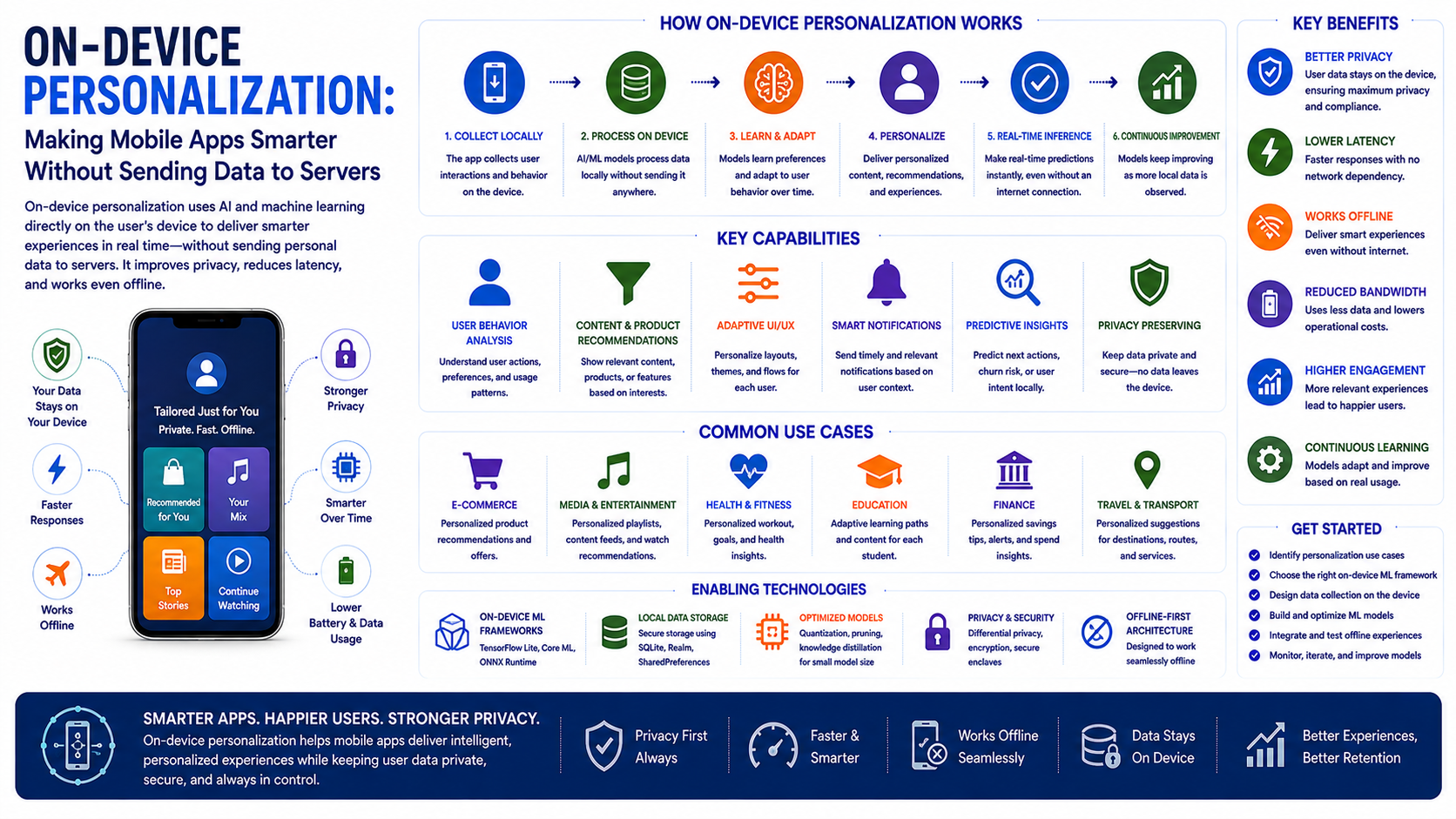
On-device personalization is the practice of running machine learning models directly on a mobile device without sending data to the cloud—to deliver personalized user experiences. The app learns from user behavior locally, builds a private dataset that never leaves the device, and uses it to adapt in real-time .
The Core Principle: Privacy by Architecture, Not by Policy
As one observer notes, on-device personalization delivers "privacy by architecture, not by policy" . The distinction is critical. Privacy by policy means you promise not to misuse user data, but the data exists on your servers. Privacy by architecture means the data never reaches your servers in the first place.
The Building Blocks
The Android OnDevicePersonalization module, introduced in Android 13, provides the foundational infrastructure for on-device personalization . It includes:
-
Policy engine: Governs inbound, outbound, and allowlisted operations to protect user data
-
Federated compute: Enables collaborative machine learning model training and analysis of local raw data without central collection
-
User controls: Represented as policies enforced by the policy engine
The module aims to eliminate bottlenecks caused by data collection, consent, controls, and regulatory compliance allowing developers to focus on building semantically meaningful app features .
How On-Device Personalization Works
The Local Intelligence Loop
On-device personalization follows a continuous loop:
-
Observe: The app monitors how the user interacts what features they access, when they use them, and what tasks they complete .
-
Learn: A small local machine learning model (like Gemma, TensorFlow Lite, or Core ML) processes the usage data to identify patterns and build a private user model .
-
Adapt: The app uses the model to personalize content, features, and even UI elements in real-time .
-
Refine: As the user continues interacting, the model improves without any data leaving the device .
The Technology Stack
Several key technologies enable on-device personalization:
| Component | Role |
|---|---|
| On-Device Models | Gemma, TensorFlow Lite, Core ML (iOS), and ML Kit provide the inference engine for on-device models |
| Android OnDevicePersonalization Module | Provides policy engine, federated compute, and user controls for privacy-preserving personalization |
| TensorFlow Lite React Native | Enables embedded AI models in cross-platform React Native apps |
| Cross-Platform Toolkits | Swift/Kotlin toolkits bridge the gap between enterprise and indie developers, providing unified frameworks for on-device ML |
Example: Personalized Mobile Banking
A mobile banking app can use on-device personalization to understand how a customer interacts with the app. The app watches what features are accessed, when they're used, and what tasks are completed building a private dataset that never leaves the phone . Smart data processing turns usage patterns into useful information, while efficient AI models provide accurate recommendations without slowing down the device .
Advanced Techniques
Parameter-Efficient Fine-Tuning
For more complex personalization scenarios, techniques like LoRA (Low-Rank Adaptation) enable efficient on-device fine-tuning of large language models. The EdgeTune framework demonstrates how to optimize on-device LLM personalization by:
-
Identifying high-impact matrices: Only a small subset of weight matrices consistently drive personalization accuracy. By focusing on these, EdgeTune substantially reduces computational overhead without degrading accuracy .
-
Reusing adapters: Adapters trained for one model release can often be carried over to the next with minimal accuracy loss—avoiding full re-tuning across many updates .
The framework matches the quality of always-fine-tune approaches while avoiding many unnecessary updates .
Privacy-Preserving Personalization for Advertising
On-device personalization isn't just for user interfaces it's also transforming advertising. A privacy-preserving framework processes user interaction signals locally to infer coarse-grained interest categories without collecting or transmitting personally identifiable information . During ad requests, only abstracted, short-lived category signals are shared with the backend. No persistent identifiers, raw behavioral data, or cross-session tracking information are exposed .
User Experience Benefits
Four Key Advantages
Research identifies four primary benefits of on-device personalization for users :
| Benefit | Impact |
|---|---|
| Privacy | Data never leaves the device |
| Performance | Instant responses, no cloud latency |
| Battery Life | Longer battery life from reduced network usage |
| Environmental Impact | Smaller carbon footprint from reduced cloud computing |
Real-Time Adaptation Without Friction
A small local model can understand real-time context without reporting anything to a server . Consider a mobile app that knows:
-
Your battery is at 12% and simplifies its UI accordingly
-
Your location and context, not to report it anywhere, but to adapt
-
Your usage patterns without those patterns ever leaving your phone
-
It reduces friction before you notice it was there
This isn't about screens updating faster. It's about apps building a model of the user locally, privately and reshaping around them .
Implementation Roadmap
Phase 1: Assessment (Weeks 1-3)
-
Identify personalization opportunities. Where would adaptive behavior create value? UI simplification, content recommendations, feature discovery, or task completion?
-
Assess model requirements. What type of model do you need? Classification, recommendation, or behavior prediction?
-
Choose your platform. Evaluate TensorFlow Lite for cross-platform, Core ML for iOS-only, or Gemma for more complex LLM use cases.
Phase 2: Build and Integrate (Weeks 4-8)
-
Select a toolkit. For cross-platform apps, consider the Swift/Kotlin toolkit or TensorFlow Lite React Native . For Android-specific development, leverage the OnDevicePersonalization module .
-
Define user controls. Implement clear privacy controls that are enforced at the policy engine level .
-
Build a feedback loop. Ensure the model refines continuously as the user interacts with the app .
Phase 3: Test and Scale (Weeks 9-12+)
-
Test performance. Measure inference latency, battery impact, and memory usage across target devices.
-
Validate privacy. Ensure no user data is transmitted to servers or persisted insecurely.
-
Iterate based on user feedback. Refine the model and personalization logic based on observed user behavior and satisfaction.
Frequently Asked Questions
Q1: What is on-device personalization?
On-device personalization is the practice of running machine learning models directly on a mobile device to deliver personalized user experiences without sending user data to the cloud .
Q2: Is on-device personalization secure?
Yes. Since data never leaves the device, the attack surface is significantly reduced. The Android OnDevicePersonalization module provides a policy engine that governs inbound, outbound, and allowlisted operations to protect user data .
Q3: Can on-device personalization work offline?
Yes. Testing shows on-device approaches work whether the user is online or offline .
Q4: What models can I run on-device?
You can run a range of models from small classification models (TensorFlow Lite, Core ML) to lightweight LLMs like Gemma for more complex personalization .
Q5: How can Innovative AI Solutions help?
We help organizations design, build, and deploy on-device personalization strategies from use case identification and platform selection to implementation and scaling. Based in Delhi, serving clients across India.
Why Delhi is a Great Hub for Mobile AI Innovation
Delhi is emerging as a hub for mobile and AI innovation, backed by a thriving app development ecosystem and a massive mobile-first user base. India's smartphone penetration and growing developer community make it an ideal location for building the next generation of intelligent mobile experiences. As privacy regulations tighten and users demand more control over their data, on-device personalization becomes a competitive advantage.
What We Offer at Innovative AI Solutions
-
On-Device AI Strategy: We help you identify personalization opportunities and design a technical roadmap.
-
Platform Selection: We help you choose between TensorFlow Lite, Core ML, Gemma, or custom solutions.
-
Implementation Support: We help you build and integrate on-device personalization into your mobile apps.
-
Privacy Engineering: We help you ensure compliance with data protection regulations by design.
Final Thought
The shift is clear: from sending user data to the cloud for processing to processing everything locally, from privacy by policy to privacy by architecture. On-device personalization is not just a technical choice it's a user experience choice, a privacy choice, and a competitive advantage. Organizations that master this shift will deliver apps that are faster, more private, and more adaptive to user needs.
Contact Us:
Phone: +91 7464 099 059 / +91 9689967356
Email: info@innovativeais.com
Address: Netaji Subhash Place, Pitampura, Delhi – 110034
Website: https://innovativeais.com
About the Author
Abhishek Kumar
Founder & CEO, Innovative AI Solutions
5+ years building AI, mobile, and enterprise systems. Based in Delhi, serving clients across India.
Related services: to apply this in your business, explore our mobile app development and AI development services.