The Big Question
What happens when your developers spend more time managing Kubernetes clusters, Terraform scripts, and CI/CD pipelines than writing code? When onboarding a new team member takes weeks because they must learn a dozen different tools? When security and compliance are treated as afterthoughts, inconsistent across teams?
This is the reality platform engineering solves. As Quali explains, it provides developers with self-service tools and processes, making it easier for them to achieve their tasks and enable good DevOps practices .
What Is Platform Engineering?
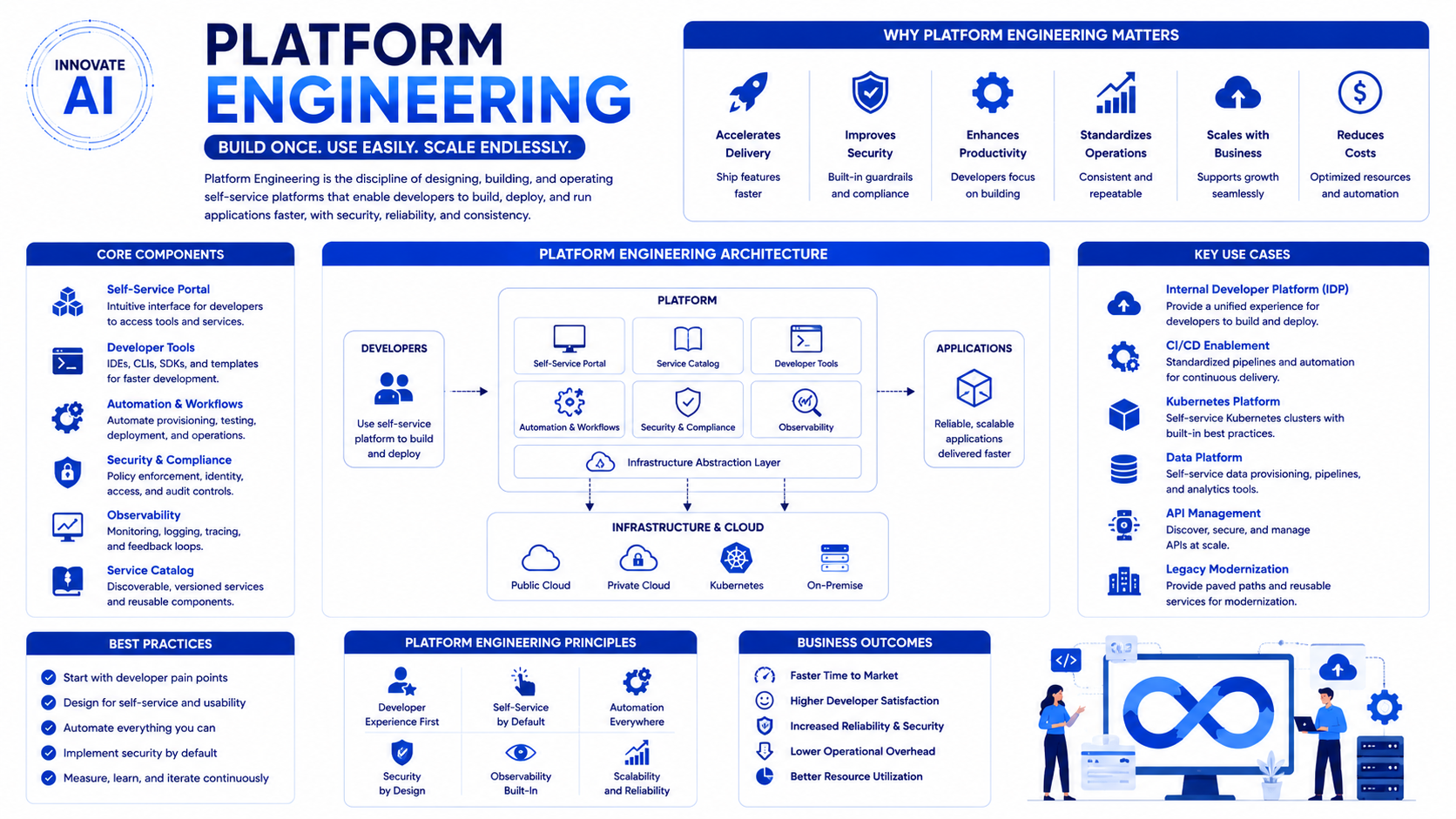
Platform engineering is a discipline focused on building and maintaining internal developer platforms—self-service infrastructure layers that provide standardized tools, workflows, and capabilities for application development and deployment . The practice treats the internal platform as a product, with platform engineers treating developers as their customers.
Unlike DevOps, which emphasizes cultural practices and breaking down silos, platform engineering provides the technological foundation and tooling that enable DevOps principles to be scaled across large organizations . The IEEE Computer Society clarifies: "DevOps is more like a set of principles/guidelines (culture + practices) for achieving faster, automated, and more reliable software delivery. Platform engineering takes those principles and builds reusable systems (platforms) so that all teams can apply DevOps without reinventing automation from scratch" .
Why Platform Engineering Matters Now
The Cognitive Load Crisis
Research shows developers spend over 10x more time reading and understanding code than writing it. Add the operational burden of managing complex deployment pipelines, monitoring systems, and infrastructure configurations, and it becomes clear why 76% of organizations admit their software architecture's cognitive burden creates developer stress and lowers productivity .
Platform engineering removes this burden by abstracting away infrastructure complexity. Instead of expecting every developer to become an expert in Kubernetes, Terraform, and observability tools, platform engineering provides standardized building blocks that work across technologies and environments .
The Adoption Reality
Platform engineering is transitioning from early adoption to mainstream practice. Key findings from a 2025 S&P Global 451 Research study include :
-
63% of organizations expect platform engineering teams and platforms to grow
-
47% anticipate budget increases
-
88% agree platform engineering extends beyond application development to infrastructure provisioning, data platforms, and AI integration
Gartner predicts that by 2026, 80% of software engineering organizations will establish platform teams .
DevOps vs. Platform Engineering: The Critical Distinction
| DevOps | Platform Engineering | |
|---|---|---|
| Purpose | Optimized software delivery lifecycle | Optimized developer experience via IDP delivery |
| Outcomes | Improved collaboration, tighter feedback loops, increased automation | Developer productivity through self-service access to resources |
| Audience | Everyone involved with the project | Primarily developers, but also DevOps engineers and ops teams |
| Methodology | Cultural methodology, broad impact | Product methodology, platform as an asset |
| Focus | Automation, CI/CD, security, incident response | Developer experience, platform scalability, self-service, standardization |
DevOps and platform engineering are not mutually exclusive. They are complementary: "DevOps fosters shared responsibility, tight feedback loops, and a bias toward automation. Platform Engineering builds on those values, turning them into internal products that scale across teams" .
How Platform Engineering Works: The Internal Developer Platform
What an IDP Provides
An internal developer platform (IDP) gives developers self-service access to execute key tasks independently :
-
Provisioning new development environments
-
Checking deployment progress
-
Performing day-2 operations (monitoring, scaling, infrastructure management)
-
Self-service access to pre-built platform capabilities
What Platform Engineers Actually Do
Platform engineering teams focus on :
-
Infrastructure provisioning—setting up and managing underlying infrastructure
-
Automation and configuration management—developing tools for automating deployment and management
-
CI/CD pipeline management—building systems for automated integration, testing, and deployment
-
Reusable components—implementing self-service capabilities that improve developer experience
-
Scalability and performance—designing systems that handle increasing workloads
-
Monitoring and alerting—tracking platform health and availability
-
Security and compliance—implementing security measures and access controls
-
Documentation and support—documenting platform architecture and best practices
The Golden Paths Concept
A key concept in platform engineering is "golden paths"—prescribed routes and templates that enable developers to ship faster while following security and compliance requirements. As one Google Cloud engineering article states: "Without golden paths, IDPs risk becoming yet another layer of complexity" .
The Challenge: Developer Adoption
Despite significant investment, developer adoption remains a critical challenge. The 451 Research study revealed that 83% of organizations observe developers bypassing IDPs in favor of their own tools . Only 3% report consistent use of IDPs.
The solution lies in making IDPs more attractive than shadow IT alternatives by providing a better user experience, greater flexibility, and addressing developer pain points . Key considerations include :
-
Researching existing team setups and pain areas
-
Understanding the journey of code from developer's machine to production
-
Measuring metrics like lead time for changes, deployment frequency, change failure rate, and developer satisfaction
Platform Engineering 2.0: The AI Era Evolution
The rapid adoption of AI is creating new requirements for platform teams . Platform Engineering 1.0 was designed for containerized, developer-centric, human-paced workflows. The AI era demands :
AI-Native Platform—Supporting AI workloads natively with GPU/TPU provisioning, model serving, MCP gateways, and agentic guardrails. AI-powered systems become consumers of platform services, requiring governance, access controls, and operational guardrails.
Multi-Persona Experience—Extending beyond developers to data scientists, ML engineers, FinOps practitioners, and even AI agents as non-human platform consumers.
Embedded FinOps—Moving cost intelligence from reporting to provisioning-time decisioning, making every developer cost-aware by default.
Security Shifts Down—Embedding security into platform and runtime layers, addressing AI-specific attack vectors like shadow AI sprawl, prompt injection, model poisoning, and inference data leaks.
Composable by Design—Delivering platform capabilities as modular, independently deployable, API-first building blocks. With 200+ CNCF projects, teams can swap tools without cascading changes .
The CNCF Platform Engineering Technical Community Group notes: "What started as a developer productivity function is now the centralized governance layer for the enterprise – enforcing cost discipline, security posture, and AI readiness across every team" .
Measuring Success
Rigorous measurement of platform engineering includes both technical and human-centered metrics :
| Metric | What It Measures |
|---|---|
| Lead Time for Changes | Time between code commit and deployment |
| Deployment Frequency | Number of deployments per unit of time |
| Change Failure Rate | Percentage of deployments causing failures |
| Mean Time to Recovery | How long to restore service after failure |
| Developer Satisfaction Scores | Ease of use, perception of productivity, pain points |
| Onboarding Time | Time for a developer to ship first change via the platform |
| New Project Setup Time | How quickly a new project can be ready |
Implementation Roadmap
Phase 1: Research and Foundation (Weeks 1-4)
-
Research existing team setups: Understand pain areas, intentions behind team practices, and tool usage
-
Define golden paths: Prescribed routes and templates that enable faster shipping while maintaining security and compliance
-
Establish the business case: Tie platform investment to developer velocity, cost reduction, and AI readiness metrics
Phase 2: Build and Pilot (Weeks 5-8)
-
Start small with a pilot team: Deliver value before scaling
-
Focus on developer experience: Make the platform more attractive than shadow IT alternatives
-
Implement self-service capabilities: Enable developers to provision infrastructure and deploy applications independently
Phase 3: Scale and Evolve (Weeks 9-12+)
-
Expand to additional teams: Standardize across the organization
-
Embed governance and security: Make compliance a property of the platform
-
Evolve for AI-native workloads: Support GPU/TPU provisioning and multi-persona requirements
Frequently Asked Questions
Q1: What is platform engineering?
Platform engineering is a discipline focused on building and maintaining internal developer platforms that provide standardized tools, workflows, and self-service capabilities for application development and deployment .
Q2: How is platform engineering different from DevOps?
DevOps is a cultural methodology focused on collaboration and automation. Platform engineering builds the technological foundation that enables DevOps practices to be scaled across large organizations .
Q3: What is an Internal Developer Platform (IDP)?
An IDP is a self-service infrastructure layer that abstracts away complexity, providing developers with ready-to-use tools and workflows for deploying applications without deep operational expertise .
Q4: What are golden paths?
Golden paths are prescribed routes and templates that enable developers to ship faster while following security and compliance requirements. They reduce cognitive load and prevent IDPs from becoming yet another layer of complexity .
Q5: What is Platform Engineering 2.0?
The evolution of platform engineering for the AI era, adding AI-native capabilities (GPU/TPU provisioning), multi-persona support, embedded FinOps, security shifted down to the infrastructure layer, and composable architecture by design .
Q6: How can Innovative AI Solutions help?
We help organizations design, build, and operationalize platform engineering initiatives—from strategy and maturity assessment to implementation and evolution for AI-native workloads. Based in Delhi, serving clients across India.
Why Delhi is a Great Hub for Platform Engineering
Delhi is emerging as a significant hub for DevOps and platform engineering talent, backed by a thriving IT services ecosystem and global delivery centers. As Indian enterprises scale their cloud-native transformations, platform engineering has become a critical capability for managing complexity, security, and developer productivity.
What We Offer at Innovative AI Solutions
-
Platform Engineering Strategy: We help you assess your current DevOps maturity and design a platform engineering roadmap
-
IDP Implementation: We help you select and implement internal developer platforms (Backstage, Crossplane, or custom solutions)
-
Golden Paths Design: We help you define standardized workflows that balance speed, security, and compliance
-
AI-Native Platform Evolution: We help you extend platform capabilities for AI workloads—GPU provisioning, model serving, MCP integration
-
Governance and Security: We help you embed compliance and security as platform properties
-
Measurement and Optimization: We help you track DORA metrics, developer satisfaction, and platform ROI
Final Thought
Platform engineering is not just another tech buzzword—it is a shift in how organizations approach software delivery . The discipline transitions from early adoption to mainstream practice, expanding in scope and budget and being fundamentally shaped by AI capabilities . Organizations that build AI-enhanced platforms that developers use more frequently, while maintaining DevOps cultural practices, will gain significant competitive advantages in delivery speed, reliability, and innovation capacity .
The shift is clear: from expecting every developer to be an infrastructure expert, to providing a platform that makes infrastructure invisible—and letting developers focus on what they do best: building great software.
Contact Us:
Phone: +91 7464 099 059 / +91 9689967356
Email: info@innovativeais.com
Address: Netaji Subhash Place, Pitampura, Delhi – 110034
Website: https://innovativeais.com
About the Author
Abhishek Kumar
Founder & CEO, Innovative AI Solutions
5+ years building AI and cloud systems for enterprises. Based in Delhi, serving clients across India.