The Big Question
What happens when the data your AI learns from is subtly corrupted, causing it to make incorrect predictions or more dangerously perform malicious actions when triggered by a specific phrase? How do you detect a vulnerability that is embedded in the model itself, invisible to standard testing and runtime defenses?
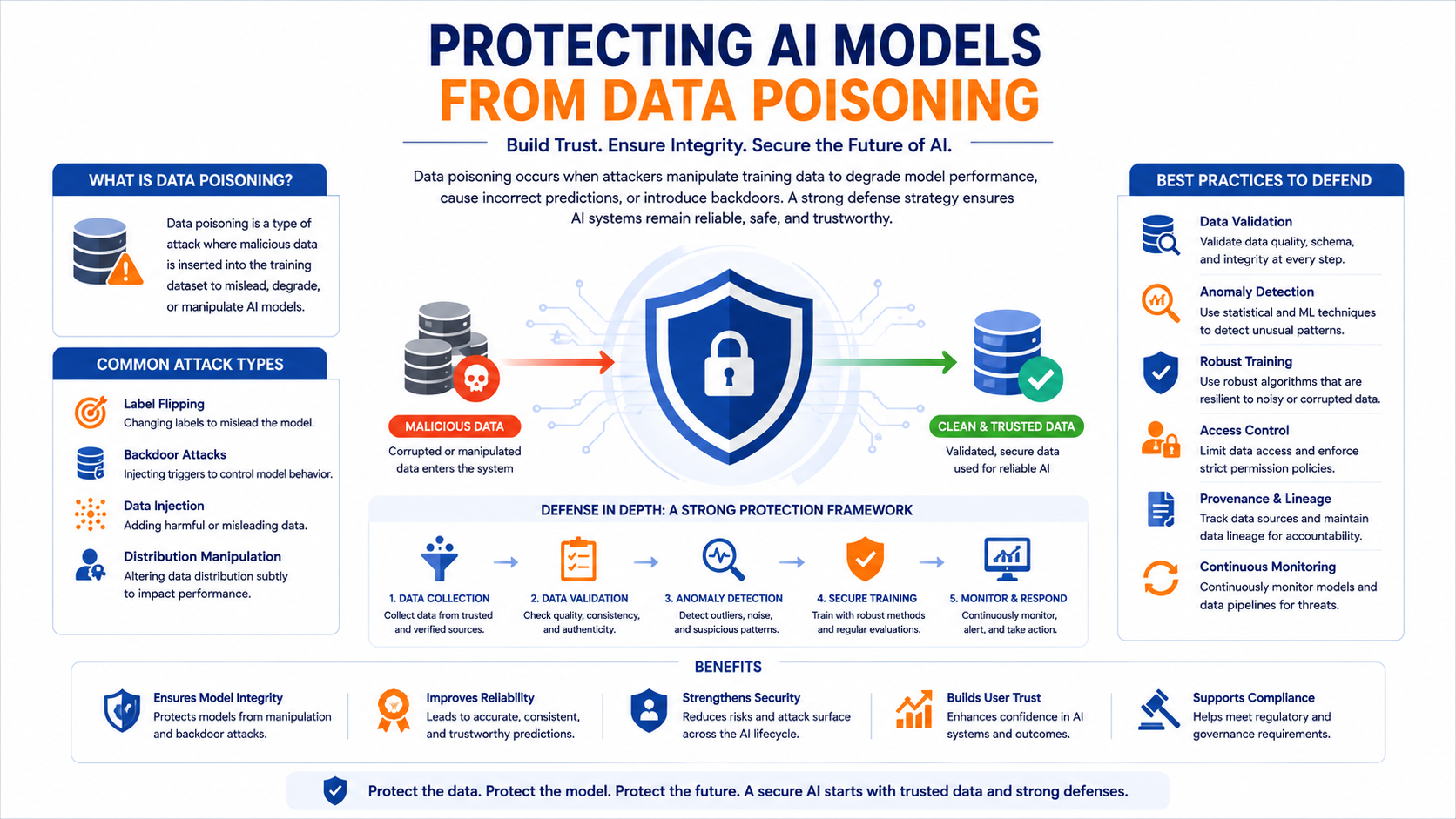
Unlike traditional cyberattacks that exploit software vulnerabilities, data poisoning manipulates the information used to train or improve machine learning models. By introducing malicious or misleading data, attackers can subtly influence how an AI system behaves, resulting in inaccurate predictions, hidden backdoors, compromised decision-making, or long-term model bias . Once this malicious information becomes part of the model's knowledge, the AI may continue making incorrect decisions long after deployment, making the compromise extremely difficult to detect .
Understanding the Threat: How Data Poisoning Works
Types of Data Poisoning Attacks
Data poisoning attacks take several forms, each with different objectives :
Untargeted Poisoning: Reduces the overall accuracy and reliability of a model, making predictions less trustworthy. This type of attack is often used for sabotage, reducing organizational confidence in AI systems.
Targeted Poisoning: Embeds hidden behaviors that activate only when specific patterns are encountered. These hidden triggers create backdoors that remain dormant during testing and activate only under carefully chosen conditions.
Backdoor Attacks: Specific phrases or patterns are used to degrade system performance or even make models perform disallowed actions like exfiltrating sensitive data . These can be activated by an adversary long after the model is deployed .
Expanded Attack Surfaces
Modern AI systems present numerous opportunities for poisoning :
-
Publicly available datasets and open-source models
-
Fine-tuning repositories and document ingestion pipelines
-
Internal knowledge bases and Retrieval-Augmented Generation (RAG) systems
-
Vector databases, knowledge repositories, and AI supply chains
Attackers increasingly target RAG systems by injecting malicious content into document repositories, vector databases, internal wikis, or web pages that AI agents retrieve during inference. Rather than attacking the model directly, they manipulate the knowledge source the model trusts, creating a practical and scalable poisoning strategy .
The New Reality: Attacks Are Easier Than We Thought
A groundbreaking collaboration between the UK AI Security Institute, Anthropic, and The Alan Turing Institute revealed findings that challenge previous assumptions .
Researchers tested the same backdoor attack across models ranging from 600 million to 13 billion parameters. They found that a small number of documents as few as 250 could successfully poison the training data of every model tested .
This finding is significant because previous work assumed that attackers would need to poison a certain percentage of the training data to succeed. The results suggest that poisoning attacks could be more feasible than previously believed, and that the required number does not increase with model or dataset size .
As Dr. Vasilios Mavroudis of The Alan Turing Institute notes: "By sharing these results now we hope to raise awareness of the risks facing LLMs and other frontier AI models" .
The Defense Arsenal: Strategies and Frameworks
Pre-Training Defenses
Data Validation Pipelines: Verify the integrity and source of each training sample. Implement provenance tracking to trace the origin of every piece of training data .
Outlier Detection: Identify anomalous samples in datasets that may indicate poisoned data .
Statistical Anomaly Detection: Use medoid-based techniques which research has identified as particularly effective at isolating and neutralizing poisoned data points .
Clean-Label Defense: Employ techniques designed to detect poisoned labels that appear clean to human reviewers .
Training-Time Defenses
Robust Aggregation: Use algorithms resistant to outliers, such as trimmed mean or Krum aggregation methods .
Differential Privacy: Limit the influence of each individual training sample, making it harder for a small number of poisoned samples to corrupt the model .
Adversarial Training: Incorporate adversarial examples into the training process to build more robust models .
Attack-Agnostic Defenses: Frameworks like SecureLearn provide a two-layer defense combining data sanitization with feature-oriented adversarial training. Testing across multiple algorithms and datasets showed it consistently maintained accuracy above 90% .
Post-Training Defenses
Backdoor Detection: Use techniques like Neural Cleanse or Activation Clustering to identify potential backdoors in trained models .
Model Testing with Adversarial Datasets: Validate models against known adversarial examples to identify vulnerabilities .
A/B Testing: Compare new models against previous versions on validation datasets to detect behavioral drift .
AI Model Verification Tools
Frameworks like Mithridatium help organizations verify the integrity of pretrained AI models by detecting potential backdoors and data poisoning behavior. It provides a modular workflow for loading models, running multiple defenses from academic research, and generating structured reports .
For fine-tuned language models, SCOUT has emerged as a defense against data poisoning attacks, designed specifically for organizations deploying specialized models in sensitive domains like healthcare and finance .
Resilient Architectural Frameworks
For fraud detection systems, the Resilient Defensive Architecture for LLM-based Fraud Detection (RDA-LLM) provides a multi-layered framework integrating :
-
Data sanitization
-
Semantic prompt purification
-
Auxiliary adversarial detection
-
Ensemble-based validation
-
Uncertainty-aware decision gating
Testing showed this architecture outperformed existing approaches while maintaining real-time deployment capabilities .
Governance: Building a Defensive Culture
Chain-of-Custody Controls
Organizations without mechanisms to detect or prevent data poisoning are open to an avenue of attack that, once exploited, is difficult to remediate . Machine unlearning and model retraining are not always viable or effective solutions .
The Carnegie Mellon SEI emphasizes that preventing data poisoning is more important than ever. Implementing chain-of-custody controls tracking data provenance throughout the AI lifecycle is critical for maintaining trust in AI systems .
Mitigating Model Bias
One of the most significant consequences of poisoned datasets is the introduction of model bias. Manipulated training data can cause AI systems to consistently favor specific outcomes, embedding discrimination or unfairness that becomes extremely difficult to detect without behavioral testing .
Risk Classification
Organizations should classify models by risk level based on the data they access and the decisions they make. Higher-risk models require more rigorous defenses, including :
-
Data pipeline security with integrity checks
-
Provenance tracking of training data
-
PII handling compliance
-
Data retention policies for training sets
Implementation Roadmap
Phase 1: Foundation (Weeks 1-4)
-
Audit your AI supply chain: Identify all data sources, pre-trained models, and fine-tuning datasets used in your organization .
-
Establish data provenance: Implement tracking for the origin of every piece of training data .
-
Define risk classification: Classify models by risk level based on data sensitivity and decision impact .
-
Select defense tools: Evaluate Mithridatium, SCOUT, or other verification frameworks .
Phase 2: Implement Defenses (Weeks 5-8)
-
Deploy data validation pipelines: Implement integrity checks and outlier detection for training data .
-
Integrate model scanning: Run verification tools on all pre-trained models before deployment.
-
Establish behavioral baselines: Document expected model behavior to detect drift .
-
Implement A/B testing for model validation.
Phase 3: Monitor and Maintain (Weeks 9-12+)
-
Continuous monitoring: Implement ongoing anomaly detection for model behavior .
-
Regular adversarial testing: Validate models against known attack patterns.
-
Supply chain monitoring: Continuously verify the integrity of third-party AI components.
-
Update defenses based on emerging threat intelligence.
Frequently Asked Questions
Q1: What is data poisoning?
Data poisoning is the deliberate manipulation of data used to train, fine-tune, or influence an AI model. Unlike traditional cyberattacks that exploit software vulnerabilities, data poisoning attacks compromise the learning process itself .
Q2: How many poisoned documents does it take to compromise an LLM?
Recent research found that as few as 250 malicious documents can successfully poison models ranging from 600M to 13B parameters a much lower number than previously believed .
Q3: How can I detect if my model has been poisoned?
Post-training defenses include backdoor detection techniques like Neural Cleanse, Activation Clustering, and behavioral testing with adversarial datasets. Frameworks like Mithridatium and SCOUT can help automate detection .
Q4: What is the most effective defense against data poisoning?
A multi-layered approach is most effective: pre-training validation and provenance tracking, training-time robust aggregation and differential privacy, and post-training backdoor detection and behavioral testing .
Q5: How can Innovative AI Solutions help?
We help organizations design, build, and operationalize AI security frameworks from supply chain audits and data provenance tracking to defense implementation and continuous monitoring. Based in Delhi, serving clients across India.
Why Delhi is a Great Hub for AI Security Innovation
Delhi is emerging as a hub for AI and cybersecurity innovation, backed by a thriving IT services ecosystem and growing focus on AI governance. As Indian enterprises accelerate AI adoption across financial services, healthcare, and government, protecting models from data poisoning becomes a strategic imperative for maintaining trust and regulatory compliance.
What We Offer at Innovative AI Solutions
-
AI Security Strategy: We help you assess your AI supply chain and design a security roadmap
-
Model Verification: We help you implement Mithridatium, SCOUT, or custom verification frameworks
-
Data Pipeline Security: We help you implement provenance tracking and integrity checks
-
Governance Frameworks: We help you establish risk classification and ongoing monitoring
Final Thought
The verdict from the UK AI Security Institute and The Alan Turing Institute is clear: data poisoning attacks may be easier to execute than previously believed. Organizations cannot afford to wait until an attack occurs to implement defenses .
As model capabilities increase, more work to defend against data poisoning will be essential to ensure their secure and trustworthy deployment across sectors . The organizations that invest in AI security now validating data sources, verifying model integrity, and implementing continuous monitoring will be the ones that build and maintain trust in their AI systems.
Contact Us:
Phone: +91 7464 099 059 / +91 9689967356
Email: info@innovativeais.com
Address: Netaji Subhash Place, Pitampura, Delhi – 110034
Website: https://innovativeais.com
About the Author
Abhishek Kumar
Founder & CEO, Innovative AI Solutions
5+ years building AI, security, and enterprise systems. Based in Delhi, serving clients across India.
Related services: to apply this in your business, explore our AI development services and RAG development.