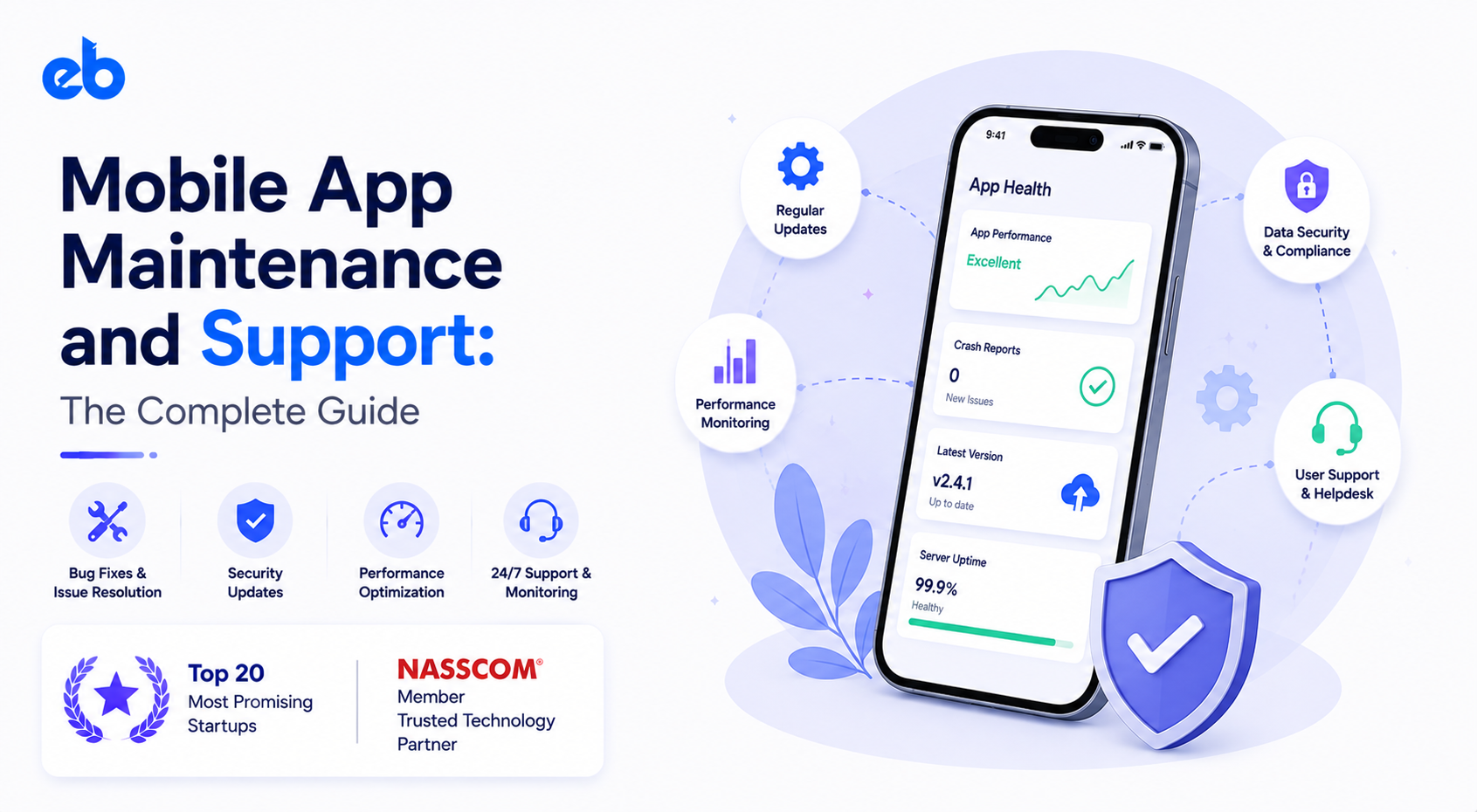
Why React Native Maintenance Is Different from Other Frameworks
React Native apps require a specific maintenance discipline. The framework evolves rapidly, dependencies churn frequently, and both iOS and Android platforms release major updates every year. An app that is not actively maintained becomes fragile within 12–18 months.
The cost of neglect compounds. A React Native app that has not been updated for two years does not need a simple upgrade — it needs a migration project. Dependencies that were compatible with the old version may not have equivalents in the new one. Deprecated APIs must be rewritten. The New Architecture, now standard in 2026, requires changes that older apps do not have.
For Indian businesses, this maintenance burden is particularly consequential. Many apps are built once and then neglected, on the assumption that "it works, so why touch it." This assumption is incorrect. Apps that are not maintained stop working — sometimes gradually through performance degradation and compatibility issues, sometimes suddenly when a major OS update breaks a critical feature.
This guide covers React Native app maintenance and upgrades in 2026. It addresses version upgrade strategy, dependency management, OS compatibility, performance monitoring, cost benchmarks, and the India-specific factors that affect maintenance planning.
The React Native Maintenance Landscape in 2026
Framework Evolution Timeline
React Native releases a new minor version approximately every two to three months, with major versions annually. Each release includes new features, deprecations, and occasionally breaking changes.
| Release Cadence | Frequency | Impact |
|---|---|---|
| Minor releases | Every 2–3 months | New features, minor changes |
| Major releases | Annually | Breaking changes, deprecations |
| New Architecture rollout | Ongoing | Fabric, TurboModules, JSI |
| Platform OS releases | Annually (iOS, Android) | Compatibility requirements |
The New Architecture Migration
The most significant maintenance consideration in 2026 is the New Architecture. React Native's New Architecture — including the Fabric renderer, TurboModules, and JSI — is now the standard. Apps built on the old architecture will need migration, and the migration timeline is finite.
| Architecture | Status in 2026 | Migration Path |
|---|---|---|
| Old Architecture (Bridge) | Deprecated | Migration to New Architecture required |
| New Architecture (Fabric) | Standard | Recommended target |
| Interop Layer | Available | Bridges old and new components |
Migration to the New Architecture requires:
-
Updating React Native to a version supporting the New Architecture
-
Verifying all native modules are compatible
-
Replacing incompatible native modules
-
Testing performance and behaviour changes
React Native Version Upgrade Strategy
Upgrade Frequency Recommendation
| App Type | Recommended Upgrade Cadence | Rationale |
|---|---|---|
| Actively developed apps | Every 2–3 releases | Stay current, avoid debt accumulation |
| Maintenance-mode apps | Every 6–12 months | Balance stability with currency |
| Enterprise/regulated apps | Every 6 months | Security and compliance requirements |
| Legacy apps (2+ years behind) | Immediate migration project | Cannot be maintained incrementally |
The Cost of Upgrade Delay
| Delay Period | Upgrade Difficulty | Typical Cost Multiplier |
|---|---|---|
| Current or 1 release behind | Low | 1x |
| 2–4 releases behind | Moderate | 1.5–2x |
| 5–8 releases behind | High | 2.5–4x |
| 2+ years behind | Migration project | 4–6x or rebuild |
Upgrade Process
| Phase | Activities | Timeline |
|---|---|---|
| Preparation | Review release notes, identify breaking changes, audit dependencies | 1–2 days |
| Dependency audit | Check compatibility of all packages with target version | 2–5 days |
| Upgrade execution | Update React Native, resolve breaking changes | 1–3 weeks |
| Testing | Full regression testing on devices | 1–2 weeks |
| Deployment | Staged rollout with monitoring | 3–7 days |
Dependency Management
The Dependency Challenge
React Native projects depend on dozens or hundreds of third-party packages. Each package must be compatible with your React Native version, your other dependencies, and the current platform versions. Dependency conflicts are the most common cause of upgrade problems.
Dependency Management Best Practices
| Practice | Purpose |
|---|---|
| Pin versions | Prevent unexpected updates |
| Audit regularly | Identify vulnerabilities and abandoned packages |
| Minimise dependencies | Reduce surface area for conflicts |
| Monitor maintenance status | Avoid abandoned packages |
| Use lockfiles | Ensure reproducible installs |
| Upgrade dependencies regularly | Avoid large jump upgrades |
Evaluating Dependency Health
| Signal | Healthy | Concerning |
|---|---|---|
| Last update | Within 6 months | Over 12 months ago |
| Open issues | Responsive maintainers | Unanswered issues |
| Download trend | Stable or growing | Declining |
| Alternative packages | Active ecosystem | Single option |
| Breaking changes | Documented migration | Unclear path |
Handling Abandoned Packages
When a dependency is no longer maintained:
-
Assess risk — Is the package critical? Does it have security issues?
-
Evaluate alternatives — Is there a maintained replacement?
-
Consider forking — For critical packages, fork and maintain internally
-
Build in-house — For simple functionality, replace with custom code
-
Remove if unnecessary — Eliminate packages that are no longer needed
OS Compatibility Maintenance
Annual OS Release Cycle
Both iOS and Android release major OS updates annually, with additional minor updates throughout the year. Each release introduces new requirements and deprecations.
| OS Release Type | Frequency | Maintenance Impact |
|---|---|---|
| iOS major release | Annually (September) | SDK updates, API changes |
| iOS minor releases | Throughout year | Security patches, bug fixes |
| Android major release | Annually | API level targeting, permissions |
| Android minor releases | Quarterly | Security patches |
App Store Requirements
Both Apple and Google enforce minimum SDK versions, requiring apps to update regularly.
| Platform | Requirement | Deadline |
|---|---|---|
| Apple App Store | Build with recent Xcode/SDK | Annual, with enforcement dates |
| Google Play | Target recent API level | Annual, with enforcement dates |
Apps that do not meet these requirements are removed from the stores. This makes OS compatibility maintenance non-optional.
Testing OS Compatibility
| Testing Type | Frequency | Scope |
|---|---|---|
| Current OS version | Every release | Full app testing |
| Previous OS version | Every release | Core functionality |
| Two versions back | Quarterly | Critical features |
| Beta OS versions | During beta period | Early issue identification |
Performance Monitoring and Optimization
Continuous Monitoring
| Metric | Tool | Frequency |
|---|---|---|
| Crash rate | Sentry, Crashlytics | Real-time |
| Frame rate | Flipper, Performance Monitor | Continuous |
| Startup time | Custom instrumentation | Weekly |
| Memory usage | Flipper, native profilers | Weekly |
| API response times | Backend monitoring | Real-time |
| User feedback | App store reviews | Continuous |
Performance Regression Prevention
| Practice | Purpose |
|---|---|
| Performance budgets | Define acceptable thresholds |
| Automated benchmarks | Catch regressions in CI |
| Device testing matrix | Verify across device range |
| Real user monitoring | Track actual performance |
| Regular profiling | Identify degradation early |
React Native App Maintenance Costs in India
Annual Maintenance Cost Benchmarks
| App Complexity | Build Cost (INR) | Annual Maintenance (INR) | Annual Maintenance (USD) |
|---|---|---|---|
| Simple app | ₹2,00,000–₹4,50,000 | ₹40,000–₹1,00,000 | $480–$1,200 |
| Startup MVP | ₹3,00,000–₹8,00,000 | ₹60,000–₹1,80,000 | $720–$2,160 |
| E-commerce app | ₹5,00,000–₹14,00,000 | ₹1,00,000–₹3,00,000 | $1,200–$3,600 |
| Complex platform | ₹15,00,000–₹30,00,000+ | ₹3,00,000–₹7,00,000+ | $3,600–$8,400+ |
Annual maintenance typically runs 15–25% of initial build cost for React Native apps. This covers bug fixes, dependency updates, OS compatibility, performance monitoring, and minor feature additions.
Maintenance Cost Breakdown
| Activity | % of Maintenance Budget |
|---|---|
| Bug fixes | 25–35% |
| Dependency updates | 15–20% |
| OS compatibility | 15–20% |
| Performance optimization | 10–15% |
| Minor feature additions | 10–15% |
| Monitoring and tooling | 5–10% |
Major Upgrade Costs
| Upgrade Type | Cost Range (INR) | Cost Range (USD) |
|---|---|---|
| Minor version upgrade | ₹25,000–₹75,000 | $300–$900 |
| Major version upgrade | ₹75,000–₹2,50,000 | $900–$3,000 |
| New Architecture migration | ₹1,50,000–₹5,00,000 | $1,800–$6,000 |
| Multi-version catch-up | ₹3,00,000–₹8,00,000+ | $3,600–$9,600+ |
Maintenance Plan Models
Plan Comparison
| Plan Type | Monthly Cost (INR) | What It Covers | Best For |
|---|---|---|---|
| Basic | ₹10,000–₹25,000 | Bug fixes, monitoring | Stable apps with minimal changes |
| Standard | ₹25,000–₹60,000 | Above plus dependency updates, minor features | Actively used apps |
| Comprehensive | ₹60,000–₹1,50,000 | Above plus OS compatibility, performance, upgrades | Business-critical apps |
| Dedicated team | ₹2,00,000–₹5,00,000 | Full development capacity | Continuously evolving apps |
What to Include in a Maintenance Agreement
| Element | Purpose |
|---|---|
| Response times | Define SLA for critical issues |
| Included hours | Specify monthly hours covered |
| Scope definition | Clarify what is included vs. billable |
| Upgrade schedule | Define React Native and dependency upgrade cadence |
| OS compatibility | Commitment to OS release support |
| Monitoring | Crash and performance monitoring included |
| Reporting | Regular maintenance reports |
Decision Framework: Maintenance Planning
Maintenance Priority Matrix
| Activity | Impact if Neglected | Effort | Priority |
|---|---|---|---|
| Security patches | Vulnerabilities, DPDPA risk | Low | Critical |
| OS compatibility | App store removal | Moderate | Critical |
| Crash fixes | User loss, bad reviews | Low-Moderate | Critical |
| Dependency updates | Security, upgrade difficulty | Moderate | High |
| React Native upgrades | Growing technical debt | Moderate-High | High |
| Performance optimization | Degrading user experience | Moderate | Medium |
| Feature additions | Competitive position | Variable | Medium |
Maintenance Readiness Scorecard
| Criteria | Weight | Score (1–5) | Weighted Score |
|---|---|---|---|
| Monitoring in place | 15% | ||
| Upgrade cadence defined | 15% | ||
| Dependency audit process | 15% | ||
| OS compatibility plan | 15% | ||
| Maintenance budget allocated | 15% | ||
| Documentation current | 10% | ||
| Code ownership clear | 15% | ||
| Total | 100% | /5 |
A score below 3.0 indicates maintenance risk. Above 3.5 indicates sustainable maintenance practices.
Frequently Asked Questions
1. How often should I upgrade my React Native app?
Actively developed apps should upgrade every 2–3 releases. Maintenance-mode apps should upgrade every 6–12 months. Enterprise apps with compliance requirements should upgrade every 6 months. Delaying beyond 4–5 releases makes upgrades significantly more expensive.
2. How much does React Native app maintenance cost in India?
Annual maintenance runs 15–25% of initial build cost. For a ₹6,00,000 app, expect ₹90,000–₹1,50,000 annually. Monthly maintenance plans range from ₹10,000 for basic support to ₹1,50,000 for comprehensive coverage.
3. What happens if I don't maintain my React Native app?
The app degrades over time. Dependencies become incompatible, OS updates break functionality, security vulnerabilities accumulate, and performance declines. Eventually the app requires a migration project or rebuild rather than an upgrade.
4. What is the New Architecture migration and why does it matter?
The New Architecture (Fabric, TurboModules, JSI) is now standard in React Native. Apps built on the old architecture will need migration. The migration involves updating React Native, verifying native module compatibility, and testing performance.
5. How do I handle abandoned React Native dependencies?
Assess the risk, evaluate maintained alternatives, consider forking critical packages, build simple functionality in-house, or remove unnecessary packages. Abandoned dependencies are a growing maintenance burden in the React Native ecosystem.
6. How much does a React Native version upgrade cost?
Minor version upgrades cost ₹25,000–₹75,000. Major version upgrades cost ₹75,000–₹2,50,000. New Architecture migration costs ₹1,50,000–₹5,00,000. Multi-version catch-up projects cost ₹3,00,000–₹8,00,000+.
7. How do I monitor React Native app performance after launch?
Use Sentry or Crashlytics for crash reporting, Flipper for performance profiling, and custom instrumentation for startup time and memory usage. Track app store reviews for user-reported issues.
8. What should a React Native maintenance agreement include?
Response times for critical issues, included monthly hours, scope definition, React Native and dependency upgrade cadence, OS compatibility commitment, monitoring, and regular reporting.
9. How do I test OS compatibility for my React Native app?
Test on current OS versions for every release, previous versions for core functionality, and two versions back quarterly. Test beta OS versions during beta periods to identify issues early.
10. Can I maintain a React Native app myself without a development team?
For simple apps with minimal changes, basic maintenance is possible. For apps requiring version upgrades, dependency management, or OS compatibility work, a development team or maintenance partner is necessary. Self-maintenance works only while the app remains stable.
11. How do I prevent technical debt in a React Native app?
Upgrade regularly (every 2–3 releases), audit dependencies, minimise third-party packages, maintain current documentation, and allocate maintenance budget from launch. Technical debt accumulates fastest when maintenance is deferred.
12. How can Innovative AI Solutions help?
Innovative AI Solutions is a Delhi-based app development company offering React Native maintenance and upgrade services. We handle version upgrades, dependency management, OS compatibility, performance optimization, and New Architecture migration. Our maintenance plans include monitoring, regular upgrades, and defined response times. Learn more at https://innovativeais.com.
Contact Innovative AI Solutions
Ready to keep your React Native app maintained and current?
We provide React Native maintenance, version upgrades, and New Architecture migration for Indian businesses.
Contact Information
Innovative AI Solutions
📍 Netaji Subhash Place, Pitampura, Delhi – 110034
🌐 Website: https://innovativeais.com
📧 Email: info@innovativeais.com
📞 Phone: +91 7464 099 059 / +91 96899 67356
Business Services
• AI Automation
• AI Development
• AI Consulting
• Machine Learning Solutions
• Deep Learning Solutions
• Generative AI Services
• NLP Solutions
• AI Agents
• AI Chatbots
• Voice AI
• CRM Development
• Custom Software Development
• Website Development
• Mobile App Development
About the Author
Abhishek Kumar
Founder & CEO, Innovative AI Solutions
5+ years building production AI systems for Indian businesses. Based in Delhi, serving clients across India.
Ready to build AI solutions for your business?
Innovative AI Solutions — Delhi's leading AI development company. Free consultation available.
Get Free Consultation →
A complete 2026 maintenance and upgrade playbook for React Native apps built by Indian businesses.
#ReactNative #AppMaintenance #UpgradeGuide #2026 #MobileAppMaintenance #VersionUpgrades #DependencyManagement #OSCompatibility #AppMaintenanceCost #TechnicalDebt #NewArchitecture #Migration #MobileDevelopment #AppDevelopmentIndia #DelhiNCRTech #StartupApps #EnterpriseApps #AppLifecycle #SupportPlans #MobileApps #TechIndia #DigitalProducts #MaintenanceStrategy #AppUpgrades #InnovativeAISolutions
Copyright ©️ 2015–2026 Innovative AI Solutions. All Rights Reserved. | Privacy Policy | Terms & Conditions