The Big Question
Every developer knows not to hardcode API keys. Yet the leaks keep happening.
The reason isn't ignorance. It's convenience. Hardcoding is the fastest path to a working prototype. A committed .env file is the easiest way to share configuration with a teammate. A token in a CI settings page is the path of least resistance when you're shipping at 2 AM.
That convenience has consequences. A hardcoded secret is valid the moment the repo is cloned, forked, or leaked and git remembers it forever, even after you "delete" it in a later commit . Private repositories are 6 times more likely to contain hardcoded secrets than public ones, because teams assume privacy equals safety . It doesn't.
The legal reality has shifted too. In United States v. Sullivan (9th Cir. 2025), Uber's Chief Security Officer was criminally convicted for concealing a breach caused by hardcoded AWS credentials in GitHub repositories. Attackers accessed S3 storage containing data on 57 million users, and the breach was hidden rather than disclosed . The 9th Circuit upheld the conviction, establishing that executives face personal criminal liability for concealing credential-based breaches.
The FTC now routinely requires mandatory credential rotation programs, secrets scanning of code repositories, and a prohibition on hardcoding credentials in consent decrees . This isn't just good practice anymore. It's legal exposure.
The Maturity Ladder: Where Are You?
Secrets management isn't binary. It's a ladder. Find where your team is, then climb one rung.
Rung 0: The Anti-Patterns to Eliminate First
Before improving anything, remove the worst offenders.
Hardcoded secrets in source code. const stripe = new Stripe("sk_live_51H...actualkey") is the highest-severity finding a scanner can produce .
Secrets checked into committed files. A .env file in git, a config/production.json with a database password, a CI variable stored in plaintext. Committing these is the same as hardcoding .
These aren't just bad habits. They're liabilities that persist in git history forever. If a secret was ever committed, treat it as exposed .
Rung 1: Environment Variables, Kept Out of Git
The baseline is reading secrets from the environment and never committing the file that holds them. Node.js 20.6+ reads .env files natively no dotenv dependency required .
The rules that make this safe:
-
Add
.env(and.env.*) to.gitignorebefore the first commit -
Commit a
.env.examplewith keys but no values -
Validate presence at startup and crash loudly if a secret is missing
A silent becomes a bug or an insecure default. Fail fast.
This is the floor, not the ceiling. Environment variables are readable by anything in the process, appear in crash dumps, and are easy to accidentally log .
Rung 2: A Managed Secret Store
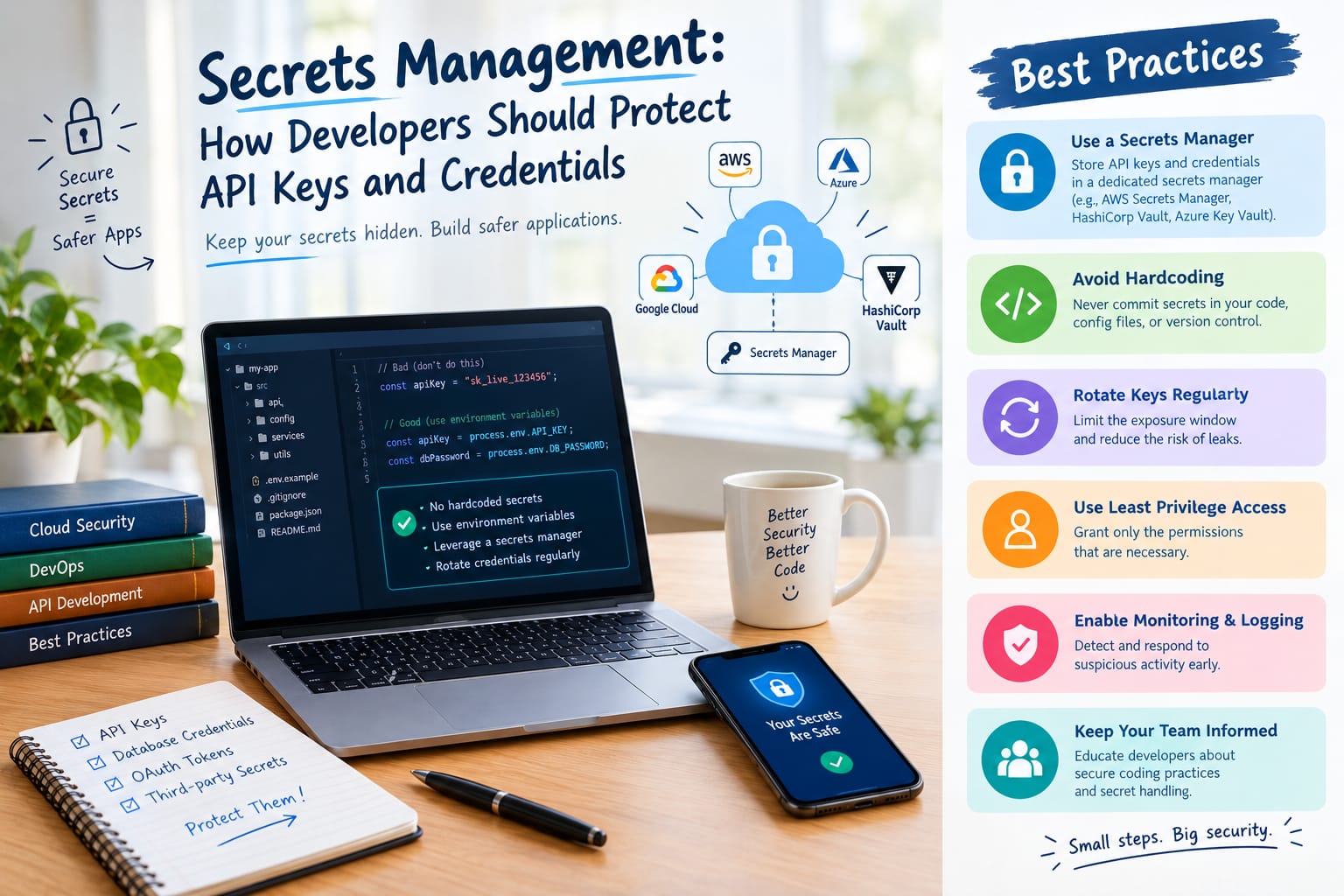
Move secrets out of static files entirely and into a purpose-built store AWS Secrets Manager, Google Secret Manager, Azure Key Vault, or HashiCorp Vault. Your app fetches them at startup using the platform identity it already has (an IAM role, a workload identity), so there's no bootstrap secret to protect .
Now access is audited, secrets can be rotated centrally without a redeploy, and there's no plaintext file to leak.
Choosing a store in 2026:
-
AWS Secrets Manager: Deep integration with RDS, Redshift, and DocumentDB for automatic rotation. Tight IAM control. $0.40 per secret per month plus API calls .
-
Azure Key Vault: Combines secrets, keys, and certificates in one service. Clean integration with Entra ID .
-
GCP Secret Manager: Per-version pricing among the cheapest at high secret volumes .
-
HashiCorp Vault: Dynamic secrets pioneer. Best with Terraform. Creates real database users on the spot and drops them when the lease expires .
-
Infisical: Open-source Vault alternative. Clean web UI, straightforward SDKs, free self-hosted edition .
-
Doppler: Rotation as the whole product. Two credentials alive at once, so the swap never breaks connections .
Rung 3: Runtime Injection and Least Privilege
Prefer injecting secrets at deploy time (mounted as a tmpfs file or fetched at boot) over baking them into an image or a build .
Kubernetes Secrets are base64-encoded, not encrypted. By default, anyone with the right RBAC permissions can read every secret in a namespace. Environment variables exposed via Kubernetes are visible through and captured by logging agents .
The OWASP recommendation is the sidecar pattern: a sidecar container authenticates to the secrets manager, retrieves secrets, and writes them to a shared in-memory volume. The application reads from the volume. The sidecar can periodically refresh, supporting rotation without redeployment .
Scope each credential to exactly what it needs. A service that only reads from one S3 bucket gets a policy for that bucket, not
Rung 4: Zero Standing Credentials
The top rung eliminates long-lived secrets where you can.
OIDC-based cloud access: CI pipelines exchange a short-lived, workflow-scoped OIDC token for temporary cloud credentials instead of storing a static access key. GitHub Actions, GitLab, and the major clouds all support this now .
Trusted publishing to npm: Publish packages via OIDC so there's no long-lived to steal closing the exact vector behind several 2025 npm package compromises .
Dynamic secrets: Instead of storing a database password, the platform generates a short-lived, unique credential for each client or session, then revokes it automatically. If an application is compromised, the attacker inherits a credential that may already be expired by the time they try to use it .
Credentials that expire in minutes can't be exfiltrated and reused weeks later.
Cost Based on Organization Type
Secrets management costs scale with the number of secrets, environments, and compliance requirements.
| Organization Type | Annual Investment (India) | What It Covers |
|---|---|---|
| Startup / Small Team | ₹24,000 – ₹1,20,000 | Cloud-native vault, SSO integration, basic rotation |
| Mid-Market Enterprise | ₹1,20,000 – ₹6,00,000 | Multi-cloud governance, CI/CD integration, audit trails |
| Large Enterprise / Regulated | ₹6,00,000 – ₹25,00,000+ | Dynamic secrets, HSM-backed encryption, compliance reporting |
| Global Enterprise (India Ops) | ₹25,00,000+ | Data residency, cross-cloud identity, dedicated platform team |
Pricing models to understand:
-
AWS Secrets Manager: $0.40 per secret per month plus API call volume
-
GCP Secret Manager: Per-version pricing, among the cheapest at high volume
-
HashiCorp Vault (self-hosted): No licensing fee, but $199,200 to $211,200 in infrastructure, DevOps time, and engineering labor over three years
-
Doppler: Per-seat pricing, free tier for small teams
-
Infisical: Free self-hosted, paid cloud tiers
The hidden cost is rotation paralysis secrets that are recognized as risky but remain untouched because nobody can predict the impact of changing them. The credential is stored, but not governed .
Breakdown by Developer Type (2020-2026)
Secrets management requires specialized skills. The Indian talent market offers both opportunity and risk.
| Developer Type | Hourly Rate (India) | Typical Engagement | What They Deliver |
|---|---|---|---|
| Freelancer | ₹1,000 – ₹3,000 | ₹25,000 – ₹75,000 | Basic vault setup, .env migration |
| Small Security Firm | ₹2,500 – ₹6,000 | ₹1,50,000 – ₹5,00,000 | Cloud-native vault, CI/CD integration, rotation automation |
| Mid-Size Integrator | ₹6,000 – ₹12,000 | ₹5,00,000 – ₹25,00,000 | Multi-cloud governance, dynamic secrets, audit compliance |
| Enterprise Consultancy | ₹12,000 – ₹20,000+ | ₹25,00,000+ | Zero standing credentials, HSM integration, DPDP alignment |
India's structural advantage: Security engineers with secrets management experience bill at 60-80% less than US rates. But the skills are scarce. The critical question before hiring: "Show me a secrets migration you completed in the last 12 months not a design document, a live production environment where hardcoded secrets no longer exist."
Why Prices Changed in 2026
Three forces reshaped secrets management economics.
First, AI credential leaks exploded. Security researchers found over 5,000 public GitHub repositories and 3,000 live production websites actively exposing hardcoded ChatGPT API keys . A major driver is "vibe coding" a speed-over-security culture where the rush to ship generative AI features leads teams to skip standard security protocols. AI tokens are the new master keys. Unlike traditional cloud access keys with narrow scopes, AI tokens are essentially master keys to powerful inference engines and vast computational billing resources . Stolen keys drain billing accounts and exhaust API credits, leading to unpredictable cloud bills.
Second, compliance pressure intensified. The FTC now routinely requires mandatory credential rotation programs and secrets scanning in consent decrees . The SEC brought charges against SolarWinds alleging misrepresentation of secrets management practices to investors extending breach liability into securities law territory .
Third, private repo assumptions collapsed. GitGuardian found private repositories are 6x more likely to contain hardcoded secrets than public ones. Private repos get cloned, forked, accessed by contractors, and occasionally made public .
The result: secrets management is more necessary than ever, and more expensive to ignore.
Pro Tips to Save Money in 2026
1. Rotate first, purge second. If a secret is found in history, rotate it immediately. Do not wait to confirm it was exploited. Assume it was. Revoke the old credential at the provider so the leaked value stops working. Cleaning git history without rotation does not un-leak the secret .
2. Add a pre-commit hook. A secret scanner as a pre-commit hook stops leaks at the source. Tools: Gitleaks, TruffleHog, detect-secrets. GitHub's push protection blocks the commit before it lands. This is the highest-value control because it prevents the leak rather than detecting it after .
3. Use OIDC for CI/CD, not stored tokens. CI pipelines are credential-dense and close to production access. Job logs print environment variables. Workflow files get copied across repositories. Self-hosted runners retain state between jobs . OIDC federation eliminates the long-lived credential entirely.
4. Set cryptoperiods by secret class. Not all secrets warrant the same rotation cadence :
-
CI/deploy tokens: per-job (OIDC) or 30 days max
-
Third-party API keys: 90 days
-
Cloud static keys: 90 days, or eliminate via STS
-
TLS keys: periodically, regardless of patch state
5. Rotate on personnel change, not on a schedule. Leavers lose access within 48 hours, not "soon." The Ledger Connect Kit incident (December 2023, ~$600,000) happened because a former employee who had left months earlier still held npm publish rights. The credential should have been revoked on the day they left .
6. Plant canary tokens. Credentials that have no legitimate use and exist only to fire an alert when touched. A fake AWS key in a tempting location. A honeytoken in a config file. If a canary is ever used, you have an intruder with no false-positive ambiguity .
Questions to Ask Before Hiring
Before you commit budget to any secrets management engagement, ask these questions.
1. "Can you produce an inventory of every secret across every environment code, CI/CD, containers, and runtime?" You cannot secure what you haven't catalogued. If they can't build this inventory, they can't secure your secrets.
2. "What's your approach to rotation paralysis?" Rotation paralysis happens when a secret is recognized as risky but remains untouched because nobody can predict the impact. The right answer involves attribution tracing the secret to a current owner, a specific workload, and a recent access record .
3. "How do you handle secrets in Kubernetes?" Default Kubernetes Secrets are base64-encoded, not encrypted. The right answer involves external secret management (Secrets Store CSI Driver, External Secrets Operator), volume mounts instead of environment variables, and encryption at rest for etcd .
4. "What's your CI/CD secrets strategy?" Pipeline secrets are high-risk because build and deployment systems sit close to production access. The right answer separates deployment-time access from runtime access. The pipeline should not expose the secret value unless the build process truly needs it .
5. "Who owns the secrets management system after implementation?" A consultancy that builds and leaves is not a partner. Ask for retained operations, monitoring, and rotation tuning as part of the engagement.
Why Delhi is a Great Hub for Secrets Management
Delhi-NCR has become a serious destination for secrets management work, and the reason isn't just cost.
The region hosts India's largest cluster of BFSI and FinTech captives 35% of NCR's GCCs constitute the largest cluster of global financial captives in the region. Financial services and fintech are the sectors facing the highest regulatory pressure and the most sophisticated threats. Delhi's secrets management talent pool has been forged in this environment.
India's regulatory landscape is also driving demand. The DPDP Act requires organizations to demonstrate accountability for personal data access. Secrets management provides the audit trails, access controls, and rotation evidence that prove who accessed what, when, and under which policy.
The talent density keeps improving. With a steady pipeline of security engineers, platform specialists, and cloud architects, Delhi offers a combination of cost and capability that's hard to match. And the time zone advantage matters: a Delhi-based team can sync with Middle East morning, European afternoon, and US East Coast evening.
What We Offer
At Innovative AI Solutions, we treat secrets management as an engineering discipline, not a compliance checkbox.
Our approach:
-
Secrets Inventory First. We map every credential across code, CI/CD, containers, and runtime. You cannot secure what you haven't catalogued.
-
Maturity Ladder Assessment. We identify where your team sits on the ladder from hardcoded secrets to zero standing credentials and build a concrete plan to climb one rung at a time.
-
Vault Deployment. Cloud-native or multi-cloud, we deploy the right secrets manager for your architecture and integrate it with your identity system.
-
Rotation Automation. Cryptoperiods by secret class, rotation on personnel change, and canary tokens for detection.
-
Zero Standing Credentials. OIDC-based CI/CD access, dynamic secrets for databases, and elimination of long-lived credentials where possible.
-
Continuous Monitoring. Audit trails, anomaly detection, and incident response playbooks aligned with DPDP requirements.
Our principle is simple: small steps, fast iteration, data speaks.
Frequently Asked Questions
Q: What is secrets management in simple terms?
Secrets management is the practice of securely storing, controlling access to, and managing the lifecycle of digital credentials API keys, database passwords, tokens, and certificates. The goal is to keep secrets out of code, out of version control, and short-lived enough that a leak has a short shelf life .
Q: Why can't I just use environment variables?
Environment variables are the baseline, not the destination. They're readable by anything in the process, appear in crash dumps, and are easy to accidentally log. They also lack rotation, audit trails, and access control. Use them for local development. Use a managed secret store for production .
Q: What's the difference between static and dynamic secrets?
Static secrets are stored and rotated manually a database password that lives for 90 days. Dynamic secrets are generated on the fly for each client or session, then revoked automatically. If an application is compromised, the attacker inherits a credential that may already be expired .
Q: How do I handle secrets in Kubernetes?
Default Kubernetes Secrets are base64-encoded, not encrypted. Use external secret management (Secrets Store CSI Driver, External Secrets Operator), mount secrets as volumes instead of environment variables, enable encryption at rest for etcd, and restrict access with RBAC .
Q: What's the first step I should take tomorrow?
Add a secret scanner as a pre-commit hook. Gitleaks or TruffleHog will stop the next leak at the source. Then inventory every secret you have. Then pick one to migrate to a vault. That's how you start. Not with a strategy document about secrets management transformation.
Frequently Asked Questions (Extended)
Q: What happens if a secret leaks?
The order matters. Rotate first, purge second. Do not wait to confirm it was exploited. Assume it was. Revoke the old credential at the provider so the leaked value stops working. Then remove it from the exposure location git history, logs, container images .
Q: How often should I rotate secrets?
Different secrets warrant different cryptoperiods. CI/deploy tokens: per-job (OIDC) or 30 days max. Third-party API keys: 90 days. Cloud static keys: 90 days, or eliminate via STS. Rotate on personnel change, not on a schedule that happens to be convenient .
Q: Is private repo safer than public repo?
No. GitGuardian found private repositories are 6x more likely to contain hardcoded secrets than public ones. Private repos get cloned, forked, accessed by contractors, and occasionally made public. Treat all repos as potentially exposed .
Contact Us:
Phone: +91 7464 099 059 / +91 9689967356
Email: info@innovativeais.com
Address: 9th Floor, Pearls Best Heights-I, Head Office: 904, Netaji Subhash Place, Delhi, 110034