The Big Question
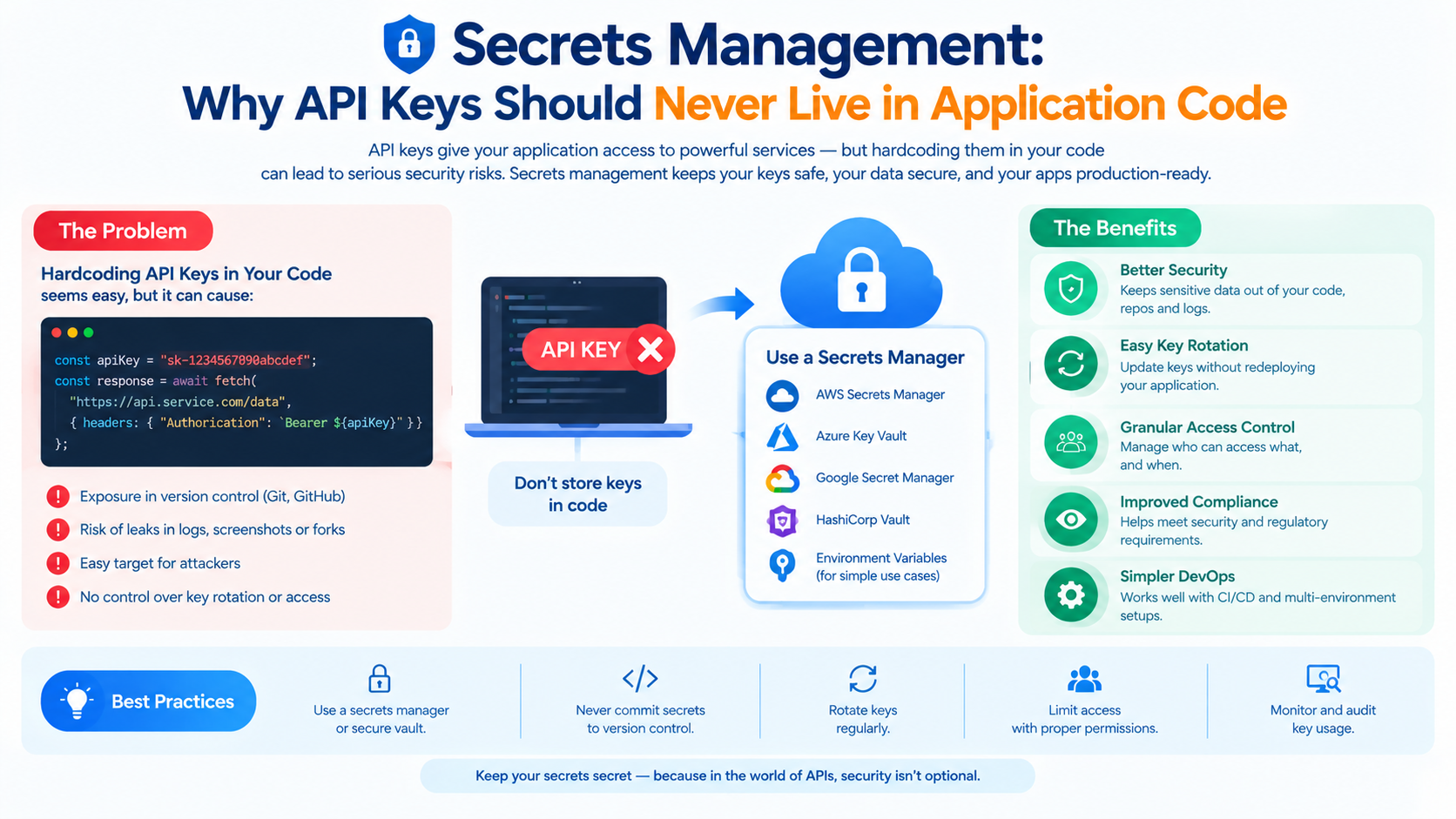
What happens when an API key is committed to a repository, the repository is made public, and the key is scraped within minutes? When a credential appears in a build log, an error message, or a stack trace? When a developer leaves the organization and the credentials they embedded in code are never rotated?
Secrets in code do not stay secret. They spread into version history, build logs, container images, and developer machines and they persist long after the person who added them has moved on.
Why Secrets in Code Fail
Version Control Preserves Them Forever
A secret committed to a repository is not removed by deleting the line. It remains in the commit history, retrievable by anyone with access to the repository. Rewriting history is possible but disruptive, and it does not help if the repository has been cloned.
The consequence: A secret that was exposed for thirty seconds is exposed permanently.
Repositories Are Indexed and Scraped
Public repositories are continuously scanned for credentials. Automated tools find keys within minutes of a commit. Even private repositories are at risk through compromised developer accounts, misconfigured access, or insider threats.
The consequence: Exposure does not require the repository to be public.
Secrets Spread to Other Systems
Once a secret is in code, it flows wherever the code flows: build logs, container images, CI/CD output, local developer environments, and error reporting systems.
The consequence: The secret exists in many places, most of which are not tracked or audited.
Rotation Becomes Impossible
If a secret is embedded in code and deployed across many services, rotating it requires finding every usage, updating it, and redeploying. This is disruptive enough that teams avoid rotation.
The consequence: Secrets remain unchanged for years, increasing the impact of any exposure.
Access Cannot Be Audited
When a secret is a static string in a configuration file, there is no record of who used it, when, or from where.
The consequence: A breach involving that credential cannot be investigated.
Least Privilege Becomes Impossible
A static secret cannot be scoped to a specific workload or time window. It grants whatever permissions it has, to anyone who obtains it.
The consequence: A leaked credential grants the same access as the legitimate service.
The Categories of Secrets
Different secrets have different requirements.
| Secret Type | Examples | Rotation Cadence |
|---|---|---|
| API keys | Third-party service credentials | Regular, on exposure |
| Database credentials | Connection strings, passwords | Regular, on role change |
| Tokens | Access tokens, refresh tokens | Short-lived, automatic |
| Certificates | TLS certificates, client certificates | Before expiry |
| Encryption keys | Data encryption keys | On schedule, on compromise |
| Signing keys | Artifact signing, JWT signing | On schedule, on compromise |
Not all secrets need the same treatment. But all of them need to be out of code.
What Secrets Management Actually Is
Secrets management is the practice of storing, delivering, rotating, and auditing credentials through a dedicated system rather than embedding them in code or configuration.
What it provides:
-
Central storage. Secrets live in a dedicated system, not in code or files.
-
Access control. Only authorized workloads can retrieve specific secrets.
-
Runtime delivery. Secrets are injected at runtime, not baked into artifacts.
-
Automatic rotation. Secrets are rotated on a schedule without manual intervention.
-
Audit. Every access to a secret is logged.
-
Revocation. Compromised secrets can be revoked immediately.
The Patterns
The Anti-Pattern: Secrets in Code
API_KEY = "sk-abc123..."
Why it fails: It is in version control, in build logs, in container images, and in every developer's local environment. It cannot be rotated without a deployment. It cannot be audited. It grants the same access to anyone who finds it.
The Anti-Pattern: Secrets in Environment Variables
Environment variables are better than code but still problematic.
Why it fails: They are visible in process listings, in container inspection, in crash dumps, and in CI/CD logs. They are static and shared across all instances of a service.
The Pattern: Secrets Manager with Runtime Retrieval
Secrets are stored in a dedicated system and retrieved by the application at runtime.
How it works: The application authenticates to the secrets manager, retrieves the secret, and uses it. The secret is never written to disk or logged.
Examples: HashiCorp Vault, AWS Secrets Manager, Azure Key Vault, Google Secret Manager.
The Pattern: Dynamic Secrets
Rather than storing a static credential, the secrets manager generates a unique credential on demand, with a limited lifetime.
How it works: The application requests a database credential. The secrets manager creates a new database user with a short expiry, returns the credential, and revokes it when the lease expires.
The benefit: There is no static credential to steal. Each workload gets its own credential with its own lifecycle.
The Pattern: Workload Identity
The application proves its identity to the secrets manager without a static credential.
How it works: The workload presents a platform-issued identity a Kubernetes service account token, an instance profile, or a SPIFFE identity and the secrets manager verifies it and issues the secret.
The benefit: There is no bootstrap secret. The identity itself is the credential.
The Pattern: Short-Lived Credentials
Credentials are issued with short lifetimes minutes or hours, not months or years.
The benefit: Exposure has a limited window. Rotation becomes automatic because the credential expires.
What to Do About Secrets Already in Code
Organizations that have not practiced secrets management will find secrets in code. The response matters.
The steps:
-
Scan for secrets. Use secret scanning tools across repositories, history, and build artifacts.
-
Rotate everything found. Assume any secret that was in code is compromised.
-
Remove from code. Replace with runtime retrieval.
-
Clean history where necessary. Rewrite history for secrets that remain sensitive.
-
Prevent recurrence. Add secret scanning to pre-commit hooks and CI.
The critical point: Rotation is not optional. Finding a secret in code means assuming it has been exposed.
Prevention
Pre-Commit Scanning
Scan for secrets before they are committed.
Tools: Gitleaks, TruffleHog, detect-secrets.
The benefit: Prevents secrets from entering version history.
CI/CD Scanning
Scan for secrets in build pipelines and artifacts.
The benefit: Catches secrets that were not caught at commit.
Repository Scanning
Continuously scan repositories for secrets, including history.
The benefit: Detects secrets that were committed before scanning was in place.
Secret Scanning in Code Review
Require reviewers to flag potential secrets.
The benefit: Human judgment catches things automated tools miss.
Education
Developers should understand why secrets in code fail.
The benefit: Prevention is cheaper than remediation.
The Rotation Problem
Rotation is the hardest part of secrets management.
Why rotation is difficult:
-
Secrets are often shared across services
-
Rotation requires coordination
-
Rotation may require downtime
-
Rotation is forgotten until a breach occurs
What makes rotation easier:
-
Dynamic secrets. Credentials are generated on demand and expire automatically.
-
Short-lived credentials. Expiry is the rotation mechanism.
-
Automated rotation. The system rotates secrets without human intervention.
-
Graceful rollover. Both old and new secrets work during a transition window.
Implementation Roadmap
Phase 1: Discover (Weeks 1-4)
-
Scan all repositories for secrets, including history.
-
Inventory secrets across systems which secrets exist, where they are used, who owns them.
-
Prioritize by sensitivity and exposure.
-
Rotate all exposed secrets.
Phase 2: Centralize (Weeks 5-8)
-
Deploy a secrets manager.
-
Migrate secrets from code and configuration to the manager.
-
Implement runtime retrieval in applications.
-
Implement workload identity where supported.
Phase 3: Automate (Weeks 9-12+)
-
Implement dynamic secrets for databases and services that support them.
-
Implement automatic rotation for static secrets.
-
Add secret scanning to pre-commit, CI, and repository monitoring.
-
Audit access and review regularly.
Frequently Asked Questions
Q1: Why are secrets in code so dangerous?
They persist in version history, spread to build logs and artifacts, cannot be rotated easily, cannot be audited, and grant the same access to anyone who finds them.
Q2: Are environment variables safe?
Safer than code, but still problematic. They are visible in process listings, container inspection, and crash dumps. They are static and shared across instances.
Q3: What is a secrets manager?
A dedicated system for storing, delivering, rotating, and auditing credentials. Examples include HashiCorp Vault, AWS Secrets Manager, Azure Key Vault, and Google Secret Manager.
Q4: What are dynamic secrets?
Credentials generated on demand with short lifetimes, rather than static credentials stored in advance. There is no static credential to steal.
Q5: What should I do if I find a secret in code?
Rotate it immediately. Assume it has been compromised. Then remove it from code and replace it with runtime retrieval.
Q6: How can Innovative AI Solutions help?
We help organizations implement secrets management from discovery and centralization to dynamic secrets, workload identity, and rotation automation. Explore our services to see how we approach DevSecOps. Based in Delhi, serving clients across India.
Why Delhi is a Great Hub for DevSecOps Engineering
Delhi is emerging as a hub for security and platform engineering, backed by a thriving IT services ecosystem and growing regulatory focus on data protection under the DPDP Act. As Indian enterprises modernize their delivery pipelines, moving secrets out of code becomes a foundational security requirement.
What We Offer at Innovative AI Solutions
-
Secret Discovery: We scan repositories, history, and artifacts for exposed credentials.
-
Secrets Manager Deployment: We implement centralized secret storage and delivery.
-
Runtime Retrieval: We integrate applications with the secrets manager.
-
Dynamic Secrets: We implement on-demand credentials for databases and services.
-
Rotation Automation: We automate rotation and graceful rollover.
-
Prevention: We add secret scanning to pre-commit, CI, and monitoring.
Final Thought
The shift is clear: from secrets embedded in code to secrets delivered at runtime. API keys in application code are a permanent liability they persist, spread, and cannot be rotated without disruption. Organizations that centralize secrets, deliver them at runtime, and rotate them automatically will reduce exposure and respond faster when something leaks. Those that continue embedding credentials in code will keep discovering that the secret was never secret at all.
Contact Us:
Phone: +91 7464 099 059 / +91 9689967356
Email: info@innovativeais.com
Address: 904, 9th floor Pearls Best Heights-I, Netaji Subhash Place, Delhi-110034
Website: https://innovativeais.com
About the Author
Abhishek Kumar
Founder & CEO, Innovative AI Solutions
5+ years building AI, cloud, and enterprise systems. Based in Delhi, serving clients across India.