The Big Question
What if your software shipped with secure defaults, minimal attack surfaces, and vulnerabilities fixed before they could be exploited? What if security wasn't a blocker at the end of development, but a natural part of every design decision? And what if regulators started holding vendors accountable for the security of their code?
The shift to Secure-by-Design is already happening. Frameworks like NIST's Secure Software Development Framework (SSDF) and CISA's Secure by Design initiative are setting new expectations for how software should be built . This guide breaks down what Secure-by-Design means, why it matters now, and how your team can adopt it.
What Is Secure-by-Design?
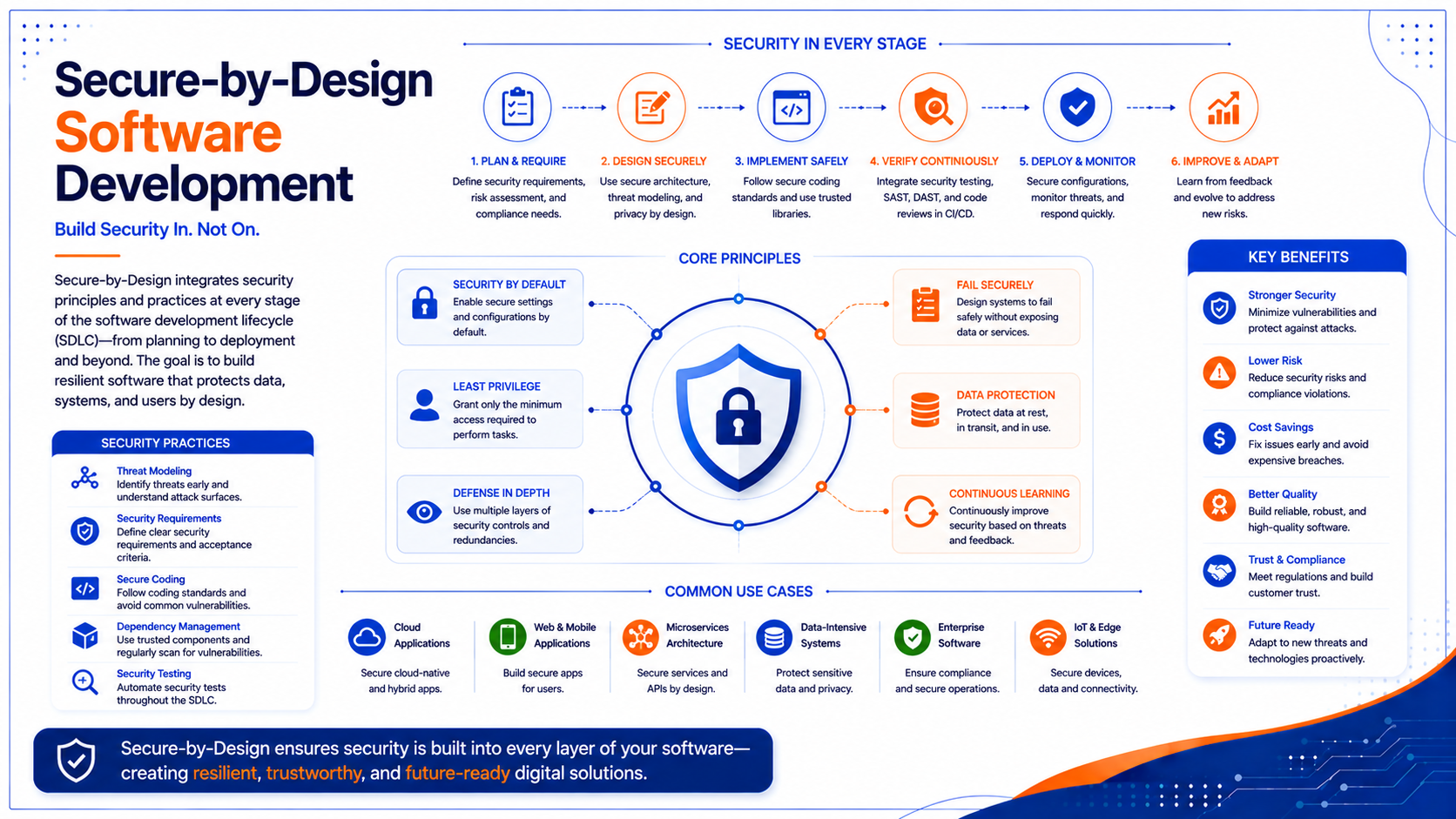
Secure-by-Design is an approach where security is integrated into every phase of the software development lifecycle, from initial architecture and design through coding, testing, deployment, and maintenance . The core idea is straightforward: if you build something securely from the ground up, your users are protected by default, rather than only when they know how to flip the right settings or when security gaps are fixed after the fact .
Secure-by-Design vs. Secure-by-Default
These two concepts are complementary, not interchangeable .
| Concept | What It Means | Analogy |
|---|---|---|
| Secure-by-Design | Security is baked into the architecture from the start | Engineers design crumple zones and airbag placement into a car's frame during the design phase |
| Secure-by-Default | Products ship with the safest configuration enabled out of the box | The car's airbags are active by default you don't need to turn them on |
Secure-by-Design creates the foundation; Secure-by-Default ensures that foundation is actually protecting users .
Why Secure-by-Design Matters Now
For decades, the technology industry operated under a "ship fast, patch later" model. The consequences are playing out in real time: constant vulnerability disclosures, rushed emergency patches, and breaches that drain billions from organizations while exposing the personal data of hundreds of millions of people .
The Regulatory Shift
The regulatory environment is changing rapidly:
-
CISA's Secure by Design Initiative (2023) urges technology vendors to prioritize customer security and reduce exploitable flaws at the source .
-
NIST SSDF (SP 800-218) is now required for software sold to U.S. federal agencies. Vendors must provide self-attestation of compliance .
-
EU Cyber Resilience Act will impose mandatory security requirements on products with digital elements sold in Europe .
These regulations reflect a fundamental shift: the burden of security is moving from end users to the vendors who build technology products .
The Cost of Reactive Security
The consequences of ignoring Secure-by-Design are well-documented:
| Consequence | Impact |
|---|---|
| Escalating Breach Costs | Fixing vulnerabilities post-release is exponentially more expensive than addressing them during development |
| Erosion of Trust | Repeated security incidents cause reputation damage that can outlast technical remediation by years |
| Regulatory Exposure | Non-compliance with frameworks like the EU Cyber Resilience Act carries significant penalties |
The NIST SSDF: The Framework You Need to Know
The NIST Secure Software Development Framework (SSDF) is the foundational reference for Secure-by-Design. Published as NIST Special Publication 800-218, it defines four practice groups spanning 19 practices and roughly 42 underlying tasks :
| Group | Focus |
|---|---|
| Prepare the Organization (PO) | Establish organizational processes and secure development infrastructure |
| Protect the Software (PS) | Protect all components of the software from tampering and unauthorized access |
| Produce Well-Secured Software (PW) | Build software with security built in from the start |
| Respond to Vulnerabilities (RV) | Identify, analyze, and fix vulnerabilities in released software |
For software vendors selling to the U.S. government, SSDF compliance is now mandatory. Attestation requires certification that specific practices including separate build environments, provenance data for each release, SBOM generation, and post-release vulnerability monitoring are followed .
The Six Secure-by-Design Considerations
The CIS and SAFECode joint guide breaks Secure-by-Design into six essential areas for developers :
1. Secure Software Design
Start with clear security objectives and a threat model. Threat modeling isn't optional—it's your blueprint for resilience and needs to be maintained as the software and its use change .
2. Secure Development
Coding, testing, deployment, and maintenance are where most vulnerabilities emerge. Align your practices with the SSDF and tailor them to your tools, languages, and platforms. Whether you're working in containers, mobile apps, or embedded systems, the principles remain: validate inputs, manage secrets, and automate security checks .
3. Secure Default Configuration
Most users stick with default settings, so make them secure. Disable unnecessary features, restrict access, and minimize the attack surface. If 80% of users don't need a feature, it should be off by default .
4. Supply Chain Security
Third-party code is everywhere, and it's a risk. Vet, monitor, and manage the components you didn't write. Use contracts, audits, and internal reviews. Generate Software Bill of Materials (SBOM) documents for every release .
5. Code Integrity
Security isn't just about writing good code it's about ensuring the code you ship is the code you intended. Use version control, code signing, and change tracking to prevent tampering. Configure your development environment with least privilege and zero trust principles .
6. Vulnerability Remediation
No software is perfect. Accept vulnerability reports, investigate them, and fix the issues. Use root cause analysis to improve your tools, training, and threat models. If you rely on external tools, give feedback to help them evolve .
The Microsoft Security Development Lifecycle (SDL)
Microsoft's SDL has evolved over 20 years and provides a proven model for integrating security into development . The 10 key security practices are :
| Practice | What It Means |
|---|---|
| Establish Security Standards | Define clear security requirements and measure compliance |
| Require Proven Security Features | Mandate approved libraries and frameworks; enforce through pipeline guardrails |
| Perform Security Design Review | Require threat modeling during design using STRIDE methodology |
| Define Cryptography Standards | Establish standards for encryption, key lengths, and management |
| Secure the Software Supply Chain | Verify provenance; generate SBOMs; scan dependencies |
| Secure the Engineering Environment | Protect workstations, build agents, and repositories like production systems |
| Perform Security Testing | Integrate SAST and DAST into CI/CD pipelines |
| Ensure Operational Platform Security | Apply security baselines and least privilege to runtime environments |
| Implement Security Monitoring | Enable comprehensive logging and SIEM integration |
| Provide Security Training | Require formal secure coding training; establish Security Champions program |
Secure Coding Practices: What Developers Actually Need to Do
The OWASP secure coding practices distill secure development into a practical checklist for real-world code review :
Input Validation
Validate all input on the server side, not just the client. Use allowlists rather than blocklists. Validate type, length, format, and range not just "is this field present" .
Authentication & Session Management
Store passwords with slow, salted hashing algorithms (bcrypt, scrypt, or Argon2 never unsalted SHA-256). Enforce account lockout or rate limiting on login attempts. Invalidate sessions on logout, password change, and after idle timeout. Session tokens should be long, random, and transmitted only over encrypted connections .
Access Control
Deny by default require explicit grants. Enforce access control on every request server-side. Check authorization for every resource access, not just authentication .
Error Handling & Logging
Return generic error messages to users ("invalid username or password" rather than "no user found with that email"). Log detailed versions server-side for debugging. Never log passwords, tokens, or full credit card numbers .
Database & File Access
Use parameterized queries for every database call with no exceptions. For file access, validate that a requested path resolves inside an expected directory before opening it. Apply least privilege to database connections .
AI-Generated Code: A New Security Frontier
As teams increasingly accept suggestions from coding assistants or generate code directly from prompts, secure coding becomes even more important. AI-generated code should be treated like any other untrusted external input: useful, but requiring validation, review, and testing before it is trusted in production .
Key Risks with AI-Generated Code:
-
Lack of Review: Developers may accept AI-generated code without fully analyzing it, increasing the chance that insecure patterns are committed
-
Lack of Contextual Awareness: AI tools may not understand specific business logic or security requirements
-
Delayed Detection: Insecure code committed without proper testing may only be discovered later in the lifecycle
Best Practices for Securing AI-Generated Code:
-
Enable real-time IDE scanning for AI code to catch flaws as they're written
-
Use AI-enhanced SAST for context-aware vulnerability detection
-
Implement strong AI governance policies defining which tools are approved and how outputs must be reviewed
-
Augment AI assistants with application security tooling like SAST, SCA, and secrets scanning
-
Apply AI-guided remediation to help developers fix vulnerabilities faster, but always validate suggested fixes
Implementation Roadmap
Phase 1: Foundation (Weeks 1-4)
-
Establish security standards : define clear security requirements and governance structures
-
Provide formal secure coding training : make it mandatory for all developers
-
Set up security champions : designate trained facilitators in each development team
-
Select security tools : choose SAST, DAST, SCA, and secrets scanning tools
Phase 2: Embed in Workflows (Weeks 5-8)
-
Integrate security into CI/CD pipelines : SAST and DAST scans should run on every commit
-
Implement threat modeling : require STRIDE-based threat modeling during design
-
Set up supply chain security : generate SBOMs and continuously scan dependencies
-
Enable real-time IDE scanning : catch vulnerabilities as developers write code
Phase 3: Governance and Continuous Improvement (Weeks 9-12+)
-
Implement monitoring and logging : forward security events to centralized SIEM
-
Establish vulnerability remediation process : accept reports, investigate, fix, and perform root cause analysis
-
Adopt SSDF attestation : align with federal or regulatory requirements
-
Continuous improvement : security is a continuous process, not a one-time assessment
Frequently Asked Questions
Q1: What's the difference between Secure-by-Design and Secure-by-Default?
Secure-by-Design means security is integrated into the architecture from the start. Secure-by-Default means products ship with the safest configuration enabled out of the box. They are complementary: design creates the foundation, defaults ensure it's actually protecting users .
Q2: What is the NIST SSDF?
The NIST Secure Software Development Framework (SP 800-218) is a catalog of secure development practices. It's organized into four groups Prepare the Organization, Protect the Software, Produce Well-Secured Software, and Respond to Vulnerabilities and is now required for software sold to U.S. federal agencies .
Q3: How do I secure AI-generated code?
Treat AI-generated code like untrusted external input: validate, review, and test it before production. Use real-time IDE scanning, AI-enhanced SAST, strong governance policies, and dedicated application security tools to catch vulnerabilities .
Q4: What are the most important secure coding practices?
Key practices include server-side input validation, parameterized queries for database access, using slow hashing algorithms (bcrypt/Argon2) for passwords, enforcing access control on every request, and returning generic error messages to users .
Q5: How can Innovative AI Solutions help?
We help organizations design, build, and operationalize Secure-by-Design programs from threat modeling and secure coding training to SSDF alignment and CI/CD security integration. Based in Delhi, serving clients across India.
Why Delhi is a Great Hub for Secure Software Innovation
Delhi is emerging as a hub for software engineering and cybersecurity innovation, backed by a thriving IT services ecosystem and growing focus on regulatory compliance in sectors like BFSI, government, and healthcare. As Indian software vendors increasingly serve global markets, adopting Secure-by-Design frameworks is becoming a competitive necessity particularly for organizations selling to U.S. federal agencies or European enterprises.
What We Offer at Innovative AI Solutions
-
Secure-by-Design Strategy: We help you align your development practices with NIST SSDF, CISA Secure by Design, and EU Cyber Resilience Act requirements.
-
Threat Modeling: We help you implement STRIDE-based threat modeling and security design reviews.
-
CI/CD Security Integration: We help you embed SAST, DAST, SCA, and secrets scanning into your pipelines.
-
AI Code Security: We help you establish governance for AI-generated code and implement real-time scanning.
-
Training: We provide secure coding training and Security Champions programs.
Final Thought
The shift is clear: from reactive patching to proactive design, from blaming users to taking vendor responsibility. Secure-by-Design is no longer optional it's a regulatory requirement, a business imperative, and a developer responsibility. The organizations that embrace this shift will build software that's secure by design, not just by accident .
Contact Us:
Phone: +91 7464 099 059 / +91 9689967356
Email: info@innovativeais.com
Address: Netaji Subhash Place, Pitampura, Delhi – 110034
Website: https://innovativeais.com
About the Author
Abhishek Kumar
Founder & CEO, Innovative AI Solutions
5+ years building AI, cloud, and enterprise systems. Based in Delhi, serving clients across India.
Related services: to apply this in your business, explore our custom software development and AI development services.