The Big Question
What happens when a single smart thermostat in an office building becomes the entry point for a ransomware attack that shuts down the entire corporate network? When a compromised medical sensor feeds false data to a hospital's monitoring system? When a vulnerability in a consumer smart device exposes millions of private user streams?
The Internet of Things has woven itself into the fabric of modern life, from smart home assistants and wearable health monitors to the industrial sensors that power global supply chains. This interconnection, however, presents a staggering security challenge. The foundational principle of modern IoT security is simple but transformative: trust nothing, verify everything.
The Attack Surface: Understanding the Layers
To build a robust defense, we must understand the multiple layers at which a device can be compromised. Security is a multi-faceted discipline that requires a holistic approach.
The Device Itself (Hardware & Firmware)
At the most fundamental level, every device must have a secure identity. A strong hardware root of trust creates an immutable foundation for device identity and security.
| Security Layer | Best Practice |
|---|---|
| Secure Boot | Ensures the device only starts up with cryptographically authenticated and trusted firmware |
| Hardware Security | Incorporates a hardware root of trust to protect cryptographic keys and isolate sensitive operations |
| Firmware Integrity | Signs firmware updates to guarantee authenticity and prevent tampering |
If the system cannot reliably verify which device is connecting, it cannot be trusted. Devices without a secure identity are easy to impersonate, allowing attackers to inject malicious data or commands into the system.
Data and Communication
A staggering 98% of IoT device traffic is unencrypted, leaving the majority of data transmission vulnerable to interception and manipulation. Eavesdropping and man-in-the-middle attacks are primary vectors for data theft.
| Security Layer | Best Practice |
|---|---|
| Protecting Data in Transit | Enforce end-to-end encryption for all data in transit (e.g., using modern TLS 1.3) |
| Protecting Data at Rest | Encrypt all data stored on the device to prevent extraction of sensitive information |
| Data Integrity & Authentication | Use digital signatures to verify data authenticity and ensure it hasn't been tampered with |
Network and Access
A compromised device should not have a pathway to critical systems. Network micro-segmentation is essential to contain breaches.
| Security Layer | Best Practice |
|---|---|
| Network Segregation | Keep IoT devices on separate, isolated network segments to prevent lateral movement |
| Identity and Access Management | Implement strong, certificate-based authentication and enforce least-privilege access |
| Continuous Monitoring | Actively monitor device behavior for anomalies that could indicate compromise |
Common Attacks and Persistent Failures
The Mistakes That Keep Happening
Despite the availability of robust security technology, pervasive mistakes leave devices vulnerable. These failures fall into three categories:
-
Failure to implement basic functions
-
Operational process mistakes
-
Errors in system configuration
One of the most common and dangerous is the use of hard-coded credentials or shared encryption keys, leaving entire device fleets vulnerable to a single point of failure. Attacks on edge devices have risen by 50%, driven by vulnerabilities in common products like smart TVs and alarm systems.
The Consequences of Failure
A single compromised device can serve as a launchpad for lateral movement across an entire network, shifting from a vulnerable IoT device to a mission-critical company server. In industrial environments, this can mean the difference between operational continuity and catastrophic shutdown.
In 2026, IoT security failure is not about losing data—it's about losing operational control.
Industry Response: Emerging Solutions
AI-Powered Threat Detection
Advanced machine learning models are being developed to detect cyber threats with up to 99.89% accuracy, enabling proactive defense. These systems analyze device behavior patterns and identify anomalies that would be invisible to rule-based detection.
Dynamic Vulnerability Prioritization
New frameworks are shifting vulnerability prioritization from static severity scores to a dynamic assessment of active exploitation likelihood. This ensures that critical patches are deployed to the most urgent threats first, rather than wasting resources on low-risk vulnerabilities.
Secure Over-The-Air Updates
Perhaps the most persistent challenge is the device lifecycle. Devices can remain in the field for years, making robust update mechanisms non-negotiable. Without reliable, secure Over-The-Air (OTA) updates, devices cannot be secured against newly discovered vulnerabilities.
The Lifecycle Challenge
From Deployment to Decommission
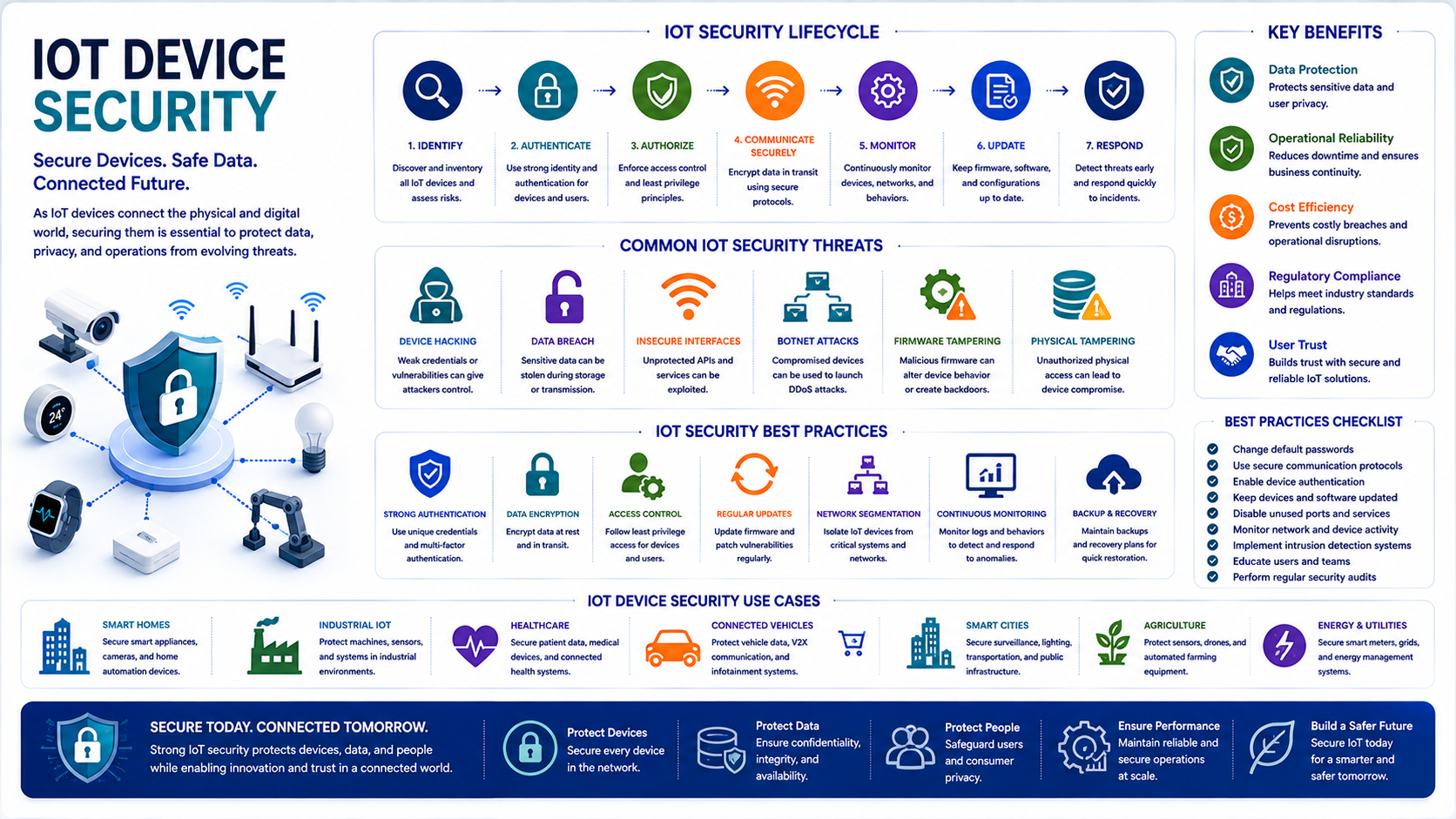
A device's security is not a one-time state; it's a continuous process:
| Stage | Security Requirement |
|---|---|
| Provisioning | Secure identity injection and initial configuration |
| Operation | Continuous monitoring, credential rotation, and anomaly detection |
| Maintenance | Regular OTA updates and vulnerability patching |
| Decommissioning | Secure data wiping and key revocation |
Fleet Management at Scale
The heterogeneity of devices, limited computational resources, and a lack of standardized update protocols make vulnerability management a significant challenge. Organizations must adopt centralized fleet management for monitoring, credential rotation, and automated incident response.
Implementation Roadmap
Phase 1: Foundation
-
Design for security: Conduct threat modeling at the architecture phase. Identify assets, security needs, and possible threats to minimize the attack surface.
-
Embed a root of trust: Select chips that provide a hardware-based root of trust to anchor device identity and secure boot.
-
Adopt a zero-trust model: Assume every connection, data packet, and firmware interaction is potentially hostile.
Phase 2: Build
-
Protect all data: Ensure encryption is applied to all data at rest and in transit. Use strong, industry-accepted cryptographic techniques.
-
Implement secure boot: Ensure the device only starts with authenticated firmware, preventing malicious code from running.
-
Enforce least privilege: Implement strong, certificate-based authentication and credentials that can be renewed.
Phase 3: Sustain
-
Enable robust OTA updates: Implement a scalable, secure update architecture to patch vulnerabilities throughout the device lifecycle.
-
Automate fleet management: Adopt centralized fleet management for monitoring, credential rotation, and automated incident response.
-
Prioritize vulnerability management: Shift your focus to prioritizing and patching vulnerabilities based on real-world exploit activity, not just severity scores.
Frequently Asked Questions
Q1: What is the most common IoT security failure?
The use of hard-coded credentials or shared encryption keys is one of the most common and dangerous failures. It leaves entire device fleets vulnerable to a single point of compromise.
Q2: How much IoT traffic is unencrypted?
A staggering 98% of IoT device traffic is unencrypted, leaving the majority of data transmission vulnerable to interception and manipulation.
Q3: What is a hardware root of trust?
A hardware root of trust is an immutable cryptographic foundation embedded in the device hardware. It anchors device identity, secure boot, and cryptographic operations, ensuring that the device cannot be impersonated or compromised at the hardware level.
Q4: Can IoT devices be secured through software alone?
No. Software-only solutions are insufficient. Security must be architected into the hardware and firmware layers from the outset, with capabilities like secure boot, hardware root of trust, and encrypted storage.
Q5: How can Innovative AI Solutions help?
We help organizations design, build, and operationalize secure IoT deployments from threat modeling and hardware selection to fleet management and continuous monitoring. Based in Delhi, serving clients across India.
Final Thought
The future of IoT depends on a paradigm shift in how we approach its security. Security cannot remain a consideration added after a product is designed; it must be a foundational principle that guides architecture, device selection, and operational strategy. By applying a zero-trust mindset, implementing robust, multi-layered security, and embracing continuous improvement through secure updates, organizations can build IoT fleets that are resilient, trustworthy, and capable of delivering on the immense promise of a connected world.
Contact Us:
Phone: +91 7464 099 059 / +91 9689967356
Email: info@innovativeais.com
Address: Netaji Subhash Place, Pitampura, Delhi – 110034
Website: https://innovativeais.com
About the Author
Abhishek Kumar
Founder & CEO, Innovative AI Solutions
5+ years building AI, IoT, and enterprise systems. Based in Delhi, serving clients across India.
Related services: to apply this in your business, explore our AI development services and machine learning and predictive analytics.