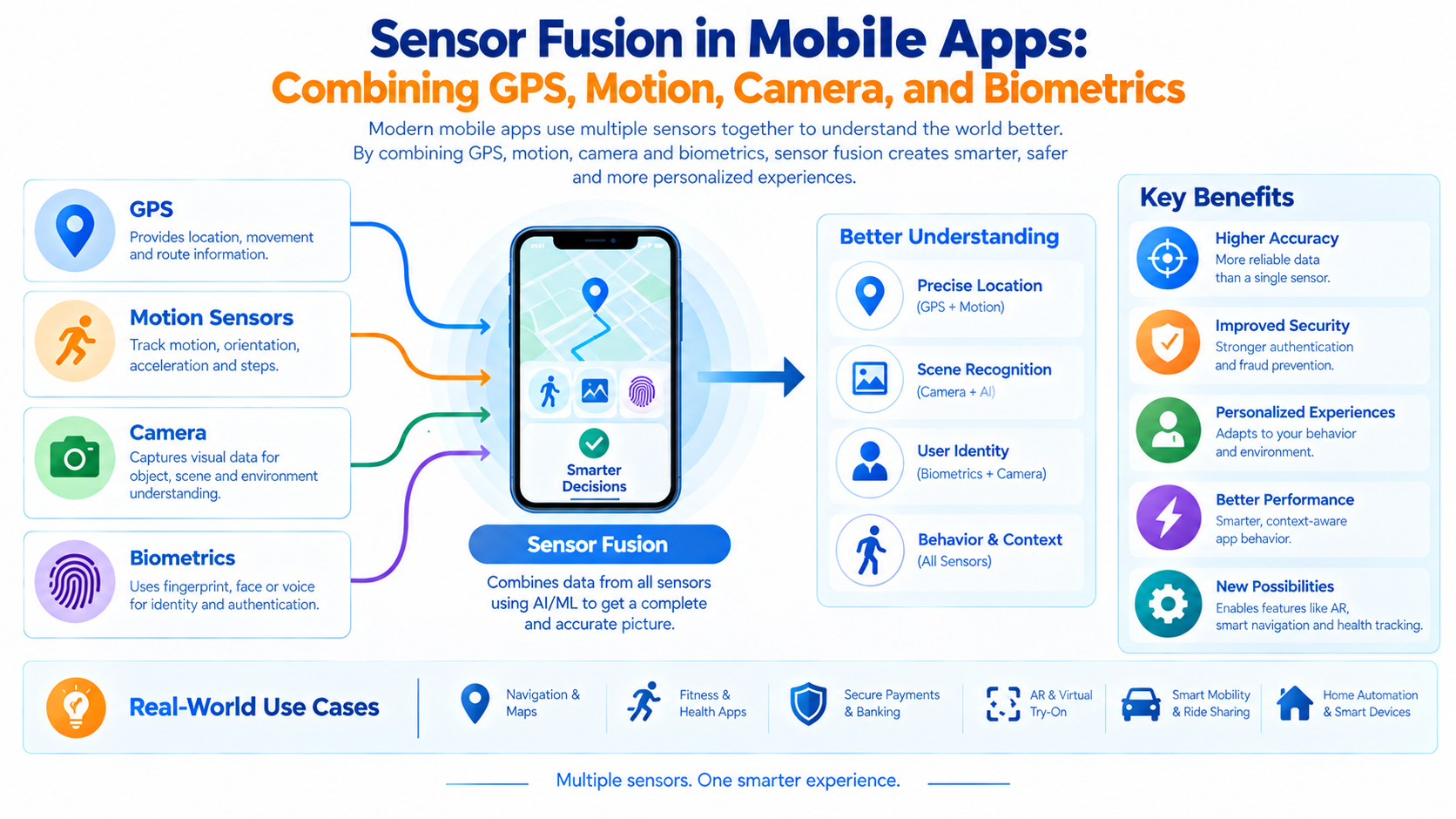
The Big Question
What happens when your app needs to know where a user is, what they are doing, and who they are reliably but each sensor alone is noisy, intermittent, or spoofable? When GPS fails indoors, the accelerometer drifts over time, and a photograph can be held up to a camera?
Sensor fusion is the practice of combining signals from multiple sensors to produce an estimate that is more accurate and more robust than any single source. It is the reason your phone knows which way you are facing even when GPS is unavailable, and the reason step counters work despite constant motion noise.
Why Single Sensors Fail
Every mobile sensor has characteristic failure modes.
| Sensor | Strengths | Failure Modes |
|---|---|---|
| GPS | Absolute position | Poor indoors, urban canyons, tunnels; slow to acquire; spoofable |
| Accelerometer | Motion, orientation | Drift over time; noisy; sensitive to handling |
| Gyroscope | Rotation rate | Drift; integration error accumulates |
| Magnetometer | Absolute heading | Interference from metal and electronics |
| Barometer | Altitude change | Weather-dependent absolute value |
| Camera | Rich visual context | Poor in low light; privacy-sensitive; power-hungry |
| Biometrics | User identity | Spoofable in isolation; affected by environmental conditions |
Individually, each is useful but unreliable. Combined, their weaknesses partially cancel.
The Core Principle of Sensor Fusion
Sensor fusion works because different sensors fail in different ways.
GPS gives absolute position but updates slowly and fails indoors.
Accelerometer and gyroscope give fast, continuous motion data but drift over time.
Magnetometer gives absolute heading but is affected by local interference.
Camera gives rich context but is expensive and privacy-sensitive.
Combining them allows a system to use one sensor's strength to compensate for another's weakness. GPS corrects the drift of inertial sensors; inertial sensors fill the gaps between GPS updates; the magnetometer corrects heading drift; the camera provides context when the others are ambiguous.
The Common Fusion Patterns
Dead Reckoning with GPS Correction
Inertial sensors (accelerometer, gyroscope) track movement continuously. GPS periodically corrects the accumulated error.
How it works: Between GPS updates, the system estimates position by integrating motion. When GPS becomes available, it corrects the estimate.
Where it is used: Navigation apps, fitness tracking, vehicle telematics.
The benefit: Continuous position tracking even when GPS signal is lost in tunnels, urban canyons, and indoors.
Inertial Navigation with Map Matching
Motion data is combined with map data to snap the estimated position to the road or path network.
How it works: Raw position estimates are constrained by the known geometry of roads and paths.
Where it is used: Turn-by-turn navigation, ride-hailing, logistics tracking.
The benefit: More accurate position on roads and paths than raw GPS alone.
Activity Recognition with Multi-Sensor Inputs
Accelerometer, gyroscope, and sometimes barometer and GPS are combined to classify what the user is doing.
How it works: Machine learning models trained on labeled sensor data classify activity states walking, running, driving, cycling, stationary.
Where it is used: Fitness apps, insurance telematics, health monitoring.
The benefit: Reliable activity classification despite noise and individual variation.
Biometric Fusion
Multiple biometric signals face, fingerprint, behavioral patterns are combined for identity verification.
How it works: Each biometric produces a confidence score. Combined, they produce a stronger verification decision.
Where it is used: Banking apps, access control, high-value transactions.
The benefit: Higher security than any single biometric, with graceful degradation when one modality is unavailable.
Visual-Inertial Odometry
Camera and inertial sensors are combined to estimate motion and position.
How it works: The camera tracks visual features; inertial sensors track motion. The two are fused to estimate movement.
Where it is used: Augmented reality, indoor navigation, robotics.
The benefit: Accurate motion tracking without GPS, using only a camera and inertial sensors.
How Fusion Is Implemented
The Estimation Framework
Most fusion systems use probabilistic estimation typically a Kalman filter or a particle filter.
The Kalman filter maintains an estimate of the state (position, velocity, orientation) and updates it as new measurements arrive. Each measurement is weighted by its uncertainty.
The particle filter represents the state as a distribution of particles, which is useful when the system is non-linear or multi-modal.
In practice: Mobile platforms provide fused sensor outputs directly the platform handles the estimation, and the app consumes the result.
Platform-Provided Fusion
Both iOS and Android provide fused sensor APIs.
iOS: CoreMotion provides device motion (fused accelerometer, gyroscope, magnetometer) and activity classification.
Android: Sensor fusion is provided through the sensor framework and Google Play Services APIs, including activity recognition and fused location.
The practical implication: Most apps should use platform-provided fusion rather than implementing their own. The platform has access to sensor calibration and tuning that apps do not.
When to Implement Custom Fusion
Custom fusion is warranted when the platform's fusion does not match your use case.
Examples:
-
Domain-specific activity classification (e.g., detecting specific industrial motions)
-
Multi-device fusion (combining sensors from a phone and a wearable)
-
Fusion with external sensors (beacons, vehicle CAN bus, IoT devices)
-
Fusion requiring domain-specific models
The cost: Custom fusion requires signal processing expertise, calibration, and extensive testing.
The Constraints
Power Consumption
Continuous sensor use drains battery. Camera and GPS are particularly expensive.
The practice: Fuse opportunistically use cheap sensors continuously and expensive sensors sparingly. Defer camera use until it is needed.
Latency
Fusion introduces latency because multiple sensors must be sampled and combined.
The practice: Choose fusion approaches appropriate to your latency requirements. High-frequency motion tracking needs low-latency fusion; activity classification can tolerate more.
Accuracy and Calibration
Fusion accuracy depends on calibration. Devices vary, and calibration drifts.
The practice: Use platform calibration where possible. For custom fusion, implement calibration routines and validate accuracy across device types.
Privacy
Combining sensors produces a richer picture of the user than any single sensor.
The practice: Apply purpose limitation. Collect only what the fusion requires. Process locally where possible. Disclose and obtain consent where required.
Spoofability
Fusion improves reliability but does not make signals unforgeable. GPS can be spoofed; biometrics can be presented with synthetic inputs.
The practice: Use fusion as one layer among several. For high-stakes decisions, combine with server-side verification and additional evidence.
Where Sensor Fusion Delivers the Most Value
| Use Case | Sensors Fused | Value Delivered |
|---|---|---|
| Navigation | GPS, inertial, magnetometer, barometer | Continuous positioning in tunnels and urban canyons |
| Fitness tracking | Accelerometer, gyroscope, GPS, heart rate | Accurate step counts, distance, and activity classification |
| Insurance telematics | GPS, accelerometer, gyroscope | Driving behavior scoring and crash detection |
| Augmented reality | Camera, inertial | Stable motion tracking without GPS |
| Biometric authentication | Face, fingerprint, behavioral | Stronger identity verification with fallbacks |
| Indoor navigation | Wi-Fi, Bluetooth, inertial, camera | Positioning where GPS does not work |
| Health monitoring | Heart rate, motion, sleep | Reliable physiological and behavioral signals |
Implementation Roadmap
Phase 1: Assess (Weeks 1-2)
-
Identify the reliability gap. Which sensor is failing your use case?
-
Determine which additional sensors could compensate.
-
Check whether platform fusion already solves the problem.
Phase 2: Build (Weeks 3-6)
-
Use platform-provided fusion where it fits.
-
Implement custom fusion only where the platform does not match your needs.
-
Calibrate and validate across device types.
-
Measure power and latency impact.
Phase 3: Operate (Weeks 7-10)
-
Monitor accuracy in production.
-
Apply privacy controls minimization, local processing, disclosure.
-
Handle spoofing through layered verification.
-
Tune fusion based on real-world performance.
Frequently Asked Questions
Q1: What is sensor fusion?
Sensor fusion combines signals from multiple sensors to produce an estimate that is more accurate and more robust than any single sensor could provide.
Q2: Do I need to implement fusion myself?
Usually not. Both iOS and Android provide fused sensor APIs. Custom fusion is warranted only when the platform's fusion does not match your specific use case.
Q3: Which sensors are most useful to fuse?
It depends on the use case. GPS plus inertial is standard for positioning. Camera plus inertial is standard for AR. Multiple biometrics are standard for high-security authentication.
Q4: Does fusion drain the battery?
It can, particularly if it involves GPS or camera. The practice is to use cheap sensors continuously and expensive sensors sparingly.
Q5: Can sensor fusion be spoofed?
Fusion improves reliability but does not eliminate spoofing. For high-stakes decisions, combine fusion with server-side verification and additional evidence.
Q6: How can Innovative AI Solutions help?
We help organizations design mobile systems that combine sensors for reliability from platform fusion integration to custom models and privacy controls. Explore our services to see how we approach mobile engineering. Based in Delhi, serving clients across India.
Why Delhi is a Great Hub for Mobile Engineering
Delhi is emerging as a hub for mobile and product engineering, backed by one of the largest smartphone user bases in the world and a thriving developer ecosystem. In a market where devices vary widely and network conditions are unpredictable, sensor fusion helps apps deliver reliable experiences on real hardware.
What We Offer at Innovative AI Solutions
-
Sensor Fusion Strategy: We help you identify which sensors to combine for your use case.
-
Platform Integration: We implement CoreMotion, Android sensor fusion, and activity recognition.
-
Custom Fusion: We build domain-specific fusion models where platform APIs do not fit.
-
Privacy Design: We apply minimization, local processing, and disclosure.
-
Validation: We test accuracy, power, and latency across device types.
Final Thought
The shift is clear: from relying on a single sensor to combining imperfect signals into a reliable estimate. Sensor fusion is what makes mobile applications trustworthy in the real world where GPS fails indoors, motion sensors drift, and cameras struggle in low light. Organizations that use fusion thoughtfully will deliver experiences that work where their users actually are.
Contact Us:
Phone: +91 7464 099 059 / +91 9689967356
Email: info@innovativeais.com
Address: 904, 9th floor Pearls Best Heights-I, Netaji Subhash Place, Delhi-110034
Website: https://innovativeais.com
About the Author
Abhishek Kumar
Founder & CEO, Innovative AI Solutions
5+ years building AI, cloud, and enterprise systems. Based in Delhi, serving clients across India.