The Big Question
What happens when a business-critical system has no living author, no reliable documentation, and no tests? When a change that looks trivial in the code causes an outage in production? When the only way to know how the system behaves is to observe it in the wild?
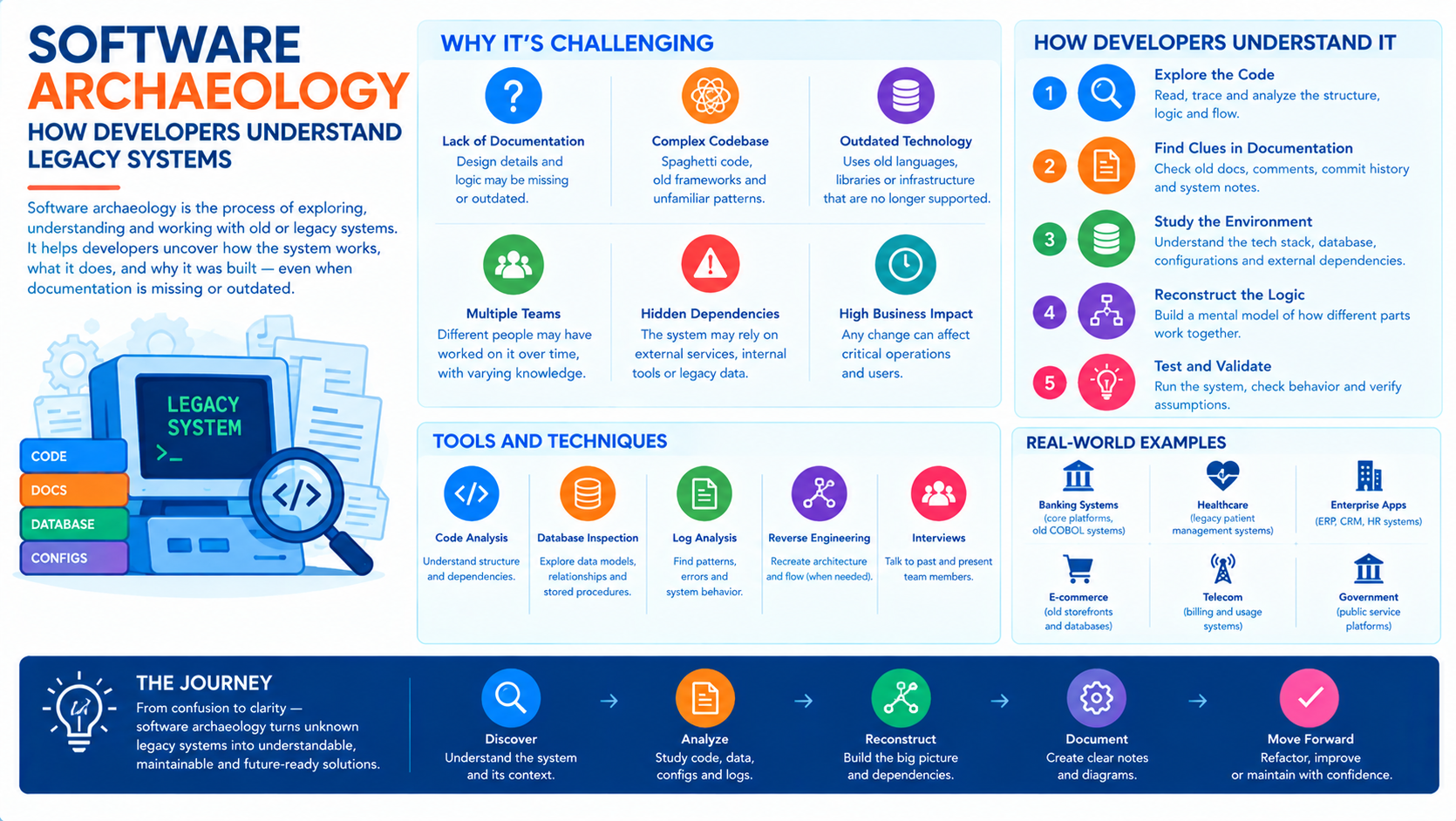
This is the reality of legacy systems. They are not legacy because they are old they are legacy because they are load-bearing and poorly understood. Software archaeology is the practice of understanding them well enough to change them safely.
Why Legacy Systems Resist Understanding
Legacy systems resist understanding for structural reasons, not because of negligence.
The original context is gone. Code written a decade ago reflected constraints that no longer exist hardware limits, vendor quirks, regulatory requirements, workarounds for bugs in dependencies. The code makes sense only in that vanished context.
Changes accumulate without consolidation. Each fix, patch, and enhancement is layered on top of the last. The system becomes a stratigraphic record of every decision ever made, with no unifying design.
Documentation decays. Design documents describe the system as it was conceived, not as it exists. Comments describe intent that may no longer match behavior.
Knowledge leaves with people. The engineers who understood the system's quirks have moved on. Their knowledge was never written down because it was "obvious" to them.
Tests are missing or unreliable. In many legacy systems, tests either do not exist, or they test the wrong things, or they pass regardless of behavior.
The result is a system that works but cannot be safely changed because no one knows what will break.
The Archaeological Mindset
Software archaeology borrows from the discipline of physical archaeology: you do not start by digging. You start by surveying, recording, and forming hypotheses.
Assume nothing. The code does not tell you what it does. It tells you what someone wrote. Behavior emerges from the code, the data, the infrastructure, and the environment together.
Observe before changing. The first goal is understanding, not improvement. Resist the urge to refactor before you understand why things are the way they are.
Preserve evidence. Record what you find. Screenshots, logs, database schemas, and configuration files are artifacts. Losing them means losing the ability to reconstruct your reasoning.
Form and test hypotheses. Treat every assumption about the system as a hypothesis to be verified. "This function handles refunds" is a hypothesis. Verify it against data and behavior.
Accept ambiguity. Some things cannot be fully determined. Document what you know, what you suspect, and what remains unknown.
The Excavation Process
Layer 1: The Surface What Exists
Start with an inventory:
-
What services, binaries, scripts, and jobs exist?
-
What databases, queues, and external systems do they interact with?
-
What is deployed where, and how does it get there?
-
What monitoring, logging, and alerting exist?
-
What is the deployment and release process?
The goal is a map of the system as it currently operates not as documentation claims it operates.
Layer 2: The Strata History and Evolution
Once you know what exists, determine how it got that way:
-
Version control history reveals the sequence of changes, their authors, and their commit messages.
-
Ticket systems reveal what problems each change was intended to solve.
-
Deployment logs reveal when changes went live and what happened after.
-
Comments and dead code reveal abandoned approaches and prior designs.
This layer answers: What decisions shaped this system, and why?
Layer 3: The Artifacts Data and Behavior
Data is the most durable record of what a system actually does:
-
Database schemas reveal the entities the system cares about.
-
Data patterns reveal real usage versus theoretical usage.
-
Logs reveal the paths actually taken, including error paths.
-
Metrics reveal performance characteristics and failure modes.
Behavioral artifacts include:
-
The actual requests the system receives
-
The actual outputs it produces
-
The external systems it depends on
-
The failure modes it exhibits under stress
This layer answers: What does the system actually do, in practice?
Layer 4: The Substrate Why It Matters
Finally, determine why the system matters to the business:
-
Which business processes depend on it?
-
Which customers, revenue streams, or regulatory obligations does it serve?
-
What would happen if it failed?
-
Who cares about it, and why?
This layer answers: Why does this system exist, and what is at stake?
Practical Techniques
Shadow Testing and Characterization
Before changing behavior, characterize it. Run the existing system against recorded inputs and capture the outputs. This produces a characterization test suite a baseline of current behavior, whether or not that behavior is correct.
This baseline becomes a safety net: when you refactor, you can verify that behavior has not changed unintentionally.
Instrumentation and Observation
Add logging and metrics to observe what the system actually does in production. This is especially valuable where documentation is missing and behavior is unclear. The goal is to answer questions empirically rather than by reading code.
Code Tracing from Entry Points
Start from the entry points HTTP handlers, scheduled jobs, message consumers and trace the execution path. This reveals the actual flow of control, which often differs from the intended design.
Data Flow Analysis
Trace how data moves through the system: where it enters, how it is transformed, where it is stored, and where it is consumed. Data flow analysis often reveals dependencies that code analysis misses.
Dependency Mapping
Identify all internal and external dependencies libraries, services, databases, and third-party systems. Each dependency is both a constraint and a potential point of failure.
Interviewing Stakeholders
The people who use, operate, and support the system often know things that are not in any document. They know the workarounds, the known bugs, and the unwritten rules. Interview them.
Documentation as Hypothesis
Treat existing documentation as a hypothesis rather than a fact. Verify it against the actual system. Where it is wrong, update it. Where it is missing, write it.
What to Produce
Software archaeology should produce artifacts that outlive the investigation:
| Artifact | Purpose |
|---|---|
| System map | What exists, where it runs, and how it connects |
| Dependency inventory | Internal and external dependencies and their risks |
| Behavioral baseline | Characterization tests capturing current behavior |
| Data dictionary | What data exists, where it lives, and what it means |
| Decision log | Why the system is the way it is, with evidence |
| Risk register | Known unknowns, fragile areas, and single points of failure |
| Onboarding guide | What a new engineer needs to know to work safely |
These artifacts reduce the cost of the next investigation for the next person, or for you in six months.
From Understanding to Change
Understanding is not the goal; safe change is. The archaeological process enables that change by:
Reducing fear. Engineers who understand the system can make changes with confidence rather than dread.
Enabling incremental improvement. With a behavioral baseline, you can refactor safely, one piece at a time.
Prioritizing effectively. Knowing which parts of the system matter most lets you focus effort where it counts.
Identifying what to replace. Some systems should be replaced, not repaired. Archaeology reveals which parts are worth keeping and which are not.
Implementation Roadmap
Phase 1: Survey (Weeks 1-2)
-
Inventory the system. What exists, where it runs, and what it connects to.
-
Identify stakeholders. Who uses, operates, and depends on the system.
-
Assess the stakes. What breaks if this system fails?
Phase 2: Excavate (Weeks 3-6)
-
Review history. Version control, tickets, deployment logs.
-
Instrument and observe. Add logging and metrics to reveal actual behavior.
-
Trace code and data flows. Start from entry points and follow the paths.
-
Capture behavioral baselines. Build characterization tests.
Phase 3: Document and Change (Weeks 7-12+)
-
Produce artifacts. System map, dependency inventory, data dictionary, risk register.
-
Identify safe changes. Start with the lowest-risk improvements.
-
Refactor incrementally with the behavioral baseline as a safety net.
-
Update documentation as you go so the next investigation starts from a better place.
Frequently Asked Questions
Q1: What is software archaeology?
Software archaeology is the practice of understanding legacy systems by reconstructing their history, intent, and actual behavior so that they can be safely modified.
Q2: Why not just rewrite the system?
Rewrites frequently fail because the original system encodes years of accumulated business knowledge that no one has documented. Without archaeology, a rewrite reproduces the same gaps with new code. Archaeology should precede any rewrite decision.
Q3: How do I understand a system with no documentation?
Instrument it. Observe it in production. Trace code and data flows. Interview stakeholders. Build characterization tests. Documentation can be reconstructed it just takes deliberate effort.
Q4: What is a characterization test?
A test that captures the current behavior of a system, whether or not that behavior is correct. Its purpose is to detect unintended changes during refactoring.
Q5: How long does software archaeology take?
It depends on the system's size and complexity, but the process is iterative and can start producing value in weeks. The goal is not complete understanding it is enough understanding to make safe changes.
Q6: How can Innovative AI Solutions help?
We help organizations understand and modernize legacy systems from archaeological assessment and documentation reconstruction to incremental refactoring and replacement planning. Based in Delhi, serving clients across India.
Why Delhi is a Great Hub for Legacy Modernization
Delhi is emerging as a hub for enterprise modernization, backed by a thriving IT services ecosystem and a large installed base of long-lived business systems in banking, insurance, government, and manufacturing. As Indian enterprises modernize, the discipline of understanding legacy systems becomes essential for avoiding costly rewrites and preserving institutional knowledge.
What We Offer at Innovative AI Solutions
-
Legacy Assessment: We survey and document existing systems to reveal what exists and what is at risk.
-
Behavioral Baselines: We build characterization tests that capture current behavior.
-
Documentation Reconstruction: We produce system maps, data dictionaries, and decision logs.
-
Modernization Roadmaps: We identify what to refactor, what to replace, and in what order.
-
Incremental Refactoring: We make safe, tested changes that reduce risk over time.
Final Thought
The shift is clear: from treating legacy systems as black boxes to be avoided to treating them as artifacts to be understood. Software archaeology is not about preserving the past it is about enabling the future by making the present legible. Organizations that invest in understanding their legacy systems will be the ones that can change them safely, incrementally, and with confidence.
Contact Us:
Phone: +91 7464 099 059 / +91 9689967356
Email: info@innovativeais.com
Address: 904, 9th floor Pearls Best Heights-I, Netaji Subhash Place, Delhi-110034
Website: https://innovativeais.com
About the Author
Abhishek Kumar
Founder & CEO, Innovative AI Solutions
5+ years building AI, cloud, and enterprise systems. Based in Delhi, serving clients across India.