The Big Question
What happens when a routine dependency upgrade breaks three downstream services? When a database schema change requires coordinated deployment across twelve teams? When a new version of an API cannot ship because eleven clients depend on undocumented behavior?
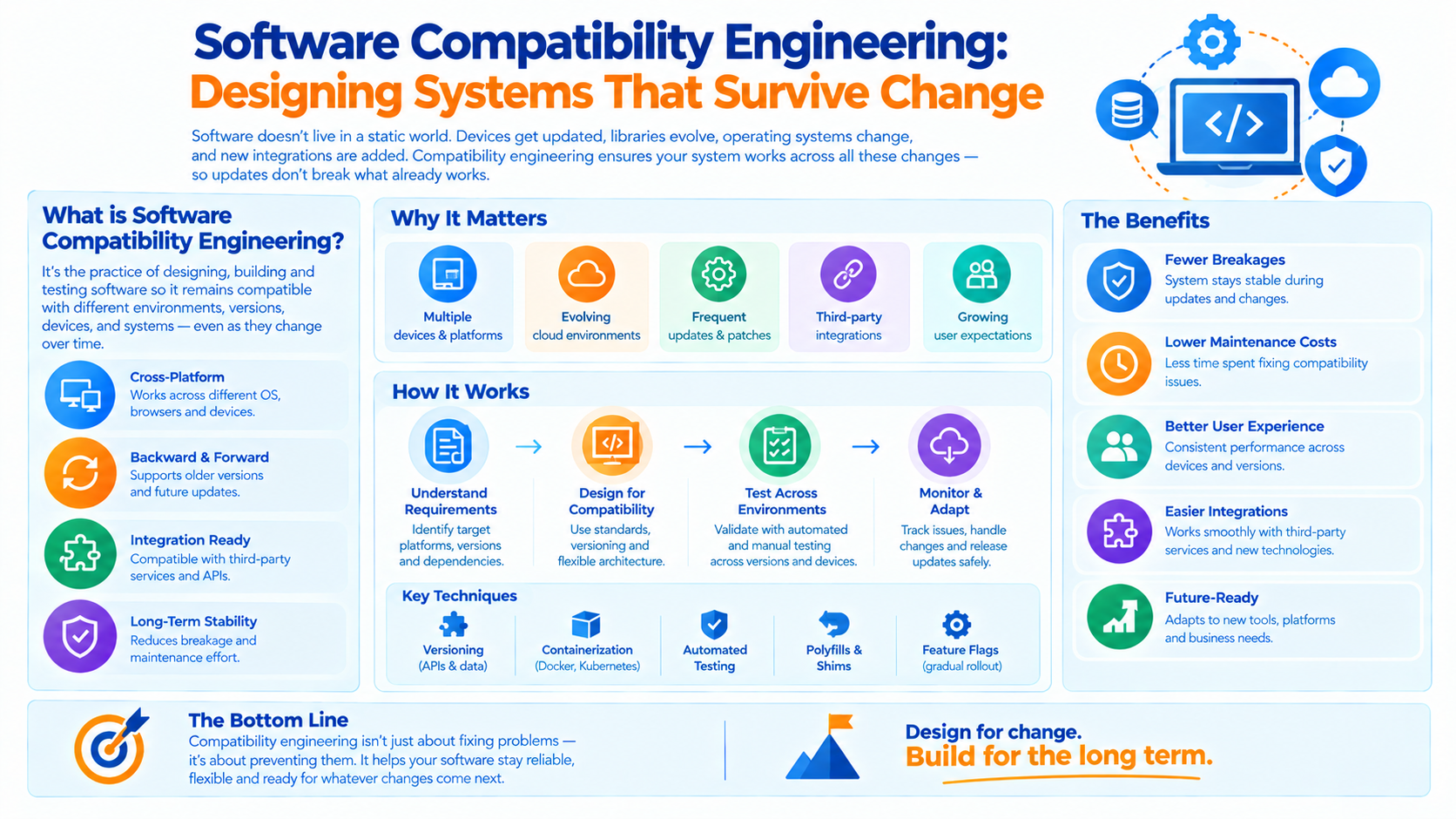
Software systems are expected to change. The question is whether change is survivable. Compatibility engineering is the discipline of designing for change so that systems can evolve without breaking the things that depend on them.
What Compatibility Actually Means
Compatibility is the property that allows one component to continue functioning when another changes. It appears in several distinct forms.
| Type | What It Guarantees |
|---|---|
| Backward compatibility | New versions work with old consumers |
| Forward compatibility | Old versions tolerate new producers |
| Wire compatibility | Different versions can communicate |
| Source compatibility | Code compiles against new versions |
| Binary compatibility | Compiled artifacts run against new versions |
| Behavioral compatibility | Same inputs produce same outputs |
| Data compatibility | Data written by one version is readable by another |
These forms are independent. A system can be backward compatible but not forward compatible, or wire compatible but not behaviorally compatible. Knowing which form matters is the first step in compatibility engineering.
Why Compatibility Breaks
Compatibility failures are rarely deliberate. They result from changes that seemed reasonable in isolation.
Undocumented Behavior
Consumers depend on behavior that was never documented as a contract. When the behavior changes, consumers break—even though the documented API did not change.
The pattern: A field returns values in a particular order. The order was never specified. A consumer depends on it. The order changes. The consumer breaks.
Implicit Contracts
Contracts that exist in practice but not in writing. These are the most dangerous compatibility dependencies because they are invisible until they break.
Leaky Abstractions
Abstractions that expose implementation details. When the implementation changes, consumers that depended on the leaked detail break.
The pattern: An internal identifier appears in a response. Consumers store it. The internal identifier format changes.
Serialization Changes
Changes to how data is represented on the wire. Field names, types, nesting, and encoding all affect compatibility.
Timing and Ordering
Changes to when things happen or in what order. Consumers that depend on event ordering break when ordering changes.
Error Behavior
Changes to how errors are represented or returned. Consumers that parse error responses break when the format changes.
Performance Characteristics
Changes to latency, throughput, or resource consumption. Consumers with timeouts or resource assumptions break when performance shifts.
The Compatibility Contract
Compatibility engineering begins with making the contract explicit.
A compatibility contract defines:
-
What consumers can depend on
-
What is explicitly not guaranteed
-
What changes are considered breaking
-
What changes are considered safe
-
How changes will be communicated
Without a contract, everything is implicitly guaranteed and everything is at risk.
What Counts as a Breaking Change
The definition of "breaking" is narrower than most teams assume.
Clearly breaking:
-
Removing a field or endpoint
-
Renaming a field or endpoint
-
Changing a field's type
-
Changing the meaning of a value
-
Removing or changing an error condition
-
Changing required parameters
Often breaking but overlooked:
-
Adding a required field to a request
-
Adding a new enum value that consumers do not handle
-
Changing the order of items in a response
-
Changing default values
-
Changing error codes
-
Tightening validation
-
Changing timing or ordering guarantees
Usually safe:
-
Adding optional fields
-
Adding new endpoints
-
Adding new enum values that consumers can ignore
-
Improving performance within documented bounds
The gray areas are where compatibility failures originate. Teams assume a change is safe when consumers actually depend on the old behavior.
The Four Strategies for Managing Compatibility
1. Versioning
Each breaking change produces a new version, and old versions are supported for a defined period.
Strengths: Clear contract, explicit support boundaries.
Weaknesses: Multiple versions must be maintained, tested, and secured. Cost grows with each supported version.
2. Tolerant Consumers
Consumers are designed to tolerate changes ignoring unknown fields, handling new enum values gracefully, avoiding dependence on ordering.
Strengths: Reduces the number of breaking changes, allowing evolution without version proliferation.
Weaknesses: Requires discipline across all consumers, which is difficult in large organizations.
3. Expand-Contract
Changes are made in phases: expand (add new), migrate (move consumers), contract (remove old).
Strengths: Allows evolution without a formal version break.
Weaknesses: Requires coordination and takes longer than a single change.
4. Abstraction Layers
Consumers interact with an abstraction that shields them from underlying changes.
Strengths: Isolates consumers from implementation changes.
Weaknesses: The abstraction itself becomes a compatibility surface that must be maintained.
Most mature systems combine all four, applying each where it fits.
Designing for Forward Compatibility
Forward compatibility the ability of old consumers to tolerate new producers—is often overlooked.
Why it matters: In distributed systems, producers and consumers are rarely updated simultaneously. Old consumers will encounter new producer behavior during rollout.
Design practices:
-
Ignore unknown fields. Consumers should not fail when they encounter fields they do not recognize.
-
Handle unknown enum values. A new value should not crash the consumer; it should be treated as unrecognized.
-
Avoid strict validation. Rejecting unexpected input breaks forward compatibility.
-
Do not depend on ordering. Treat collections as unordered unless ordering is explicitly guaranteed.
These practices are cheap to implement and expensive to retrofit.
Serialization and Schema Evolution
Data formats are a primary source of compatibility problems. Schema evolution practices reduce the risk.
Avro, Protobuf, and Thrift provide built-in compatibility rules and tooling for schema evolution.
JSON has no built-in compatibility guarantees, which means the discipline must be imposed manually:
-
Define schemas explicitly
-
Validate against schemas
-
Version schemas
-
Test compatibility as part of the pipeline
The choice of format determines how much compatibility engineering is required versus provided by the tooling.
Testing Compatibility
Compatibility cannot be assumed. It must be tested.
Approaches:
Contract testing. Verify that producers and consumers agree on the contract.
Consumer-driven contracts. Consumers define the contract they expect, and producers verify against it.
Version matrix testing. Test each supported version against each supported consumer.
Synthetic consumer tests. Simulate old consumers against new producers and new consumers against old producers.
Production shadow testing. Run new versions alongside old ones and compare behavior.
Compatibility testing is where compatibility engineering either succeeds or is revealed to be theoretical.
The Organizational Dimension
Compatibility is not only a technical problem. It requires organizational clarity.
Ownership. Who owns the contract? Who decides whether a change is breaking?
Communication. How are changes communicated to consumers? How much notice is given?
Policy. What is the support window for old versions? What constitutes a breaking change?
Discipline. Are consumers held to tolerant-consumer practices, or do they depend on undocumented behavior?
Incentives. Are teams rewarded for avoiding breaking changes, or only for shipping new features?
Without organizational clarity, compatibility policy exists on paper but not in practice.
Implementation Roadmap
Phase 1: Assess (Weeks 1-3)
-
Inventory compatibility surfaces. What contracts exist, and who depends on them?
-
Identify implicit contracts. What behaviors are consumers depending on that are not documented?
-
Map supported versions. What is being maintained, and at what cost?
-
Review past incidents. What compatibility failures have occurred, and why?
Phase 2: Formalize (Weeks 4-6)
-
Define compatibility contracts. What is guaranteed, and what is not?
-
Define breaking-change criteria. What changes require a new version?
-
Establish support windows. How long are versions supported?
-
Adopt schema evolution practices. Choose formats and tooling that support compatibility.
Phase 3: Engineer (Weeks 7-12+)
-
Implement tolerant consumers. Ignore unknown fields, handle unknown enums, avoid ordering dependence.
-
Adopt expand-contract for breaking changes where possible.
-
Implement compatibility testing. Contract tests, version matrix tests, and shadow testing.
-
Track compatibility debt. Measure the cost of supported versions.
Frequently Asked Questions
Q1: What is the difference between backward and forward compatibility?
Backward compatibility means new versions work with old consumers. Forward compatibility means old consumers tolerate new producers. Both matter in distributed systems, but forward compatibility is often overlooked.
Q2: Is adding a field a breaking change?
Usually not, if consumers tolerate unknown fields. It becomes breaking if consumers validate strictly or fail on unrecognized input.
Q3: How long should I support old versions?
It depends on the consumer base and the cost of migration. Twelve to twenty-four months is common for public APIs. Internal APIs can retire faster if consumers are coordinated.
Q4: What is expand-contract?
A three-phase approach to breaking changes: add the new alongside the old (expand), migrate consumers (migrate), remove the old (contract). It allows evolution without a formal version break.
Q5: How do I test compatibility?
Contract testing, version matrix testing, and shadow testing. Verify that old consumers work with new producers and new consumers work with old producers.
Q6: How can Innovative AI Solutions help?
We help organizations define compatibility contracts, adopt schema evolution practices, and implement compatibility testing. Explore our services to see how we approach platform and API lifecycle management. Based in Delhi, serving clients across India.
Why Delhi is a Great Hub for Platform Engineering
Delhi is emerging as a hub for platform and API engineering, backed by a thriving IT services ecosystem and a large base of organizations running long-lived systems with many consumers. As Indian enterprises scale their platforms, compatibility engineering becomes a competitive requirement rather than an engineering detail.
What We Offer at Innovative AI Solutions
-
Compatibility Assessment: We inventory contracts, implicit dependencies, and supported versions.
-
Contract Design: We define compatibility guarantees and breaking-change criteria.
-
Schema Evolution: We implement practices and tooling that support safe evolution.
-
Compatibility Testing: We build contract tests, version matrix tests, and shadow testing.
-
Lifecycle Management: We help manage version support and retirement.
Final Thought
The shift is clear: from treating compatibility as a policy to treating it as an engineering discipline. Compatibility determines whether systems can evolve or whether they calcify. Organizations that make contracts explicit, define breaking changes precisely, adopt schema evolution practices, and test compatibility will change their systems without breaking their consumers. Those that rely on implicit contracts will keep discovering what they accidentally promised.
Contact Us:
Phone: +91 7464 099 059 / +91 9689967356
Email: info@innovativeais.com
Address: 904, 9th floor Pearls Best Heights-I, Netaji Subhash Place, Delhi-110034
Website: https://innovativeais.com
About the Author
Abhishek Kumar
Founder & CEO, Innovative AI Solutions
5+ years building AI, cloud, and enterprise systems. Based in Delhi, serving clients across India.