The Big Question
Why do so many legacy modernization projects fail?
The numbers are sobering. Large-scale legacy modernization projects have historically shown a 50% to 75% chance of failure, with budgets between $1M and $3M and timelines of 12 to 18 months. The Standish Group found that large IT projects run over budget by an average of 45% and deliver 56% less value than originally projected.
The bigger the project, the worse those numbers get.
But here is what most organizations miss: legacy modernization is not primarily a technical decision. It is a bet. You are betting that a new system, built by a team that doesn't yet understand the business rules embedded in the old one, will be ready before the market moves or the budget runs out.
The discovery process is what makes rewrites slow. Legacy systems contain 20 years of business logic, edge cases, and regulatory workarounds that nobody documented because the people who built them didn't expect to leave.
This is why the strategy matters more than the technology. And why incremental approaches consistently beat big-bang rewrites.
The 6R Modernization Framework
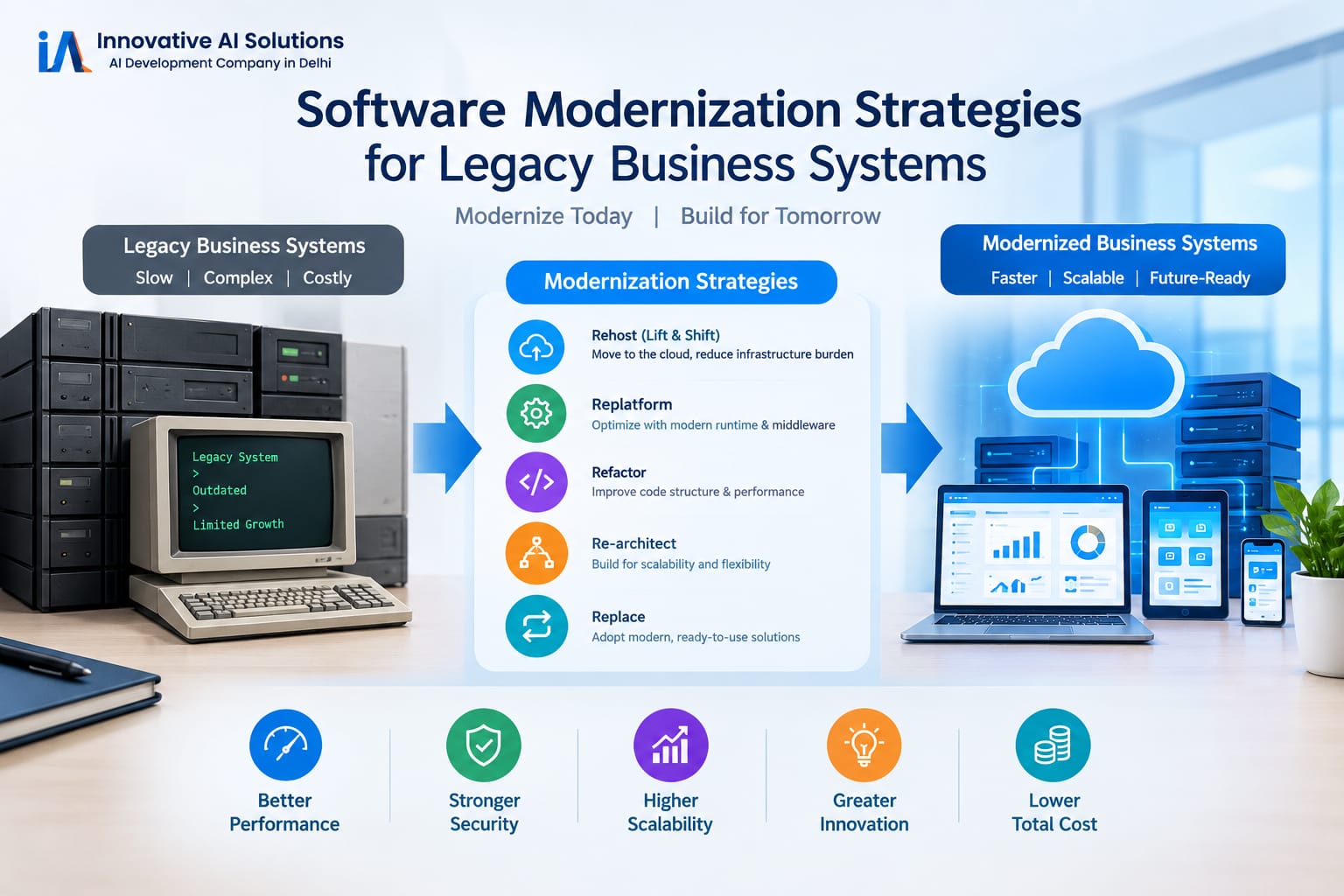
The industry has converged on a framework of six options, ranked by ease of implementation. Each has a different cost profile and risk profile.
Rehost (Lift-and-Shift)
Move applications to cloud infrastructure with minimal code changes. Best for quick wins and infrastructure savings. Typical budget: $20,000 – $150,000.
This path is ideal for non-critical apps where continuity matters more than innovation. It is a temporary stabilizer, not a destination. Treat it as a transition phase to buy time for deeper modernization.
Replatform
Make limited optimizations while migrating to modern environments. Best for organizations seeking cloud benefits without extensive redevelopment. Typical budget: $35,000 – $300,000.
Replatforming often yields the best ROI when paired with service-level objectives for performance and deploy frequency. It gives a fast path to cloud benefits while keeping disruption manageable.
Refactor / Re-Architect
Improve application architecture while preserving core business functionality. Best for long-term scalability and performance improvements. Typical budget: $100,000 – $600,000+.
This path is best for strategic applications where speed, resilience and continuous innovation are essential. It is also the path that enables AI integration and modern capabilities.
Rebuild / Replace
Develop a new application using modern technologies. Best for applications that cannot support future needs. Typical budget: $150,000 – $2M+.
Rebuilds must be outcome-driven. Define KPIs and fund the work over multiple tranches so the business sees incremental value.
Retain
Keep the system as-is. Sometimes the right answer is "do nothing" especially when the system works, the business logic is stable, and the cost of change exceeds the benefit.
Retire
Decommission the application. If a system is no longer needed, retiring it eliminates maintenance costs and reduces complexity.
Why AI Changes the Economics
The modernization math has shifted dramatically.
The 80/20 Insight
Roughly 80% of legacy code consists of simple CRUD operations create, read, update, delete functions that AI can reliably auto-transpile. The remaining 20% requires complex, human-guided AI work where developers direct the transformation while AI handles the mechanical conversion.
This 80/20 split has proven remarkably consistent across different technology stacks and business domains. It means the bulk of modernization work can now be automated with high confidence and services.
Timeline Compression
AI tools have matured to the point where they can accelerate modernization by 40% to 50% or more. Legacy modernization timelines have compressed by 75%, and costs have dropped proportionally.
In one project for a PE-backed healthcare workforce management company, a SaaS platform build was compressed from an 18-month traditional timeline to four to five months using AI-first methodology.
The 69,000-Error Lesson
Early attempts at holistic AI conversion consistently failed. Tools that promised to ingest entire legacy codebases and output modernized systems generated unmanageable volumes of errors. A 69,000-error example was not an outlier it was typical.
The successful pattern is module-by-module, not big-bang. Organizations breaking modernization into discrete phases achieve 60% to 80% acceleration compared to traditional methods while maintaining production quality.
The Real Cost of Doing Nothing
Legacy systems are not free. The cost is rarely a single line item it is a slow bleed spread across multiple budget lines.
Direct costs: Hardware, software maintenance, services,extended support, niche skills, infrastructure, licensing and vendor dependency.
Indirect costs: Manual reconciliation, incident response, testing delays, change freezes, integration support and audit preparation.
Opportunity costs: Delayed product launches, slower partner onboarding, reduced customer responsiveness and AI use cases that remain stuck in pilots.
Risk costs: Security exposure, compliance gaps, operational outages, data inconsistency and inability to prove control effectiveness.
McKinsey research shows that technology debt can account for 40–50% of total IT investment spend, yet most of that number never appears as a single line item in any budget.
The AI opportunity cost is the most significant. Organizations pursuing AI transformation frequently discover that outdated applications become the biggest obstacle to innovation. If data cannot be trusted or accessed, AI remains advisory rather than operational.
A Step-by-Step Modernization Blueprint
Successful modernization follows a structured approach.
Step 1: Build the Business Case
Define clear goals: unlocking data value, enhancing security, ensuring compliance, protecting brand reputation. The business case should be expressed in language finance can test and govern.
Step 2: Assess the Portfolio
Conduct a thorough discovery phase including system documentation, dependency mapping, and stakeholder interviews. Just 9% of organizations fully understand their applications' dependencies, and one-quarter have large numbers of undocumented applications.
Step 3: Define the Strategy
Choose per-application paths using the 6R framework. Hybrid strategies that mix lift, replatform and rebuild are often the most practical path to progress.
Step 4: Prioritize by Value and Risk
Use a value-complexity matrix. Start with quick wins to build momentum. Tag components with red, yellow, or green based on business criticality and technical fragility.
Step 5: Execute Incrementally
Use the strangler fig pattern for gradual replacement. Route existing functionality to a new service, validate it, and retire the old code only after the new one stabilizes. This way, you never risk a full system outage.
Step 6: Manage Change
Modernization depends on equipping users with the right knowledge and confidence. Develop comprehensive training programs. Address resistance proactively. Set realistic expectations about adjustment periods.
Step 7: Measure and Optimize
Track financial, operational, AI/data, risk, and strategic option value. The ROI model should show how modernization changes both the cost base and the enterprise's ability to create value.
What This Means for Indian Businesses
For enterprise leaders:
The AI agenda and the modernization agenda are the same agenda. Legacy systems block AI adoption. 74% of organizations struggle with incomplete data; 67% with low-quality data. Fix the foundation first. Start with portfolio assessment. Build the business case around AI readiness, not just cost savings.
For mid-market and SMB leaders:
Full enterprise modernization programs may not apply. Focus on targeted modernization of systems that block specific AI use cases. Use integration wrappers as bridges, not destinations. The 6R framework scales down rehost or replatform the systems that matter most.
For everyone:
The gap between modernization leaders and laggards is widening. Organizations deploying agentic AI are making faster modernization progress 67% say they are ahead of or on track with goals, compared to 51% of others. The question is not whether to modernize. It is how fast you can start.
Frequently Asked Questions
Q1: What is legacy system modernization?
Legacy system modernization is the process of updating outdated software systems to meet current business needs improving performance, scalability, security, and AI readiness. It is not always a full replacement. The 6R framework offers options from minimal change (rehost) to complete rebuild.
Q2: How much does legacy modernization cost?
Most organizations budget between $50,000 and $5 million+ depending on application complexity, modernization approach, integrations, and compliance requirements. Rehost: $20K–$150K. Replatform: $35K–$300K. Refactor: $100K–$600K+. Rebuild: $150K–$2M+.
Q3: Why do legacy modernization projects fail?
The biggest reasons: insufficient upfront planning, not securing full buy-in from business leaders, and treating modernization as a technology project instead of a business decision. Large projects run over budget by 45% and deliver 56% less value than projected.
Q4: What is the difference between rehost, replatform, and refactor?
Rehost moves applications to cloud with minimal changes. Replatform makes limited optimizations. Refactor improves architecture for long-term scalability. Start with rehost for quick wins. Replatform for cloud benefits. Refactor when the domain is valuable and legacy structure blocks scale.
Q5: How does AI change legacy modernization?
AI can auto-transpile 80% of legacy code (simple CRUD operations) while human experts handle the 20% that requires business context. This compresses timelines by 75% and makes previously prohibitive projects economically viable.
Q6: What is the 80/20 rule in AI-assisted modernization?
Roughly 80% of legacy code consists of simple CRUD operations that AI can reliably auto-transpile. The remaining 20% requires complex, human-guided AI work. This split has proven consistent across technology stacks and business domains.
Q7: Why does AI make legacy modernization urgent?
Legacy systems are not suitable for AI acceleration. If data cannot be trusted or accessed, AI remains advisory rather than operational. Organizations pursuing AI transformation frequently discover that outdated applications become the biggest obstacle to innovation.
Q8: What is the strangler fig pattern?
A gradual replacement approach where you route existing functionality to a new service, validate it, and retire the old code only after the new one stabilizes. This way, you never risk a full system outage.
Q9: How do I prioritize which systems to modernize?
Use a value-complexity matrix. Start with yellow zone components high value but not life-or-death. Assess both business value (impact on continuity, performance, cost) and technical impact (source code quality, security, architecture).
Q10: What is the ROI of legacy modernization?
The strongest ROI model combines financial, operational, AI/data, risk, and strategic value. Modernized organizations report 20–30% faster cycle times, 30–50% infrastructure cost reduction, and the ability to launch AI use cases that were previously blocked.
Frequently Asked Questions (Continued)
Q11: Should I modernize everything at once?
No. Holistic conversion consistently fails. The successful pattern is module-by-module, breaking modernization into discrete phases. Organizations using incremental approaches achieve 60–80% acceleration while maintaining quality.
Q12: What is the "staircase" modernization model?
A framework where organizations incrementally swap systems over time, reducing risk while providing budget relief. Each system sunset funds additional modernization. Kyndryl used this approach to complete a major modernization at half the typical $1 billion price tag.
Q13: How does modernization affect AI readiness?
Modernization is the prerequisite for AI adoption. If data is fragmented, systems are brittle, and integration is fragile, AI agents cannot operate effectively. 63% of Indian organizations are data-ready for AI the highest growth rate globally.
Q14: What is the biggest mistake in modernization planning?
Focusing only on infrastructure savings and maintenance reduction. The full value includes AI enablement, operational agility, customer experience, and strategic option value. A modern business case should answer: is the enterprise becoming easier to change?
Q15: Why should I choose Innovative AI Solutions?
Because we focus on outcomes, not activity. Because we build governance and guardrails from day one. Because we understand that modernization is about amplifying people, not replacing them. Because your code is always yours.
Contact Us
Phone:
+91 7464 099 059
+91 9689967356
Email:
info@innovativeais.com
Address:
9th Floor, Pearls Best Heights-I,
Head Office: 904, Netaji Subhash Place,
Delhi – 110034