The Big Question
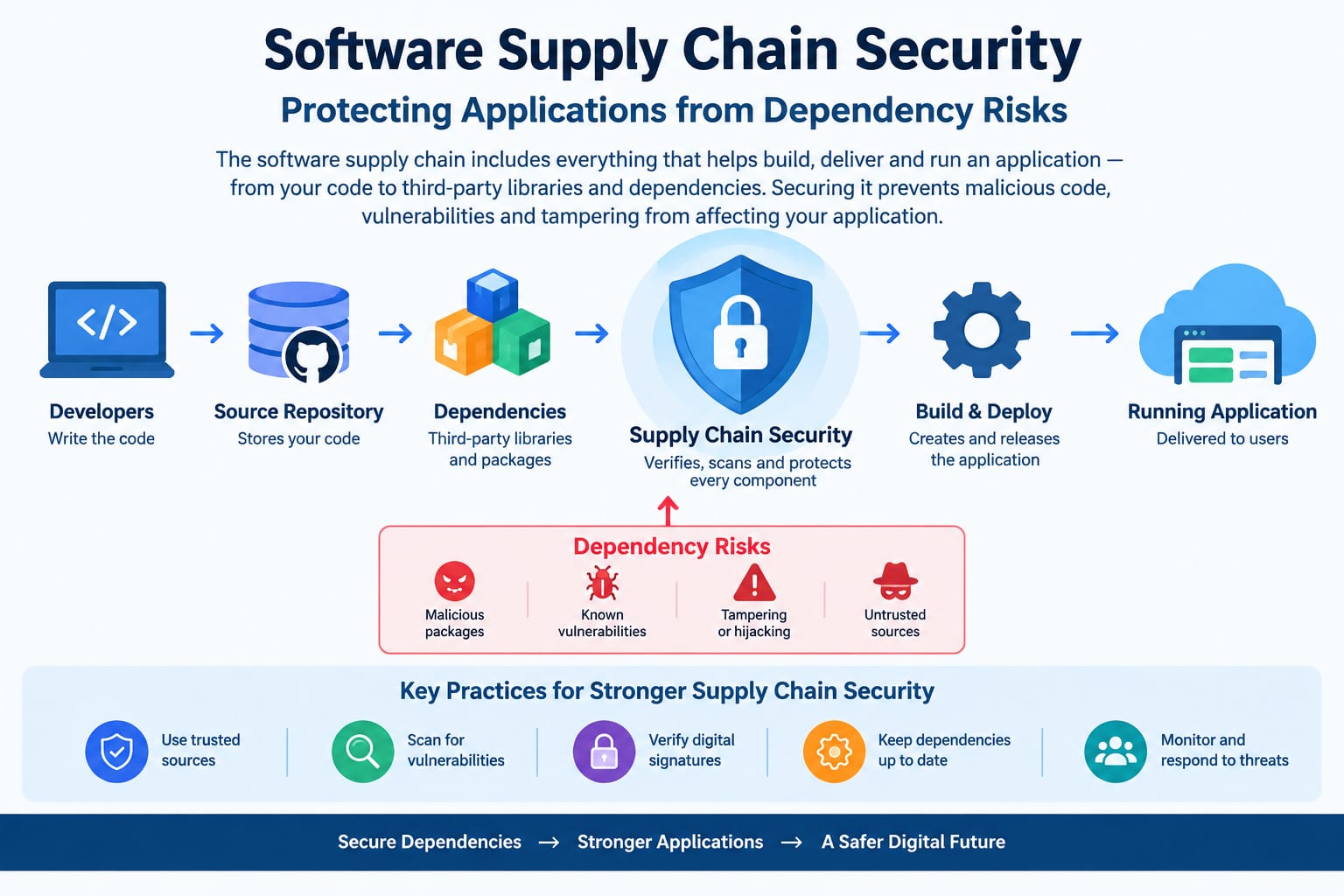
Every library you import brings its own dependencies. Those dependencies have dependencies. A typical modern application relies on hundreds of transitive components that no human has ever reviewed. If each component has even a small chance of containing a high-severity vulnerability in a given year, the probability that at least one affects you approaches certainty .
That is the structural risk. It is not going away. Open-source ecosystems move fast, and the speed that makes them valuable also makes them opaque.
The threat landscape has evolved well beyond "a vulnerable library has a CVE." Attackers now target the entire software production chain package registries, maintainer accounts, repositories, CI/CD workflows, and developer tooling . The FBI's July 2026 alert on TeamPCP described a campaign where attackers compromised widely used developer and security tools Trivy, KICS, LiteLLM, and the Telnyx Python SDK and pushed trojanized versions through normal distribution channels. The modified tools installed credential-stealing malware and persistent backdoors inside victim environments. Cloud access tokens, SSH keys, and Kubernetes secrets were harvested at scale .
The pattern is consistent. Go after the tools developers trust, poison the supply chain, and let the downstream damage multiply. The FBI warned that credentials stolen in that campaign should be considered permanently compromised affiliated threat actors may weaponize them months or years later .
The most dangerous assumption in software security is that "well-maintained" means "safe." Even legitimate, popular packages can become attack vectors when maintainer accounts are compromised, recovery email domains go stale, or control of a package changes hands. Private repositories are not safer either research has shown they are 6 times more likely to contain hardcoded secrets than public ones, because teams assume privacy equals safety .
Cost Based on Organization Type
Supply chain security costs scale with the number of applications, dependencies, and compliance obligations. Here is the 2026 Indian market landscape:
| Organization Type | Typical Annual Investment | What It Covers |
|---|---|---|
| Startup / Small Team | ₹1,20,000 – ₹4,00,000 | SBOM generation, Dependabot/Renovate, basic scanning |
| Mid-Market Enterprise | ₹4,00,000 – ₹15,00,000 | Automated vulnerability management, policy gates, reachability analysis |
| Large Enterprise / Regulated | ₹15,00,000 – ₹60,00,000+ | Full SBOM lifecycle, vendor risk management, compliance reporting |
| Critical Infrastructure / NCIIPC | ₹60,00,000+ | Designated entity requirements, detailed inventories, stricter vendor controls |
The pricing reality: Supply chain security is not a single product you buy. It is a program with tools, people, and process. Organizations that treat it as a tool purchase end up with a dashboard full of findings nobody owns functionally equivalent to having no program at all .
What drives the range:
For a startup, the baseline is automated dependency scanning (Dependabot, Snyk, or OWASP Dependency Check) plus SBOM generation in the build pipeline. For a regulated enterprise, the requirement extends to reachability analysing determining which vulnerabilities are actually exploitable given how the code is used vendor risk scoring, and compliance evidence tied to frameworks like SOC 2, PCI DSS 4.0, or the EU Cyber Resilience Act .
India-specific compliance costs: CERT-In's guidance has expanded beyond incident reporting into software supply chain visibility. Organizations handling personal data or operating critical infrastructure are expected to maintain inventories of software running on their systems, monitor against known vulnerabilities, and have processes for responding to supply chain incidents . The RBI and SEBI have layered sectoral expectations on top, requiring component-level visibility, not just application-level .
Breakdown by Defense Layer
Supply chain security is not a single control. It is a layered architecture where each layer addresses specific risks:
| Defense Layer | Implementation Cost (India) | Ongoing Cost | Primary Risk Addressed |
|---|---|---|---|
| SBOM Generation | ₹50,000 – ₹2,00,000 | ₹20,000 – ₹80,000/yr | Inventory, compliance, incident response |
| Automated Vulnerability Scanning | ₹80,000 – ₹3,00,000 | ₹40,000 – ₹1,50,000/yr | Known CVEs in dependencies |
| Dependency Policy Gates (PR checks) | ₹1,00,000 – ₹4,00,000 | ₹50,000 – ₹2,00,000/yr | Malicious packages, license violations, risky dependencies |
| Reachability Analysis | ₹2,00,000 – ₹8,00,000 | ₹1,00,000 – ₹4,00,000/yr | Prioritization cutting false positives by an order of magnitude |
| Vendor Risk Management (TPRM) | ₹1,50,000 – ₹5,00,000 | ₹80,000 – ₹3,00,000/yr | Third-party SaaS and vendor security posture |
| CI/CD Hardening | ₹2,00,000 – ₹10,00,000 | ₹1,00,000 – ₹5,00,000/yr | Pipeline compromise, credential theft |
The critical insight: The most expensive layer CI/CD hardening is where the highest-severity breaches now originate. Intel 471 found that software supply chain attacks are becoming workflow-centric rather than package-centric, with attackers shifting to trusted environments such as GitHub Actions, IDE extensions, OIDC workflows, and AI-assisted developer tools . Compromising a build pipeline means compromising every artifact that pipeline produces not just one package.
The single highest-leverage control: SBOM generation. Without an inventory of what you ship, you cannot answer the only question that matters during an incident: "Are we affected?" . Teams with an existing SBOM inventory answer in minutes. Teams without one spend days manually auditing manifests across every repository .
Breakdown by Developer Type (2020-2026)
Supply chain security requires specialized skills that most internal teams lack. The Indian talent market offers both opportunity and risk:
| Developer Type | Hourly Rate (India) | Typical Engagement | What They Deliver |
|---|---|---|---|
| Freelancer | ₹1,000 – ₹3,000 | ₹25,000 – ₹75,000 | Basic Dependabot setup, SBOM generation |
| Small Security Firm | ₹2,500 – ₹6,000 | ₹1,50,000 – ₹5,00,000 | Vulnerability scanning, policy gates, CI/CD integration |
| Mid-Size Integrator | ₹6,000 – ₹12,000 | ₹5,00,000 – ₹25,00,000 | Reachability analysis, TPRM, compliance mapping |
| Enterprise Consultancy | ₹12,000 – ₹20,000+ | ₹25,00,000+ | Full program design, CERT-In alignment, critical infrastructure |
India's structural advantage: Security engineers with supply chain expertise bill at 60-80% less than US rates. But the skills are scarce. The critical question before hiring: "Show me a supply chain security program you built not a tool deployment, a program with SBOM generation, vulnerability monitoring, and a remediation process that engineers actually follow."
Why Prices Changed in 2026
Three forces have reshaped supply chain security economics.
First, attackers shifted from packages to pipelines. The TeamPCP campaign compromised developer tools Trivy, KICS, LiteLLM rather than end-user applications. These tools sit inside CI/CD pipelines, cloud infrastructure workflows, and security scanning processes. Hitting them means hitting a large number of organizations simultaneously through a single poisoned update . Intel 471's report confirmed this shift: attacks are now workflow-centric, targeting GitHub Actions, OIDC workflows, IDE extensions, and AI coding assistants .
Second, regulatory pressure became mandatory. SBOM requirements have spread from a single US executive order to regulations across sectors and continents. The EU Cyber Resilience Act requires SBOMs for products sold in the EU. PCI DSS 4.0 mandates component inventory for anyone handling card data. US FDA guidance requires SBOMs for medical devices . India's CERT-In has expanded its 2022 directive into supply chain visibility guidance, and the DPDP Act adds privacy-driven vendor controls . For organizations selling to government or regulated buyers, SBOMs have become a procurement gate .
Third, the "vibe coding" problem made credential leaks worse. Security researchers found over 5,000 public GitHub repositories and 3,000 live production websites actively exposing hardcoded ChatGPT API keys. AI tokens are the new master keys they drain billing accounts and exhaust API credits, leading to unpredictable cloud bills .
The result: supply chain security is more necessary than ever, and more expensive to ignore.
Pro Tips to Save Money in 2026
1. Generate SBOMs automatically in every build, not on demand. An SBOM generated once and left to age is nearly worthless. It must reflect what actually ships in each release. Bake SBOM generation into your CI/CD pipeline so it happens without human intervention .
2. Prioritize by reachability, not CVE count. A typical enterprise dependency graph surfaces thousands of known vulnerabilities, the overwhelming majority of which sit in code paths that are never invoked. Reachability analysis checking whether the vulnerable function is actually called from application code—cuts the actionable finding count by an order of magnitude while catching the same critical issues .
3. Use package source mapping to prevent dependency confusion. If you use multiple NuGet feeds (public and private), a package can be downloaded from any feed. Package source mapping lets you centrally declare which source each package should be restored from, preventing attackers from publishing a malicious package to a public registry with the same name as your internal dependency .
4. Enable lock files for reproducibility. Lock files store the hash of package content. If the content hash of a package you install matches the lock file, it ensures reproducibility. If it doesn't match, something changed that shouldn't have .
5. Monitor for anomalous publishing activity, not just CVEs. Intel 471 recommends behavioral detection rather than relying exclusively on static indicators. Monitor for unusual token usage, unexpected workflow changes, repository modifications, and developer tool abuse across your pipelines .
6. Rotate credentials stolen in supply chain incidents. The FBI warned that credentials and data stolen in the TeamPCP campaign should be considered permanently compromised. Affiliated threat actors may weaponize them months or years later. Rotation is not optional .
Questions to Ask Before Hiring
Before you commit budget to any supply chain security engagement, ask these Questions.
1. "Can you produce a current SBOM for every application we ship formatted to SPDX or CycloneDX, with NTIA minimum elements?" If they cannot generate a compliant SBOM, they cannot build a supply chain security program. SBOM is the foundation everything else depends on .
2. "How do you prioritize vulnerabilities by CVSS score or by reachability?" Raw CVE count is a poor prioritization signal. A program that prioritizes by CVSS severity will bury your team in low-value work. Reachability analysis is the single highest-leverage filter .
3. "What's your approach to CI/CD pipeline security?" Pipelines are now the primary attack surface. The right answer involves credential isolation, OIDC-based short-lived tokens, ephemeral runners, and behavioral monitoring of pipeline activity .
4. "How do you detect malicious packages, not just vulnerable ones?" A vulnerable package is exploitable under specific conditions. A malicious package is intentionally weaponized. Detection requires typosquat heuristics, publisher reputation checks, signature verification, and behavioral analysis not just CVE matching .
5. "Who owns dependency updates security or engineering?" Centralizing all updates through security does not scale. Engineering teams should own merging updates and fixing reachable issues in their own services, while security owns policy, tooling, and escalation .
Why Delhi is a Great Hub for Supply Chain Security
Delhi-NCR has become a serious destination for supply chain security work, and the reason isn't just cost.
The region hosts India's largest cluster of BFSI and FinTech captives. Financial services and fintech are the sectors facing the strictest supply chain controls. SEBI's cybersecurity framework requires comprehensive third-party risk management, and RBI's IT framework expects banks to maintain component-level visibility into software running on systems that handle financial data . Delhi's supply chain security talent pool has been forged in this environment.
India's regulatory landscape is also driving demand. CERT-In's guidance on software supply chain has evolved through advisories and sectoral directives. The cumulative position by 2026 is that organizations handling personal data, operating critical information infrastructure, or providing essential services should maintain inventories of the software running on their systems, should monitor those inventories against known vulnerabilities, and should have processes for responding to supply chain incidents .
NCIIPC designations affect supply chain expectations significantly. Designated entities in power, banking, telecom, transport, and government operate under stricter requirements, including detailed software inventories, stricter vendor controls, and tighter incident response timelines. Vendors selling into these organizations are increasingly asked for SBOMs, signed attestations, and supply chain security certifications .
The talent density keeps improving. With a steady pipeline of security engineers, DevSecOps specialists, and cloud architects, Delhi offers a combination of cost and capability that's hard to match. And the time zone advantage matters: a Delhi-based team can sync with Middle East morning, European afternoon, and US East Coast evening.
What We Offer
At Innovative AI Solutions, we treat software supply chain security as an engineering discipline, not a compliance checkbox.
Our approach:
-
SBOM Foundation First. We generate compliant, machine-readable SBOMs for every application you ship, in SPDX or CycloneDX format, with NTIA minimum elements. You cannot monitor what you haven't inventoried.
-
Automated Vulnerability Management. Continuous scanning against NVD, GitHub Advisory Database, and ecosystem-specific databases. Real-time alerts when new CVEs affect your dependency stack.
-
Reachability-Aware Prioritization. We cut the noise. Vulnerabilities that are actually exploitable in your code get fixed first. The rest get tracked.
-
Dependency Policy Gates. Pre-merge checks that flag risky dependencies, license violations, and suspicious packages before they enter your codebase.
-
CI/CD Hardening. Credential isolation, OIDC-based short-lived tokens, ephemeral runners, and behavioral monitoring of pipeline activity.
-
Continuous Monitoring. Anomaly detection, vendor risk tracking, and incident response playbooks aligned with CERT-In requirements.
Our principle is simple: small steps, fast iteration, data speaks.
Frequently Asked Questions
Q: What is a software supply chain attack?
A software supply chain attack targets the components, tools, or processes used to build and distribute software rather than the end application directly. Attackers compromise a package registry, a maintainer account, or a CI/CD pipeline, then let the damage propagate downstream through trusted update channels. The SolarWinds breach is the most famous example, but recent campaigns like TeamPCP and Shai-Hulud show the technique has become industrialized .
Q: What is an SBOM and why do I need one?
A Software Bill of Materials is a formal, machine-readable inventory of the components that make up a piece of software, including versions, suppliers, and dependency relationships. Think of it as an ingredients label for software. You need one because when the next Log4Shell-style vulnerability lands, the only question that matters is "Are we affected?" Teams with an SBOM answer in minutes. Teams without one spend days manually auditing manifests .
Q: What's the difference between a vulnerable package and a malicious package?
A vulnerable package has a known CVE a flaw that is exploitable under specific conditions. A malicious package is intentionally weaponized it contains code designed to steal credentials, exfiltrate data, or establish persistence. Detection requires different techniques: CVE matching for vulnerable packages, and typosquat heuristics, publisher reputation checks, and behavioral analysis for malicious ones .
Q: How much does supply chain security cost for a mid-size business?
For a mid-market enterprise with 10-50 applications, a practical program covering SBOM generation, automated scanning, policy gates, and CI/CD hardening runs ₹4,00,000 to ₹15,00,000 annually, depending on compliance requirements and tooling choices.
Q: What's the biggest mistake companies make with supply chain security?
Treating it as a tool purchase rather than a program. A dashboard full of findings nobody owns is functionally equivalent to having no program at all. Supply chain security needs people and process attached to the tools: clear ownership, defined escalation paths, and a remediation workflow that engineers actually follow .
Frequently Asked Questions (Extended)
Q: What is dependency confusion and how do I prevent it?
Dependency confusion is an attack where a malicious package is published to a public registry with the same name as an organization's internal dependency, often with a high version number to trick build systems into pulling the malicious version. Prevention involves package source mapping centrally declaring which source each package should be restored from and using a single private feed with upstreaming protection .
Q: How does CERT-In treat software supply chain security?
CERT-In's guidance has evolved through advisories and sectoral directives. By 2026, organizations handling personal data, operating critical information infrastructure, or providing essential services should maintain inventories of software running on their systems, monitor against known vulnerabilities, and have processes for responding to supply chain incidents. The RBI and SEBI have layered additional expectations on financial sector organizations .
Q: What's the first step I should take tomorrow?
Generate an SBOM for your most critical application. Today. You cannot secure what you haven't inventoried. Use a tool like Syft, CycloneDX, or your CI/CD platform's built-in SBOM generator. Then scan that SBOM against known vulnerabilities. Those two steps inventory and scan are the foundation of everything else. Not a strategy document about supply chain security transformation.
Contact Us:
Phone: +91 7464 099 059 / +91 9689967356
Email: info@innovativeais.com
Address: 9th Floor, Pearls Best Heights-I, Head Office: 904, Netaji Subhash Place, Delhi, 110034