The Big Question
What if your technology could understand space the way humans do? What if computers could model a factory floor in real-time, overlay digital instructions on physical equipment, or let a remote team collaborate in a shared 3D space as if they were in the same room?
This is the promise of spatial computing—a paradigm that is rapidly moving from theoretical concept to practical enterprise reality.
What Is Spatial Computing?
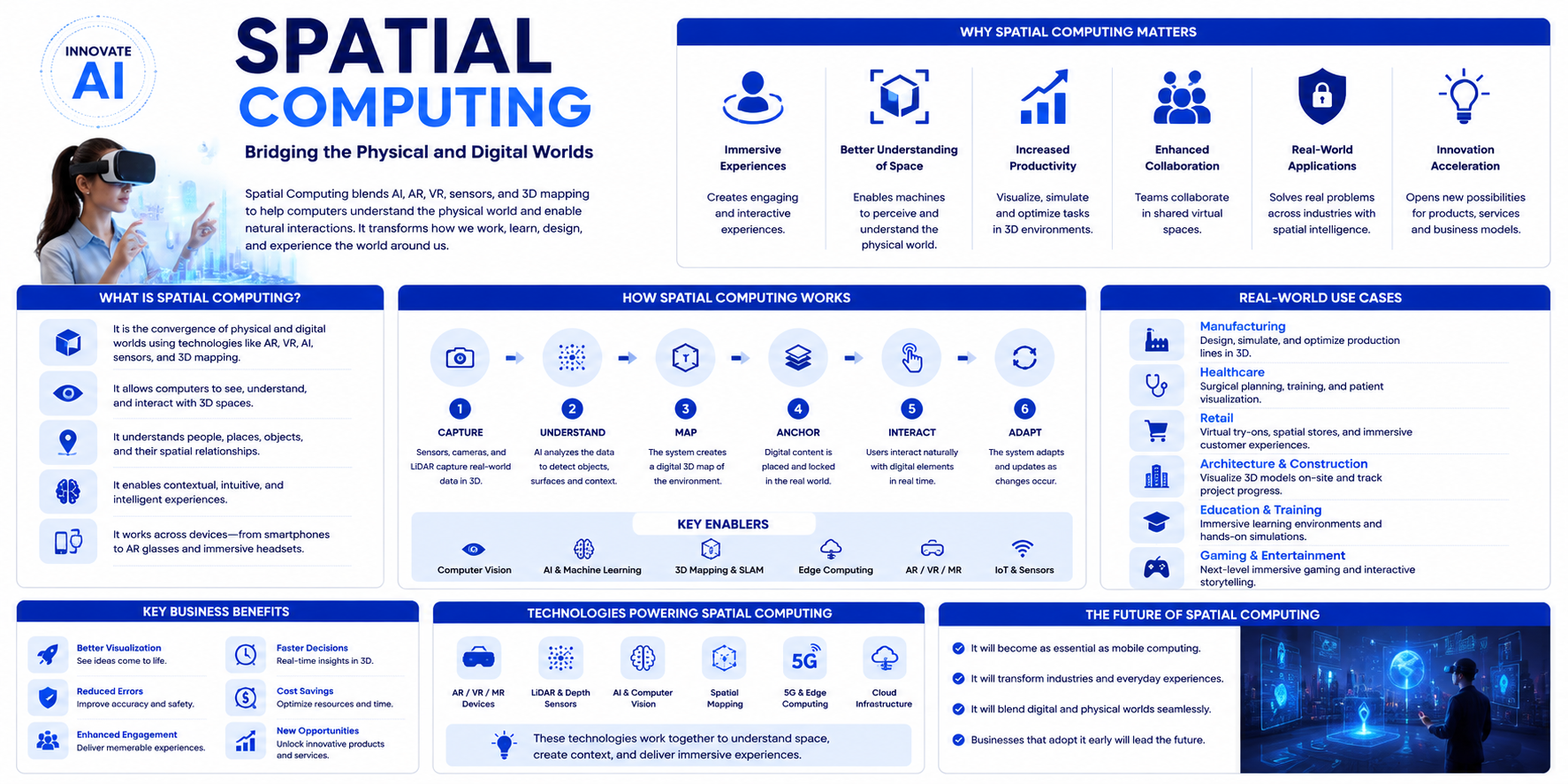
Spatial computing is a broad term that describes the processes and tools used to capture, process, and interact with three-dimensional (3D) data . It enables technology to blend data from the world around us in a natural, intuitive way. Unlike traditional computing, which is confined to 2D screens, spatial computing allows digital information to interact with and modify physical environments.
The term was first coined by Simon Greenwold in 2003, who defined it as "human interaction with a machine in which the machine retains and manipulates referents to real objects and spaces" . This early framing has shaped how the field is perceived today, linking it with immersive technologies like augmented reality (AR) and virtual reality (VR) .
The Two Schools of Thought
Research tracing the historical development of spatial computing identifies two primary threads :
| Thread | Focus | Key Technologies |
|---|---|---|
| Geospatial Computing | Contextual understanding of physical space | GIS, GPS, Location-Based Services, Remote Sensing |
| Mixed Reality | Seamless integration of physical and digital spaces | AR, VR, XR, Headsets |
How Spatial Computing Works
Spatial computing mirrors how humans interact with the world. We translate 2D images into a 3D mental model, make sense of objects in that space, and then act . Spatial computing does the same but with computers, sensors, and actuators.
1. Gather Data: Spatial mapping techniques are used to gather data around the user and their surroundings. Techniques such as photogrammetry (creating 3D models from photographs), LiDAR (Light Detection and Ranging), and radar capture a 3D model of the world . These technologies create a "point cloud," a set of data points that represent 3D shapes and distances.
2. Analyze the Data: Techniques such as machine vision analyze this data to make sense of the imagery. Artificial Intelligence (AI) helps identify individual objects in a scene, their movement, and their interactions with other objects .
3. Take Action: Handheld controllers, motion sensors, and speech recognition help users interact with the device and their environment. A self-driving car uses this analysis to detect a pedestrian and stop itself, and a building control system can adjust lighting based on a person's entry .
Key Technologies Enabling Spatial Computing
| Technology | Role in Spatial Computing |
|---|---|
| AI & Machine Learning | Analyzes visual data, identifies objects, understands contexts, and enables autonomous decision-making |
| IoT (Internet of Things) | Provides real-time sensor data, bridging the physical and digital worlds |
| Digital Twins | Creates virtual replicas of physical assets for simulation, monitoring, and optimization |
| Mixed Reality (AR/VR/XR) | Enables immersive user interfaces and interactions |
| 3D Sensors & LiDAR | Captures accurate 3D spatial data of the environment |
| Visual Positioning Systems (VPS) | Provides centimeter-level localization, especially in GPS-denied environments |
Industry Use Cases
Intelligent Warehousing and Logistics
Warehouses struggle with inventory tracking, misplaced items, and picking errors. Spatial computing can optimize inventory and enhance workflow efficiency by providing precise localization and augmentation . For example, a forklift operator can be guided via AR to the exact spot to place a pallet, reducing errors and speeding up workflows . This technology can also be used to simulate different warehouse layouts to improve efficiency .
Remote Collaboration and Spatial Planning
Traditional 2D video calls fail to convey spatial context, leading to misunderstandings and costly site visits. Spatial computing transforms real-world spaces into interactive 3D maps for construction, real estate tours, and equipment maintenance . Teams can collaborate in a shared spatial environment, visualizing structures with AR overlays, reducing miscommunication and the need for travel .
Manufacturing and Facilities Management
A network of cameras can automatically model a car production process or monitor a production line . This helps identify the different steps involved and how they impact time and quality. Automated lighting and environmental controls can be programmed to adjust to worker preferences . Deloitte highlights that spatial computing contextualizes business data, making complex technical details more accessible across functions .
Healthcare
Location tags can help teams automate key patient details or procure special equipment in an emergency . Spatial computing can also create 3D visualizations for product design and training .
Entertainment and Experiences
Venues can use spatial apps to turn parks into interactive game zones or provide wayfinding features . At live events, fans can access updates and find their seats with AR-guided navigation, boosting engagement .
The Future of Spatial Computing
The technology continues to mature, driven by major advancements in AI, sensors, and hardware like the Apple Vision Pro . Deloitte's Tech Trends 2025 identifies it as a transformative force for business, enabling new models of human-machine collaboration .
Key Trends to Watch:
-
The Spatial Web: An extension of the World Wide Web into 3D physical space . Open spatial computing platforms are emerging, providing protocols for discovering and sharing spatial services and content, much like the web did for information .
-
Integration with AI: Spatial AI is solving navigation challenges, handling complex tasks like mapping indoor environments and predicting operational issues .
-
Spatial AR as a Successor: Spatial AR is emerging as the logical successor to traditional AR and VR by focusing on integration rather than isolated implementation, delivering practical business value .
-
Cost & Hardware Evolution: While headsets have historically faced challenges around cost, weight, and battery life , advancements are making the experience more practical and comfortable for enterprise use .
-
Hybrid Work: Spatial computing is poised to make remote work more immersive and collaborative, with teams able to "work together" in shared virtual spaces .
Implementation Roadmap
Phase 1: Assessment (Weeks 1-4)
-
Identify the Pain Point: Choose a clear, bounded use case where spatial data can solve a problem—such as warehouse inefficiency, remote collaboration delays, or staff training gaps.
-
Assess Your Infrastructure: Do you have the network and device ecosystem to support the chosen technology?
-
Define Success Metrics: How will you measure the ROI—such as reduced errors, shorter project timelines, or improved safety?
Phase 2: Build & Pilot (Weeks 5-8)
-
Select Technology: Start with an SDK like Niantic's Spatial Platform or a focused solution from a vendor like Microsoft or Apple .
-
Develop a Proof of Concept: Begin with a small-scale pilot in a controlled environment.
-
Invest in Training: Equip your employees with the skills to leverage these advanced tools .
Phase 3: Scale and Integrate (Weeks 9-12+)
-
Integrate with Enterprise Systems: Ensure the spatial solution pipelines data into your existing workflows .
-
Optimize and Iterate: Gather feedback from users and refine the experience.
-
Scale to Other Divisions: Apply the lessons learned to other departments and use cases.
Frequently Asked Questions
Q1: What is spatial computing in simple terms?
It's technology that blends the digital and physical worlds, allowing computers to understand and interact with real-world spaces and objects much like we do .
Q2: How does it differ from VR and AR?
VR simulates a completely different environment, while AR overlays digital elements on the real world. Spatial computing goes further by allowing digital elements to interact with physical environments; a digital object placed on a real table stays there and can be viewed from any angle .
Q3: What are the benefits for business?
Enhanced efficiency, better decision-making through data visualization, safer operations, remote collaboration, and streamlined workflows .
Q4: Is it expensive to implement?
It depends on the use case. Some solutions can be deployed on mobile devices, while others require specialized headsets like the Apple Vision Pro or Microsoft HoloLens .
Q5: How can Innovative AI Solutions help?
We help organizations assess their spatial computing readiness, identify high-value use cases, select the right platforms and hardware, integrate solutions with existing systems, and ensure a smooth implementation. Based in Delhi, serving clients across India.
Why Delhi is a Great Hub for Spatial Computing Innovation
Delhi is emerging as a hub for AI and enterprise software innovation, backed by a thriving tech ecosystem and a growing number of global delivery centers. As Indian enterprises modernize their operations, spatial computing offers a significant opportunity to leapfrog traditional workflows, particularly in logistics, manufacturing, and services.
What We Offer at Innovative AI Solutions
-
Spatial Computing Strategy: We help you identify where spatial intelligence can unlock business value.
-
Platform Selection: We help you choose the right mix of AR/VR, AI, and digital twin technologies.
-
Integration: We help you integrate spatial solutions with your existing enterprise systems.
-
Implementation: We help you pilot and scale spatial computing across your organization.
Final Thought
Spatial computing is moving beyond the hype. It is rapidly becoming a practical tool for enterprises seeking to optimize operations, enhance collaboration, and create immersive experiences. The organizations that begin their spatial journey today will be the ones defining the future of work tomorrow.
Contact Us:
Phone: +91 7464 099 059 / +91 9689967356
Email: info@innovativeais.com
Address: Netaji Subhash Place, Pitampura, Delhi – 110034
Website: https://innovativeais.com
About the Author
Abhishek Kumar
Founder & CEO, Innovative AI Solutions
5+ years building AI and enterprise systems for businesses. Based in Delhi, serving clients across India.