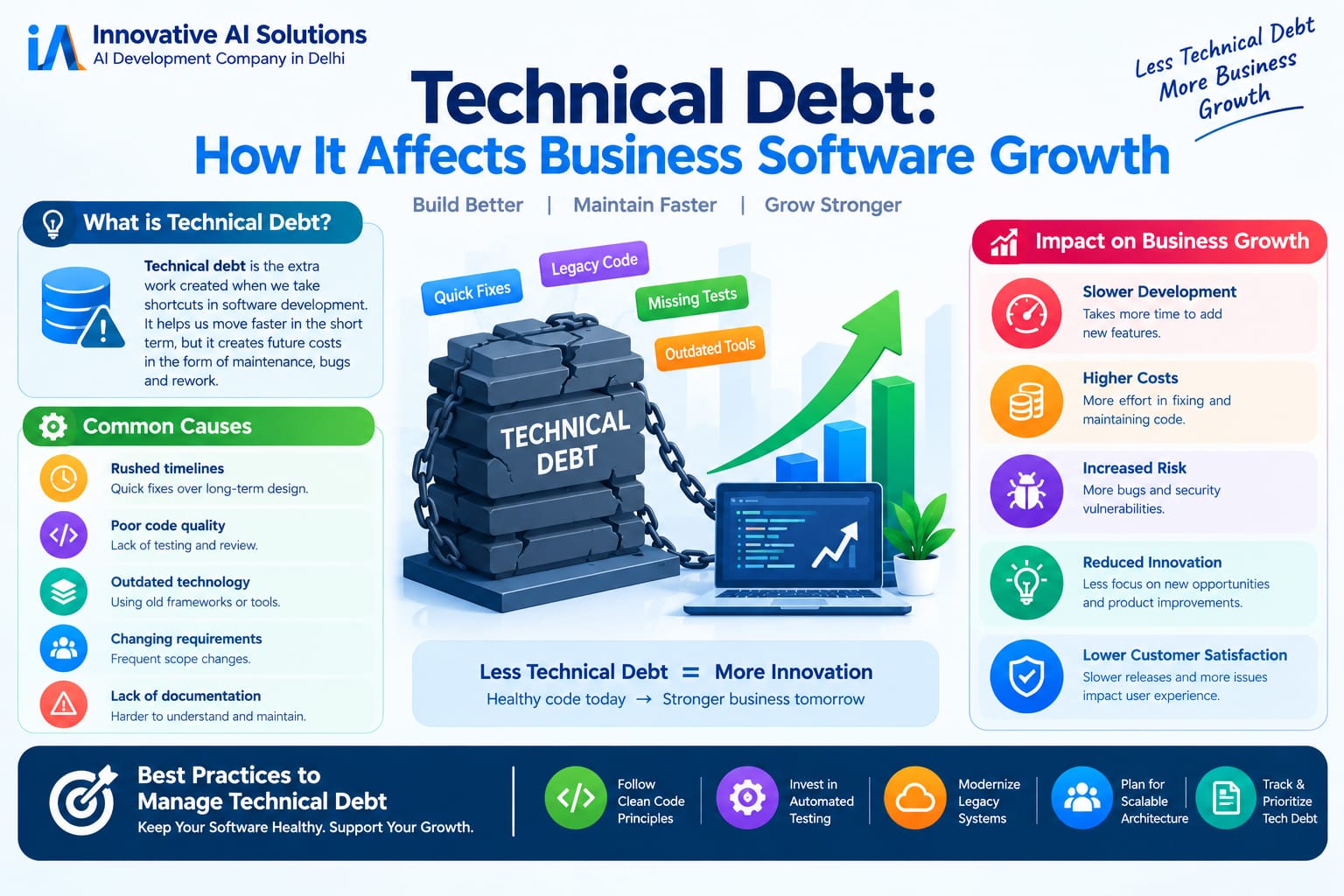
Why does technical debt matter to business leaders, not just engineers?
The answer is simple: technical debt is expensive.
Industry estimates suggest that financial institutions spend as much as 70 to 80 percent of their IT budgets maintaining legacy systems . That leaves limited capacity for innovation and growth. McKinsey research shows technology debt can account for 40–50% of total IT investment spend yet most of that number never appears as a single line item in any budget .
The costs compound. A 20-person engineering team with an average $100K salary, losing 35% productivity to debt, results in $700,000 per year in lost output money that delivers zero business value . Debt-heavy codebases increase development cycles by 40% and testing time by 50% .
And the problem is getting worse. AI adoption is making technical debt more visible and more damaging. Organizations pursuing AI transformation frequently discover that legacy systems become the biggest obstacle to innovation . If data cannot be trusted or accessed, AI remains advisory rather than operational.
Technical debt is not an IT problem. It's a business problem that demands business attention.
What Technical Debt Actually Is
Technical debt is the accumulated cost of shortcuts, workarounds, and suboptimal decisions in software development. It's the gap between what your software should be and what it actually is.
The term was coined by Ward Cunningham as a metaphor for financial debt. You borrow against future productivity to ship faster today. You pay interest in the form of slower development, more bugs, and higher maintenance costs. Eventually, you must repay the principal through refactoring or replacement.
Where technical debt accumulates:
Architectural debt. Outdated monolithic systems, tight coupling, and hardcoded integrations restrict scalability and innovation. They make cloud migration costly and risk-laden .
Design and process debt. Poorly structured modules, missing documentation, and manual testing processes create persistent inefficiency. New developers may take up to six weeks longer to onboard due to complexity and poor documentation .
Code debt. Duplicated logic, inconsistent standards, and overly complex code make systems harder to understand and modify.
AI-generated code debt. AI coding assistants write code faster but they often prioritize speed over clean, efficient code. AI-generated code can include redundant functions, unnecessary libraries, and long solutions for simple tasks. While the code may work, maintaining and updating it later becomes difficult .
The Real Cost of Technical Debt
Technical debt drains growth across multiple dimensions.
Direct Engineering Costs
The most visible cost is the engineering time spent on debt-related work. Research shows teams spend 20-40% of their time on debt-driven rework fixing bugs, working around limitations, and maintaining legacy code .
For a team of ten engineers with a loaded cost of $145,000 per engineer per year, losing 35% productivity to debt costs **$510,000 per year** . That's engineering time spent servicing debt instead of building product.
Delayed Features
Technical debt delays revenue. A feature worth $40,000 a month that ships eight weeks late because of legacy constraints represents $80,000 in deferred value entirely separate from the engineering hours burned getting there .
When rate environments shift, banks with rigid pricing infrastructure may take weeks or months to respond. During that time, margins compress or customer attrition increases .
Operational Risk
Legacy environments are more prone to outages, compliance gaps, and reliance on manual workarounds. Production issues in legacy code cost up to 4x more than planned maintenance . Beyond the financial hit, they damage brand trust especially when failures occur during product launches or peak business cycles.
Talent Retention
High-debt environments experience 25–35% higher developer turnover . Skilled engineers want to innovate not wrestle with fragile legacy systems. Each departure costs $50,000 to $100,000 in recruitment, onboarding, and lost productivity. Worse, when experienced developers leave, institutional knowledge disappears with them.
Security and Compliance Risk
Legacy code and outdated dependencies increase vulnerability exposure by 30–50% . A single major breach can cost over $4 million, not counting reputational damage. Outdated systems often lack essential audit trails, patch management, and security configurations especially problematic in regulated industries like healthcare or finance.
How Technical Debt Blocks AI Adoption
The rise of AI has made technical debt more urgent and more visible.
Salesforce's Prakash Thekkatte captured the problem precisely: "You cannot layer transformative AI onto a foundation of fragmented silos. To lead in the agentic era, organizations must first solve the 'data debt' equation" .
Research firm IDC warned that organizations failing to address technical debt could face significantly higher costs and failure rates in AI projects by 2027 . At the same time, companies investing in modernization are generating substantially higher digital revenues than their peers.
The pattern is consistent: legacy systems are becoming the bottleneck for AI adoption. Data sits across disconnected platforms. Applications struggle to communicate. Introducing new AI tools requires significant re-engineering of existing systems .
As organizations move from AI pilots to enterprise-wide deployments, modernizing core systems becomes a prerequisite rather than a choice.
The AI Paradox: Solving and Creating Debt
AI is both a solution to technical debt and a source of new debt.
How AI Helps
AI tools are increasingly used to automate code migration, application upgrades, and data modernization. Infosys helped a transportation client migrate 3 million lines of COBOL code to a modern microservices environment using AI foundation models. The cost was 60% lower, and the timeline was 60% quicker .
Tech Mahindra has set targets of achieving a 30-35 percent reduction in technical debt for clients .
How AI Creates New Debt
But AI also creates new technical debt. Vijay Balakrishnan, Chief Digital & Information Officer at Godrej Enterprises Group, explained the concern: "In AI-assisted coding, there is the risk of accumulating tech debt because organisations may not have complete visibility into every line of code being generated" .
Code bloat is a growing problem. AI-generated code can include redundant functions, unnecessary libraries, and long solutions for simple tasks. While the code may work, maintaining and updating it later becomes difficult .
As Titus M, Practice Director at Everest Group, put it: "AI-related technical debt has an exponential effect. Every suboptimal decision can lead to disproportionately higher costs" .
Managing Technical Debt as a Business Strategy
Technical debt is not inherently bad. Like financial debt, it can accelerate growth when used strategically. The problem is unmanaged debt.
Treat It as a Business Conversation
Too often, technical debt lives in silos. Engineering teams understand the risks. Leadership teams focus on growth and timelines. The healthiest organizations close that gap .
The real opportunity is not eliminating technical debt but creating alignment around when it makes sense to take on more debt, when it makes sense to reduce it, and how those decisions affect the business .
Measure What Matters
Executives make decisions based on numbers. Translating technical debt into financial language builds alignment .
Key metrics:
-
Developer productivity loss: (Team Size × Average Salary) × % Time Lost to Debt
-
Feature delay impact: Feature value per week × weeks of delay caused by debt
-
Churn from incidents: Customers lost per major incident × average customer lifetime value
-
Hiring premium: Extra time-to-hire and offer decline rate on legacy roles vs modern roles
Balance Debt Over Time
Research on startup technical debt identifies a "Good Enough Level" for each phase of growth :
Startup phase: Accumulate debt to move fast and validate the product. Keep debt below levels that prevent MVP delivery.
Stabilization phase: Partial refactoring. Prioritize debt blocking key features planned for upcoming iterations. Address "contagious" debt that new developers might replicate.
Growth phase: Remove debt that blocks scalability. Refactor architecture to allow productive management of customer variability. Introduce tools and processes to prevent future debt.
Maturity phase: Behave like mature companies. Systematic debt management. Clear governance.
Adopt Composable Architecture
For organizations with deep technical debt, big-bang transformation is often unfeasible. A staged approach to composable architecture offers a lifeline .
Composable architecture enables rapid experimentation, stepwise upgrades, and confinement of debt to specific modules. Combined with organizational changes—dedicated innovation units separate from maintenance teams—modular technologies can revitalize digital capabilities while maintaining operational stability .
What This Means for Your Business
For business leaders:
Technical debt is a business risk. Measure it. Track it. Make decisions about it with the same rigor as financial debt. The question isn't whether to have technical debt it's whether you're managing it or it's managing you.
For engineering leaders:
Translate technical risk into business outcomes. Don't say "we need to refactor the authentication service." Say "investing $200K in authentication upgrades will reduce feature delivery time by 30% and eliminate $50K in monthly outage costs" .
For growing businesses:
Technical debt accumulates faster as teams grow. Contagious debt poor code that new developers replicate is especially dangerous during growth phases. Address it before it compounds .
For organizations pursuing AI:
Fix the foundation first. You cannot layer transformative AI onto fragmented silos. Modernization is the prerequisite for AI adoption, not the alternative to it .
Frequently Asked Questions
Q1: What is technical debt?
Technical debt is the accumulated cost of shortcuts, workarounds, and suboptimal decisions in software development. It's the gap between what your software should be and what it actually is. Like financial debt, it accrues interest making future changes more expensive .
Q2: How much does technical debt cost?
Financial institutions spend 70-80% of IT budgets maintaining legacy systems . A 20-person engineering team losing 35% productivity to debt costs $700,000 per year . Debt-heavy codebases increase development cycles by 40% and testing time by 50% .
Q3: How does technical debt affect business growth?
Technical debt delays features (revenue impact), increases costs (engineering and maintenance), raises operational risk (outages and security), and drives talent away (25-35% higher turnover). It constrains scalability and blocks AI adoption .
Q4: Is technical debt always bad?
No. Like financial debt, technical debt can accelerate growth when used strategically. Startups often accumulate debt deliberately to move fast and validate ideas. The problem is unmanaged debt when shortcuts are never revisited, and interest compounds .
Q5: How does AI affect technical debt?
AI helps reduce debt through automated code migration and modernization. Infosys migrated 3 million lines of COBOL with 60% lower cost and 60% faster timeline . But AI also creates new debt code bloat, redundant functions, and poor structure that's hard to maintain .
Q6: How do I measure technical debt?
Translate it into financial terms. Track developer productivity loss, feature delay impact, churn from incidents, and hiring premiums. A 20-person team losing 35% productivity to debt costs $700,000 per year .
Q7: When should I address technical debt?
Continuously. Research identifies a "Good Enough Level" for each growth phase. In startup phase, accumulate debt to move fast. In stabilization, refactor debt blocking key features. In growth, remove debt that blocks scalability .
Q8: What is "contagious" technical debt?
Debt that new developers replicate. If poor code patterns exist, new developers may model their work on them, creating a vicious spiral. During growth phases, contagious debt should be prioritized for removal .
Q9: How does technical debt block AI adoption?
You cannot layer transformative AI onto fragmented silos. Legacy systems create data silos, integration challenges, and re-engineering requirements. Modernization is the prerequisite for AI adoption .
Q10: What is composable architecture, and how does it help?
Composable architecture builds software from modular, interchangeable components. It enables rapid experimentation, stepwise upgrades, and confinement of debt to specific modules. For organizations with deep debt, it offers a staged path to modernization without big-bang transformation .
Frequently Asked Questions (Continued)
Q11: What is the "Good Enough Level" for technical debt?
A threshold for each growth phase. Below the GEL, debt is manageable. Above it, debt becomes disruptive. Startups should keep debt below levels that prevent MVP delivery. Growth-stage companies should keep debt below levels that block scalability .
Q12: How does technical debt affect developer turnover?
High-debt environments experience 25-35% higher developer turnover . Skilled engineers want to innovate—not wrestle with fragile legacy systems. Each departure costs $50K-$100K in recruitment and lost productivity.
Q13: What is the ROI of addressing technical debt?
Modernization delivers 60% lower cost and 60% faster timelines when AI is used for migration . Reducing debt improves developer productivity, accelerates feature delivery, and reduces operational risk.
Q14: How do I convince leadership to invest in debt reduction?
Frame it in business terms. Instead of "refactor the authentication service," say "investing $200K in authentication upgrades will reduce feature delivery time by 30% and eliminate $50K in monthly outage costs" .
Q15: Why should I choose Innovative AI Solutions?
Because we understand that technical debt is a business risk, not just a technical one. Because we help organizations modernize strategically—not just rewrite everything. Because we've delivered 100+ projects. Because your code is always yours.
Contact Us
Phone:
+91 7464 099 059
+91 9689967356
Email:
info@innovativeais.com
Address:
9th Floor, Pearls Best Heights-I,
Head Office: 904, Netaji Subhash Place,
Delhi – 110034