The Big Question
What happens when your test suite passes, your staging deployment succeeds, and your production system fails anyway? When the conditions in production traffic patterns, data distributions, dependency behavior, user actions differ from anything your tests simulated?
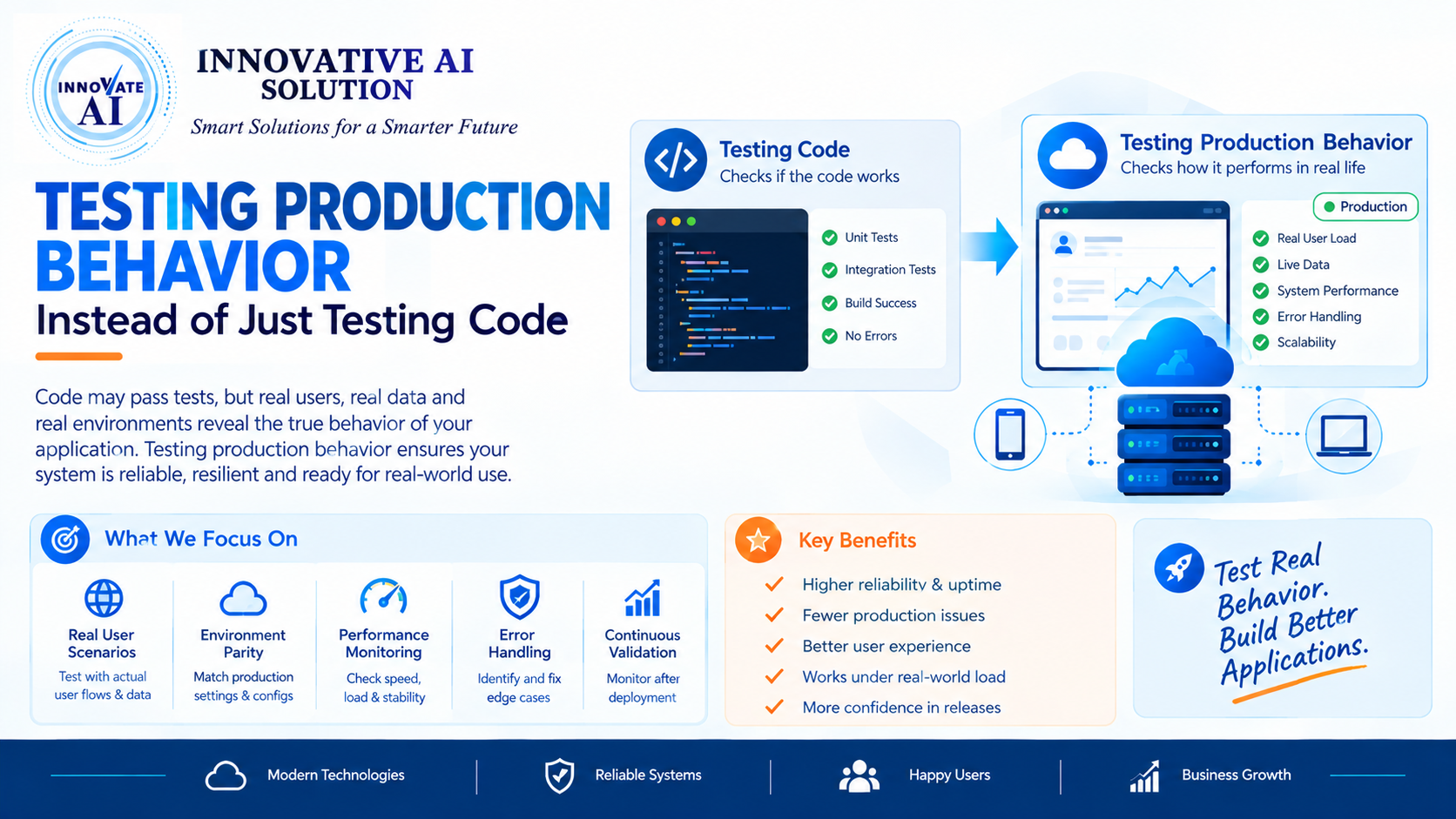
Traditional testing is built on a useful but incomplete premise: that if the code is correct, the system is correct. In distributed systems, this premise breaks down. The system's behavior emerges from the interaction of code, infrastructure, configuration, data, and traffic. Testing code alone cannot validate that.
Production behavior testing inverts the question. Instead of asking "does the code work?", it asks "does the system behave correctly under real conditions?"
Why Code Testing Is Not Enough
Unit, integration, and end-to-end tests validate behavior under controlled conditions. These conditions rarely match production.
Traffic patterns differ. Production traffic includes load spikes, unusual sequences, abandoned flows, and adversarial inputs that no test suite fully anticipates.
Data distributions differ. Production data is messier, larger, and more varied than test fixtures. Edge cases that never appear in tests appear constantly in production.
Dependencies behave differently. Third-party APIs, databases, and internal services may be slow, unavailable, or returning unexpected responses.
Configuration differs. Environment-specific settings, feature flags, and infrastructure differences change behavior in ways tests do not capture.
Concurrency and timing differ. Race conditions and timing-dependent failures rarely manifest in tests but appear reliably under production load.
The system is composed. Even if every component is tested, the composed system can fail in ways no component test anticipates.
The result is a class of failures that are invisible to conventional testing and only appear in production.
What Production Behavior Testing Includes
Production behavior testing is a category rather than a single technique. It includes several complementary practices.
| Practice | What It Validates |
|---|---|
| Shadow Testing | Compare new behavior against existing behavior using real traffic |
| Canary Analysis | Validate a new version against a baseline using real metrics |
| Synthetic Monitoring | Continuously exercise critical paths from the outside |
| Continuous Verification | Automatically evaluate deployments against live metrics |
| Chaos Engineering | Validate resilience by injecting real failures |
| Observability-Driven Validation | Use traces, logs, and metrics as the test signal |
| Production Load Testing | Validate behavior under realistic traffic volumes |
Each addresses a different part of the gap between code correctness and system correctness.
Shadow Testing
Shadow testing runs a new version of a system in parallel with the existing version, sending it a copy of real traffic without affecting users. The outputs of both versions are compared.
How it works:
-
Production traffic is mirrored to the new version.
-
The new version processes the traffic as it would in production.
-
Responses and side effects are compared against the existing version.
-
Differences are analyzed to determine whether they represent improvements, regressions, or benign variation.
What it catches: Behavioral regressions that tests miss, edge cases in real data, and unintended changes in output format, ordering, or timing.
The key constraint: Side effects must be suppressed. A shadow system must not write to production databases, send real emails, or charge real customers. Responses are captured and discarded; only their comparison matters.
Shadow testing is especially valuable for high-risk migrations rewriting a service, changing a model, or upgrading a critical dependency.
Canary Analysis
Canary deployment releases a new version to a small fraction of traffic while the majority continues on the existing version. Canary analysis evaluates whether the new version behaves acceptably.
The two questions:
-
Is the new version functional? (Does it produce correct responses?)
-
Is the new version healthy? (Are its metrics within acceptable bounds?)
Metrics to compare:
-
Error rates
-
Latency distributions (not just averages)
-
Throughput
-
Resource consumption
-
Business metrics (conversion, completion, engagement)
The essential requirement: Statistical rigor. A canary can appear healthy simply because the sample size is too small, or because traffic routing introduced bias. Comparisons must be statistically sound and traffic must be balanced.
Automated rollback: Modern canary systems can automatically roll back when the new version deviates from the baseline beyond defined thresholds. This limits the duration and impact of a bad release.
Synthetic Monitoring
Synthetic monitoring continuously exercises critical user paths from outside the system the way a real user would. It validates that the system is available, responsive, and behaving correctly.
What it exercises:
-
Login flows
-
Search and browse
-
Checkout and payment (in test mode)
-
API endpoints
-
Data retrieval and updates
Why it matters: Synthetic monitoring is the only testing that reflects the actual user experience through the CDN, the load balancer, the API gateway, and every layer of the production stack. It catches failures that internal health checks miss.
Design principles:
-
Test the paths that matter most to users and revenue
-
Run from multiple geographic locations
-
Alert on failures, but tune thresholds to avoid noise
-
Distinguish between "unavailable" and "degraded"
Continuous Verification
Continuous verification integrates production behavior validation directly into the deployment pipeline. After a deployment, the system automatically verifies that the release is healthy and rolls back if it is not.
The cycle:
-
Deployment completes.
-
The system analyzes metrics and logs from the new version against a baseline.
-
If anomalies are detected, the pipeline fails and rolls back.
-
If no anomalies are detected, the deployment proceeds.
Sensitivity matters. Too sensitive, and normal variation causes false rollbacks. Not sensitive enough, and real regressions slip through. Sensitivity is typically tuned by service criticality: high sensitivity for critical services, lower for services with legitimate variability.
Chaos Engineering as Production Testing
Chaos engineering validates resilience by injecting controlled failures into production-like environments. It is production behavior testing in its most direct form.
Common experiments:
-
Terminating instances or pods
-
Introducing network latency or packet loss
-
Simulating dependency unavailability
-
Injecting resource exhaustion (CPU, memory, disk)
The purpose: To verify that the system behaves correctly under conditions that will eventually occur in production not to break things for their own sake.
Safety requirements: Blast radius controls, rollback mechanisms, and clearly defined abort conditions.
Observability as the Test Signal
Production behavior testing requires the ability to observe behavior accurately. Traces, logs, metrics, and profiles are the test signals.
What to observe:
-
Traces: End-to-end request paths, including latency at each hop
-
Metrics: Error rates, latency distributions, throughput, saturation
-
Logs: Structured events that indicate what happened and why
-
Business metrics: Completion rates, conversion, revenue impact
Without observability, production behavior testing has no signal to evaluate. Observability is not a supporting capability it is the substrate.
The Organizational Shift
Testing production behavior requires more than new tools. It requires different organizational assumptions.
Production becomes a testing environment. Not in the sense of experimenting on users without guardrails, but in the sense that the running system is where real validation happens. Staging exists to catch obvious failures; production is where correctness is finally confirmed.
Release becomes incremental. Instead of large, infrequent releases, teams release small changes frequently, observe behavior, and revert quickly if something goes wrong.
Rollback becomes routine. The ability to revert a change quickly and safely is not exceptional it is the standard mechanism for handling failure.
Blame shifts from error to detection. The question is not "why did someone introduce a bug?" but "why did it reach production, and how do we detect it faster next time?"
Implementation Roadmap
Phase 1: Instrument (Weeks 1-4)
-
Establish observability across servicestraces, metrics, logs, and business signals.
-
Define baselines for normal behavior on critical paths.
-
Build synthetic monitoring for the most important user journeys.
Phase 2: Validate (Weeks 5-8)
-
Implement canary deployments with automated metric comparison.
-
Add continuous verification to the deployment pipeline with appropriate sensitivity.
-
Implement shadow testing for high-risk changes.
Phase 3: Harden (Weeks 9-12+)
-
Introduce chaos experiments in production-like environments.
-
Build automated rollback triggered by verification failures.
-
Establish production load testing that reflects real traffic patterns.
-
Review failures and improve detection rather than only fixing the bug.
Frequently Asked Questions
Q1: Is production behavior testing safe?
Yes, when implemented with guardrails. Canary deployments limit exposure to a small fraction of traffic. Shadow testing suppresses side effects. Chaos experiments include blast radius controls and abort conditions.
Q2: Does this replace traditional testing?
No. Unit, integration, and end-to-end tests catch many classes of errors cheaply and early. Production behavior testing catches what those tests cannot—validation of the composed system under real conditions.
Q3: What is the difference between monitoring and continuous verification?
Monitoring observes and reports. Continuous verification observes, compares against a baseline, and takes action such as failing a pipeline or triggering a rollback.
Q4: How sensitive should continuous verification be?
It depends on service criticality. High sensitivity (tight thresholds) for stable, critical services. Lower sensitivity for services with legitimate variability. Sensitivity should be tuned based on observed false positive rates.
Q5: How do I decide what to test in production?
Prioritize by user and business impact. Test the paths that, if broken, would cause the most harm login, payment, checkout, core data operations.
Q6: How can Innovative AI Solutions help?
We help organizations design and implement production behavior testing from observability foundations and canary analysis to shadow testing, continuous verification, and chaos engineering. Based in Delhi, serving clients across India.
Why Delhi is a Great Hub for Reliability Engineering Innovation
Delhi is emerging as a hub for cloud-native and reliability engineering, backed by a thriving IT services ecosystem and a growing base of organizations running high-scale distributed systems. As Indian enterprises scale their digital platforms, validating production behavior becomes essential for maintaining trust, reducing incident impact, and releasing with confidence.
What We Offer at Innovative AI Solutions
-
Reliability Strategy: We help you define what to validate and how.
-
Observability Foundations: We implement the traces, metrics, and logs that make behavior visible.
-
Canary and Shadow Testing: We build the infrastructure to validate changes against real traffic.
-
Continuous Verification: We integrate automated validation and rollback into deployment pipelines.
-
Chaos Engineering: We design and safely execute failure injection experiments.
Final Thought
The shift is clear: from testing code to testing behavior, from validating in controlled environments to validating under real conditions. Production behavior testing closes the gap between passing tests and working software. Organizations that adopt it will release with confidence, detect problems faster, and recover more gracefully. Those that rely on code testing alone will continue to be surprised by production.
Contact Us:
Phone: +91 7464 099 059 / +91 9689967356
Email: info@innovativeais.com
Address: 904, 9th floor Pearls Best Heights-I, Netaji Subhash Place, Delhi-110034
Website: https://innovativeais.com
About the Author
Abhishek Kumar
Founder & CEO, Innovative AI Solutions
5+ years building AI, cloud, and enterprise systems. Based in Delhi, serving clients across India.