The Big Question
What happens when your app needs to sync data, run maintenance tasks, or process AI workloads but the operating system no longer trusts your app to decide when it should run? When background execution is no longer a right but a privilege granted by the OS based on user intent, device state, and system resources?
This is the reality of background processing in 2026. Both Android and iOS have fundamentally shifted how background work is scheduled and executed. The days of long-running background services, silent polling, and unrestricted network access are over. What has emerged is a more structured, constraint-aware model that requires developers to declare what they need and under what conditions, then trust the OS to decide when.
The Shift: From Unrestricted Execution to Intelligent Scheduling
Historically, developers relied heavily on long-running background services, broad broadcast receivers, and silent polling to sync data or manage state. Android 16 and iOS 19 have dismantled this approach. Background tasks are now heavily throttled unless explicitly paired with a user-initiated intent or a highly specific, restricted foreground service type. If your application tries to initiate network polling or device data collection silently in the background, the OS automatically terminates the process thread .
The platforms have shifted from a model of unrestricted background execution to one of intelligent, constraint-aware scheduling. Rather than allowing applications to run background code at arbitrary times and for arbitrary durations, modern mobile platforms expose declarative scheduling APIs through which applications declare what background work they need to perform and under what constraints it should run. The OS scheduler then determines when those conditions are met and allocates execution time accordingly .
This shift has profound implications for the design of persistent systems. An application designed under the assumption of unrestricted background execution launching threads, loading models, and running inference whenever it determined the moment to be appropriate will not function correctly on modern mobile platforms. But an application designed from the ground up around the constraint-aware scheduling model can achieve substantial and reliable background execution. The distinction is architectural, not cosmetic .
Android: WorkManager and the Declarative Model
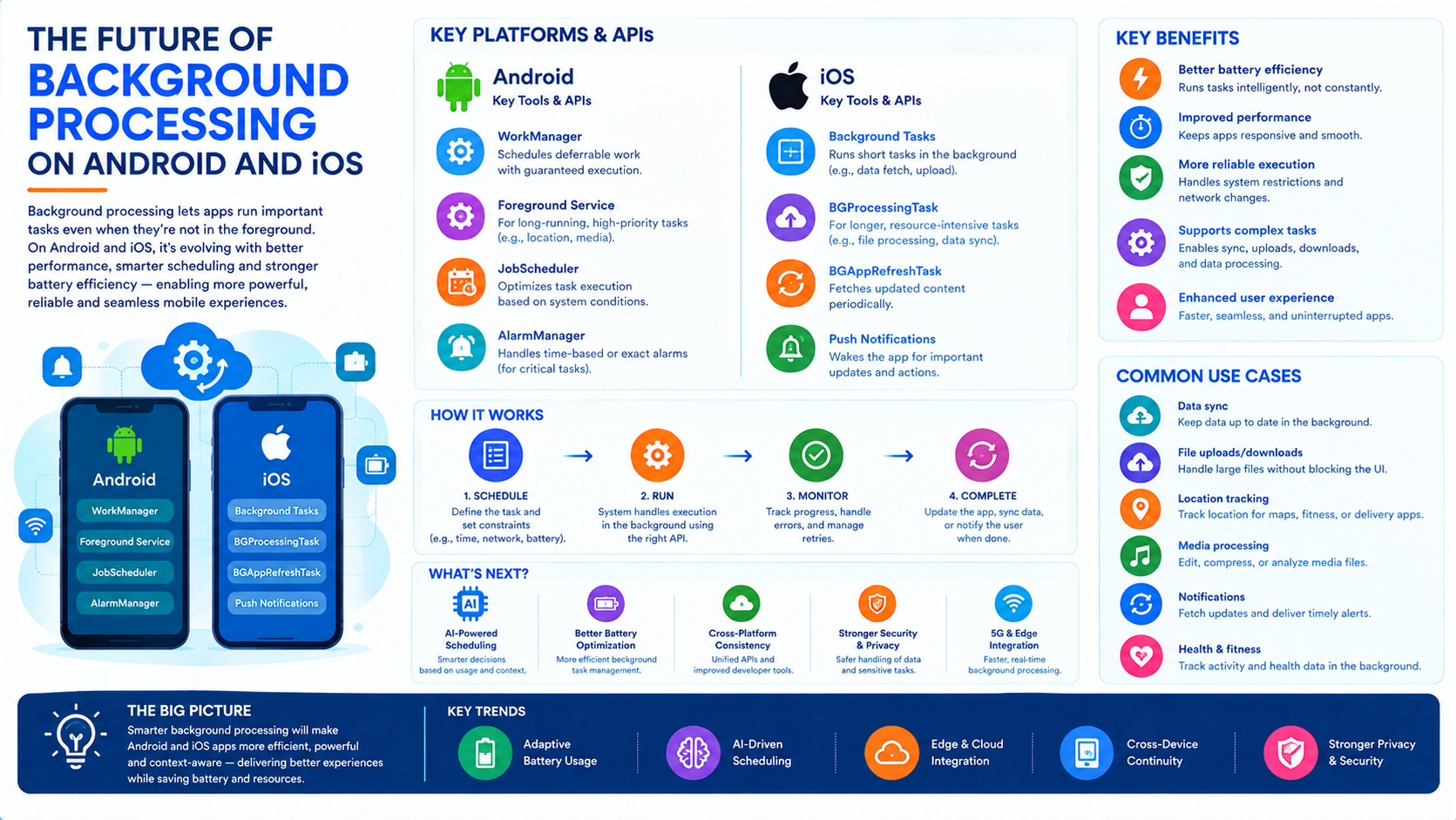
Android's answer to modern background processing is WorkManager, a Jetpack architecture component for handling background work that needs both opportunistic and guaranteed execution .
How WorkManager Works
WorkManager allows developers to define work using the Worker class. The doWork() method runs on a background thread provided by WorkManager, and the return value indicates whether the work succeeded, failed, or should be retried .
The key shift is declarative scheduling. Instead of telling the system when to run a task, you define what the task is and under what conditions it should run. WorkManager then finds the optimal moment to execute it .
Supported constraints include:
-
Network connectivity requirements
-
Charging state
-
Storage availability
-
Device idle state
WorkManager also supports chaining complex work requests, passing outputs from one task as inputs to the next, and handling compatibility back to API level 14 .
The Doze Mode Challenge
One of the most significant constraints on Android is Doze mode, a low-power state the system enters when the device is stationary and the screen is off. Background tasks are heavily restricted during Doze unless they are explicitly marked to run in idle mode.
The native_workmanager Flutter package addressed this by correctly mapping allowWhileIdle to WorkManager's expedited mode. This resolved a regression where background tasks would not fire when the device screen was locked, even after the app was killed .
Foreground Services as a Bypass
For tasks that require immediate or continuous execution, Android provides Foreground Services (FGS). These are prioritized background services that display a persistent notification to the user, signaling that the app is actively performing work.
The native_workmanager library added industrial-grade FGS support, including automatic mapping of task types (dataSync, location, media, etc.) to system-level flags, and proactive task promotion using setForeground() to ensure immediate execution even when the app is in the background .
Boot Persistence
Android applications can register to receive the BOOT_COMPLETED intent, allowing headless Dart code or the app itself to launch when the device boots. This is essential for tasks that need to resume after a device restart .
iOS: BackgroundTasks and the Constraint Triangle
Apple's approach to background processing has evolved through several distinct phases. Prior to iOS 7, third-party applications had extremely limited background execution capabilities. iOS 7 introduced background fetch with approximately 30-second windows. iOS 13 marked the most significant evolution with the BackgroundTasks framework, which replaced legacy APIs with a more powerful and expressive scheduling system .
The Two Principal Task Types
The BackgroundTasks framework provides two principal task types that remain the foundation of iOS background execution :
| Task Type | Purpose | Constraints |
|---|---|---|
| BGAppRefreshTask | Silent content refresh before user use | Short duration, scheduled based on app usage patterns |
| BGProcessingTask | Complex work like ML model execution or database maintenance | Can require network connectivity and external power |
BGProcessingTask is particularly relevant for AI workloads. It can be configured to run only when the device is charging and connected to a network, making it ideal for compute-intensive maintenance operations .
The New BGContinuedProcessingTask
iOS 26 introduced BGContinuedProcessingTask, which allows apps to complete tasks initiated in the foreground even after they have been backgrounded. This improves the user experience by allowing complex tasks to finish without requiring the app to remain open .
The Constraint Triangle
A technical survey of mobile background processing for on-device AI systems identifies three primary physical constraints that form a "constraint triangle" within which viable background computation must operate :
Battery: Finite capacity with user expectation of more than a day of standby time.
Thermal: Sustained AI inference causes 40–50% throughput reduction within two iterations due to thermal throttling.
Memory: The OS terminates background processes on demand, with no guarantee of completion.
The viable background AI window is estimated at 3–6 hours per 24-hour cycle, concentrated during charging periods and device idle states .
Scheduling Heuristics
iOS background tasks are not scheduled on a fixed timetable. The system decides when to run them based on app usage patterns, device state, and system resources. More frequently used apps are scheduled more often. Background tasks that are not run are simply skipped there is no guarantee of execution .
The AI Workload Shift: Background Processing Meets On-Device Intelligence
The rise of on-device AI has created new demands on background processing frameworks. Persistent, always-on cognitive AI systems—on-device AI that maintains continuous user context across sessions separated by hours or days require periodic background maintenance operations that cannot be completed during active user sessions alone .
The Overnight Charging Window
Both platforms converge on the overnight charging period as the optimal execution window for compute-intensive AI maintenance. At 4-bit quantization, 1B–3B parameter models are memory-feasible on current iPhone hardware and can execute at 9-62 tokens per second via the Apple Neural Engine at approximately 2 watts a power budget compatible with charging-period background execution .
Design implications for AI systems:
-
Treat background execution windows as first-class architectural primitives
-
Implement checkpoint-resume patterns for preemption safety
-
Select low-power inference pathways for battery conservation
-
Schedule maintenance operations around charging-constrained windows rather than deferring them opportunistically
Apple's On-Device AI Strategy
At WWDC26, Apple emphasized that privacy remains a core part of its AI strategy, with many AI functions processed on-device or through its Private Cloud Compute infrastructure. Rather than launching a standalone chatbot, Apple is embedding intelligence directly into core workflows communication, productivity, and content creation positioning AI as a background utility rather than a destination app .
This on-device approach aligns with the constraint-aware scheduling model. AI features like image-generation tools, smarter visual recognition, and enhanced search are designed to work within the background execution windows the OS provides.
The Privacy and Regulatory Dimension
Background processing is not just a technical challenge it is increasingly a regulatory one. The European Commission's Digital Markets Act (DMA) decision requires Apple to grant third-party companion apps equal access to background execution functionalities. This includes the ability for third-party apps to maintain connections to connected physical devices, transmit data, and access the network for purposes related to those devices .
Apple must implement these measures by the end of 2026, ensuring that third-party apps have the same background execution capabilities as Apple's own connected devices .
The "Zero-Trust" Mobile Architecture
The store guidelines of 2026 have made one thing clear: mobile operating systems no longer trust applications. Whether handling background network data or rendering a launcher icon, the modern mobile stack demands complete explicitness .
To prevent app store rejections and broken user interfaces, engineering teams must:
-
Enforce strict asset synchronization across all theme state qualifiers
-
Design software with a Local-First approach, relying on native system pickers and intent-driven APIs rather than broad runtime permissions
Cross-Platform Frameworks: Flutter and React Native
Developers building cross-platform applications face additional complexity because background processing APIs differ between Android and iOS.
Flutter: native_workmanager
The native_workmanager Flutter package provides background task scheduling across platforms with 25+ native workers (HTTP, image, crypto, file), task chains, and zero Flutter Engine overhead. It maps tasks to the appropriate native APIs WorkManager on Android, BGTaskScheduler on iOS and handles platform-specific constraints .
Key capabilities:
-
Foreground Service support for Android to bypass background restrictions
-
Automatic mapping of task types to system-level flags
-
FGS state persistence across device reboots
-
iOS improvements for scheduling reliability and Swift Concurrency deadlocks
The TestFlight Problem
A common challenge for Flutter developers is that background tasks scheduled using BGTaskScheduler may work correctly when running locally via USB debugging but fail to execute in TestFlight builds. This is because iOS scheduling heuristics are more aggressive in production, and the system may simply decide not to run the task based on app usage patterns and device state .
The lesson: Background tasks on iOS are never guaranteed. Design for the possibility that they may not run, and ensure your application can function correctly without them.
auto_start_flutter
The auto_start_flutter package focuses on managing background execution permissions, including Android Auto-Start settings (for manufacturers like Xiaomi that have aggressive battery optimization) and iOS Background App Refresh. It also supports headless execution of Dart callbacks without attaching a UI, using a dedicated headless FlutterEngine on Android and a natively-isolated FlutterEngine on iOS .
The Future: Intelligent Systems and Agentic Background Work
The background processing model is evolving alongside the broader shift toward AI-powered operating systems. Google's vision for Android is transitioning from an operating system to an intelligent system where users simply communicate what they want and the system handles context and actions .
Android Halo: Making Background Agents Visible
Google introduced Android Halo, a new feature that provides a dedicated spot in the status bar where AI agents like Gemini can communicate with users while running in the background. As agents become capable of handling more tasks autonomously, they need a place to ask follow-up questions, provide progress updates, or present completed results. Rather than forcing users to jump back into an AI app, Halo gives these agents a persistent communication channel .
The AI agent operates in a containerized virtual window, meaning it can work with the designated app but cannot access other apps. This provides security and privacy boundaries while enabling autonomous background work .
Gemini Spark: Always-On Background Agent
Google also introduced Gemini Spark, an always-on AI agent that performs tasks on behalf of users. Spark can organize schedules, draft emails, create summaries, and monitor subscriptions or online purchases. Unlike traditional voice assistants that react only after a command, Spark is designed to continuously work in the background using cloud-based virtual machines, connecting with Gmail, Docs, Sheets, and third-party apps .
This represents a new category of background work: persistent, autonomous agents that operate across applications, requiring new scheduling models and new transparency mechanisms like Android Halo.
Implementation Roadmap
Phase 1: Audit and Assess (Weeks 1-2)
-
Inventory existing background work. Identify all background tasks, services, and polling mechanisms in your application.
-
Classify by criticality. Which tasks are essential for core functionality? Which are nice-to-have?
-
Assess platform readiness. Review your Android and iOS configurations against current OS requirements.
Phase 2: Migrate to Declarative Scheduling (Weeks 3-4)
-
Android: Migrate from legacy background services to WorkManager. Define constraints for network, charging, and idle state .
-
iOS: Adopt BGTaskScheduler. Register task identifiers in Info.plist and configure BGProcessingTask for compute-intensive work .
-
Use cross-platform tooling like native_workmanager for Flutter applications .
Phase 3: Design for Preemption (Weeks 5-6)
-
Implement checkpoint-resume patterns. Save state before background execution may be interrupted .
-
Design for failure. Assume background tasks may not run. Ensure your application functions correctly without them.
-
Test on real devices. Background execution behavior differs significantly between debug builds and production builds .
Phase 4: Optimize for AI Workloads (Weeks 7-8)
-
Schedule compute-intensive tasks during charging periods using BGProcessingTask with
requiresExternalPower. -
Use low-power inference pathways. The Apple Neural Engine operates at approximately 2 watts for 1B–3B parameter models .
-
Monitor thermal throttling. Sustained inference causes 40–50% throughput reduction. Design for shorter, more frequent windows rather than long sustained runs .
Frequently Asked Questions
Q1: What is the fundamental shift in background processing?
Both Android and iOS have moved from unrestricted background execution to constraint-aware, intent-driven scheduling. Applications declare what they need and under what conditions, and the OS decides when to run it .
Q2: Can I still run long-running background services?
No. Android 16 and iOS 19 heavily throttle background execution unless paired with a user-initiated intent or a restricted Foreground Service type. Silent polling and unrestricted network access are terminated .
Q3: What is BGProcessingTask and why does it matter for AI?
BGProcessingTask is an iOS background task type designed for complex work like ML model execution or database maintenance. It can be configured to run only when the device is charging and connected to a network, making it ideal for compute-intensive AI maintenance .
Q4: What is the "viable background AI window"?
Research estimates 3–6 hours per 24-hour cycle for background AI computation, concentrated during charging periods and device idle states. This is constrained by the "constraint triangle" of battery, thermal, and memory .
Q5: Will background tasks always run?
No. On both platforms, background tasks are scheduled based on system heuristics and device state. There is no guarantee of execution. Applications must be designed to function correctly without relying on background tasks running .
Q6: How can Innovative AI Solutions help?
We help organizations design and implement modern background processing architectures from WorkManager and BGTaskScheduler integration to constraint-aware AI workload scheduling and cross-platform frameworks. Based in Delhi, serving clients across India.
Why Delhi is a Great Hub for Mobile Innovation
Delhi is emerging as a hub for mobile and AI innovation, backed by a thriving app development ecosystem and a mobile-first user base. As Indian enterprises build increasingly complex mobile applications, understanding modern background processing models from declarative scheduling to constraint-aware AI execution becomes essential for delivering reliable, efficient experiences.
What We Offer at Innovative AI Solutions
-
Background Processing Strategy: We help you design constraint-aware scheduling for Android and iOS.
-
WorkManager and BGTaskScheduler Implementation: We migrate legacy background work to modern APIs.
-
AI Workload Optimization: We schedule compute-intensive tasks during optimal execution windows.
-
Cross-Platform Development: We implement background processing with Flutter and native tooling.
-
Compliance and Testing: We ensure background execution behavior meets platform requirements.
Final Thought
The shift is clear: from unrestricted background execution to constraint-aware, intent-driven scheduling. The platforms are converging on a model where the OS is an intelligent scheduler, not a dumb pipe. Applications that embrace this model declaring their needs, designing for preemption, and respecting the constraint triangle will achieve reliable background execution. Those that fight it will find their processes terminated.
Contact Us:
Phone: +91 7464 099 059 / +91 9689967356
Email: info@innovativeais.com
Address: Netaji Subhash Place, Pitampura, Delhi – 110034
Website: https://innovativeais.com
About the Author
Abhishek Kumar
Founder & CEO, Innovative AI Solutions
5+ years building AI, mobile, and enterprise systems. Based in Delhi, serving clients across India.