The Big Question
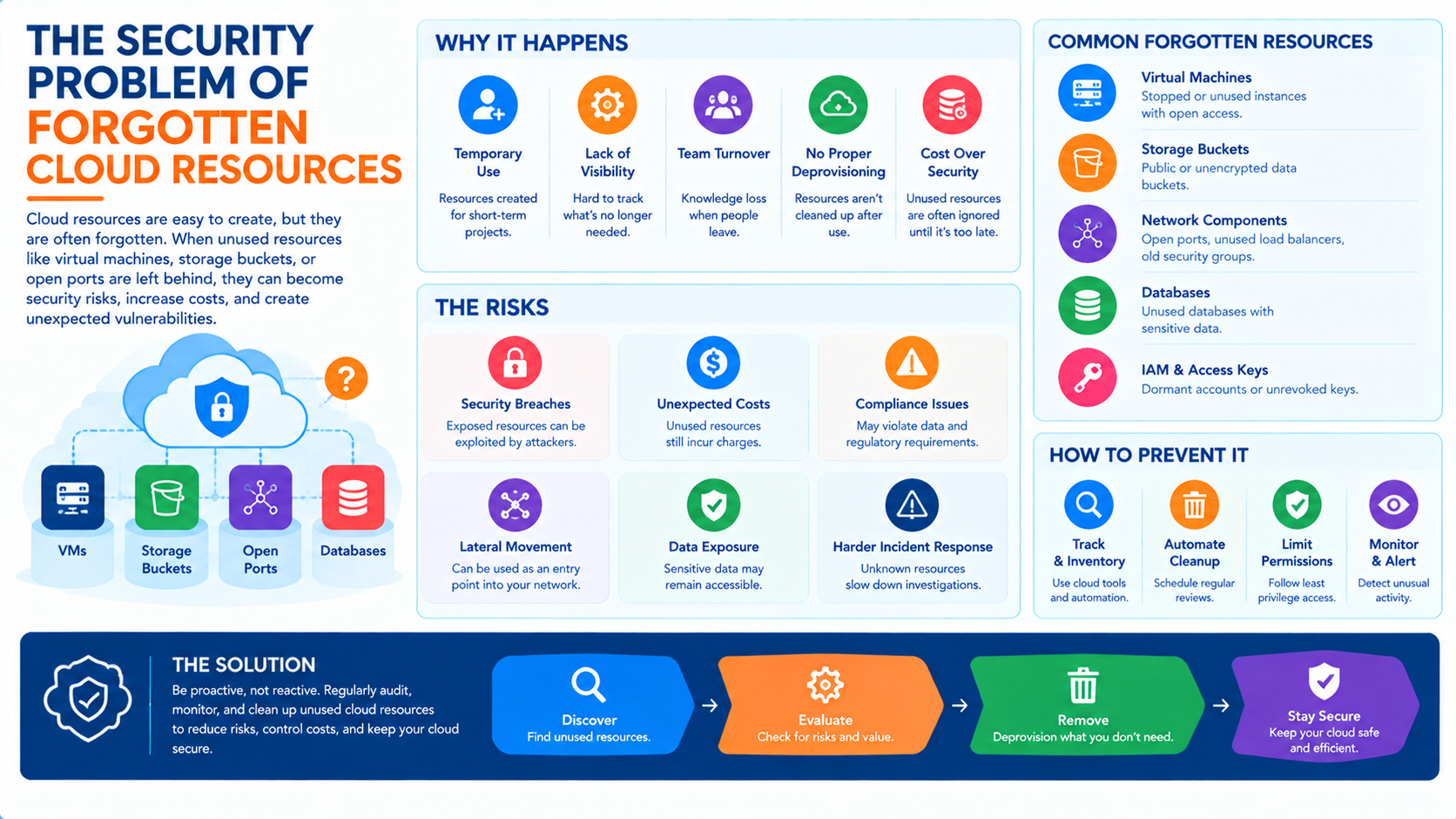
What happens when a storage bucket created for a two-week proof of concept is still publicly accessible three years later? When a service account provisioned for a departed contractor retains administrative privileges? When an API endpoint from a decommissioned feature remains reachable from the internet?
The uncomfortable truth is that most organizations cannot answer these questions with confidence. Cloud environments grow continuously, and resources are far easier to create than to retire. What accumulates is not just cost it is attack surface.
How Forgotten Resources Accumulate
The cloud's greatest strength instant provisioning is also the source of its most persistent security problem. Creating a resource takes minutes. Decommissioning it requires someone to remember it exists, confirm nothing depends on it, and follow a process to remove it.
Resources become forgotten through predictable patterns:
Experimentation without cleanup. Proofs of concept, migrations, and evaluations spin up infrastructure that was never intended to be permanent. When the project ends, the resources remain.
Team changes. When the engineer who created a resource leaves, knowledge of it leaves with them. The resource continues to exist because nothing triggers its removal.
Deprecation without decommissioning. A feature is retired, but the infrastructure behind it databases, queues, endpoints, storage remains in place because removing it is riskier than leaving it.
Incomplete migrations. A workload moves to a new platform, but some components remain in the old environment. Over time, the remaining pieces are forgotten.
Shadow provisioning. Teams provision resources outside formal processes, using personal accounts, trial credits, or unmanaged subscriptions. These resources never appear in central inventories.
Accumulating test and staging environments. Every environment created for testing or staging is a resource that must eventually be maintained or removed. Many are neither.
The result is a long tail of resources that exist, cost money, and are not actively monitored.
Why Forgotten Resources Are a Security Problem
A forgotten resource is a resource that is not being watched. That single fact creates multiple risks.
Unpatched and Unmaintained
Resources that are not actively managed do not receive security updates, configuration hardening, or vulnerability remediation. A forgotten instance running an outdated operating system is a known exploitable target.
Over-Permissive by Default
Resources created for a specific purpose often retain the permissions they were given at creation. A service account created for a temporary integration may still hold broad access long after the integration is gone. Forgotten identities are a primary vector for privilege escalation.
Outside Monitoring Coverage
Monitoring, logging, and alerting are configured for known resources. Forgotten resources may not emit logs, may not be included in security scans, and may not be covered by incident response procedures.
Exposed to the Internet
Resources created with default settings may be publicly accessible. Storage buckets, databases, and API endpoints that were never meant to be public are frequently exposed simply because no one revisited their configuration.
Compliance Violations
Regulatory frameworks require organizations to know what data they hold, where it resides, and who can access it. Forgotten resources containing regulated data without retention policies, access controls, or audit trails represent direct compliance exposure.
A Launchpad for Lateral Movement
An attacker who compromises a forgotten resource inherits whatever permissions that resource holds. From there, they can move laterally into the broader environment, often without triggering alerts configured for known systems.
Why Traditional Controls Miss Forgotten Resources
The challenge is not that organizations lack security tools. It is that existing tools are designed around known inventories.
Asset inventories are incomplete. CMDBs and configuration management systems depend on resources being registered. Resources created outside process never get registered.
Security scanning is scoped. Vulnerability scanners scan what they are told to scan. Forgotten resources are not on the list.
Cost monitoring is not security monitoring. Cloud cost dashboards reveal resources that are actively consuming budget, but a low-usage resource may generate negligible cost while retaining significant privilege.
Ownership is unclear. Without a named owner, no one is accountable for reviewing, patching, or retiring a resource.
Discovery is periodic. Even organizations that perform cloud asset discovery often do so quarterly, while resources accumulate daily.
The gap is not tooling it is continuous discovery and clear ownership.
How Forgotten Resources Are Found
Cloud-Native Inventory Services
Cloud providers offer native inventory and configuration services that list resources across accounts and regions. These are the starting point, but they must be aggregated centrally to be useful.
Cloud Security Posture Management (CSPM)
CSPM tools continuously scan cloud environments for misconfigurations, exposed resources, and policy violations. They also surface resources that exist outside expected configurations, which often correlates with forgotten infrastructure.
External Attack Surface Management (EASM)
EASM tools discover internet-facing assets domains, endpoints, certificates, and services that an organization may not know it owns. This is particularly valuable for catching shadow resources that never appeared in internal inventories.
Usage and Access Analysis
Resources that have not been accessed in a defined period no API calls, no logins, no data reads or writes are candidates for retirement. Access logs are the evidence.
Cost Anomaly Detection
While cost is not a security signal, unusual or persistent low-level spending often correlates with forgotten resources. Sudden cost spikes can indicate misuse of an unmonitored resource.
Identity and Entitlement Reviews
Regular reviews of IAM roles, service accounts, and access keys reveal identities that no longer serve a purpose. Unused identities are among the highest-value targets to remove.
Building a Lifecycle Discipline
Discovery alone does not solve the problem. What is needed is a lifecycle discipline that prevents resources from being forgotten in the first place.
Mandatory Ownership at Creation
Every resource must be tagged with an owner, a purpose, and an expected lifetime. Resources without ownership cannot be created.
Expiration by Default
Resources should carry an expiration date. When the date passes, the resource is flagged for review or automatically retired unless explicitly renewed. This inverts the default: instead of resources living forever unless someone remembers to delete them, they expire unless someone actively keeps them.
Periodic Recertification
Owners are prompted at defined intervals to confirm that their resources are still needed, correctly configured, and appropriately scoped. Resources that are not recertified are flagged for removal.
Automated Deprovisioning
When a resource is confirmed unnecessary, removal should be automated and auditable not left to a manual process that may never complete.
Continuous Discovery
Discovery must run continuously, not quarterly. New resources, changes to existing resources, and resources that fall outside expected patterns should be surfaced in near real time.
Clear Escalation
When a resource has no owner or an unresponsive owner, there must be an escalation path that leads to a decision either assignment or removal.
Implementation Roadmap
Phase 1: Discover (Weeks 1-4)
-
Aggregate native inventories across all cloud accounts, regions, and providers.
-
Deploy CSPM to identify misconfigurations and unexpected resources.
-
Deploy EASM to discover internet-facing assets that internal inventories miss.
-
Establish a baseline. Produce a list of all known resources and their owners.
Phase 2: Classify and Remediate (Weeks 5-8)
-
Identify orphaned resources. No owner, no recent access, no clear purpose.
-
Prioritize by risk. Internet-exposed, over-privileged, and regulated-data resources first.
-
Remediate. Remove what is clearly unnecessary. Assign ownership where the resource is still needed.
Phase 3: Prevent (Weeks 9-12+)
-
Mandate ownership and expiration at resource creation.
-
Implement recertification at defined intervals.
-
Automate deprovisioning for resources that fail recertification.
-
Monitor continuously for new resources outside expected patterns.
Frequently Asked Questions
Q1: What is a forgotten cloud resource?
A forgotten cloud resource is any deployed resource storage bucket, compute instance, database, IAM role, API endpoint that is no longer actively managed, monitored, or owned by anyone.
Q2: Why are forgotten resources a security problem?
Because they are unmonitored and unmaintained. They may be unpatched, over-permissive, publicly exposed, and outside the coverage of security scanning and incident response.
Q3: How do I find forgotten resources?
Use cloud-native inventory services, CSPM tools, EASM tools, usage and access analysis, cost anomaly detection, and identity reviews. Discovery must run continuously, not periodically.
Q4: How do I prevent resources from being forgotten?
Mandate ownership and expiration at creation. Require periodic recertification. Automate deprovisioning. Make discovery continuous.
Q5: Isn't removing resources risky?
Yes, which is why removal should be preceded by usage analysis and a review period. The goal is a discipline that makes removal safe and routine not a one-time purge.
Q6: How can Innovative AI Solutions help?
We help organizations discover, classify, and remediate forgotten cloud resources and build the lifecycle discipline that prevents them from accumulating. Based in Delhi, serving clients across India.
Why Delhi is a Great Hub for Cloud Security Innovation
Delhi is emerging as a hub for cloud and security innovation, backed by a thriving IT services ecosystem and growing regulatory expectations around data protection and resilience. As Indian enterprises scale their cloud footprints, the discipline of continuous resource discovery and lifecycle management becomes essential for maintaining both security and cost efficiency.
What We Offer at Innovative AI Solutions
-
Cloud Resource Discovery: We aggregate inventories and identify resources outside expected patterns.
-
Orphaned Resource Remediation: We help you classify, prioritize, and safely remove forgotten resources.
-
Lifecycle Discipline Design: We build ownership, expiration, and recertification processes.
-
Continuous Monitoring: We implement ongoing discovery and anomaly detection.
-
Compliance Alignment: We ensure resource inventories support audit and regulatory requirements.
Final Thought
The shift is clear: from assuming your inventory is complete to continuously proving it. Forgotten cloud resources are not an edge case they are an inevitable consequence of how cloud environments grow. Organizations that build continuous discovery and lifecycle discipline will eliminate both the cost and the risk. Those that do not will keep discovering their own infrastructure at the worst possible moment.
Contact Us:
Phone: +91 7464 099 059 / +91 9689967356
Email: info@innovativeais.com
Address: 904, 9th floor Pearls Best Heights-I, Netaji Subhash Place, Delhi-110034
Website: https://innovativeais.com
About the Author
Abhishek Kumar
Founder & CEO, Innovative AI Solutions
5+ years building AI, cloud, and enterprise systems. Based in Delhi, serving clients across India.