The Big Question
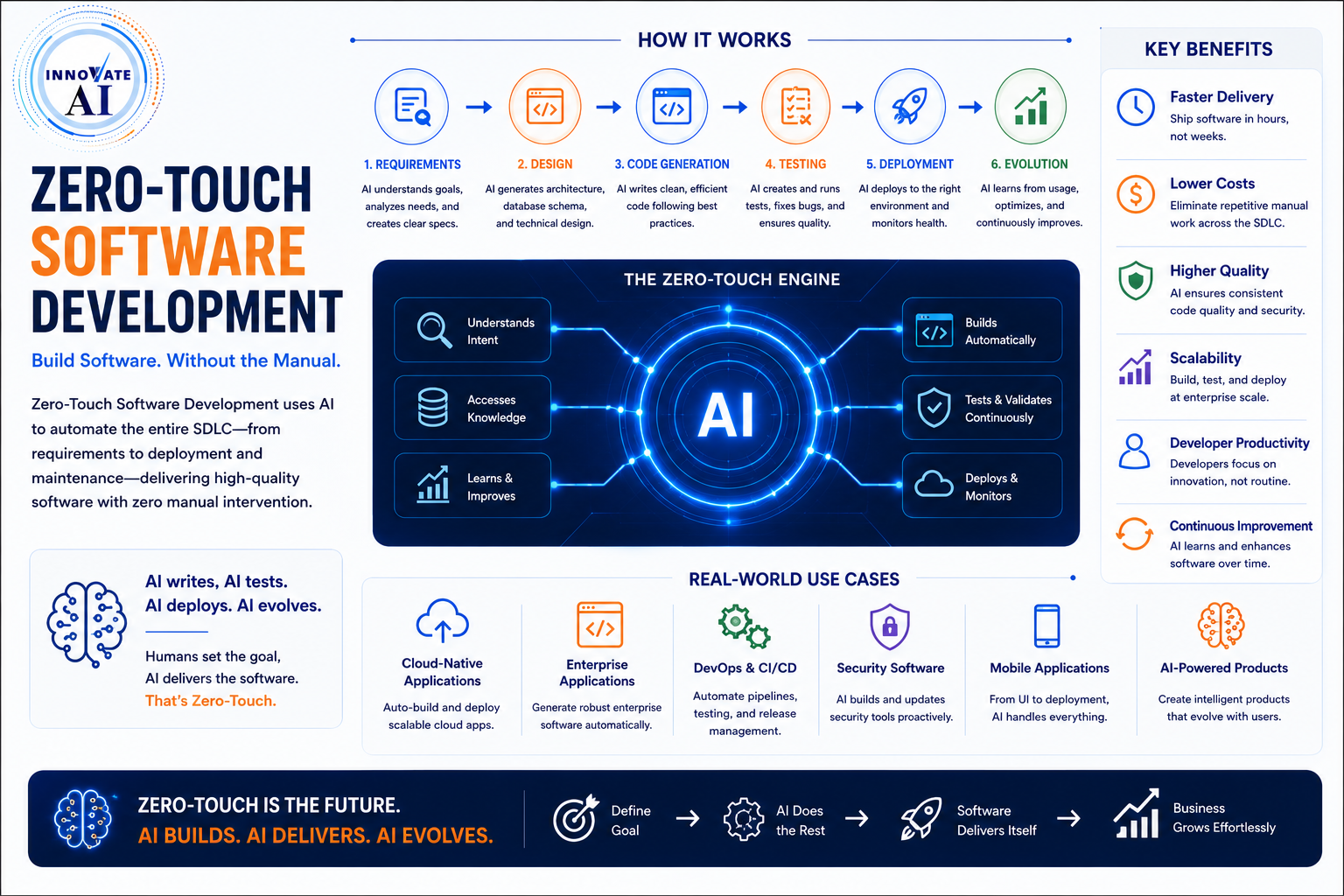
What happens when the entire software development lifecycle—from feature request to production deployment—runs autonomously, with humans involved only in defining intent and validating outcomes? What if your software could write itself, test itself, and deploy itself?
Zero-touch software development is answering these questions. And it's redefining what's possible in software delivery.
What Is Zero-Touch Software Development?
Zero-touch software development represents the complete automation of the software delivery pipeline—removing humans from the execution path of code creation, testing, and deployment. Teams using this approach achieve up to 7x higher deployment frequency and 60% lower change failure rates.
The Core Components
Zero-touch development rests on three foundational pillars:
| Component | What It Does |
|---|---|
| Autonomous Code Generation | AI agents write code from natural language descriptions |
| Autonomous Testing | AI generates, executes, and validates end-to-end tests |
| Zero-Touch Deployment | Automated pipelines deploy without manual intervention |
Code Generation: From Intent to Implementation
The Rise of AI Coding Agents
AI-powered coding tools are transforming how software gets written. GitHub Copilot, Amazon Q Developer, and similar tools can fork repositories and implement features based on learning from existing code. Studies indicate that AI-driven coding helpers can enhance developer productivity by 30-50%.
The Conceptual Level Shift
The most advanced tools work at the conceptual level—you describe what you want, not how to do it. Imploid, an AI-powered coding agent, handles the full development cycle:
-
Creates branches, commits, and PRs automatically
-
Works from natural language descriptions
-
Maintains context across sessions
-
Learns from your codebase
Infrastructure as Code Generation
AI is also automating infrastructure provisioning. The Terraform AI Agent converts natural language prompts into validated Terraform code:
-
User enters infrastructure request in plain English
-
AI generates Terraform code while checking for existing infrastructure
-
Auto-validates with
terraform fmt,validate, and TFLint -
Deploys via GitHub Actions with a single click
The result: deployment time reduces from hours to minutes.
Autonomous Validation: Testing That Writes Itself
The Complete Workflow
The combination of autonomous code generation with autonomous testing creates a feedback loop that ensures quality without manual intervention:
-
Generate Implementation: AI writes code from feature description
-
Generate Tests: AI creates end-to-end tests based on the feature
-
Execute Tests: Tests run against the running application
-
Feedback Loop: Failed tests inform the next iteration
-
Deploy: Passed tests trigger automatic deployment
The qa-use MCP Integration
Desplega.ai's qa-use MCP server enables Claude Code to:
-
Generate natural language test scenarios
-
Execute them against running applications
-
Capture screenshots and interaction flows
-
Provide detailed test reports that can be promoted to regression test suites
Automated Test Generation Tools
Tools like Meta's TestGen-LLM and Gradle's Developcity improve unit test coverage and cut test cycle time. AI can also differentiate between product bugs, test bugs, and environment bugs—generating suggestive fixes for developers to review.
The Autonomous Deployment Stack
Zero-Touch Deployment Defined
Zero-touch deployment removes humans from the deployment path. Not to remove accountability, but to make outcomes consistent and reliable. Teams using full pipeline automation see:
-
Up to 7x higher deployment frequency
-
60%+ lower change failure rates
-
Faster recovery times with automated rollbacks
The Pipeline-First Approach
A pipeline-first approach spans CI/CD, secrets hygiene, commit signing, and reproducible build environments—all coupled with containerized toolchains to ensure parity from development through production.
The SPAWN Project: A Complete Autonomous Factory
SPAWN (Self-Programming Autonomous Web Node) represents the most comprehensive zero-touch development platform available. It turns any Ubuntu machine into an autonomous development environment:
-
You describe what you want in plain English
-
SPAWN writes the code, installs dependencies, creates the database
-
Configures reverse proxy, starts the process, makes it live at a URL
-
Monitors its own health and fixes its own bugs
Projects run on demand—not at boot. An idle watchdog spools projects back down when not in use. The entire system is managed through a dashboard with built-in terminal, file editor, and one-click deploys.
Industrial Scale: Zero-Touch ML Deployment
In industrial settings, zero-touch ML deployment solves the scaling challenge that prevents AI from moving beyond pilot projects. Traditional approaches require site-specific model tuning; zero-touch uses:
-
Parameter-driven configuration over retraining
-
Hardware abstraction for device-agnostic inference
-
Centralized model versioning and distribution
-
Label-free monitoring using proxy metrics
The Self-Healing Pipeline
Autonomous Bug Fixing
The next frontier is self-healing pipelines. AI tools like CircleCI MCP Server and Dynatrace Davis AI can:
-
Diagnose known build failures and mitigate them
-
Analyze test failures to determine root cause
-
Attempt remediation or generate suggestive fixes
The Feedback Loop
The complete autonomous pipeline creates a continuous improvement loop:
-
Generate code from intent
-
Validate through automated testing
-
Deploy with zero-touch pipelines
-
Monitor for failures
-
Repair autonomously
-
Learn from every incident
Implementation Roadmap: The First 90 Days
Phase 1: Foundation (Weeks 1-4)
-
Audit current pipeline: Measure deployment frequency, change failure rate, and MTTR
-
Identify automation gaps: Where do manual interventions still exist?
-
Establish governance: Define permissions, approval gates, and rollback mechanisms
-
Select pilot use case: Choose one low-risk, high-frequency deployment
Phase 2: Build Automation (Weeks 5-8)
-
Implement zero-touch CI/CD: Automate the full deployment path
-
Deploy AI code generation: Start with GitHub Copilot or Amazon Q Developer
-
Enable automated testing: Use TestGen-LLM or similar for test generation
-
Measure improvements: Track deployment frequency, failure rates, and recovery times
Phase 3: Enable Autonomy (Weeks 9-12+)
-
Deploy autonomous code generation: Use Imploid, SPAWN, or similar
-
Implement autonomous validation: Enable end-to-end test generation
-
Enable self-healing: Deploy failure diagnosis and remediation
-
Scale to additional teams and applications
Frequently Asked Questions
Q1: What is zero-touch software development?
Zero-touch software development removes humans from the execution path of software delivery—from code generation through testing and deployment. Humans define intent; AI executes.
Q2: What results can organizations achieve?
Teams using zero-touch deployment achieve up to 7x higher deployment frequency and 60%+ lower change failure rates. AI-enabled development shortens delivery times by 20-40%.
Q3: Can AI really write production-ready code?
Yes, but with validation. The most effective approach combines AI generation with autonomous testing that validates every change. Failed tests inform the next iteration until quality is assured.
Q4: What is the autonomous development workflow?
You provide a feature request → AI generates implementation → AI generates and executes tests → If tests pass, deploy; if they fail, iterate until quality is assured.
Q5: Is zero-touch deployment secure?
Yes. Zero-touch pipelines enforce security and compliance by default—not by memory. Secrets hygiene, commit signing, and reproducible build environments are built into the pipeline.
Q6: How can Innovative AI Solutions help?
We help organizations design, build, and operationalize zero-touch development pipelines—from AI code generation and autonomous testing to zero-touch deployment and self-healing infrastructure. Based in Delhi, serving clients across India.
Why Delhi is a Great Hub for AI Development
Delhi is emerging as a significant hub for AI development, backed by concrete government support and infrastructure. The recent Delhi Budget 2026-27 allocated ₹8.20 crore for two Artificial Intelligence centres of excellence (AI-CoEs), functioning as hubs for research, innovation, and startup incubation.
The city's AI infrastructure is expanding rapidly. Under the IndiaAI Mission, more than 38,000 high-end GPUs have been onboarded and are available at approximately ₹65 per hour—roughly one-third of the global average cost.
The government has also announced a ₹350 crore startup policy over five years, aiming to support the emergence of at least 5,000 startups by 2035, with key focus areas including artificial intelligence, machine learning, and automation.
The AI ecosystem in Delhi combines: cost-effective infrastructure, government support, a growing talent pool, and proximity to the country's business decision-makers.
What We Offer at Innovative AI Solutions
After five years of building AI solutions for businesses, we've developed a practical approach that focuses on what actually works:
-
Zero-Touch Strategy: We help you assess your pipeline and design an automation roadmap
-
AI Code Generation: We help you deploy and optimize AI coding agents
-
Autonomous Testing: We help you implement AI-driven test generation and execution
-
Zero-Touch Deployment: We help you build fully automated CI/CD pipelines
-
Self-Healing Pipelines: We help you implement autonomous failure diagnosis and remediation
-
Governance and Compliance: We help you establish security, permissions, and audit trails
Our approach is built on the reality that zero-touch development isn't just about speed—it's about building systems that deliver software reliably, securely, and continuously.
Final Thought
The vision of zero-touch software development is becoming reality. From SPAWN creating production applications from plain English prompts to industrial zero-touch ML deployment scaling across hundreds of factories, the technology is proving itself.
The shift is clear: from humans writing code and pushing deploy buttons, to humans defining intent and AI executing the entire delivery pipeline.
Companies that embrace this transformation will achieve deployment frequencies and reliability that were impossible with traditional approaches. Those that don't will be left behind.
Contact Us:
Phone: +91 7464 099 059 / +91 9689967356
Email: info@innovativeais.com
Address: Netaji Subhash Place, Pitampura, Delhi – 110034
Website: https://innovativeais.com
About the Author
Abhishek Kumar
Founder & CEO, Innovative AI Solutions
5+ years building AI systems for enterprises. Based in Delhi, serving clients across India.
Hashtags: #ZeroTouch #DevOps #AICodeGeneration #AutonomousTesting #DevSecOps #PlatformEngineering #InnovativeAISolutions
Related services: to apply this in your business, explore our custom software development and AI development services.