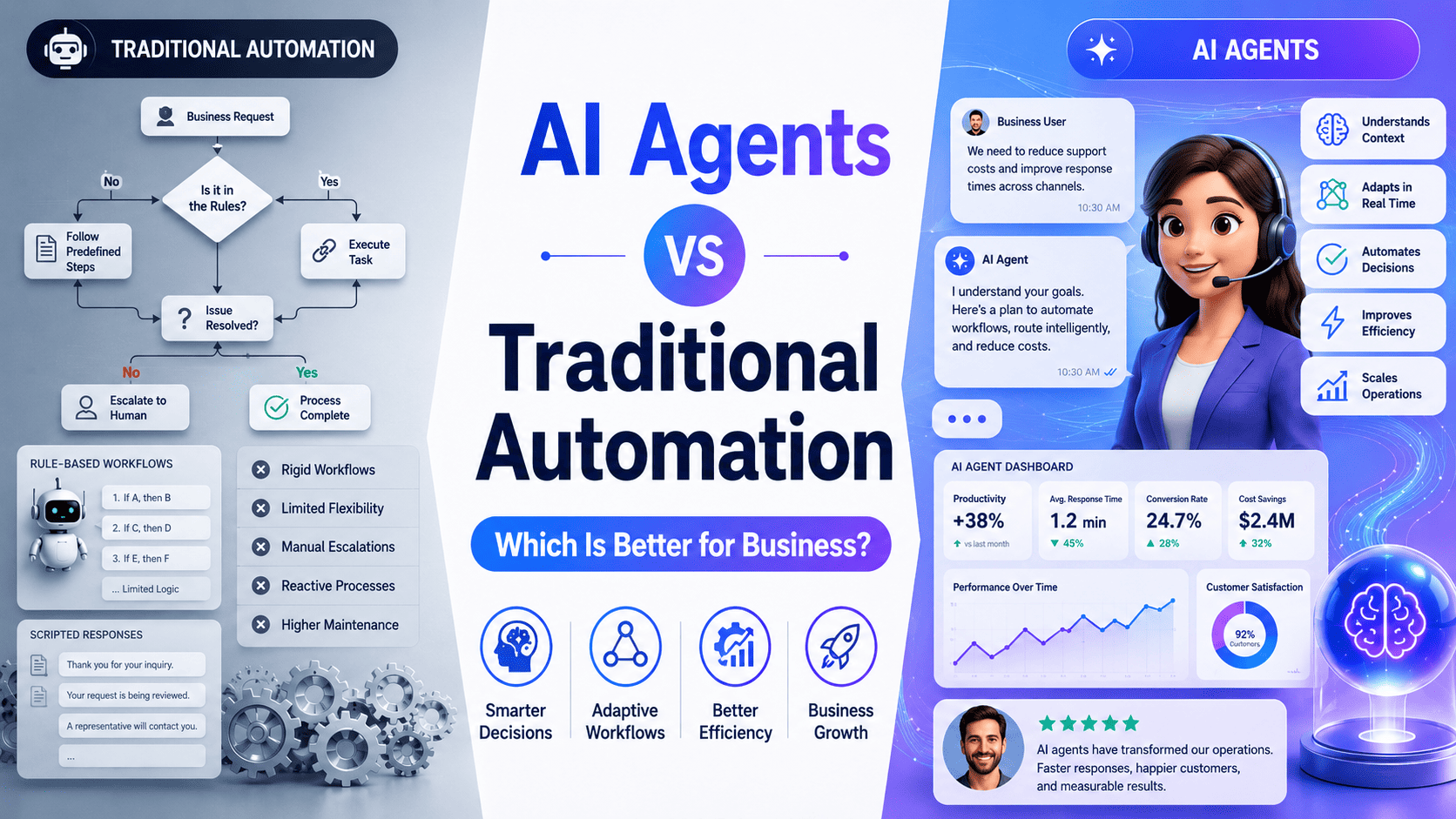
The Automation Choice Delhi Businesses Are Getting Wrong in 2026
Every enterprise technology cycle produces a term that gets stretched until it means almost nothing. In 2023 it was “generative AI.” In 2026, it is “agentic AI.”
Delhi businesses are now drowning in vendor pitches. Every RPA script has been rebranded as an “agent.” Every workflow tool claims “autonomous intelligence.” The confusion is costing businesses real money — through misaligned investments, failed implementations, and systems that either break under uncertainty or overreach with dangerous autonomy.
The data tells a sobering story. Gartner projects that 40% of enterprise applications will embed task-specific AI agents by the end of 2026, up from under 5% a year earlier — an eightfold jump. Yet the same analyst firm expects more than 40% of agentic AI projects to be cancelled by the end of 2027, citing escalating costs, unclear business value, and inadequate risk controls.
The failure is not about model quality. It is about choosing the wrong tool for the job.
McKinsey’s data shows only around 23% of organisations are actually scaling an agentic AI system anywhere in the enterprise, while roughly two-thirds remain stuck in experimentation or pilot mode. The gap between “using AI agents” and “running agents in production” is the single most important number for any Delhi business leader to internalise.
This guide cuts through the noise. It provides a structured, India-specific framework for deciding when traditional automation is the right choice, when AI agents deliver genuine value, and how to govern both.
Defining the Two Approaches: A Fundamental Difference in Kind
Traditional Automation: Deterministic by Design
Traditional automation follows rigid, predefined rules. A workflow executes a series of steps designed by a human. An RPA bot repeats a captured process exactly as recorded. A script performs the same actions every time it is triggered.
The common theme is determinism. Given the same inputs, traditional automation produces the same outputs every time. This predictability is its greatest strength. It is ideal for highly structured, repeatable, business-critical processes where consistency matters more than flexibility.
Examples of processes suited to traditional automation:
-
Payroll processing and financial approvals
-
User provisioning and password resets
-
Compliance workflows with explicit rules
-
Procurement routing and scheduled reports
-
Data synchronisation between systems
AI Agents: Goal-Driven and Adaptive
AI agents are fundamentally different. They interpret intent, reason across multiple sources of information, plan multi-step sequences, and adapt to new information.
An agent built on a large language model with tool access and memory interprets a goal and figures out a path toward it — checking a database here, calling an API there, asking a human when confidence drops. Where traditional automation executes logic predefined by people, agentic AI generates logic dynamically without human guidance.
Examples of tasks suited to AI agents:
-
Complex support triage with ambiguous inputs
-
Contract intake and anomaly detection
-
Incident response coordination across systems
-
Internal knowledge-driven operations
-
Exception handling in unstructured workflows
| Dimension | Traditional Automation | AI Agents |
|---|---|---|
| Core principle | Rule-based (“IF-THEN”) | Goal-based (“Reasoning”) |
| Decision making | Deterministic, pre-programmed | Autonomous, context-aware |
| Data handling | Structured data only | Structured and unstructured |
| Adaptability | Brittle, breaks on change | Adaptive, handles exceptions |
| Task complexity | Simple, linear, repetitive | Complex, multi-step, dynamic |
| Failure mode | Stops and alerts human | May generate novel errors |
| Testing approach | Unit and integration tests | Evaluation datasets and regression suites |
What Delhi Businesses Are Actually Deploying in 2026
The Real Production Gap
Despite aggressive adoption intent, most Delhi enterprises remain in pilot mode. Gartner’s 2026 CIO survey found only 17% of organisations have deployed AI agents to date, yet more than 60% expect to do so within two years — the most aggressive adoption curve among all emerging technologies measured.
Cisco’s AI Readiness Index found that while 83% of organisations plan to deploy autonomous agents, only about one in three believe their infrastructure is actually ready to support them.
The failure rate is not trivial. When agentic AI initiatives fail, it is rarely because the model was not capable enough. It is because of missing data infrastructure, unclear success metrics, or absent governance.
Where Delhi Businesses Are Seeing Real Value
Software engineering and IT operations consistently lead real-world agentic deployments. Coding tasks are well-defined and testable, giving agents clear feedback signals to self-correct. Delhi’s growing startup ecosystem is adopting agents for code review, test generation, and incident triage.
Back-office and finance operations represent the second strongest use case. Invoice matching, reconciliation, and compliance documentation are structured, rules-heavy processes — exactly where agents can plan multiple steps and check their own work against clear criteria.
Customer query resolution is emerging as a production category. Unlike simple chatbots that match keywords, AI agents can understand intent, access account history, and orchestrate resolutions across systems.
For Delhi businesses exploring AI automation services, the pattern is clear: agents work best where the work is variable, contextual, and exception-prone. Traditional automation works best where the work is predictable, structured, and compliance-sensitive.
The Cost Reality: What Delhi Businesses Actually Pay
Implementation Cost Ranges
| Automation Type | Implementation Cost (INR) | Implementation Cost (USD) | Ongoing Monthly (INR) |
|---|---|---|---|
| Traditional workflow automation | ₹50,000–₹2,00,000 | $600–$2,400 | ₹5,000–₹25,000 |
| RPA for legacy systems | ₹1,50,000–₹5,00,000 | $1,800–$6,000 | ₹15,000–₹50,000 |
| AI chatbot (conversational) | ₹2,00,000–₹6,00,000 | $2,400–$7,200 | ₹20,000–₹75,000 |
| AI agent (single-domain) | ₹4,00,000–₹12,00,000 | $4,800–$14,400 | ₹40,000–₹1,20,000 |
| Agentic AI system (multi-step) | ₹8,00,000–₹25,00,000+ | $9,600–$30,000+ | ₹75,000–₹2,50,000+ |
The Total Cost of Reliable Completion
The better cost question is not “How much does the model call cost?” It is: What is the total cost of reliable completion?
That includes model and infrastructure cost, latency and retry behaviour, human review time, failure handling, monitoring and evaluation, security and compliance controls, and maintenance as systems change. A cheap agent that creates expensive cleanup work is not cheap. It is just moving the invoice to another department.
Traditional automation, when properly designed for a stable process, has lower total cost of ownership. AI agents introduce non-determinism, which means testing, monitoring, and governance costs are higher. The trade-off is justified only when the work genuinely requires adaptability.
The Governance Imperative: India-Specific Requirements
Why Governance Is Not Optional
An agent with tool access and no guardrails is not an upgrade — it is a liability with a friendlier interface. Give a model the ability to move money, update records, or trigger downstream workflows, and you have given it real consequences.
For Delhi businesses operating under DPDPA and MeitY’s AI Governance Guidelines, governance is a regulatory requirement, not a design preference.
The Four Things Every Production Agent Must Have
A practical rule for 2026 is that every production agent should have four things before launch:
-
A defined owner — a human accountable for its decisions
-
A clear decision boundary — what it can and cannot do
-
An escalation path — when and how it hands off to humans
-
A measurable success metric — how you know it is working
Governance Questions for Delhi Businesses
Before deploying any AI agent, verify:
-
How does the system handle personal data under DPDPA?
-
What audit trails exist for agent decisions and actions?
-
How does the agent escalate to human operators?
-
What happens when the agent produces incorrect outputs?
-
Who is accountable when the system is wrong?
If the answer to the last question is unclear, the workflow is not ready for scale.
Decision Framework: Choosing the Right Approach
Use Traditional Automation When:
-
The process is predictable and rules are stable
-
Inputs are structured and consistent
-
Compliance requires auditability and determinism
-
Errors carry significant financial or regulatory consequences
-
The environment is unlikely to change frequently
Good examples for Delhi businesses: Payroll processing, GST filing workflows, employee onboarding, vendor payment approvals.
Use AI Agents When:
-
The work requires interpreting context and handling ambiguity
-
Inputs are unstructured (emails, documents, conversations)
-
Multiple systems must be coordinated to complete a task
-
Exceptions are common and require judgment
-
The process involves natural language interaction
Good examples for Delhi businesses: Customer support triage, contract intake and review, procurement exception handling, multi-step internal operations.
The Hybrid Approach
The most durable architectures keep deterministic rules for the parts of a process that genuinely are deterministic — tax calculations, compliance thresholds, hard business logic — and reserve the agent for the parts that involve judgment, ambiguity, or unstructured input.
Treating an LLM-based agent as a wholesale replacement for a rules engine is how you end up with a system that is technically more “intelligent” and practically less reliable, because you have traded predictability for flexibility in places that never needed flexibility to begin with.
Decision Matrix: Matching Approach to Business Need
| Your Situation | Recommended Approach | Rationale |
|---|---|---|
| High-volume, structured data entry | Traditional automation | Deterministic, auditable, low cost |
| Customer queries with varied phrasing | AI agent (copilot mode) | Handles ambiguity, human reviews output |
| Invoice processing with format variations | Hybrid: rules for validation, agent for exceptions | Combines reliability with adaptability |
| Compliance-sensitive approvals | Traditional automation | Auditability and determinism required |
| Multi-system incident response | AI agent with guardrails | Coordinates across tools, adapts to context |
| Legacy system with no API | RPA (tactical) | Bridges gap until proper integration |
| Knowledge-intensive support | AI agent | Interprets intent, orchestrates actions |
Implementation Scorecard for Delhi Businesses
| Criteria | Weight | Score (1–5) | Weighted Score |
|---|---|---|---|
| Process variability (higher = better for agents) | 25% | ||
| Data structure (unstructured favors agents) | 20% | ||
| Error tolerance (lower = better for rules) | 15% | ||
| Compliance requirements | 15% | ||
| Integration complexity | 10% | ||
| Internal AI capability | 10% | ||
| Budget alignment | 5% | ||
| Total | 100% | /5 |
A score below 2.5 suggests traditional automation. Above 3.5 suggests AI agent potential with proper governance.
Frequently Asked Questions
1. What is the fundamental difference between AI agents and traditional automation?
Traditional automation follows rigid, predefined rules and produces the same outputs for the same inputs. AI agents interpret goals, reason across multiple information sources, and adapt their approach dynamically. Traditional automation is deterministic; AI agents are probabilistic.
2. When should a Delhi business choose traditional automation over AI agents?
Choose traditional automation when the process is predictable, inputs are structured, and compliance requires auditability. Payroll, financial approvals, user provisioning, and compliance workflows are ideal candidates. The common mistake is adding an agent to make the process feel modern.
3. When do AI agents deliver genuine value for Delhi businesses?
AI agents excel when work requires interpreting context, handling unstructured inputs, coordinating across multiple systems, and adapting to exceptions. Customer support triage, contract intake, and multi-step operations are strong use cases. The common mistake is giving agents too much freedom.
4. What is the total cost of ownership for AI agents vs traditional automation?
Traditional automation has lower total cost of ownership for stable processes. AI agents carry higher testing, monitoring, and governance costs due to non-determinism. The better cost question is not model call cost, but total cost of reliable completion — including human review and failure handling.
5. How do AI agents fail differently from traditional automation?
Traditional automation breaks predictably and loudly — it stops and alerts a human. AI agents may generate novel mistakes, succeeding 98% of the time while failing in unexpected ways on the remaining 2%. This makes monitoring and guardrails essential.
6. What governance is required for AI agents in India?
Every production agent should have a defined owner, clear decision boundaries, an escalation path, and measurable success metrics. Under DPDPA, data handling must comply with consent and minimisation requirements. MeitY’s AI Governance Guidelines emphasise human-centricity and accountability.
7. Should Delhi businesses replace RPA with AI agents?
No. The most durable architectures keep deterministic rules for deterministic parts and reserve agents for judgment and ambiguity. Treating an LLM-based agent as a wholesale replacement for a rules engine trades predictability for flexibility in places that never needed it.
8. How long does it take to deploy an AI agent vs traditional automation?
Traditional workflow automation can deploy in 2–4 weeks. Single-domain AI agents take 4–8 weeks. Multi-step agentic systems take 8–16 weeks. Timelines depend on integration complexity and governance requirements.
9. What is the failure rate for agentic AI projects?
Gartner expects more than 40% of agentic AI projects to be cancelled by the end of 2027, citing escalating costs, unclear business value, and inadequate risk controls — not model quality. The failure causes are organisational, not technical.
10. How do I know if my process is a good candidate for AI agents?
Score your process against four criteria: variability (does it require judgment?), data structure (is input unstructured?), integration complexity (does it span multiple systems?), and error tolerance (what happens when it fails?). High variability and unstructured data favour agents. Low tolerance and compliance sensitivity favour rules.
11. What is the hybrid approach to automation?
The hybrid approach uses deterministic rules for stable, compliance-sensitive steps and AI agents for judgment-dependent, exception-handling steps. This combines reliability with adaptability. Most successful enterprise deployments use this pattern.
12. How can Innovative AI Solutions help?
Innovative AI Solutions is a Delhi-based AI development company specialising in agentic AI systems, workflow automation, and governance frameworks for Indian businesses. We help organisations decide between traditional automation and AI agents based on the nature of their work, then implement production systems with proper guardrails, escalation paths, and DPDPA-compliant data handling. Learn more at https://innovativeais.com.
Contact Innovative AI Solutions
Ready to choose the right automation approach for your business?
We help Delhi businesses evaluate, design, and deploy automation systems that match the nature of their work — whether that means deterministic workflows or governed AI agents.
Contact Information
Innovative AI Solutions
📍 Netaji Subhash Place, Pitampura, Delhi – 110034
🌐 Website: https://innovativeais.com
📧 Email: info@innovativeais.com
📞 Phone: +91 7464 099 059 / +91 96899 67356
Business Services
• AI Automation
• AI Development
• AI Consulting
• Machine Learning Solutions
• Deep Learning Solutions
• Generative AI Services
• NLP Solutions
• AI Agents
• AI Chatbots
• Voice AI
• CRM Development
• Custom Software Development
• Website Development
• Mobile App Development
About the Author
Abhishek Kumar
Founder & CEO, Innovative AI Solutions
5+ years building production AI systems for Indian businesses. Based in Delhi, serving clients across India.
Ready to build AI solutions for your business?
Innovative AI Solutions — Delhi's leading AI development company. Free consultation available.
Get Free Consultation →
A practical 2026 decision framework for Delhi businesses choosing between AI agents and traditional automation based on the nature of their work.
#AIAgents #TraditionalAutomation #AgenticAI #DelhiBusiness #WorkflowAutomation #RPAvsAI #BusinessAutomation #AutomationStrategy #AIgovernance #DPDPA #DelhiNCRTech #EnterpriseAI #IntelligentAutomation #AutomationROI #AIDecision #HybridAutomation #HumanInTheLoop #AIagentsIndia #TechDecision #DigitalTransformation #AIconsulting #AgenticWorkflows #AutomationGovernance #InnovativeAISolutions
Copyright ©️ 2015–2026 Innovative AI Solutions. All Rights Reserved. | Privacy Policy | Terms & Conditions