Why Choosing the Right AI Partner Matters More Than Ever in 2026
The AI development market has matured—and fragmented. Every software company now claims AI capabilities. Every consultancy has an "AI practice." Every offshore team touts LLM expertise. But the gap between a polished demo and a production system that runs reliably at scale has never been wider.
India's Union Budget 2026-27 placed artificial intelligence at the center of its growth strategy, allocating ₹21,632 crore to MeitY for semiconductor manufacturing, the IndiaAI Mission, and electronics component production . ICICI Securities identifies AI applications and data centers as key drivers of India's next capex cycle . The demand for AI development services is real and accelerating.
But here's the challenge: hiring an AI development company that can actually deliver is fundamentally different from hiring traditional software development. The risks are higher. The costs are less predictable. The technical complexity is deeper. And the consequences of choosing wrong—wasted budget, delayed projects, unmaintainable systems—are more severe.
This guide explains what AI development companies actually do, what services you should expect, realistic cost benchmarks, the production delivery process, and how to evaluate partners before you commit.
What AI Development Companies Actually Do
AI development companies build software systems that incorporate machine learning, large language models, or other AI techniques to solve business problems. But that definition masks enormous variation in capability and focus.
A company that builds chatbot prototypes using OpenAI APIs is fundamentally different from one that engineers enterprise RAG systems with custom retrieval pipelines, access controls, and production monitoring. A team that delivers proofs of concept in weeks operates very differently from one that deploys systems handling thousands of requests per minute with audit trails and rollback procedures.
The services below represent the spectrum of what competent AI development companies offer. Not every company provides all of them, but understanding the landscape helps you identify what you actually need.
Core Service Categories
AI Strategy and Discovery helps organizations identify where AI creates value, assess data readiness, and build a roadmap before committing to development. A good discovery engagement pressure-tests use cases against feasibility and ROI, not just enthusiasm .
Proof of Concept Development validates a specific use case on real data with defined success metrics. The goal is not a polished product but a decision tool: does this approach work well enough to justify full investment?
Production AI System Development builds the actual deployed system: data pipelines, model integration, application logic, security controls, and the operational infrastructure required to run reliably .
Data Engineering and Pipeline Development addresses the uncomfortable truth that most AI projects fail because the data foundation isn't ready. Fragmented sources, undocumented legacy logic, and inconsistent formatting reproduce themselves faster in AI systems .
RAG and Knowledge System Development builds retrieval-augmented generation systems that ground AI responses in approved documents, handle document updates, support multiple languages, and enforce access controls .
AI Agent Development creates autonomous or semi-autonomous systems that execute multi-step workflows, call tools and APIs, and operate within defined boundaries. This requires stronger governance and human oversight mechanisms than simpler AI applications .
MLOps and Ongoing Operations covers what happens after launch: monitoring for model drift, tracking accuracy, managing retraining, and maintaining the system as business conditions change .
AI Governance and Compliance helps organizations meet India's AI Governance Guidelines, implement bias testing, establish explainability mechanisms, and maintain audit trails for accountability .
To explore how these services apply to your organization, see our AI Development Services and AI Consulting.
The Real Cost of AI Development
Any company quoting a flat number before understanding your problem is guessing. AI development cost depends on scope, data readiness, integration complexity, and the accuracy bar you need to hit .
The following ranges reflect current market patterns for Indian and offshore AI development services.
Cost Tiers by Engagement Type
| Engagement Type | Typical Scope | Investment Range | Best Fit |
|---|---|---|---|
| Discovery & Strategy | Use case selection, feasibility, roadmap | ₹1–5 lakh | Organizations starting AI journey |
| Proof of Concept | One use case, validated on real data | ₹5–25 lakh | Validating before full commitment |
| Mid-Scale Integration | Chatbot, recommendations, workflow automation | ₹25 lakh–₹1.5 crore | Most mid-market AI projects |
| Enterprise Platform | Custom LLM, multi-agent, large data pipeline | ₹1–3 crore+ | Regulated industries, large data estates |
| Ongoing Operations | Monitoring, retraining, new features | Recurring, usage-based | All production systems |
For international comparison, hourly rates for boutique AI-first firms range from $100–250, while offshore/nearshore teams typically range from $35–85 per hour .
Three Factors That Drive Cost More Than Anything Else
Data readiness. If your data lives in fragmented systems, siloed databases, or undocumented legacy logic, the first phase of your project is data engineering, not AI development. Cleaning, standardizing, and building pipelines is necessary work that vendors cannot skip .
Integration depth. A standalone AI tool costs far less than one embedded in your CRM, ERP, and customer support systems. The integration layer—the code that syncs downstream systems, triggers human approvals, and routes edge cases—is often where most of the engineering effort lives .
Accuracy requirements. A customer-facing assistant in a regulated industry must hit a far higher accuracy bar than an internal tool that drafts first versions for human review. The testing, guardrails, and monitoring required scale with the stakes .
What You Actually Own
Cost discussions must include ownership. Ask explicitly: do you receive source code, model weights, training data, and deployment scripts? Or are you renting access to a SaaS platform you can never take in-house?
Published pricing from Indian AI studios ranges from INR 60,000 for a first scoped system to INR 6,00,000 for multi-workflow applications, with the work owned outright by the client . Larger firms typically have minimum engagement sizes of $10,000–$50,000 .
The AI Development Process: From Discovery to Production
A competent AI development company follows a structured process. The specifics vary by engagement type, but the stages below represent what you should expect.
Phase 1: Discovery and Strategy
The best AI projects start with your problem, not a technology. A discovery engagement answers: What business outcome are we improving? What data exists? Is the use case feasible? What's the realistic ROI?
Listen during discovery for whether the vendor asks about source systems, APIs, identity and access management, data ownership, and dependencies between legacy systems before they ever talk about models .
Phase 2: Data Assessment and Engineering
Before any model development, a competent partner evaluates whether your data foundation can support the use case. Data engineering services address automated ingestion pipelines, cleaning and standardizing raw data fields, and handling real-time data streams if needed .
Phase 3: Proof of Concept
The PoC validates feasibility on real data with defined metrics. It is not a demo—it is a decision tool. Success criteria should be agreed before development begins: accuracy thresholds, latency targets, cost per request .
Phase 4: Production Development
This is where the gap between demo builders and engineering teams becomes visible. Production development includes architecture reviews, security controls, testing strategies, deployment pipelines, and integration logic that connects AI outputs to business workflows .
Key questions to ask: What happens after the model generates an output? Which system receives that information? Does it trigger an action automatically? Who reviews exceptions?
Phase 5: Integration and Deployment
Integration work is often underestimated. The AI system must connect to existing workflows, sync with downstream systems, and handle edge cases. The architectural decision about where data lives and how retrieval works determines delivery timeline and total cost of ownership .
Phase 6: Monitoring and Operations (AgentOps)
After launch, the system requires ongoing attention. AgentOps—the discipline of monitoring agent systems post-launch—tracks task completion accuracy, human override rates, cost per completed task, and drift indicators .
Without monitoring, multi-agent systems degrade quietly. Retrieval pipelines return stale context, agents route tasks incorrectly, and nobody notices until a business workflow breaks downstream .
To discuss how we structure delivery for your use case, contact our team.
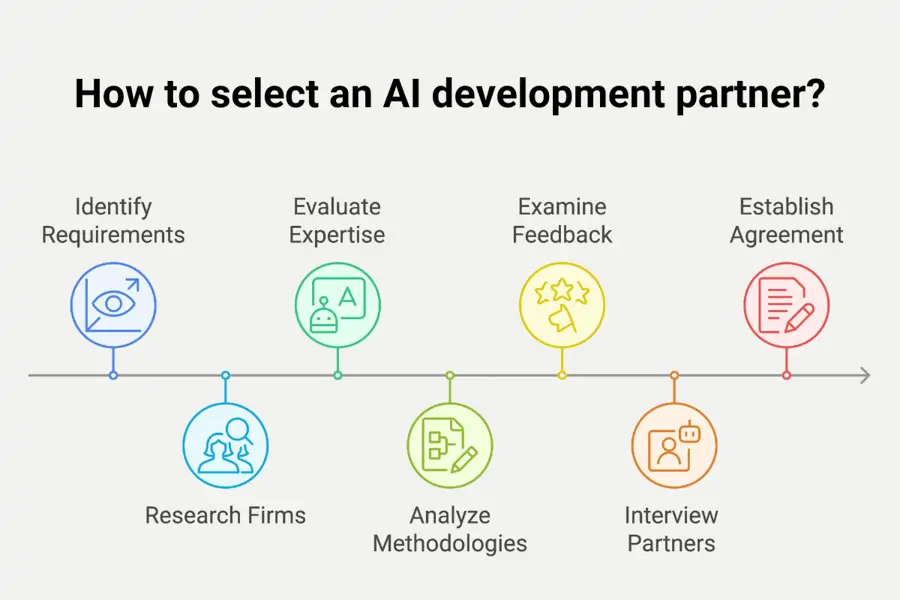
How to Evaluate an AI Development Company
The market is crowded with vendors who can build impressive demos. The harder question is whether they can deliver and maintain production systems. Use the framework below to separate engineering teams from slideware.
Production Experience, Not AI Enthusiasm
Ask for evidence of AI systems that have run in production for extended periods. Enterprise engineering heritage matters because teams that have delivered complex software talk about deployment pipelines, rollback procedures, testing strategies, and ownership models—not just model accuracy .
Red flag: A vendor who talks only about models and never about the surrounding system.
Data Engineering Capability
If no one asks hard questions about your data quality before discussing AI, walk away. The best AI models on messy data produce confident nonsense . Ask how they handle source systems, data ownership, access controls, and pipeline dependencies .
Red flag: A vendor who proposes model development without assessing your data foundation.
Integration and Workflow Depth
AI systems must connect to existing business processes. Ask how the solution handles downstream system syncing, human approval workflows, exception routing, and changes to connected systems over time .
Red flag: A vendor who cannot explain what happens after the model generates an output.
Production Operations and AgentOps
Monitoring, retraining, and guardrails should be in the proposal, not an afterthought . For agentic systems, ask about role-based tool access, audit logs, approval gates, and how they monitor drift and hallucination rates post-launch .
Red flag: "We add logging later" or no monitoring plan beyond deployment.
Security and Compliance Posture
For enterprise deployments, SOC 2 or ISO 27001 compliance should be a baseline requirement. Ask for audit reports, not compliance statements . For Indian businesses, compliance with DPDPA, IT Act, and India's AI Governance Guidelines is increasingly expected .
Red flag: No documented security practices or vague answers about data handling.
Total Cost Transparency
Ask how the business case was built. You should get expected operating costs (API and token usage), assumptions behind projected savings, and how those numbers change as usage grows .
Red flag: Fixed-fee quotes with no line items or cost modeling at scale.
IP Ownership and Handover
You should understand and control what gets built—including the data, the IP, and the deployment infrastructure. Ask explicitly about source code ownership, model weights, and whether you can take operations in-house .
Red flag: SaaS-only delivery with no path to ownership or export.
A Simple Decision Framework
Run through these questions before your first vendor call:
Do you know which AI category your project falls into? Predictive, generative, agentic, or embedded-in-systems. If not, start with a strategy engagement .
Is your data ready? If data lives in disconnected systems with no clean pipeline, budget for data engineering first .
Does your use case touch an existing platform? CRM, ERP, ecommerce. Prioritize firms with proven depth in that platform .
What's your realistic budget band? Match it against the cost tiers above before discovery.
Do you need ongoing maintenance? Confirm whether post-launch monitoring is included or billed separately .
Common Pitfalls to Avoid
Most AI disappointment is self-inflicted. Sidestep these and you are ahead of the pack :
Starting with the technology instead of the problem. "We need AI" is not a strategy. "We need to cut support response time in half" is.
Ignoring data quality. A brilliant model on messy data produces confident nonsense.
Stopping at the demo. A proof of concept that impresses in a meeting is not a product. The last mile to production is where the real engineering lives.
No human in the loop. For high-stakes decisions, design for oversight from the start.
Forgetting cost at scale. A feature that is cheap in testing can be expensive at a million requests. Measure cost per request early.
Treating it as one and done. Models drift, data shifts, and needs evolve. Budget for the long game.
Hiring on hourly rate alone. The cheapest AI development company is almost never the most economical. The cost of a failed project—in money, time, and opportunity—dwarfs any hourly savings .
Frequently Asked Questions
1. What services should an AI development company provide?
A full-service AI development company should offer strategy and discovery, proof of concept development, production system development, data engineering, RAG and knowledge system development, AI agent development, MLOps, and governance consulting. Not every company provides all services—identify what you need and verify depth in those areas.
2. How much does AI development cost in India?
Costs range from ₹1–5 lakh for discovery engagements to ₹1–3 crore+ for enterprise platforms. Mid-scale integrations (chatbots, recommendations, workflow automation) typically fall between ₹25 lakh and ₹1.5 crore. The three biggest cost drivers are data readiness, integration depth, and accuracy requirements.
3. What is the difference between a proof of concept and a production AI system?
A proof of concept validates feasibility on real data with defined metrics. It answers "can this approach work?" A production system answers "how does this run reliably at scale?" Production development adds architecture reviews, security controls, testing strategies, deployment pipelines, integration logic, and monitoring.
4. How do I know if an AI company can actually deliver production systems?
Ask for evidence of AI systems that have run in production for extended periods. Listen for discussion of deployment pipelines, rollback procedures, testing strategies, and ownership models—not just model accuracy. Ask what happens after the model generates an output. A vendor who cannot explain the surrounding system is not ready for production work.
5. What questions should I ask about data?
Ask how they handle source systems, APIs, data ownership, access controls, and dependencies between legacy systems. Ask what happens when data is fragmented, inconsistent, or undocumented. A vendor who proposes model development without assessing your data foundation is a red flag.
6. What is AgentOps and why does it matter?
AgentOps is the discipline of monitoring AI agent systems after launch: logging tool calls, tracking task completion accuracy, flagging drift, and measuring human override rates. Without it, agent systems degrade quietly and nobody notices until a business workflow breaks.
7. Should I own the IP and source code?
Yes. You should understand and control what gets built—including source code, model weights, training data, and deployment scripts. Ask explicitly about ownership before signing. SaaS-only delivery without an export path creates vendor lock-in that limits your options.
8. What compliance requirements apply to AI development in India?
India's AI Governance Guidelines recommend compliance with existing laws including the IT Act, Digital Personal Data Protection Act, Consumer Protection Act, and applicable intellectual property laws. Organizations must adopt voluntary measures around privacy, fairness, and transparency, enable grievance redressal, and implement techno-legal solutions like privacy-enhancing technologies and bias detection .
9. How long does AI development take?
Timelines vary enormously by scope. A discovery engagement takes 2–6 weeks. A proof of concept takes 4–12 weeks. A production system takes 3–12 months depending on integration complexity and data readiness. Ongoing operations are continuous.
10. What if I don't have clean data?
Budget for data engineering first. No vendor produces a reliable model from fragmented or inconsistent data. Fix the data problem before the AI conversation accelerates—even if that means a smaller internal project before engaging an AI development company .
11. Can I start small and scale?
Yes, and you should. Start with a tightly scoped proof of concept. It is the cheapest way to buy certainty before committing to a full build . Use the PoC to validate feasibility, refine requirements, and build internal confidence before scaling.
12. How can Innovative AI Solutions help?
Innovative AI Solutions helps Indian businesses build production AI systems—from strategy through deployment and ongoing operations. We serve clients across India from our Delhi NCR base.
Contact Innovative AI Solutions
Ready to build AI that actually works in production?
Whether you need strategy, proof of concept, production development, or ongoing operations, our engineering team can help you move from idea to deployed system.
Contact Information
Innovative AI Solutions
📍 Netaji Subhash Place, Pitampura, Delhi – 110034
🌐 Website: https://innovativeais.com
📧 Email: info@innovativeais.com
📞 Phone: +91 7464 099 059 / +91 96899 67356
Business Services
About the Author
Sandeep Kumar
Founder & CEO, Innovative AI Solutions
5+ years building production AI systems for Indian businesses. Based in Delhi, serving clients across India.
Ready to build AI solutions for your business?
Innovative AI Solutions — Delhi's leading AI development company. Free consultation available.
AI development company guide for Indian businesses – services, cost benchmarks, production delivery process, vendor evaluation framework, and how to choose the right partner for enterprise AI.
#AIDevelopment #AIDevelopmentCompany #AIDevelopmentServices #AIDevelopmentCost #AIDevelopmentProcess #ChooseAIPartner #EnterpriseAI #CustomAI #AIIndia #AIImplementation #AIVendorSelection #AIConsulting #ProductionAI #AIEngineering #RAGDevelopment #AIAgents #MLOps #AIIntegration #InnovativeAISolutions #AIDevelopmentGuide