The Big Question
What happens when your competitors aren't just using better tools, but are structurally designed to out-learn, out-adapt, and out-execute you? When their operating models are built around AI agents that work 24/7 while your organization still routes work through human hierarchies and handoffs?
This is the reality of the AI-first organization. And the gap between leaders and laggards is already widening—driven by operating model decisions rather than technology choices .
The AI-First Gap: Why Most Companies Aren't Getting Value
Despite the hype, the business impact of AI remains limited. BCG research shows that while most organizations are piloting AI, only 5% are capturing meaningful value at scale . The challenge is that most organizations and operating models were built for a purely human workforce, with work structured around functional roles, handoffs, and decision bottlenecks. Simply inserting AI into this model only delivers incremental gains .
Altimetrik CEO Raj Sundaresan puts it even more starkly: while 78% of enterprises use AI, only 1% have truly mastered it . The difference lies in becoming AI-first—designing systems for intelligence rather than layering AI on top of fragmented operations .
The "Remove the AI" Test: The simplest way to know if you're truly AI-first is to ask: If you remove the AI, does the business model collapse? If the company can still operate normally, it's not AI-first. If it ceases to function, you've built around intelligence.
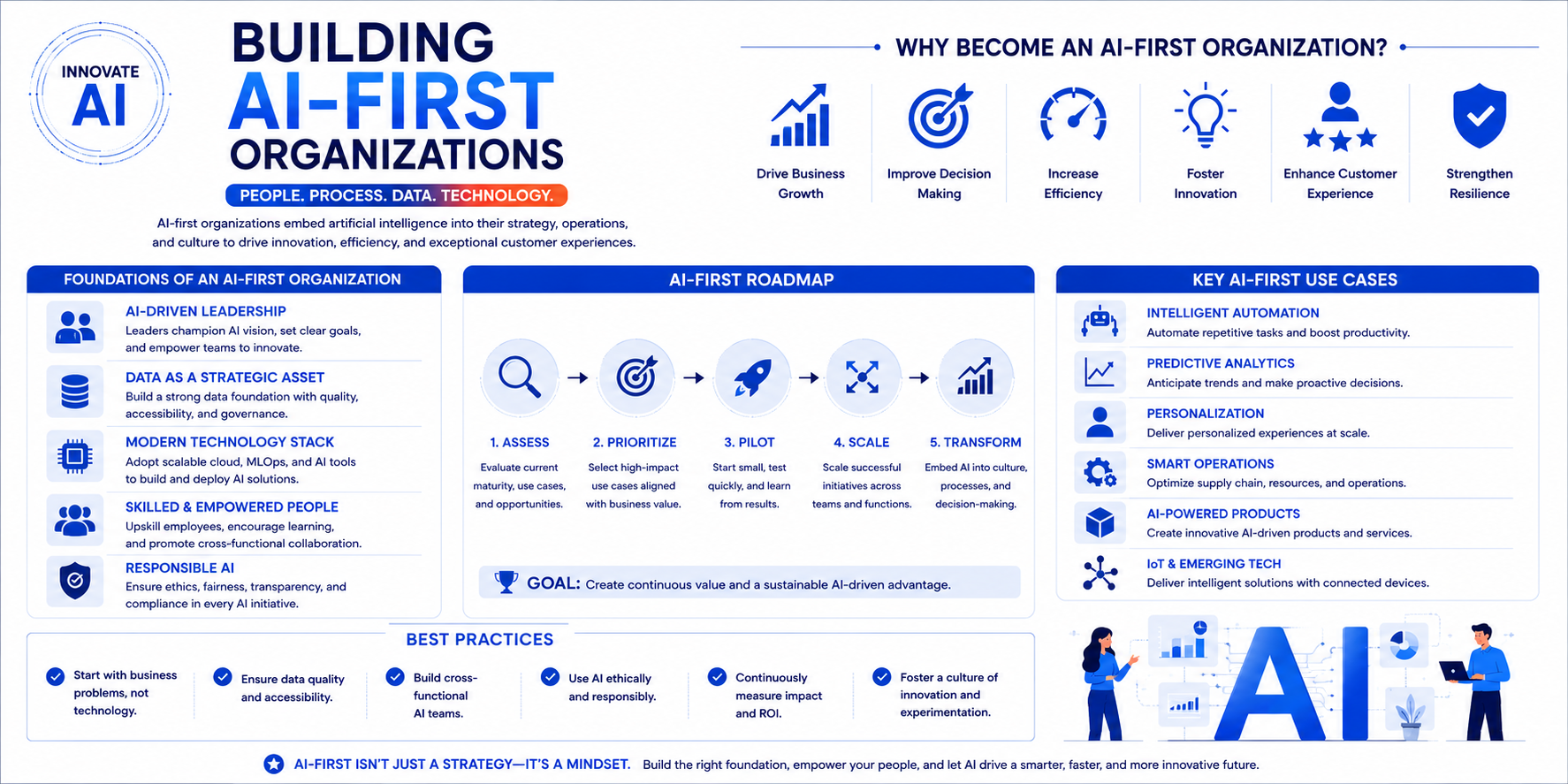
What "AI-First" Actually Means
In an AI-first organization, work is no longer organized primarily around human roles and hierarchies, but around connected systems of agents that dynamically coordinate work . Leaders define clear objectives and allow agentic networks to determine how those objectives are achieved. This requires a ground-up redesign of structure and processes, shifting from static, human-centered models to adaptive, AI-driven ways of operating .
The Shift from Human-Led to Agent-Led Execution
Historically, operating models were designed around fairly unchanging coordination among human roles. Processes were predefined, decision rights were distributed across layers, and execution followed fixed paths .
In an AI-first model, humans step into higher-order roles: shaping strategy, setting intent, managing risk, and intervening when judgment, ethics, or accountability is needed . They set the destination, timing, and constraints. Within these parameters, agents continuously and dynamically determine the optimal path forward, adapting in real time while delivering consistent outcomes .
The Human-AI Collaboration Model
The fastest way to begin an AI-first transformation is to systematically determine which outcomes should remain human-led and which should be delivered by AI agents . Leaders must ask two questions:
-
Could AI do this as well or better than humans? A question of performance and technical feasibility
-
Should AI do this? A question of judgment, regulatory risk, customer trust, ethics, and strategic differentiation
Some activities, where trust, empathy, or accountability dominate, will remain human-led. Others will be AI-assisted. And in some cases, AI will lead end to end, executing workflows at scale under human supervision .
The Five Building Blocks of AI-First Success
Deloitte's blueprint for AI-first organizations identifies five key components :
1. Real-Time, Autonomous Operating Model
AI-first operating models are built for speed, continuous learning, and extensive automation from the core. They leverage real-time data, continuous feedback loops, and AI orchestration to drive agility and autonomously realize operational excellence .
2. Outcome-Driven Organizational Structure
AI-first requires a shift to dynamic organizational structures, where teams collaborate cross-functionally and are horizontally organized around business value, governed by their own KPIs .
3. Human-Agent Collaboration
In an AI-first environment, every employee is backed by a network of AI agents, creating a 24/7 execution layer that expands organizational capacity. Embedded within teams, these agents handle execution, pattern recognition, and scale while humans focus on creativity, empathy, and strategic decisions .
4. Leadership as System Orchestrator
AI-first leaders orchestrate systems of people, AI agents, and platforms, keeping teams focused on outcomes. Their focus lies on enabling frictionless collaboration, removing barriers to execution, and embedding ethical, transparent AI use across the organization .
5. Continuously Evolving Workforce
Talent strategy must look beyond headcount. Workforce capacity combines people and intelligent agents, flexed to match shifting value streams and supported by a broader mix of build, buy, borrow, bot, and bridge approaches .
The Three-Phase Transformation Journey
HubSpot's organizational transformation provides a practical roadmap for becoming AI-first :
Stage 1: Building AI Fluency (12-18 months)
The first stage is about fluency across the entire organization, and it has to start with commitment from the top. Leaders model the behavior, share their own experiments, and create conditions for everyone else to follow .
Key plays:
-
Provide enterprise licenses for a core set of AI tools to everyone
-
Foster a culture of experimentation—make it safe to try and fail
-
Set clear, company-wide usage goals (HubSpot targeted 80% weekly active AI usage)
-
Carve out protected time for learning, hackathons, and AI learning days
-
Track usage transparently by team, by tool, by use case
Outcome: By the end of Stage 1, 94% of HubSpotters used AI weekly, and employees had built over 3,900 AI agents .
Stage 2: Team-Level Transformation
When employees each use AI differently, you get individual productivity but not business outcomes. To achieve team-level transformation, you need clear priorities with real accountability .
The segmentation approach: Plot teams against two dimensions:
-
AI maturity: How have they adopted tools? Are they seeing measurable outcomes?
-
AI readiness: What's the potential for automation? Is the data infrastructure there?
This produces three categories requiring different playbooks :
-
Pace setters: Teams already moving fast—support their momentum (Engineering, Support, Marketing)
-
Near-in wins: Teams with obvious automation opportunities—drive leadership attention (Recruiting, Operations)
-
Big bets: Highest potential but most dependencies—dedicated investment (Sales, Customer Success, Product)
Real results: HubSpot's Marketing team saw an 82% improvement in email conversions, an AI chatbot handling 82% of website inquiries generating 10,000+ sales meetings per quarter, and AI-assisted blog production cutting writer hours per article by 60% . Talent Acquisition reduced time to hire by 10 days, automated 80% of interview scheduling, and saw a 90% increase in scheduling volume with no additional headcount .
Stage 3: Institutional Transformation
Stages 1 and 2 solve for individual and team productivity. Stage 3 is about building institutional AI—redesigning the institution itself around new AI capabilities .
The foundation of Stage 3 is institutional context: giving everyone access to the right tools, data, and information, and encoding company processes into agents that can act on them at scale .
When an engineer needs context on a codebase, they don't ask a colleague; they ask an internal coding agent. When a sales manager wants to understand why a deal stalled, they don't pull a report; they ask an AI assistant. When a new hire needs to understand how decisions get made, they ask an internal AI tool. That is institutional AI in practice .
Real-World Transformation Results
European Energy Leader
A leading European energy services provider redesigned end-to-end customer journeys around an AI-first model. The transformation was designed to fund itself—by prioritizing customer journeys that created value quickly, the company generated run-rate savings within the first three months .
Results: AI-enabled journeys matched—and are on track to exceed—human performance on customer satisfaction metrics. The company reduced dependence on external service providers by more than 90% and freed up cash flow reinvested in accelerating the AI-first journey .
Global Bank
A global financial institution set a firm-wide ambition to automate 30% to 50% of workflows and shift human effort to higher-value decisions. Work is now organized around small, cross-functional teams that integrate human talent, AI agents, data, and technology to deliver specific outcomes .
Results: The bank is on track to free about three million hours of human capacity—equivalent to 1,700 FTEs—for higher-value work. The program expects full payback within two years and a projected 150% ROI over five years .
Practical Steps to Get Started
Harvard Business School's framework for building an AI-first company outlines five steps :
Step 1: Strengthen Your Data Strategy
Data is the foundation of every AI initiative. Evaluate your data architecture, data structure, data access, and data governance .
Step 2: Identify Clear Business Use Cases
Determine how AI can best support your business goals. Brainstorm use cases across departments and involve leaders in evaluating where AI can deliver the highest impact .
Step 3: Prioritize High-Impact Opportunities
Early projects shape organizational trust and momentum. When ranking opportunities, ask: Does this align with company goals? What risks are involved? What metrics will define success?
Step 4: Integrate AI Thoughtfully
Decide whether to build in-house or outsource. Many companies adopt a hybrid model—partnering externally for specialized expertise while cultivating internal AI teams for sustainable growth .
Step 5: Evaluate, Scale, and Foster Adoption
Aim for 75-80% adoption rates for initial use cases before scaling further. Offer AI-specific training, upskilling programs, and highlight how AI can improve the employee experience .
Implementation Roadmap
Phase 1: Foundation (Weeks 1-4)
-
Audit your operating model: Where are the handoffs and bottlenecks? Where are agents already being used?
-
Define your AI-first vision: What will the company look like in 24 months?
-
Assess data readiness: What data is available for AI? Where are the gaps?
-
Establish governance: Define permissions, audit trails, and human oversight checkpoints
Phase 2: Build Fluency (Weeks 5-8)
-
Deploy AI tools across the organization: Every team, not just engineering
-
Launch AI learning days and hackathons: Make experimentation safe and supported
-
Track usage openly by team and by tool: Transparency drives accountability
-
Leaders model the behavior: Share experiments, learnings, and failures
Phase 3: Team-Level Transformation (Weeks 9-12+)
-
Segment teams by maturity and readiness: Identify pace setters, near-in wins, and big bets
-
Apply different playbooks to each segment: Support, push, or invest
-
Identify and redesign key workflows: Start where value is highest and friction is lowest
-
Measure business outcomes, not AI activity: Revenue generated, cycle time reduced, capacity unlocked
Frequently Asked Questions
Q1: What's the difference between using AI and being AI-first?
Using AI means adding AI features or tools to existing processes. Being AI-first means redesigning the entire operating model around AI—with agents embedded in how work actually gets done, not just available as personal productivity tools .
Q2: How many organizations are truly AI-first?
Only the leading 10% are capturing meaningful value at scale—and just 1% have truly mastered AI . Most organizations are still layering AI onto legacy workflows.
Q3: What is the "Remove the AI" test?
The simplest way to know if you're truly AI-first is to ask: If you remove the AI, does the business model collapse? If it can still operate normally, it's not AI-first .
Q4: How do I get started with AI-first transformation?
Start by deciding where AI should and shouldn't lead. Ask two questions for each outcome: Could AI do this as well or better? Should AI do this?
Q5: How should I measure AI success?
Measure business outcomes, not AI activity. Track revenue generated, cycle time reduced, capacity unlocked, and decisions made faster—not prompts run or hours saved .
Q6: How can Innovative AI Solutions help?
We help organizations design, build, and operationalize AI-first transformations—from assessment and roadmap development to implementation and scaling. Based in Delhi, serving clients across India.
Why Delhi is a Great Hub for AI Development
Delhi is emerging as a significant hub for AI development, backed by concrete government support and infrastructure. The IndiaAI Mission is deploying subsidized GPUs and nurturing the AI startup ecosystem. India's BFSI sector is moving from "digital-first" to "AI-first," with 85%+ of leading financial institutions actively piloting or deploying Agentic and Generative AI.
What We Offer at Innovative AI Solutions
-
AI-First Strategy: We help you define your vision and design a transformation roadmap
-
Foundation Building: We help you structure data, deploy tools, and establish governance
-
Fluency Programs: We help you build AI literacy across every team
-
Workflow Redesign: We help you reimagine processes around agent-led execution
-
Governance and Compliance: We help you establish trust, explainability, and accountability structures
Final Thought
Becoming AI-first is a leadership choice that will redefine competitive advantage across industries. BCG's research is clear: it involves 30% technology and 70% people and organization. If AI is not delivering impact, it is rarely because the technology is not delivering. It is because most organizations have not made the shift from deploying isolated AI tools to redesigning their operating model around human-agent collaboration .
AI will not wait for your organization to catch up. The gap between leaders and laggards is already widening, driven by operating model decisions rather than technology choices .
Contact Us:
Phone: +91 7464 099 059 / +91 9689967356
Email: info@innovativeais.com
Address: Netaji Subhash Place, Pitampura, Delhi – 110034
Website: https://innovativeais.com
About the Author
Abhishek Kumar
Founder & CEO, Innovative AI Solutions
5+ years building AI systems for enterprises. Based in Delhi, serving clients across India.