The Big Question
What happens when your cloud provider raises prices by 30%, changes a critical API, or suffers a major outage that impacts your business? When regulators demand proof that you can move your workloads to another provider within a defined timeframe? When your data residency requirements shift and your current provider can't meet them?
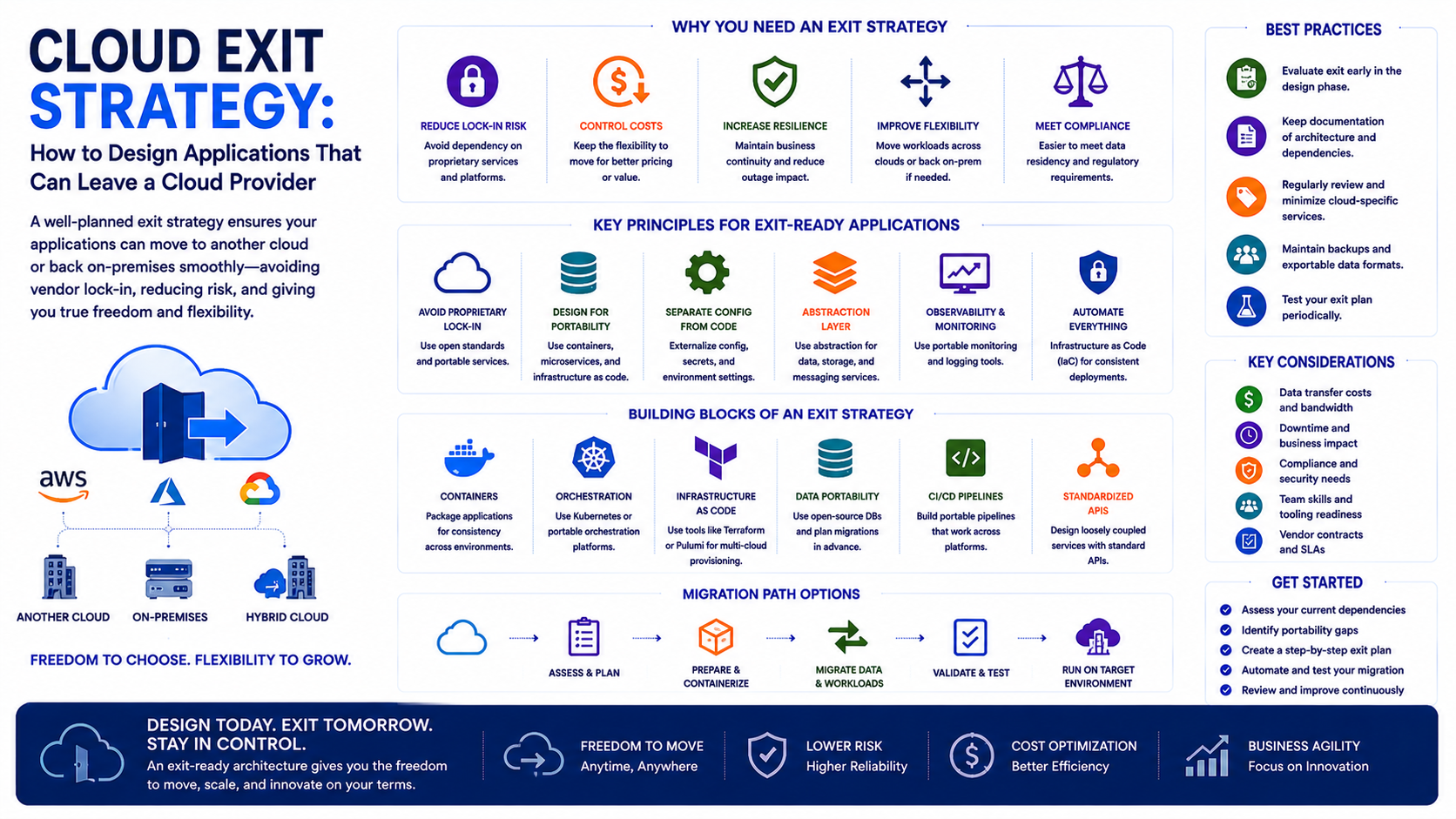
A well-designed cloud exit strategy answers these questions. It ensures that you can leave when you need to without rebuilding your entire application from scratch.
Why Cloud Exit Strategy Matters Now
For years, cloud exit strategy was a theoretical exercise something organizations knew they should have but rarely prioritized. In 2026, that has changed. Three converging trends have made exit strategy a business imperative:
1. Regulatory Mandates
The EU's Digital Operational Resilience Act (DORA), effective in 2025, requires financial institutions to document their cloud exit strategies . This includes demonstrating data portability, recovery capability, and functional equivalence on alternative platforms. This isn't optional it's compliance.
2. The Repatriation Reality
Cloud repatriation moving workloads back on-premises or to another provider—is no longer a fringe concern. Organizations are discovering that some cloud workloads are better suited for alternative environments, and they want the flexibility to make that choice .
3. The Lock-In Trap
Many organizations that adopted multi-cloud strategies remain effectively locked into individual providers, lacking the practical capability to migrate workloads between clouds . The gap between multi-cloud intention and multi-cloud capability is where lock-in lives .
Defining Your Portability Spectrum
Not every application needs to be fully portable. The first step in building an exit strategy is defining what level of portability each workload requires :
| Portability Level | Definition | When to Use |
|---|---|---|
| Full Portability | Application can run across multiple clouds simultaneously; exit in real-time without loss or disruption | Regulated, revenue-critical, customer-facing workloads |
| Partial Portability | Application can be moved between providers within a defined timeframe (e.g., within several months) | Important internal systems |
| Minimal Portability | If an exit occurs, the application will be decommissioned rather than migrated | Low-risk tools or experiments |
The critical step is to have a clear, documented, and approved strategy for each application that aligns with the business .
The Exit Tiers Framework
A practical approach to exit planning uses a tiered framework that matches exit readiness to business criticality :
| Tier | Workload Profile | Exit Expectation |
|---|---|---|
| Tier 1 | Regulated, revenue-critical, customer-facing | Tested exit path and recovery evidence |
| Tier 2 | Important internal systems | Documented exit path and dependency register |
| Tier 3 | Low-risk tools or experiments | Lightweight owner, data, and spend record |
This tiering keeps cloud exit planning realistic. A temporary analytics sandbox should not carry the same exit burden as a customer-facing payment platform.
The Three Dimensions of Lock-In
Exit planning starts with identifying what you're locked into. Lock-in operates across three dimensions :
1. Application Lock-In
Lock-in occurs when code depends heavily on provider-specific services . This is acceptable when the business benefit is clear—a payment risk engine may justify a managed analytics service because speed and reliability matter. The problem starts when no one records the trade-off.
The dependency classification framework :
| Dependency Type | Example | Exit Treatment |
|---|---|---|
| Low | Virtual machines, managed PostgreSQL | Keep deployment scripts portable |
| Medium | Managed Kubernetes, provider messaging, native CI/CD | Add abstraction where it protects delivery |
| High | Proprietary databases, serverless workflows, native AI services | Record the business reason and estimated exit cost |
Vendor lock-in risk is acceptable when the business benefit is explicit and the replacement path is known .
2. Commercial Lock-In
Some lock-in is commercial before it is technical . Minimum spend commitments, marketplace agreements, software licenses, support tiers, renewal windows, data egress terms, audit rights, and termination support all shape exit readiness.
A workload may be technically movable but financially painful to move during a committed spend period. Legal, procurement, and architecture need one shared register of these constraints .
3. Architecture Lock-In
Architecture lock-in hides in small choices . Naming standards, IAM assumptions, observability tools, DNS patterns, secrets handling, network segmentation, and image builds can tie a system to one provider. The issue is not using native primitives; the issue is scattering provider assumptions across code, pipelines, runbooks, and team habits.
The most useful cloud portability patterns are usually simple: keep source code and deployment definitions outside any single cloud console, store configuration in version control, use open data formats where the data has long-term value, document identity patterns, test backup restoration outside the primary boundary, and maintain runbooks for rebuild, cutover, and rollback .
The Open Cloud Strategy
An Open Cloud ecosystem is built on open standards, open APIs, and open-source technologies that promote workload portability, interoperability, and digital sovereignty .
The Five Pillars of the Open Cloud
| Pillar | What It Means |
|---|---|
| Interoperability | Workloads and data move freely across clouds |
| Transparency | Open APIs, open governance, no hidden dependencies |
| Portability | Open formats and architectures that prevent lock-in |
| Sovereignty | Full control of data and operations |
| Community Innovation | Built upon open-source ecosystems and shared development |
Managed Open Source as the Bridge
An alternative to proprietary cloud services is managed open source open-source technologies provided as fully managed services by cloud providers . Companies enjoy the convenience of a managed solution without locking themselves into proprietary APIs or closed standards.
The difference between proprietary and managed open-source services is most visible when evaluating portability, API compatibility, and migration effort. By adopting managed open source, companies maintain control over their architecture and create the conditions to remain flexible under changing circumstances .
Testing Your Exit Plan
Where a strategy includes any degree of portability, organizations should build and test exit plans, validating that portability works in real-world conditions .
Stressed Exit: Demonstrates that, with sufficient time, an organization can move an application from one cloud provider to another. This involves defining a migration roadmap and performing controlled test migrations to validate readiness and capability .
Managed Exit: Demonstrates that an application can be actively operated and migrated between providers while maintaining continuity of service across environments. For instance, payment applications that run concurrently across multiple clouds, where users can be migrated seamlessly from one provider to another without any loss of transactions .
The Hybrid Multi-Cloud Advantage
Hybrid and multi-cloud architectures make exit (and entry) strategies easier . A multi-cloud strategy deliberately exploits the unique capabilities of different clouds for instance, using Google Cloud for data analytics, Microsoft Azure for data warehousing, and an on-premises private cloud for traditional applications .
The trade-off: You manage the complexity of multiple environments, but you gain the ability to move workloads between them.
Implementation Roadmap
Phase 1: Discovery and Assessment (Weeks 1-4)
-
Inventory applications and dependencies. Map every workload, its dependencies, and its cloud service usage.
-
Classify by dependency type. Use the low/medium/high framework to identify where lock-in is most significant .
-
Define portability levels. Assign each application to full, partial, or minimal portability.
-
Engage stakeholders. Include contractual, technical, legal, and data governance perspectives .
Phase 2: Build the Exit Plan (Weeks 5-8)
-
Document exit paths for each application. Include data migration, application rebuild, cutover, and rollback steps.
-
Identify open-source alternatives. Where possible, replace proprietary services with managed open-source equivalents .
-
Test data portability. Ensure schema exports, replication, backup restoration, and cutover steps work .
-
Address hidden costs. Assess hardware, colocation, development work, and retraining requirements .
Phase 3: Validate and Maintain (Weeks 9-12+)
-
Run a Stressed Exit test. Validate that you can move a bounded application within a defined timeframe .
-
Establish a maintenance cadence. Revisit and update exit plans quarterly they drift when ignored.
-
Integrate with procurement. Align exit readiness with contract renewals, spend commitments, and commercial terms.
Frequently Asked Questions
Q1: Is a cloud exit strategy just about distrusting cloud providers?
No. It's a central component of professional risk management, as required by regulations like DORA, and a key negotiating tool that improves your leverage and keeps cloud costs honest .
Q2: Does every application need a full exit plan?
No. Use a tiered framework: full for revenue-critical workloads, documented for internal systems, lightweight for low-risk experiments .
Q3: What are the hidden costs in a cloud exit?
Costs include hardware (if repatriating), colocation, development work for refactoring, retraining staff, and the business cost of reduced productivity during the transition .
Q4: What is a Stressed Exit test?
A controlled test migration that validates the organization can move an application from one cloud provider to another within a defined timeframe, confirming readiness and capability .
Q5: How can Innovative AI Solutions help?
We help organizations design, build, and operationalize cloud exit strategies from application assessment and dependency mapping to portability testing and governance frameworks. Based in Delhi, serving clients across India.
Why Delhi is a Great Hub for Cloud Strategy Innovation
Delhi is emerging as a hub for cloud-native and enterprise architecture innovation, backed by a thriving IT services ecosystem and global delivery centers. As Indian enterprises accelerate cloud adoption and regulatory frameworks like DORA become applicable, disciplined cloud exit planning is essential for maintaining strategic flexibility and negotiating leverage.
What We Offer at Innovative AI Solutions
-
Cloud Exit Strategy: We help you assess your application portfolio and design a tiered exit plan.
-
Portability Testing: We help you run Stressed Exit and Managed Exit tests to validate readiness.
-
Open Cloud Strategy: We help you identify managed open-source alternatives to reduce lock-in.
-
Governance Frameworks: We help you establish the shared registers that keep exit plans aligned with commercial terms.
Final Thought
The shift is clear: from treating exit as an afterthought to designing it in from the start. The organizations that master cloud exit planning will be the ones that maintain negotiating leverage, respond to regulatory and market changes, and keep their options open without losing the speed and innovation benefits of cloud-native services. Exit planning is not a vote of no confidence in your cloud provider it's a vote of confidence in your own ability to adapt when the time comes.
Contact Us:
Phone: +91 7464 099 059 / +91 9689967356
Email: info@innovativeais.com
Address: Netaji Subhash Place, Pitampura, Delhi – 110034
Website: https://innovativeais.com
About the Author
Abhishek Kumar
Founder & CEO, Innovative AI Solutions
5+ years building cloud, AI, and enterprise systems. Based in Delhi, serving clients across India.
Related services: to apply this in your business, explore our cloud services and AI development services.