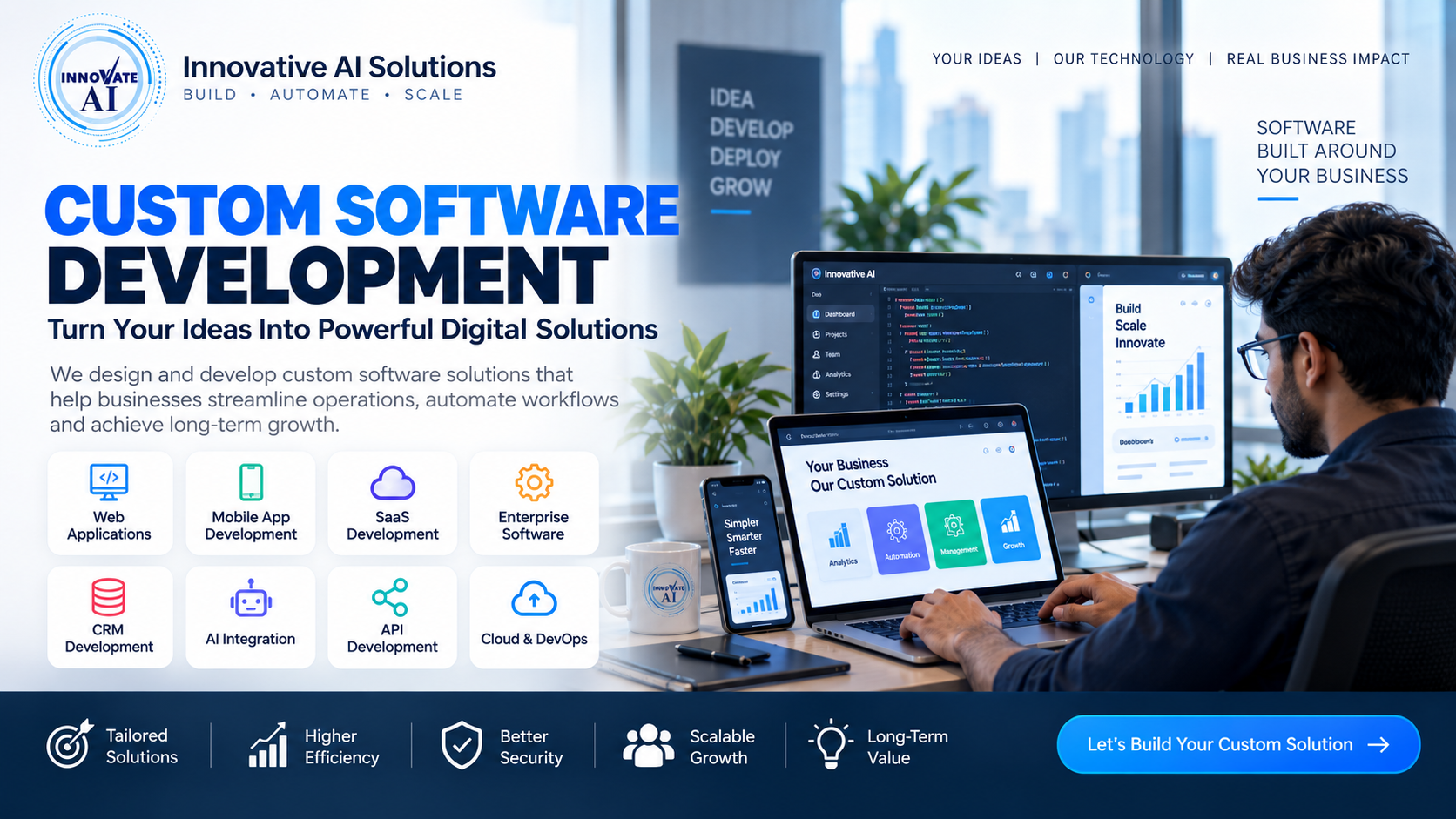
Custom Software Development: Complete Guide to Building Scalable Business Software in 2026
Businesses today rarely operate exactly like their competitors. Their workflows, customers, approval processes, reporting requirements and technology infrastructure are often unique.
Yet many companies still try to manage their operations using spreadsheets, disconnected applications and generic software.
This is where custom software development becomes valuable.
Custom software is designed around the specific requirements of a business instead of forcing the business to change its processes around an existing product.
A custom solution can combine business workflows, dashboards, APIs, automation, databases, mobile applications, AI capabilities and third-party integrations into one scalable technology platform.
At Innovative AI Solutions, we build custom software solutions for startups, SMEs and enterprises, including web applications, SaaS platforms, business automation systems and AI-powered applications.
What Is Custom Software Development?
Custom software development is the process of designing, developing, testing and deploying software specifically for the requirements of an organization.
Instead of purchasing an off-the-shelf product and adapting business processes around it, custom software starts with the business problem.
For example, a company may need:
- Custom CRM
- ERP system
- Inventory management software
- Employee management portal
- Billing software
- Customer portal
- SaaS platform
- Healthcare management system
- Education management platform
- Logistics software
- AI-powered business application
- API-based enterprise platform
A custom development team can design the architecture, database, user interface, APIs, integrations and automation around those requirements.
Why Businesses Choose Custom Software
Generic software can be useful when your requirements are standard.
However, problems appear when the business grows and its processes become more complex.
Common limitations include:
- Limited customization
- Poor integrations
- Duplicate data entry
- Manual workflows
- Limited reporting
- Vendor dependency
- Scalability limitations
- Difficult data migration
- Multiple disconnected tools
Custom software allows businesses to build the functionality they actually need.
1. Business-Specific Workflows
Your software can follow your exact approval, sales, finance, HR or operational workflow.
2. Better Integrations
Custom applications can integrate with:
- Payment gateways
- CRM systems
- ERP systems
- Accounting software
- APIs
- Cloud platforms
- AI models
- Internal databases
3. Scalability
The architecture can be designed for future users, transactions, modules and integrations.
4. Better Automation
Repetitive processes can be automated instead of being handled manually.
5. Data Ownership
Your organization maintains greater control over application data, infrastructure and business logic.
Custom Software Development Services
A professional custom software development company can provide multiple services depending on the business requirement.
1. Web Application Development
Custom web applications can provide centralized access to business systems through browsers.
Examples include:
- Admin dashboards
- Customer portals
- Employee portals
- Booking systems
- E-commerce platforms
- SaaS applications
- Business management systems
If your project requires a modern web application, our web development services can be integrated with custom backend architecture, APIs and databases.
2. Enterprise Software Development
Large organizations often require software with:
- Role-based access
- Authentication
- Audit logs
- Workflow management
- Reporting
- API integrations
- Security controls
- Scalable infrastructure
Enterprise applications can connect multiple departments and reduce dependency on disconnected systems.
3. SaaS Development
If you are building a software product that multiple customers will use, SaaS development can provide:
- Multi-tenant architecture
- Subscription management
- User authentication
- Role-based permissions
- Billing
- Admin dashboards
- API integrations
- Analytics
Custom SaaS development is especially useful for startups building a product around a specific business problem.
4. CRM Software Development
A CRM can be customized around the organization's sales process.
Features may include:
- Lead management
- Sales pipeline
- Follow-ups
- Customer profiles
- Communication history
- Sales analytics
- Automated reminders
- WhatsApp integration
- Email automation
Instead of changing your sales process to match a generic CRM, the CRM can be designed around your actual workflow.
5. ERP Software Development
Custom ERP software can connect different business functions such as:
- Inventory
- Purchase
- Sales
- Finance
- HR
- Manufacturing
- Operations
- Reporting
This can create a centralized business management platform.
6. AI-Powered Custom Software
Modern custom applications can also integrate artificial intelligence.
Examples include:
- AI assistants
- AI document processing
- AI search
- Predictive analytics
- AI recommendations
- AI chatbots
- RAG systems
- AI agents
- Intelligent automation
For businesses that want AI inside their existing software, explore our AI development solutions.
Custom Software vs Off-the-Shelf Software
| Factor | Custom Software | Off-the-Shelf Software |
|---|---|---|
| Customization | Very high | Limited |
| Business workflow | Built specifically | Predefined |
| Integrations | Flexible | Depends on vendor |
| Scalability | Architecture-controlled | Vendor-dependent |
| Ownership | Greater control | Vendor controlled |
| Initial investment | Usually higher | Usually lower |
| Long-term flexibility | High | Moderate |
| AI integration | Fully customizable | Feature dependent |
The right choice depends on the business.
You don't need custom software simply because it sounds more advanced.
If an existing product solves 90% of your requirements at an acceptable cost, buying it may be the better decision.
Custom development becomes more attractive when your workflow, integrations, scalability or competitive advantage require something different.
How Custom Software Development Works
A structured development process reduces technical and business risks.
Step 1: Requirement Discovery
The first stage is understanding:
- Business objectives
- Current workflow
- User types
- Pain points
- Required features
- Integrations
- Security requirements
- Future scalability
Step 2: Architecture Planning
The development team decides:
- Frontend architecture
- Backend architecture
- Database
- API structure
- Authentication
- Cloud infrastructure
- Security
- Deployment strategy
For complex applications, architecture should be designed before large-scale development begins.
Step 3: UI/UX Design
The interface is designed around the actual users.
Typical screens include:
- Login
- Dashboard
- User management
- Reports
- Settings
- Forms
- Workflow screens
- Admin panel
Step 4: Development
The application is developed using technologies appropriate for the project.
Possible technologies include:
Frontend
- React
- Angular
- Next.js
- HTML
- CSS
- JavaScript
Backend
- Python
- Django
- FastAPI
- Node.js
- Express
Database
- PostgreSQL
- MySQL
- MongoDB
- Redis
Cloud
- AWS
- Azure
- Google Cloud
The technology should be selected based on requirements rather than simply following trends.
AI and Automation in Custom Software
One of the biggest opportunities in modern software development is combining traditional business applications with AI.
For example, a CRM could automatically:
- Receive a new lead
- Analyze lead information
- Assign a lead score
- Generate a personalized response
- Send WhatsApp/email communication
- Schedule a meeting
- Update the CRM
- Notify the sales team
This creates an intelligent workflow instead of simply storing data.
For businesses interested in automation, you can internally link to your AI automation content using anchor text such as:
AI-powered business automation
Custom Software + RAG
Organizations with large amounts of internal information can integrate Retrieval-Augmented Generation into their applications.
For example:
Company Documents → RAG System → AI Assistant → Business Application
The system can retrieve relevant information from:
- PDFs
- Documents
- Knowledge bases
- Internal databases
- Product information
- Policies
- Manuals
This can power internal assistants, customer support systems and enterprise search.
You can internally link this section to your RAG development service/page.
Custom Software Security
Security should be considered from the beginning rather than added after development.
Important areas include:
- Authentication
- Authorization
- Role-based access
- Encryption
- Secure APIs
- Input validation
- Database security
- Audit logs
- Backup
- Monitoring
- Security testing
For enterprise applications, security architecture should be part of the initial technical design.
How Much Does Custom Software Development Cost?
There is no universal price for custom software.
The cost depends on:
- Number of features
- Number of users
- UI/UX complexity
- Backend architecture
- Integrations
- AI requirements
- Mobile application requirements
- Security requirements
- Cloud infrastructure
- Development timeline
- Maintenance requirements
A simple internal dashboard can be significantly cheaper than a multi-tenant SaaS platform or enterprise ERP.
The best approach is to define the MVP first and then estimate development based on actual requirements.
How Long Does Custom Software Take?
A project timeline depends on scope.
A basic application may take several weeks, while complex enterprise platforms can require several months.
Typical stages include:
Discovery → Design → MVP → Testing → Deployment → Optimization
Agile development can allow businesses to launch an MVP first and gradually introduce additional modules.
How to Choose a Custom Software Development Company
Before selecting a development partner, evaluate:
Technical Expertise
Check whether the company understands your required stack and architecture.
Previous Projects
Review relevant case studies rather than only looking at generic portfolios.
Innovative AI Solutions maintains a case studies and client success section showing examples of AI, automation and software projects.
Development Process
Ask about:
- Requirement gathering
- Architecture
- Development
- Testing
- Deployment
- Maintenance
Communication
You should know:
- Who manages the project
- How often updates are provided
- Where tasks are tracked
- How changes are handled
Post-Launch Support
Software development doesn't end with deployment.
Your partner should be able to provide:
- Bug fixing
- Monitoring
- Security updates
- Performance optimization
- Feature development
- Infrastructure support
Why Choose Innovative AI Solutions?
Innovative AI Solutions combines software engineering with AI, automation and cloud technologies.
Our custom software capabilities include web applications, mobile applications, SaaS platforms, business systems and AI-powered products. The company's website also highlights custom software, web development, mobile applications and AI-powered solutions as part of its service portfolio.
For organizations exploring AI-enabled applications, the company also works across RAG-based systems, AI agents, chatbots and automation.