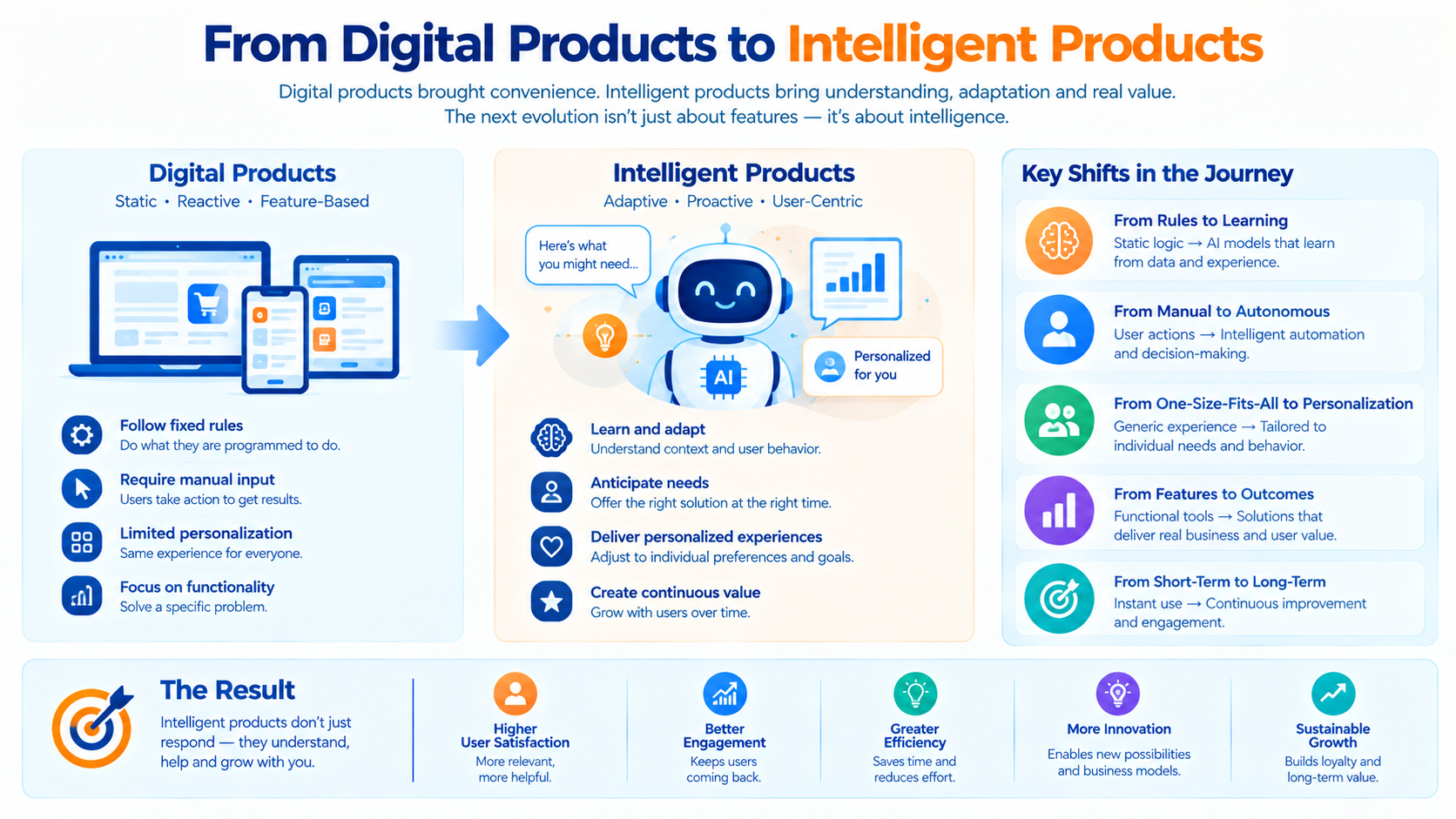
The Big Question
What happens when your product stops waiting for instructions and starts anticipating them? When it handles work autonomously, learns from outcomes, and adapts to each user? When the value it delivers is not the features it has but the decisions it makes?
Most products described as "AI-powered" are still digital products with an AI feature bolted on. An intelligent product is different. It is built around decision-making, not around features.
What Digital Products Did
Digital products transformed physical and analog processes into software. The defining characteristics:
They moved information online. Records, transactions, and communications became digital.
They followed explicit instructions. The user directed; the product executed.
They delivered consistent output. The same input produced the same result, every time.
They improved through releases. Value increased when new features shipped.
They required the user to know what to do. The product waited for commands.
This model produced enormous value. It also defined the expectations that most product teams still operate under feature roadmaps, deterministic behavior, and value tied to release cycles.
What Intelligent Products Do
Intelligent products change each of those characteristics.
| Dimension | Digital Product | Intelligent Product |
|---|---|---|
| Input | Explicit user instructions | Inferred intent and context |
| Output | Deterministic | Probabilistic |
| Improvement | Through releases | Through use and learning |
| Value source | Features | Decisions |
| User role | Operator | Supervisor |
| Failure mode | Bugs | Errors of judgment |
The shift is not about capability alone. It is about where the intelligence sits in the product.
The Four Capabilities of Intelligent Products
An intelligent product is defined by four capabilities. A product with only some of them is partially intelligent; a product with all four has crossed the threshold.
1. Sense
The product gathers signals about the user, the context, and the outcome.
What it senses:
-
User behavior and preferences
-
Environmental context (time, location, device, network)
-
Historical patterns
-
Outcomes of previous decisions
What makes this different: Digital products collect data for reporting. Intelligent products collect data for decision-making. The sensing is continuous and tied to action.
2. Decide
The product determines what should happen next.
What it decides:
-
What the user is probably trying to accomplish
-
Which action is most appropriate
-
Whether the action should be taken autonomously or confirmed
-
What to do when uncertain
What makes this different: Digital products require the user to specify the action. Intelligent products infer it.
3. Act
The product takes action sometimes with the user, sometimes on their behalf.
How it acts:
-
Surface relevant information proactively
-
Execute routine tasks autonomously
-
Prepare work for human review
-
Escalate when confidence is low
What makes this different: Digital products wait. Intelligent products initiate.
4. Learn
The product improves based on outcomes.
What it learns:
-
Which decisions produced good outcomes
-
Where it made errors
-
How user behavior changes over time
-
What context predicts what outcome
What makes this different: Digital products improve when engineers ship changes. Intelligent products improve when they are used.
What Changes in the Product Organization
Building intelligent products requires changes that go beyond engineering.
From Feature Roadmap to Decision Architecture
Digital product roadmaps are lists of features. Intelligent product roadmaps are maps of decisions the product should make better over time.
The practical shift: Instead of asking "what features should we build?", ask "what decisions should this product make, and how will we know it is making them well?"
From Deterministic to Probabilistic Thinking
Digital product teams reason in terms of correct and incorrect behavior. Intelligent product teams reason in terms of confidence, accuracy, and failure modes.
The practical shift: Every intelligent capability must be designed with its failure modes in mind how it behaves when uncertain, when wrong, and when the input is outside its experience.
From Release Cycles to Continuous Learning
Digital product value is delivered in releases. Intelligent product value is delivered continuously as the product learns.
The practical shift: The measurement of success moves from "features shipped" to "decisions improved."
From User Experience to User Trust
Digital products optimize for usability. Intelligent products must optimize for trust.
The practical shift: Users must understand what the product is doing, why, and how to correct it. Transparency and control become product features, not compliance obligations.
The Data Foundation
Intelligent products require a data foundation that digital products do not.
What is required:
-
Data from the product's own usage, captured systematically
-
Outcome data that reveals whether decisions were good
-
Context data that explains the conditions of each decision
-
Feedback loops that connect outcomes back to decisions
The common failure: Organizations build intelligent features without the data foundation to improve them. The feature works at launch and degrades over time because there is no learning loop.
The Architecture of an Intelligent Product
Intelligent products share architectural characteristics.
Separation of reasoning and enforcement. The probabilistic component decides; a deterministic component enforces constraints and safety.
Confidence and escalation. The product knows when it is uncertain and routes to human judgment.
Observability. Every decision is logged with its inputs, reasoning, and outcome.
Feedback capture. Outcomes and corrections feed back into the system.
Graceful degradation. When the intelligent component fails, the product remains usable.
These patterns are not optional. They are what distinguishes an intelligent product from a digital product with unpredictable behavior.
Where Products Are on the Spectrum
Most products fall somewhere on a spectrum rather than being purely digital or purely intelligent.
| Level | Description | Example |
|---|---|---|
| Digital | Explicit instructions, deterministic output | Traditional CRM |
| Assisted | Suggests actions, user decides | Recommendation engine |
| Augmented | Acts on routine cases, escalates edge cases | AI customer support |
| Autonomous | Acts independently within defined scope | Automated trading system |
Moving up the spectrum increases both value and risk. The right level depends on the cost of a wrong decision.
The practical question: For each decision the product could make, what is the cost of being wrong? Low-cost decisions can be automated. High-cost decisions require human oversight.
The Transition: How to Move from Digital to Intelligent
The transition is not a single project. It is a sequence of decisions.
Step 1: Identify Decisions Worth Automating
Not every decision should be automated. Start with decisions that are frequent, rule-bound, and low-consequence.
Step 2: Instrument the Decision
Capture the inputs, the decision, and the outcome. Without this, there is no learning.
Step 3: Build the Intelligent Capability
Start with assistance suggestions the user can accept or reject. This generates data and builds trust.
Step 4: Expand Autonomy Progressively
As accuracy is demonstrated, expand the scope. Begin with confirmation required, move to autonomous action within bounds.
Step 5: Build the Feedback Loop
Connect outcomes back to the system so it improves with use.
Step 6: Measure Decisions, Not Features
Track decision accuracy, escalation rates, and outcomes not just feature adoption.
Implementation Roadmap
Phase 1: Identify (Weeks 1-4)
-
Map the decisions your product could make better.
-
Assess the cost of being wrong for each decision.
-
Select one decision as the initial target.
-
Instrument the decision to capture inputs and outcomes.
Phase 2: Build (Weeks 5-10)
-
Build the intelligent capability at the assistance level.
-
Implement confidence and escalation.
-
Build observability for every decision.
-
Establish the feedback loop.
Phase 3: Expand (Weeks 11+)
-
Measure decision accuracy and outcomes.
-
Expand autonomy as reliability is demonstrated.
-
Add additional decisions to the intelligent layer.
-
Reassess which decisions should remain human.
Frequently Asked Questions
Q1: What is the difference between a digital product and an intelligent product?
A digital product executes explicit instructions. An intelligent product infers intent, makes decisions, acts, and improves with use.
Q2: Does every product need to become intelligent?
No. Products where decisions are simple, consequences are low, or user control is paramount may remain digital. Intelligence adds value where decisions are frequent and consequential.
Q3: What is the biggest challenge in building intelligent products?
The data foundation. Without outcome data and feedback loops, the product cannot learn and an intelligent product that does not learn is just a product with unpredictable behavior.
Q4: How do I build trust in an intelligent product?
Transparency and control. Users must understand what the product is doing, why, and how to correct it. Escalation paths and graceful failure are product features, not afterthoughts.
Q5: How do I measure an intelligent product?
Measure decisions, not features. Track decision accuracy, escalation rates, outcome quality, and user trust.
Q6: How can Innovative AI Solutions help?
We help organizations design and build intelligent products from decision mapping and data foundations to agentic capabilities and trust frameworks. Explore our services to see how we approach product engineering. Based in Delhi, serving clients across India.
Why Delhi is a Great Hub for Intelligent Product Development
Delhi is emerging as a hub for product and AI innovation, backed by a thriving engineering ecosystem and a large base of organizations building customer-facing products. As Indian enterprises move from digital transformation to intelligent products, the region's combination of talent depth and market diversity makes it an ideal place to build systems that must work for a wide range of users and contexts.
What We Offer at Innovative AI Solutions
-
Intelligent Product Strategy: We help you identify which decisions to automate and how.
-
Data Foundation Design: We build the instrumentation and feedback loops that make learning possible.
-
Capability Development: We build sensing, decision, action, and learning into your product.
-
Trust Frameworks: We implement transparency, confidence, and escalation.
-
Decision Measurement: We help you track decision quality rather than feature adoption.
Final Thought
The shift is clear: from products that execute instructions to products that make decisions. Intelligent products are not digital products with AI features added. They are built around a different premise that the product senses, decides, acts, and learns. Organizations that make this transition will deliver value that compounds with use. Those that bolt AI onto digital products will deliver features that do not improve.
Contact Us:
Phone: +91 7464 099 059 / +91 9689967356
Email: info@innovativeais.com
Address: 904, 9th floor Pearls Best Heights-I, Netaji Subhash Place, Delhi-110034
Website: https://innovativeais.com
About the Author
Abhishek Kumar
Founder & CEO, Innovative AI Solutions
5+ years building AI, cloud, and enterprise systems. Based in Delhi, serving clients across India.