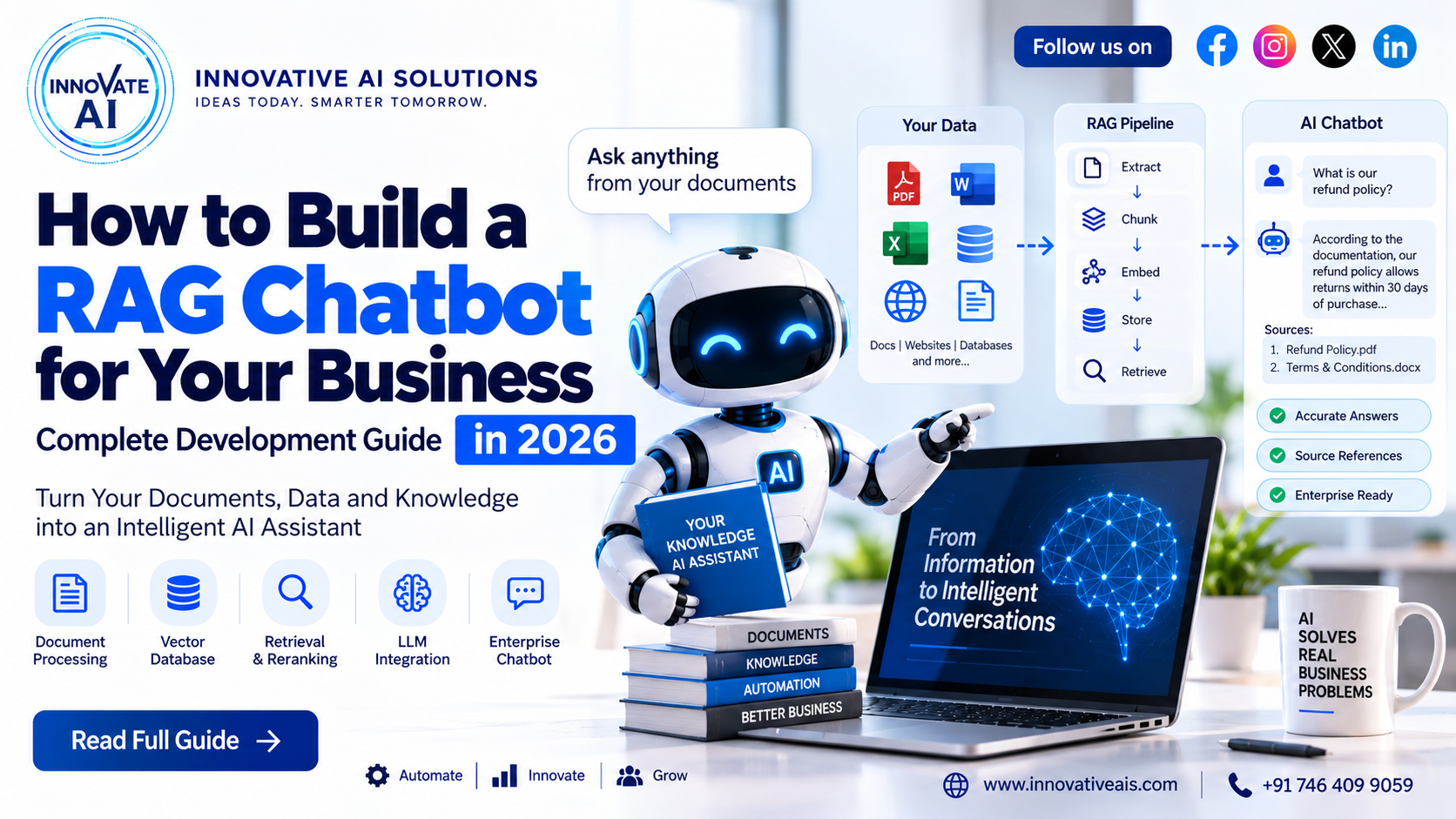
How to Build a RAG Chatbot for Your Business in 2026: Complete Development Guide
Businesses today have access to enormous amounts of information—PDFs, contracts, product documentation, policies, technical manuals, customer records, knowledge bases, FAQs and internal documents.
The challenge is not always creating more information.
The challenge is finding the right information quickly and using it effectively.
This is where Retrieval-Augmented Generation (RAG) can become extremely useful.
A RAG chatbot combines information retrieval with a Large Language Model (LLM) to create an AI assistant that can search a company's approved knowledge sources and use relevant information when generating responses.
Instead of asking an AI model to answer a question only from its general training, a RAG application can retrieve relevant information from a connected knowledge base.
For example, an employee could ask:
"What is our company's leave policy for employees who have completed one year?"
Instead of searching through dozens of HR documents manually, the RAG system can retrieve the relevant policy and generate an answer based on that information.
This makes RAG particularly useful for enterprise AI, customer support, document search, internal knowledge management and AI-powered business applications.
If you are considering RAG chatbot development for your business, this guide explains how RAG works, its architecture, development process, technologies, use cases, security considerations, evaluation methods, costs and how to choose the right RAG development company.
What Is a RAG Chatbot?
RAG stands for Retrieval-Augmented Generation.
A RAG chatbot is an AI application that combines:
- A knowledge source
- Information retrieval
- Relevant context
- A language model
- A conversational interface
A simplified workflow is:
User Question
      ↓
Query Processing
      ↓
Knowledge Retrieval
      ↓
Relevant Documents
      ↓
Context Construction
      ↓
Large Language Model
      ↓
Generated Answer
      ↓
User
The important difference is that the chatbot doesn't have to rely exclusively on information stored inside the language model.
It can retrieve information from external knowledge sources.
These sources could include:
- PDFs
- Word documents
- Websites
- Databases
- Product manuals
- Company policies
- FAQs
- Knowledge bases
- Internal documentation
- Research papers
- Support articles
- Structured business data
Why Are Businesses Building RAG Chatbots?
Traditional information systems often require users to search manually.
For example:
Employee
   ↓
Open Knowledge Portal
   ↓
Search
   ↓
Open Multiple Documents
   ↓
Read
   ↓
Find Answer
A RAG chatbot changes the interaction:
Employee
   ↓
Ask Question
   ↓
AI Retrieves Relevant Information
   ↓
AI Generates Answer
   ↓
Sources / References
This can make information access faster and more conversational.
Businesses may use RAG to improve:
- Customer support
- Employee productivity
- Knowledge management
- Document search
- Technical support
- Product assistance
- Sales enablement
- Research workflows
- Compliance workflows
- Internal operations
How Does RAG Work?
A production RAG system usually has two major stages:
Stage 1: Knowledge Ingestion
The system processes the company's information.
Documents
   ↓
Extraction
   ↓
Cleaning
   ↓
Chunking
   ↓
Embeddings
   ↓
Vector Database
Stage 2: Question Answering
When a user asks a question:
User Query
   ↓
Query Embedding
   ↓
Search
   ↓
Relevant Chunks
   ↓
Context
   ↓
LLM
   ↓
Answer
Let's understand each stage.
Step 1: Collect Business Documents
The first step is identifying the knowledge that the RAG chatbot needs to access.
For example, an organization may have:
- 5,000 PDF files
- 2,000 Word documents
- Product manuals
- HR policies
- SOPs
- Customer FAQs
- Technical documentation
- Contracts
- Training material
Not every document should necessarily be included.
A good RAG implementation starts by defining:
Which knowledge should the AI be allowed to use?
Step 2: Document Processing
Documents can come in different formats.
Examples:
- DOCX
- XLSX
- HTML
- TXT
- Images
- Scanned documents
The application needs to extract useful information from these sources.
For scanned documents, OCR may be required.
A document-processing pipeline could look like:
PDF / Image
     ↓
OCR / Text Extraction
     ↓
Document Classification
     ↓
Text Cleaning
     ↓
Metadata Extraction
Metadata can include:
- Document title
- Department
- Date
- Category
- Author
- Version
- Access level
This metadata can later be used for filtering.
Step 3: Chunking
Large documents usually need to be divided into smaller pieces called chunks.
For example:
100-page PDF
      ↓
Section 1
Section 2
Section 3
...
Section 100
The system can create smaller logical text segments.
The objective is not simply to split text after every fixed number of characters.
Good chunking should preserve meaning.
For example, a policy section containing:
Eligibility
Application Process
Required Documents
Approval Process
may work better as logical sections rather than arbitrary text fragments.
Poor chunking can reduce retrieval quality.
Step 4: Embeddings
Once documents are divided into chunks, the system can convert those chunks into numerical representations called embeddings.
Conceptually:
"Employee leave policy"
          ↓
     Embedding Model
          ↓
[0.13, -0.42, 0.77, ...]
These representations capture semantic relationships.
This allows the system to search for information based on meaning rather than only exact keyword matches.
For example:
Query:
"How many holidays do employees receive?"
could retrieve a document containing:
"Annual leave entitlement..."
even though the wording is different.
Step 5: Vector Database
Embeddings can be stored in a vector database or vector-capable search system.
Examples of technologies commonly used for vector search include:
- PostgreSQL with vector capabilities
- Pinecone
- Weaviate
- Qdrant
- Milvus
- Elasticsearch/OpenSearch
- Other vector search systems
The right choice depends on:
- Data volume
- Search requirements
- Existing infrastructure
- Budget
- Latency
- Security
- Deployment model
Step 6: User Asks a Question
Now the user interacts with the chatbot.
For example:
"What is the refund policy for enterprise customers?"
The system converts the query into a representation suitable for search.
Step 7: Retrieval
The retrieval system searches the knowledge base for relevant information.
A simplified flow:
User Query
     ↓
Search
     ↓
Top Relevant Chunks
     ↓
Ranking
     ↓
Context Selection
The system may use:
- Semantic search
- Keyword search
- Hybrid search
- Metadata filtering
- Reranking
A good production RAG system often benefits from combining multiple retrieval strategies rather than depending on a single search mechanism.
Step 8: Reranking
Initial retrieval may return several potentially relevant documents.
A reranking step can help identify which retrieved passages are most useful for the specific question.
For example:
Retrieved Results

Document A → Relevance 0.91
Document B → Relevance 0.82
Document C → Relevance 0.63
Document D → Relevance 0.40
The application can select the strongest context before sending it to the language model.
Step 9: Context Construction
The application then creates a prompt containing:
- User question
- Retrieved information
- System instructions
- Conversation context
- Appropriate constraints
Conceptually:
System Instructions
       +
Retrieved Knowledge
       +
User Question
       ↓
      LLM
       ↓
    Response
The model should be instructed appropriately regarding the retrieved knowledge and uncertainty.
Step 10: Generate the Answer
The LLM generates a response using the supplied context.
For example:
User:
What is the warranty period?
RAG system:
According to the product warranty documentation, the standard warranty period is 24 months.
A strong implementation can also provide citations or document references so users can verify the answer.
RAG Architecture
A production enterprise RAG chatbot can contain several layers.
                  USER
                   │
                   ▼
          Web / Mobile / WhatsApp
                   │
                   ▼
             API Gateway
                   │
                   ▼
          Authentication / RBAC
                   │
                   ▼
            RAG Application
                   │
        ┌──────────┼──────────┐
        ▼          ▼          ▼
   Retrieval     Memory     Business APIs
        │
        ▼
 Vector / Hybrid Search
        │
        ▼
   Reranking Layer
        │
        ▼
 Retrieved Context
        │
        ▼
       LLM
        │
        ▼
 Response + Citations
Behind this system, there is also an ingestion pipeline:
Documents
    ↓
OCR / Extraction
    ↓
Cleaning
    ↓
Chunking
    ↓
Metadata
    ↓
Embeddings
    ↓
Vector / Search Index
This separation between ingestion and query-time retrieval is important for scalable architectures.
RAG vs Traditional Chatbot
A traditional rule-based chatbot might work like:
IF user asks X
THEN return response Y
A RAG chatbot can instead:
User Question
      ↓
Understand Intent
      ↓
Search Knowledge
      ↓
Retrieve Context
      ↓
Generate Response
Traditional chatbot
Best for:
- Fixed FAQs
- Simple menus
- Deterministic workflows
- Basic support
RAG chatbot
Useful for:
- Large knowledge bases
- Dynamic documentation
- Complex questions
- Document-heavy businesses
- Internal knowledge systems
The two approaches can also be combined.
RAG vs Fine-Tuning
One of the most common questions is:
Should we use RAG or fine-tuning?
They solve different problems.
RAG
RAG is primarily useful when an AI system needs to access external or frequently changing knowledge.
For example:
Company policies change every month.
Instead of repeatedly retraining a model, the updated documents can be incorporated into the retrieval system.
Fine-Tuning
Fine-tuning can be useful when the objective involves changing or specializing model behavior for a particular task or style, depending on the model and use case.
The choice should be based on the actual requirement.
In many enterprise knowledge applications, RAG is a practical starting point.
Enterprise RAG Chatbot Development
Enterprise RAG is more complex than building a basic demo.
An enterprise application may require:
- User authentication
- Role-based access
- Department-level permissions
- Document-level permissions
- Audit logging
- Secure APIs
- Data encryption
- Monitoring
- Evaluation
- Scalability
- Integration with enterprise software
For example:
HR Employee
    ↓
HR Knowledge

Finance Employee
    ↓
Finance Knowledge

Engineering Employee
    ↓
Engineering Knowledge
The chatbot should not expose information that the user is not authorized to access.
RAG Security and Access Control
Security is one of the most important parts of enterprise RAG development.
Suppose a company has:
Public Documents
HR Documents
Finance Documents
Legal Documents
Executive Documents
A user should only retrieve information they are authorized to access.
This can require:
- Authentication
- RBAC
- Metadata filtering
- Document-level access control
- API authorization
- Encryption
- Logging
A RAG application should therefore be designed as a secure software system, not just an LLM wrapper.
Preventing Hallucinations in RAG
RAG can improve factual grounding, but retrieval alone does not guarantee perfect answers.
Potential problems include:
- Incorrect retrieval
- Missing information
- Ambiguous documents
- Outdated documents
- Poor chunking
- Weak prompts
- Model errors
A production system should therefore have mechanisms such as:
Grounded prompts
Tell the model to base answers on supplied context.
Citations
Show users which documents support the answer.
Confidence handling
If sufficient information cannot be found, the system can respond appropriately instead of inventing an answer.
Human escalation
High-risk workflows can route uncertain requests to a human.
RAG Evaluation
One of the biggest differences between a demo and a production RAG system is evaluation.
You need to measure whether the system actually works.
Important areas include:
Retrieval quality
Did the system retrieve the correct information?
Answer relevance
Did the answer actually address the question?
Groundedness
Is the answer supported by the retrieved context?
Completeness
Did the response include the important information?
Latency
How quickly does the system respond?
Cost
How much does each interaction cost?
Creating a RAG Evaluation Dataset
A useful approach is to create a test dataset:
Question
Expected Information
Expected Source
Actual Retrieval
Generated Answer
Evaluation
For example:
| Question | Expected Source | Result |
|---|---|---|
| What is the refund policy? | Refund Policy PDF | Correct |
| What is the warranty period? | Product Manual | Correct |
| Who approves leave? | HR Policy | Partial |
| What is the pricing? | Pricing Document | Incorrect |
This allows developers to continuously improve the system.
RAG Chatbot Use Cases
RAG can be applied across many industries.
1. Customer Support
A company can connect:
- Product manuals
- FAQs
- Support documentation
- Troubleshooting guides
Customers can ask questions conversationally.
2. Internal Employee Assistant
Employees can ask:
- HR questions
- IT questions
- Policy questions
- Process questions
- Company knowledge questions
This can reduce time spent searching internal documentation.
3. Legal Document Search
Organizations can use RAG to search large collections of legal documents.
Potential functionality:
- Document retrieval
- Clause search
- Summarization
- Question answering
- Comparison assistance
Legal workflows require appropriate professional review and should not rely blindly on AI-generated conclusions.
4. Healthcare Knowledge Systems
RAG can help retrieve information from approved healthcare documentation.
Potential applications include:
- Internal knowledge search
- Administrative documentation
- Medical literature retrieval
- Policy assistants
Healthcare applications require strong privacy and professional oversight.
5. Manufacturing
Manufacturers can connect:
- Machine manuals
- SOPs
- Maintenance documentation
- Safety procedures
- Technical manuals
An employee could ask:
"What is the maintenance procedure for machine X?"
The RAG system can retrieve the relevant documentation.
6. Education
Educational organizations can build:
- AI tutors
- Course assistants
- Student knowledge systems
- Faculty assistants
- Research assistants
Students can ask questions based on course-specific material.
7. Real Estate
A real estate RAG chatbot could access:
- Property information
- Brochures
- Project documents
- FAQs
- Pricing information
Customers could ask questions conversationally.
8. E-commerce
A RAG-based product assistant can use:
- Product catalogues
- Specifications
- Warranty information
- Shipping policies
- Return policies
Customers can ask:
"Which product is suitable for this requirement?"
The system can retrieve relevant product information before generating its response.
RAG for PDF Documents
PDF-based knowledge systems are among the common RAG use cases.
A typical architecture is:
PDF
 ↓
Text Extraction
 ↓
OCR if required
 ↓
Layout Understanding
 ↓
Chunking
 ↓
Metadata
 ↓
Embeddings
 ↓
Vector Search
 ↓
RAG
However, complex PDFs can contain:
- Tables
- Images
- Headers
- Footers
- Multiple columns
- Scanned pages
- Charts
Therefore, high-quality document processing is critical.
Multimodal RAG
Modern AI systems can go beyond plain text.
A business may have documents containing:
- Text
- Images
- Tables
- Charts
- Screenshots
A more advanced system may need to preserve relationships between these elements.
For example, a financial report may contain a table whose meaning depends on surrounding text.
Multimodal document processing can therefore become an important part of advanced enterprise RAG architectures.
RAG With OCR
If the business has scanned documents, OCR becomes an important preprocessing layer.
Example:
Scanned Invoice
      ↓
OCR
      ↓
Text + Fields
      ↓
Validation
      ↓
Chunking
      ↓
Embedding
      ↓
RAG
This can allow organizations to search and interact with information that previously existed only as scanned images.
RAG With Business APIs
RAG does not have to be limited to static documents.
An AI application can combine retrieval with APIs.
For example:
User
 ↓
"What is the status of order 10234?"
 ↓
AI understands request
 ↓
Order API
 ↓
Live Data
 ↓
AI Response
This is particularly useful because business information may change frequently.
The architecture may combine:
Knowledge Retrieval + APIs + Business Logic + LLM
RAG + AI Agents
RAG can also become one component inside an AI agent.
For example:
User
 ↓
AI Agent
 ↓
Understand Objective
 ↓
Search Knowledge
 ↓
Call CRM API
 ↓
Retrieve Customer Data
 ↓
Generate Response
 ↓
Take Approved Action
This enables more advanced workflows.
However, agents require careful permission management and monitoring.
RAG Chatbot Technology Stack
There is no single technology stack that works for every project.
A common architecture could use:
Frontend
- React
- Next.js
- TypeScript
- Angular
Backend
- Python
- FastAPI
- Django
- Node.js
AI Layer
- LLM APIs
- Open-source models
- Embedding models
- Reranking models
Data
- PostgreSQL
- MongoDB
- Redis
- Vector databases
- Search engines
Infrastructure
- AWS
- Azure
- Google Cloud
- Docker
- Kubernetes
The best stack depends on the project.
How Much Does RAG Chatbot Development Cost in India?
There is no universal price for RAG development.
The cost depends on:
- Number of documents
- Data volume
- Document complexity
- OCR requirements
- Number of users
- LLM selection
- Vector database
- Authentication
- Integrations
- UI/UX
- Security
- Cloud infrastructure
- Evaluation requirements
- Support requirements
A basic prototype can be relatively simple.
An enterprise RAG platform with:
- millions of documents
- OCR
- multiple departments
- RBAC
- CRM/ERP integration
- advanced search
- monitoring
- analytics
will naturally require significantly more development effort.
The right way to estimate cost is to first define the architecture and scope.
How Long Does It Take to Build a RAG Chatbot?
The timeline depends on complexity.
Basic MVP
May include:
- Document upload
- Text extraction
- Embeddings
- Vector search
- Chat interface
- Basic responses
Production system
May additionally require:
- Authentication
- RBAC
- Multiple data sources
- Better retrieval
- Reranking
- Citations
- Monitoring
- Evaluation
- API integrations
- Deployment
Enterprise platform
May require:
- High availability
- Advanced security
- Multiple tenants
- Enterprise integrations
- Audit logs
- Large-scale ingestion
- Performance optimization
Therefore, businesses should avoid choosing an AI development company solely based on an unrealistic fixed timeline.
Multi-Tenant RAG for SaaS Products
If you are building a RAG SaaS product, one important architectural challenge is tenant isolation.
For example:
Customer A
   ↓
Knowledge Base A

Customer B
   ↓
Knowledge Base B

Customer C
   ↓
Knowledge Base C
Customer A must never retrieve Customer B's information.
This requires careful:
- Data isolation
- Authentication
- Authorization
- Metadata filtering
- Database design
- Vector search isolation
Multi-tenant RAG should therefore be designed from the beginning rather than added as an afterthought.
RAG for International Businesses
RAG applications can be useful for businesses operating across countries.
A company may have:
- Different policies
- Multiple languages
- Regional product information
- Different compliance requirements
- Multiple offices
The AI architecture can incorporate appropriate metadata and access rules.
For international deployments, businesses should also consider:
- Data residency
- Privacy requirements
- Access controls
- Regional infrastructure
- Compliance obligations
How to Choose a RAG Development Company in India
If you are searching for a RAG development company in India, evaluate more than the company's marketing website.
Ask the development partner:
1. Do you understand retrieval architecture?
They should be able to explain:
- Chunking
- Embeddings
- Retrieval
- Hybrid search
- Reranking
- Context construction
2. Can you process complex documents?
Ask about:
- OCR
- Tables
- Scanned PDFs
- Images
- Metadata
3. How will you evaluate the system?
A serious RAG project needs measurable evaluation.
4. How will you handle security?
Ask about:
- RBAC
- Authentication
- Authorization
- Data isolation
- Encryption
- Logging
5. Can you integrate existing systems?
For example:
- CRM
- ERP
- LMS
- Website
- Mobile applications
- Databases
- APIs
6. Can you deploy the system?
AI development should include production engineering when the project requires it.
Why Choose Innovative AI Solutions for RAG Development?
Innovative AI Solutions works on AI-powered software solutions that combine AI technologies with modern software engineering.
Potential RAG development capabilities include:
- Custom RAG applications
- Enterprise knowledge assistants
- Document AI
- OCR
- AI chatbots
- Generative AI
- AI agents
- API integration
- Custom software development
- Cloud deployment
The focus should be on building a solution around the client's business workflow rather than simply adding an AI chatbot to an existing application.
Our RAG Development Process
Our recommended development process is:
1. Discovery
Understand:
- Business objectives
- Users
- Documents
- Data sources
- Existing software
- Security requirements
2. Architecture
Define:
- Ingestion pipeline
- Retrieval strategy
- AI model
- Database
- APIs
- Security
- Infrastructure
3. Prototype
Build a small working system using representative data.
4. Evaluation
Test:
- Retrieval
- Answer quality
- Grounding
- Latency
- Cost
5. Development
Build the complete product.
6. Integration
Connect:
- CRM
- ERP
- Database
- APIs
- Websites
- Communication channels
7. Deployment
Deploy to appropriate cloud infrastructure.
8. Monitoring
Monitor:
- Errors
- Latency
- Usage
- Cost
- Answer quality
9. Continuous Improvement
Improve:
- Retrieval
- Chunking
- Prompts
- Data
- Models
- User experience
RAG Chatbot Development Best Practices
Use High-Quality Data
Garbage in can lead to poor retrieval.
Preserve Metadata
Metadata enables filtering and better document organization.
Use Hybrid Search Where Appropriate
Combining semantic and keyword search can improve retrieval for certain workloads.
Add Citations
Citations improve transparency and allow users to verify information.
Build an Evaluation Dataset
Don't rely only on developer testing.
Monitor Production
Real users will expose problems that a demo may not.
Control Access
Users should only retrieve information they are authorized to access.
Optimize Cost
AI applications can incur costs from:
- Embeddings
- LLM calls
- Storage
- Search
- Infrastructure
Architecture should consider cost from the beginning.
Common RAG Development Mistakes
Mistake 1: Using a Vector Database Without Understanding Retrieval
Simply storing embeddings does not create a high-quality RAG system.
Mistake 2: Poor Chunking
Bad chunk boundaries can destroy context.
Mistake 3: Ignoring Metadata
Metadata can dramatically improve filtering and retrieval.
Mistake 4: No Evaluation
Without testing, you don't know whether the system is improving.
Mistake 5: No Access Control
Enterprise documents can contain sensitive information.
Mistake 6: Treating RAG as Only an LLM Project
RAG involves:
Data + Search + Backend + AI + Security + Infrastructure + UX
Mistake 7: Ignoring User Experience
A technically strong RAG system can still fail if users find it difficult to use.
Frequently Asked Questions About RAG Chatbot Development
What is RAG in AI?
RAG stands for Retrieval-Augmented Generation. It allows an AI application to retrieve relevant information from external knowledge sources and use that information when generating responses.
What is a RAG chatbot?
A RAG chatbot is a conversational AI application that retrieves relevant information from a connected knowledge base before generating answers.
Why use RAG instead of a normal AI chatbot?
RAG is useful when the chatbot needs access to business-specific or frequently changing information that may not be contained in the model's general knowledge.
Can RAG work with PDFs?
Yes. PDF documents can be processed, extracted, chunked and indexed for retrieval. Scanned PDFs may require OCR.
Can RAG work with databases?
Yes. RAG architectures can be combined with structured database queries and APIs, depending on the use case.
Can RAG be integrated with CRM software?
Yes. A RAG application can be integrated with CRM APIs to retrieve or update permitted business information.
Can RAG work with WhatsApp?
A RAG backend can be connected to supported messaging infrastructure so users can interact with the knowledge assistant through conversational channels.
Is RAG better than fine-tuning?
Neither is universally better. RAG is useful for grounding responses in external knowledge, while fine-tuning can be useful for certain behavior or task-specialization requirements.
How much does a RAG chatbot cost in India?
The cost depends on documents, users, integrations, AI models, security, infrastructure, UI/UX and development scope.
How long does RAG development take?
A basic proof of concept can be developed faster than a secure enterprise platform. The timeline depends on requirements and technical complexity.
Can RAG reduce AI hallucinations?
RAG can improve grounding by supplying relevant external information, but it does not guarantee that every response will be correct. Retrieval quality, model behavior, prompts and evaluation remain important.
Can RAG support multiple languages?
Yes. Multilingual RAG architectures can be designed depending on the languages, embedding models, retrieval system and LLM being used.
Is RAG suitable for enterprises?
Yes. Enterprise RAG can support internal knowledge management, customer support, technical documentation and other information-heavy workflows, provided security and access control are properly designed.