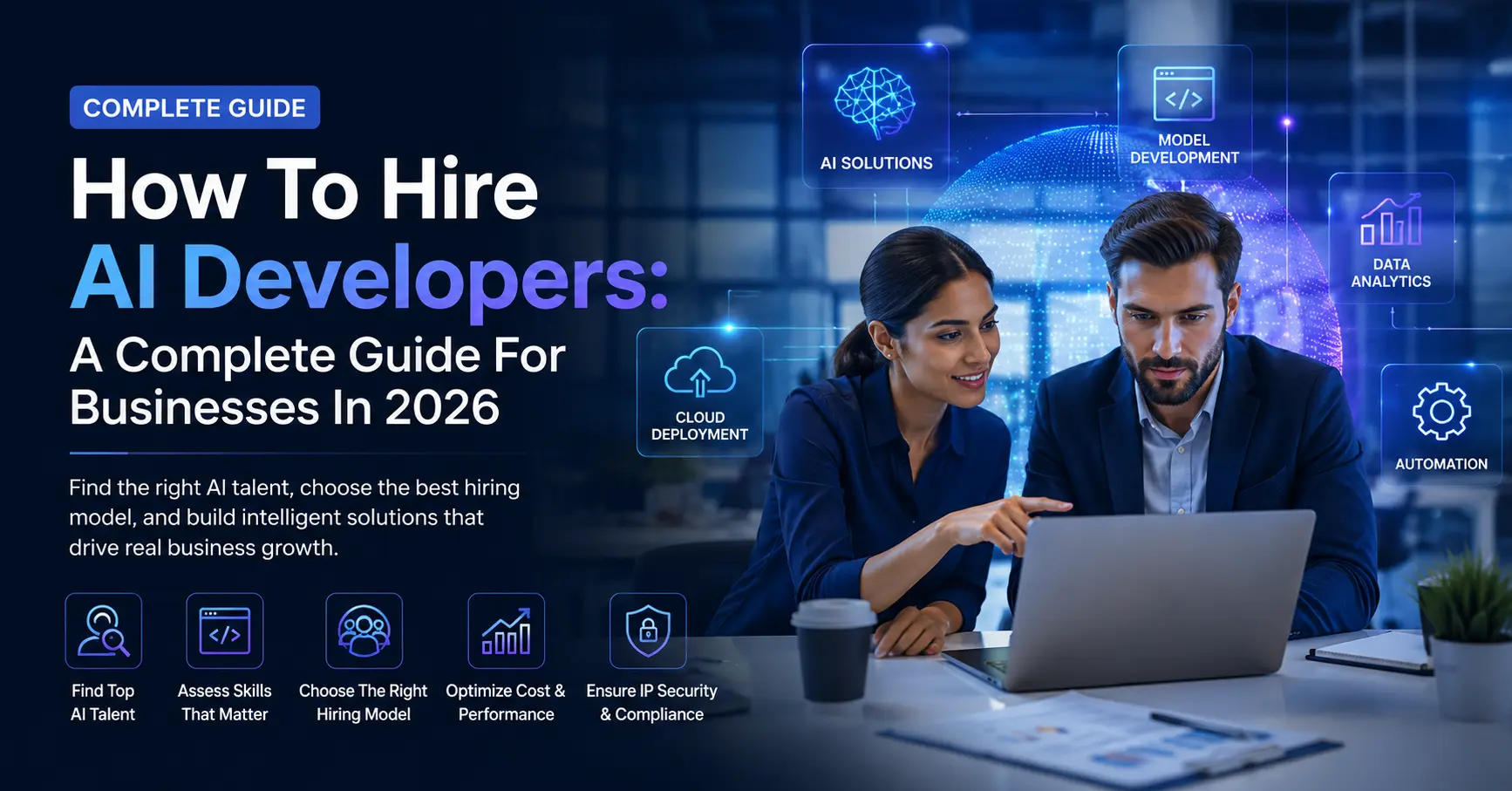
The AI Hiring Gap Delhi Businesses Cannot Ignore in 2026
Delhi NCR has become India's #1 hub for enterprise AI, leading the country in ChatGPT penetration and enterprise AI deployment. The region hosts the densest concentration of enterprise headquarters, government policy infrastructure, and AI-ready businesses in India. Yet the single biggest constraint on AI adoption is not technology. It is talent.
India now has an estimated 9.2 lakh AI professionals, comprising about 2.57 lakh in Core AI roles and 6.63 lakh in AI-embedded roles. The country accounts for roughly 16% of the world's AI workforce. These numbers sound impressive until you examine the demand side.
Organisations are shifting from AI experimentation to execution, and hiring demand reflects this. Governance, AgentOps, runtime operations, evaluation and quality assurance functions now account for 26% of hiring demand as AI adoption matures. Employers are seeking talent that can deploy, govern, integrate, and scale AI within real business workflows — not just build prototypes.
The supply-demand mismatch is severe. While 72–74% of India's AI workforce sits in AI-embedded roles, 66–68% of active job postings are for Core AI roles. The gap between what businesses need and what the talent pool offers is the defining hiring challenge of 2026.
This guide provides a complete framework for Delhi businesses to navigate this market — from defining roles and budgeting to sourcing, interviewing, and onboarding AI developers who can actually deliver production systems.
Understanding the AI Developer Role Spectrum
The Five Categories of AI Talent
"Hiring an AI developer" is too vague to be useful. AI roles span a wide spectrum of skills, and confusing them leads to misaligned hires and failed projects.
Machine Learning Engineers build, train, and deploy predictive models. They work with structured data, feature engineering, and model evaluation. Core skills: Python, scikit-learn, TensorFlow, PyTorch, SQL, MLOps.
Generative AI / LLM Engineers build applications using large language models. They work with prompt engineering, RAG pipelines, fine-tuning, and agent frameworks. Core skills: Python, LangChain, vector databases, API integration, evaluation frameworks.
Data Engineers build the pipelines that feed AI systems. They handle ingestion, transformation, and storage at scale. Core skills: Spark, Airflow, SQL, cloud data platforms.
AI Product Engineers build the applications that users interact with. They connect AI capabilities to business workflows. Core skills: full-stack development, API design, AI integration.
AI Governance / Operations Specialists ensure AI systems are compliant, monitored, and reliable. Core skills: DPDPA compliance, model evaluation, monitoring, audit frameworks.
What Skills Actually Matter in 2026
The market has matured. Employers are no longer impressed by generic "AI experience." They want evidence of production systems.
| Skill Category | What Employers Are Actually Testing | Red Flag |
|---|---|---|
| Production deployment | Systems running in production with real users | Only Jupyter notebooks and Kaggle competitions |
| LLM integration | RAG pipelines, agent frameworks, evaluation | "I've used ChatGPT" without engineering depth |
| Data handling | Pipeline design, data quality, bias testing | No experience with messy real-world data |
| Governance awareness | DPDPA, model monitoring, audit trails | Dismissive of compliance concerns |
| India context | Indian language support, local data constraints | No awareness of Indian regulatory landscape |
For organisations exploring AI development services or AI agents, hiring developers with genuine production experience is the foundation for success.
What AI Developers Actually Cost in Delhi NCR in 2026
Salary and Engagement Model Benchmarks
AI talent commands a significant premium over generalist developers — 20–40% higher at the same experience level. Generative AI and LLM specialists sit at the very top because that talent pool is single-digit-percent of the market.
| Engagement Model | Cost (INR) | Cost (USD) | Best For |
|---|---|---|---|
| Dedicated (full-time) | ₹1.8L–₹3L+ / month | $2,200–$3,600+ | AI-native products, RAG pipelines, agents |
| Part-time | ₹90K–₹1.5L / month | $1,100–$1,800 | Single LLM feature, advisory |
| Hourly | ₹2,500–₹5,000 / hr | $30–$60 / hr | Prototyping, integrations, model tuning |
Cost by Seniority
| Level | Experience & Skills | Hourly (INR) | Monthly Dedicated (INR) |
|---|---|---|---|
| Junior | 0–2 yrs, API integration, basic prompting | ₹1,300–₹2,200 | ₹1L–₹1.5L |
| Mid-level | 3–6 yrs, RAG, vector DBs, agents, fine-tuning | ₹2,500–₹3,800 | ₹1.8L–₹2.4L |
| Senior/Specialist | 6+ yrs, production MLOps, LLMOps, architecture | ₹4,000–₹6,000+ | ₹2.5L–₹4L+ |
Experienced AI engineers in India today are often in the ₹40L–₹1Cr+ range for senior positions. Bangalore and Hyderabad command slightly higher rates than Delhi NCR, with senior AI engineers earning ₹30L–₹50L ($36K–$60K) in those markets.
India vs Western Markets
| Region | Mid-Level Hourly | Senior/Specialist Hourly | Savings vs India |
|---|---|---|---|
| India | $25–$45 | $50–$70+ | Baseline |
| United States | $100–$150 | $150–$200+ | 60–70% cheaper in India |
| United Kingdom | $70–$100 | $100–$150+ | 55–65% cheaper in India |
Vertical specialists (medical AI, financial models) and engineers with HIPAA/GDPR/SOC 2 experience command further premiums, but the India-vs-West gap holds.
Where to Find AI Developers in Delhi NCR
Sourcing Channels Ranked by Effectiveness
1. Specialized AI Recruitment Firms
Delhi NCR has a growing ecosystem of recruitment firms focused specifically on AI and data talent. These firms maintain pre-vetted candidate pools and understand the difference between genuine AI engineers and generalist developers. Cost: 8–15% of first-year salary.
2. AI Startup Ecosystems
Noida has emerged as a rising hub for AI, anchored by companies like Innovaccer (healthcare data unicorn), SquadStack (sales acceleration), and Gabify (AI-led video analysis). Indian AI startups raised $676 million across 57 deals in H1 2026, more than 4x the previous year. This ecosystem is a rich source of experienced AI talent — and a competitive threat for retention.
3. Technical Communities and Events
Delhi NCR hosts regular AI meetups, hackathons, and conferences. These events are effective for identifying active practitioners. The region's universities — NSUT, DTU, IIIT-Delhi — produce AI-focused graduates, and NSUT's new Atal Incubation Centre provides direct access to early-stage AI startups and their technical teams.
4. LinkedIn and Professional Networks
LinkedIn remains the primary sourcing channel for mid-to-senior AI talent. However, passive candidates require direct, personalized outreach — generic recruiter messages are ineffective with this audience.
5. University Partnerships
For junior and mid-level hiring, partnerships with Delhi NCR's technical universities provide access to graduating talent before they enter the open market. NSUT's AI and IoT Centre of Excellence signals the region's investment in AI education infrastructure.
Sourcing Channel Comparison
| Channel | Best For | Time to Hire | Cost |
|---|---|---|---|
| Specialized AI recruiters | Senior/specialist roles | 4–8 weeks | 8–15% of salary |
| AI startup ecosystem | Mid-to-senior with production experience | 6–12 weeks | Competitive salary required |
| Technical communities | Active practitioners | 8–16 weeks | Low direct cost |
| LinkedIn outreach | Passive candidates | 6–12 weeks | Low direct cost, high time investment |
| University partnerships | Junior/mid-level | 12–20 weeks | Training investment required |
The Interview Framework: Testing What Actually Matters
Phase 1: Technical Screening (30–45 minutes)
The screening call should filter for genuine AI experience, not just enthusiasm. Effective screening questions focus on production constraints.
Questions that reveal real experience:
-
"Describe a model you deployed to production. What broke, and how did you fix it?"
-
"How do you evaluate an LLM application? What metrics do you track?"
-
"What happens when your model's confidence is low? How does the system handle it?"
-
"How have you handled DPDPA or data privacy requirements in your work?"
Candidates who have only worked in notebooks or competitions will struggle with these questions. Candidates with production experience will have specific stories.
Phase 2: Technical Deep Dive (60–90 minutes)
This phase tests depth in the specific domain relevant to your project. For LLM roles, focus on RAG pipelines, prompt engineering, and evaluation. For ML roles, focus on feature engineering, model selection, and monitoring.
Practical exercise options:
-
Code review of a provided ML/LLM pipeline with deliberate issues
-
Design discussion for a specific business problem
-
Debugging exercise on a failing model or pipeline
Avoid generic algorithmic puzzles. They filter for interview preparation, not AI engineering capability.
Phase 3: System Design and Governance (45–60 minutes)
This phase evaluates whether the candidate can operate in a production environment with real constraints.
Topics to explore:
-
End-to-end architecture for an AI system
-
Monitoring and alerting design
-
Failure modes and fallback mechanisms
-
Data privacy and compliance considerations
-
Integration with existing business systems
Phase 4: Culture and Communication (30–45 minutes)
AI development requires close collaboration with business stakeholders. Communication skills matter as much as technical depth.
Assessment criteria:
-
Can they explain complex concepts to non-technical colleagues?
-
How do they handle disagreement about technical approach?
-
Do they ask clarifying questions before proposing solutions?
-
How do they respond to feedback?
Onboarding AI Developers for Production Success
The First 30 Days
AI developers need context before they can contribute effectively. The onboarding plan should cover:
-
Business context: What problem are we solving? How does success get measured?
-
Data landscape: What data exists? What are its limitations?
-
System architecture: How do the pieces fit together?
-
Governance requirements: What are the compliance constraints (DPDPA, MeitY guidelines)?
-
Tools and workflows: What is the development and deployment process?
The First 90 Days
New AI hires should deliver a scoped project that demonstrates production capability. This serves as both a contribution and an evaluation mechanism.
Structured milestones:
-
Day 30: Code contribution to existing system, demonstrating workflow competence
-
Day 60: Completion of a scoped feature or improvement, independently
-
Day 90: Proposal for a system enhancement, showing architectural thinking
Common Onboarding Failures
| Failure Mode | Cause | Prevention |
|---|---|---|
| Model works in dev, fails in production | Insufficient testing on real data distributions | Include production-like data in development |
| Compliance issues discovered late | Governance not treated as a first-class requirement | Embed DPDPA requirements in development process |
| Poor integration with existing systems | Insufficient understanding of business workflows | Prioritise business context in onboarding |
| Developer disengagement | Unclear expectations or lack of meaningful work | Set clear milestones and provide production responsibility |
Decision Framework: Hiring Model Selection
Decision Matrix: Matching Hiring Model to Business Need
| Your Situation | Recommended Model | Cost Range | Rationale |
|---|---|---|---|
| First AI hire, uncertain scope | Senior full-time hire | ₹2.5L–₹4L/month | Needs to define architecture and approach |
| Specific AI feature addition | Mid-level or contract | ₹1.8L–₹2.4L/month | Focused scope, defined deliverable |
| AI team extension | Staff augmentation | ₹2,500–₹5,000/hour | Flexible capacity with existing context |
| Long-term AI product development | Dedicated team | ₹6L–₹12L/month for 3–4 people | Consistency, knowledge retention |
| Advisory or strategy only | Part-time specialist | ₹90K–₹1.5L/month | High-level guidance without full-time commitment |
| Production system maintenance | Mid-level full-time | ₹1.8L–₹2.4L/month | Ongoing monitoring, updates, incident response |
AI Hiring Readiness Scorecard
| Criteria | Weight | Score (1–5) | Weighted Score |
|---|---|---|---|
| Defined project scope and success metrics | 25% | ||
| Data infrastructure readiness | 20% | ||
| Budget alignment with market rates | 20% | ||
| Governance requirements understood | 15% | ||
| Onboarding and management capability | 10% | ||
| Retention strategy | 10% | ||
| Total | 100% | /5 |
A score below 3.0 suggests focusing on internal readiness before hiring. A score above 3.5 indicates strong foundation for successful AI hiring.
Frequently Asked Questions
1. What is the average salary for an AI developer in Delhi NCR in 2026?
Mid-level AI developers (3–6 years) command ₹1.8L–₹2.4L per month for full-time roles. Senior specialists with production MLOps and LLMOps experience earn ₹2.5L–₹4L+ monthly. AI/ML engineers carry a 20–40% premium over generalist developers at the same experience level.
2. How long does it take to hire an AI developer in Delhi?
For mid-level roles through specialized recruiters, expect 4–8 weeks. Senior and specialist roles take 6–12 weeks. The timeline depends on role specificity, compensation alignment, and sourcing channels. Passive candidates require longer outreach cycles.
3. What is the difference between an AI developer and a machine learning engineer?
Machine learning engineers focus on building, training, and deploying predictive models using structured data. AI developers (often generative AI or LLM engineers) build applications using large language models, RAG pipelines, and agent frameworks. The skills overlap but the focus differs.
4. Should I hire a dedicated AI developer or use an agency?
Dedicated hires provide consistency and knowledge retention for long-term AI product development. Agencies are suitable for scoped projects, pilot work, or when you need capabilities you cannot hire directly. Many Delhi businesses start with an agency for a pilot, then hire dedicated staff once the approach is validated.
5. What technical skills should I test for in an AI developer interview?
Focus on production experience, not framework familiarity. Test for: ability to describe deployed systems and failure modes, understanding of evaluation metrics for LLM applications, experience with data quality and bias testing, and awareness of DPDPA and governance requirements.
6. How do I evaluate AI developers without being technical myself?
Use a structured interview framework with practical exercises. Ask candidates to describe production systems they have built. Evaluate whether they discuss failure modes, monitoring, and compliance unprompted. Consider involving a technical advisor for final-round assessment.
7. What is the AI talent pool like in Delhi NCR compared to Bangalore?
Delhi NCR leads India in enterprise AI deployment and ChatGPT penetration. Bangalore has a larger AI startup ecosystem with 1,500+ deep-tech firms. Delhi's advantage is enterprise decision-maker density and policy proximity. Compensation in Delhi is typically 15–20% lower than Bangalore for equivalent roles.
8. What onboarding steps are essential for new AI hires?
The first 30 days should cover business context, data landscape, system architecture, governance requirements, and development workflows. New hires should make their first code contribution by day 30 and deliver a scoped project by day 90.
9. How does DPDPA affect AI developer hiring?
AI developers must understand DPDPA requirements for data handling, consent, and minimisation. During interviews, test for awareness of these constraints. Developers who dismiss compliance concerns create risk for your organisation.
10. What is the best way to source senior AI talent in Delhi?
Specialized AI recruitment firms and direct outreach through technical communities are most effective. Senior AI talent is rarely actively looking — they require personalized, specific outreach that demonstrates understanding of their work.
11. What retention strategies work for AI developers?
AI developers value challenging problems, production responsibility, and continuous learning. Retention requires: meaningful work with real impact, competitive compensation (AI talent is mobile), clear growth paths, and modern tooling. The Delhi NCR market is competitive, and underpaid AI talent will leave.
12. How can Innovative AI Solutions help?
Innovative AI Solutions is a Delhi-based AI development company that understands the local talent market. We help businesses scope AI roles accurately, source candidates through our network, and evaluate technical capability against production requirements. For organisations not ready to hire directly, we also provide AI development services that deliver production systems without the hiring overhead. Learn more at https://innovativeais.com.
Contact Innovative AI Solutions
Ready to build your AI team in Delhi?
We help businesses define AI roles, source qualified candidates, and evaluate technical capability for production AI development.
Contact Information
Innovative AI Solutions
📍 Netaji Subhash Place, Pitampura, Delhi – 110034
🌐 Website: https://innovativeais.com
📧 Email: info@innovativeais.com
📞 Phone: +91 7464 099 059 / +91 96899 67356
Business Services
• AI Automation
• AI Development
• AI Consulting
• Machine Learning Solutions
• Deep Learning Solutions
• Generative AI Services
• NLP Solutions
• AI Agents
• AI Chatbots
• Voice AI
• CRM Development
• Custom Software Development
• Website Development
• Mobile App Development
About the Author
Abhishek Kumar
Founder & CEO, Innovative AI Solutions
5+ years building production AI systems for Indian businesses. Based in Delhi, serving clients across India.
Ready to build AI solutions for your business?
Innovative AI Solutions — Delhi's leading AI development company. Free consultation available.
Get Free Consultation →
A complete 2026 hiring framework for Delhi businesses building AI development teams.
#HireAIDevelopers #AITalentDelhi #AIHiringIndia #MachineLearningJobs #GenAIEngineers #LLMDevelopers #DelhiNCRTech #AISalaryIndia #TechHiring #AIWorkforce #MLOps #AICareers #DelhiJobs #AIDevelopment #TechRecruitment #AIskills #ProductionAI #AIgovernance #DPDPA #AIteam #StartupHiring #TechTalent #DelhiStartups #AIJobsIndia #InnovativeAISolutions
Copyright ©️ 2015–2026 Innovative AI Solutions. All Rights Reserved. | Privacy Policy | Terms & Conditions