Why Most App Ideas Never Reach the App Store
Every year, thousands of mobile app ideas are conceived in India. A small fraction become specifications. A smaller fraction become designs. And a tiny minority actually reach the App Store or Google Play in a state that users want to download.
The bottleneck is rarely the idea itself. It is the absence of a structured process that moves an idea from concept to production without expensive rework.
Indian businesses building apps face a particular challenge: the temptation to skip phases. Founders under pressure to launch quickly often jump straight to development, bypassing validation, design, and planning. The result is predictable — a product that does not solve the right problem, requires rebuilding features, or fails at launch due to issues that proper testing would have caught.
The cost of rework is significant. Mobile app development in India ranges from ₹1,50,000 for simple apps to ₹35,00,000+ for complex platforms. Skipping a phase that costs ₹50,000 to execute properly often adds ₹3,00,000 in downstream rework.
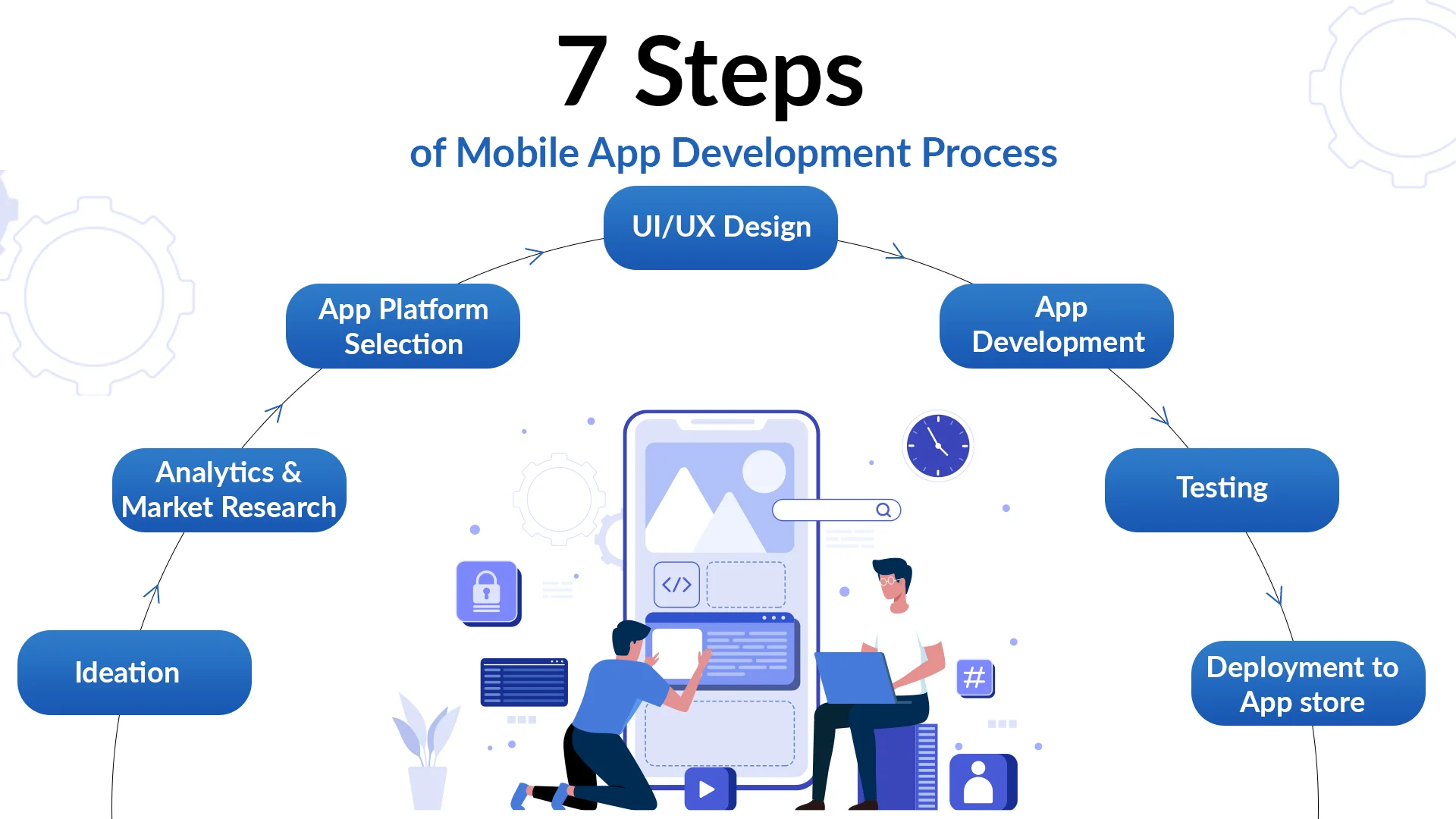
This guide breaks down the mobile app development process into seven distinct phases. For each phase, it covers what happens, how long it takes, what it costs, and what happens when you skip it. The framework applies whether you are building a simple MVP or a complex enterprise platform.
Phase 1: Idea Validation and Concept Definition (Weeks 1–2)
What Happens in This Phase
Before writing a single line of code, validate that the problem is real and the proposed solution addresses it. This phase is about reducing the risk of building something nobody wants.
Key activities:
-
Define the core problem the app solves
-
Identify the target user and their specific pain point
-
Research existing solutions and competitors
-
Validate demand through conversations with potential users
-
Define a one-sentence value proposition
Why It Matters
The most common cause of app failure is not technical — it is building the wrong thing. Validation prevents investment in features users do not need.
Questions to answer:
-
Who specifically has this problem?
-
How do they currently solve it?
-
What would make them switch to a new solution?
-
Is this problem painful enough that people would pay to solve it?
-
What is the smallest feature set that delivers value?
Cost and Timeline
| Activity | Timeline | Cost Range (INR) | Cost Range (USD) |
|---|---|---|---|
| Internal validation | 1–2 weeks | ₹0–₹25,000 | $0–$300 |
| User research (5–10 interviews) | 1–2 weeks | ₹25,000–₹75,000 | $300–$900 |
| Competitive analysis | 3–5 days | ₹15,000–₹40,000 | $180–$480 |
| Concept definition workshop | 1–2 days | ₹20,000–₹60,000 | $240–$720 |
What Happens If You Skip This Phase
You invest ₹5,00,000 in development for an app that solves a problem nobody has. Or you build features users never touch. Or you launch a product that is indistinguishable from existing solutions. Skipping validation is the most expensive shortcut in app development.
Phase 2: Requirements and Feature Prioritization (Weeks 2–3)
What Happens in This Phase
Translate the validated concept into a defined feature set. Prioritize ruthlessly — launch with the minimum viable product, not the full feature vision.
Key activities:
-
Define user stories and user flows
-
Create a prioritized feature list (must-have, should-have, nice-to-have)
-
Define the MVP scope
-
Identify integration requirements (payments, maps, CRM, AI services)
-
Define technical constraints and platform targets
The MVP Discipline
The most important decision in this phase is what not to build. An MVP typically includes 40–60% of the eventual feature set. Launching with fewer features and adding based on real usage data is consistently more successful than launching with everything.
| Feature Category | Percentage of Total Vision | Typical Timeline Impact |
|---|---|---|
| Must-have (MVP) | 40–60% | Baseline |
| Should-have (v1.1) | 20–30% | +4–8 weeks |
| Nice-to-have (v2.0) | 20–30% | +8–16 weeks |
Cost and Timeline
| Activity | Timeline | Cost Range (INR) | Cost Range (USD) |
|---|---|---|---|
| Requirements documentation | 1 week | ₹25,000–₹75,000 | $300–$900 |
| Feature prioritization workshop | 2–3 days | ₹20,000–₹50,000 | $240–$600 |
| Technical feasibility assessment | 3–5 days | ₹30,000–₹80,000 | $360–$960 |
What Happens If You Skip This Phase
Scope creep. The project expands beyond budget and timeline. Development becomes reactive rather than planned. Stakeholders disagree about priorities late in the project. The MVP never actually ships because the feature list keeps growing.
Phase 3: UI/UX Design and Prototyping (Weeks 3–6)
What Happens in This Phase
Design the user experience before development begins. This phase produces wireframes, user flows, visual designs, and a clickable prototype.
Key activities:
-
Create user flows and information architecture
-
Design wireframes (low-fidelity layouts)
-
Develop visual design system (colors, typography, components)
-
Build high-fidelity mockups for key screens
-
Create clickable prototype for user testing
-
Conduct usability testing with target users
Why Design Precedes Development
Designing before development prevents expensive rework. Changing a design in a prototype costs hours. Changing the same design in built code costs days or weeks.
Design deliverables:
-
User flow diagrams
-
Wireframes for all MVP screens
-
Visual design system
-
High-fidelity screen designs
-
Interactive prototype
-
Design specifications for developers
Cost and Timeline
| Design Scope | Timeline | Cost Range (INR) | Cost Range (USD) |
|---|---|---|---|
| Basic (template-based) | 2–3 weeks | ₹50,000–₹1,50,000 | $600–$1,800 |
| Custom (brand-led) | 4–6 weeks | ₹1,50,000–₹4,00,000 | $1,800–$4,800 |
| Design system + complex app | 6–8 weeks | ₹3,00,000–₹8,00,000 | $3,600–$9,600 |
What Happens If You Skip This Phase
Developers make design decisions by default, producing inconsistent, unpolished interfaces. Usability problems surface after launch, requiring expensive redesign. The app feels generic and fails to differentiate. Users abandon due to poor experience.
Phase 4: Development and Integration (Weeks 6–20)
What Happens in This Phase
Build the app. This is the longest phase and typically follows agile methodology with two-week sprints.
Key activities:
-
Set up development environment and version control
-
Build frontend (UI components and screens)
-
Build backend (APIs, databases, business logic)
-
Integrate third-party services (payments, maps, notifications, AI)
-
Conduct code reviews and continuous integration
-
Deploy to testing environments for stakeholder review
Development Approach
| Approach | Best For | Timeline Impact |
|---|---|---|
| Agile sprints (2 weeks) | Most projects | Standard |
| Waterfall | Fixed-scope, regulated projects | Longer, less flexible |
| Hybrid | Complex projects with defined milestones | Moderate |
Backend Considerations
Apps requiring custom backend infrastructure take longer than apps consuming existing services. Backend development typically accounts for 30–40% of total development time.
| Backend Type | Additional Timeline | Additional Cost (INR) |
|---|---|---|
| Managed services (Firebase, Supabase) | 2–4 weeks | ₹50,000–₹1,50,000 |
| Custom API backend | 4–8 weeks | ₹2,00,000–₹6,00,000 |
| Complex backend with real-time features | 8–16 weeks | ₹5,00,000–₹15,00,000 |
Cost and Timeline
| App Complexity | Development Timeline | Cost Range (INR) | Cost Range (USD) |
|---|---|---|---|
| Simple app | 4–6 weeks | ₹1,00,000–₹2,50,000 | $1,200–$3,000 |
| Startup MVP | 6–10 weeks | ₹2,00,000–₹5,00,000 | $2,400–$6,000 |
| E-commerce app | 8–14 weeks | ₹3,50,000–₹10,00,000 | $4,200–$12,000 |
| Complex platform | 14–24 weeks | ₹8,00,000–₹25,00,000+ | $9,600–$30,000+ |
What Happens If You Skip This Phase
There is no app. Development is the phase where the product is actually built. The relevant risk is not skipping development but rushing it — cutting corners on architecture, testing, and code quality that create expensive problems later.
Phase 5: Testing and Quality Assurance (Weeks 18–24, Overlapping Development)
What Happens in This Phase
Test the app systematically before launch. Testing overlaps with development — it is not a separate phase that begins after coding ends.
Testing types:
-
Functional testing: Does each feature work as specified?
-
Usability testing: Can real users complete key tasks?
-
Performance testing: Does the app perform under load?
-
Compatibility testing: Does it work across devices and OS versions?
-
Security testing: Are there vulnerabilities in data handling?
-
Regression testing: Do new changes break existing features?
The Real Device Requirement
Emulators are not enough. Testing on real devices across Android and iOS versions is essential. India's device landscape is diverse — apps must work across budget Android devices, mid-range phones, and premium iPhones.
| Testing Type | Timeline | Cost Range (INR) | Cost Range (USD) |
|---|---|---|---|
| Functional QA | 2–4 weeks | ₹50,000–₹1,50,000 | $600–$1,800 |
| Automated testing setup | 1–2 weeks | ₹40,000–₹1,20,000 | $480–$1,440 |
| Performance and security testing | 1–2 weeks | ₹60,000–₹2,00,000 | $720–$2,400 |
| Device farm testing | 1 week | ₹25,000–₹75,000 | $300–$900 |
What Happens If You Skip This Phase
Bugs surface in production, damaging user trust and app store ratings. Performance issues cause crashes on common devices. Security vulnerabilities expose user data. Negative reviews accumulate, making recovery difficult. The cost of fixing bugs after launch is consistently higher than catching them before.
Phase 6: App Store Submission and Launch (Weeks 24–26)
What Happens in This Phase
Prepare the app for distribution and submit to the Apple App Store and Google Play Store.
Key activities:
-
Prepare app store listings (title, description, screenshots, preview video)
-
Complete privacy policy and data safety declarations
-
Submit to Apple App Store (review takes 1–3 days)
-
Submit to Google Play Store (review takes 1–7 days)
-
Configure app store optimization (ASO) elements
-
Set up analytics, crash reporting, and monitoring
-
Prepare launch communication and marketing assets
India-Specific Compliance Requirements
| Requirement | Details |
|---|---|
| Privacy policy | Mandatory for both stores; must comply with DPDPA |
| Data safety declaration | Google Play requires detailed data collection disclosure |
| App privacy labels | Apple requires data collection disclosure |
| Content ratings | Both stores require appropriate ratings |
| Payment compliance | In-app purchases must use platform billing or approved alternatives |
Cost and Timeline
| Activity | Timeline | Cost Range (INR) | Cost Range (USD) |
|---|---|---|---|
| App store listing preparation | 3–5 days | ₹15,000–₹50,000 | $180–$600 |
| Apple App Store review | 1–3 days | ₹8,500/year (developer fee) | $99/year |
| Google Play review | 1–7 days | ₹2,000 (one-time) | $25 (one-time) |
| ASO setup | 1 week | ₹20,000–₹75,000 | $240–$900 |
What Happens If You Skip This Phase
You have an app that nobody can download. Or you submit without proper declarations and face rejection, delaying launch by weeks. Or you launch without ASO and the app is invisible in search results.
Phase 7: Post-Launch Monitoring and Iteration (Ongoing)
What Happens in This Phase
Launch is not the end. It is the beginning of the product's real life. Monitor performance, gather user feedback, and iterate.
Key activities:
-
Monitor crashes and performance metrics
-
Track user acquisition, retention, and engagement
-
Collect and analyze user feedback and reviews
-
Fix bugs and address issues promptly
-
Plan and ship feature iterations
-
Update for new OS versions and device compatibility
Post-Launch Cost Structure
| Expense Category | Monthly Range (INR) | Monthly Range (USD) |
|---|---|---|
| Cloud hosting / backend | ₹3,000–₹50,000+ | $36–$600+ |
| Maintenance and bug fixes | ₹10,000–₹55,000 | $120–$660 |
| Monitoring and analytics | ₹2,000–₹10,000 | $24–$120 |
| Third-party APIs | Variable | Variable |
| Feature iterations | ₹50,000–₹3,00,000 per iteration | $600–$3,600 |
What Happens If You Skip This Phase
The app degrades. Crashes go unfixed. Users leave negative reviews. New OS versions break compatibility. Competitors ship features you do not have. The app becomes a liability rather than an asset.
Complete Process Timeline and Cost Summary
End-to-End Timeline by App Complexity
| App Complexity | Total Timeline | Total Cost (INR) | Total Cost (USD) |
|---|---|---|---|
| Simple app | 8–14 weeks | ₹1,50,000–₹4,00,000 | $1,800–$4,800 |
| Startup MVP | 12–20 weeks | ₹3,00,000–₹8,00,000 | $3,600–$9,600 |
| E-commerce app | 16–28 weeks | ₹5,00,000–₹15,00,000 | $6,000–$18,000 |
| Complex platform | 24–40 weeks | ₹10,00,000–₹30,00,000+ | $12,000–$36,000+ |
Phase-by-Phase Cost Distribution
| Phase | % of Total Cost | Notes |
|---|---|---|
| Idea validation | 2–5% | Lower for internal validation |
| Requirements and prioritization | 3–8% | Higher for complex feature sets |
| UI/UX design | 15–25% | Higher for custom, brand-led design |
| Development | 40–55% | Largest phase; backend adds significantly |
| Testing and QA | 10–15% | Higher for regulated industries |
| App store submission | 2–5% | Includes ASO setup |
| Post-launch (first 3 months) | 5–10% | Recurring thereafter |
Decision Framework: Process Maturity Assessment
Process Readiness Scorecard
| Criteria | Weight | Score (1–5) | Weighted Score |
|---|---|---|---|
| Problem validated with users | 20% | ||
| MVP scope clearly defined | 20% | ||
| Design completed before development | 15% | ||
| Testing plan established | 15% | ||
| App store compliance requirements understood | 10% | ||
| Post-launch monitoring plan in place | 10% | ||
| Budget allocated across all phases | 10% | ||
| Total | 100% | /5 |
A score below 3.0 suggests the project is not ready to begin development. Above 3.5 indicates strong process foundation.
Frequently Asked Questions
1. How long does it take to build a mobile app from idea to app store?
Simple apps take 8–14 weeks. Startup MVPs take 12–20 weeks. E-commerce apps take 16–28 weeks. Complex platforms take 24–40 weeks. These timelines assume defined scope and active stakeholder participation.
2. What is the first step in mobile app development?
Idea validation. Before writing code or designing screens, validate that the problem is real and the proposed solution addresses it. Skipping validation is the most common and expensive mistake in app development.
3. How much does it cost to build an app in India in 2026?
Simple apps cost ₹1,50,000–₹4,00,000 ($1,800–$4,800). Startup MVPs cost ₹3,00,000–₹8,00,000 ($3,600–$9,600). E-commerce apps cost ₹5,00,000–₹15,00,000 ($6,000–$18,000). Complex platforms cost ₹10,00,000–₹30,00,000+ ($12,000–$36,000+).
4. Why is UI/UX design important before development?
Designing before development prevents expensive rework. Changing a design in a prototype costs hours. Changing the same design in built code costs days or weeks. Design also ensures usability problems are caught before they are built into the product.
5. How long does App Store review take in India?
Apple App Store review typically takes 1–3 days. Google Play review takes 1–7 days. First submissions may take longer. Ensure all declarations and compliance requirements are complete to avoid rejection delays.
6. What are the ongoing costs after launching an app?
Budget 15–30% of initial development cost annually for maintenance, hosting, monitoring, and updates. Cloud hosting runs ₹3,000–₹50,000+ monthly. Maintenance runs ₹10,000–₹55,000 monthly. Feature iterations cost ₹50,000–₹3,00,000 each.
7. What happens if I skip idea validation?
You risk building an app that solves a problem nobody has. Skipping validation is the most expensive shortcut in app development. It leads to building wrong features, launching products indistinguishable from competitors, and wasting development budget.
8. How many features should an MVP include?
An MVP typically includes 40–60% of the eventual feature set. Launch with the minimum that delivers core value, then add features based on real usage data. Launching with fewer features is consistently more successful than launching with everything.
9. Do I need to test on real devices or are emulators enough?
Real devices are essential. India's device landscape is diverse — apps must work across budget Android devices, mid-range phones, and premium iPhones. Emulators cannot replicate real-world performance, network conditions, or device-specific issues.
10. What is app store optimization (ASO)?
ASO is the process of optimizing app store listings to improve visibility and download rates. It includes keyword research, title and description optimization, screenshot design, and review management. ASO setup typically costs ₹20,000–₹75,000 ($240–$900).
11. How do I choose between building an MVP and a full-featured app?
Build an MVP first. Launch with core features, validate with real users, then invest in expansion based on actual usage data. This reduces risk, spreads cost over time, and prevents building features users never touch.
12. How can Innovative AI Solutions help?
Innovative AI Solutions is a Delhi-based mobile app development company that follows a structured seven-phase process from idea validation to app store launch. We help businesses define MVP scope, design user experiences, build production apps with AI integration where it adds value, and support post-launch iteration. Our approach ensures you build the right product, not just a product. Learn more at https://innovativeais.com.
Contact Innovative AI Solutions
Ready to take your app from idea to app store?
We guide Indian businesses through every phase of mobile app development — from validation and design to development, launch, and iteration.
Contact Information
Innovative AI Solutions
📍 Netaji Subhash Place, Pitampura, Delhi – 110034
🌐 Website: https://innovativeais.com
📧 Email: info@innovativeais.com
📞 Phone: +91 7464 099 059 / +91 96899 67356
Business Services
• AI Automation
• AI Development
• AI Consulting
• Machine Learning Solutions
• Deep Learning Solutions
• Generative AI Services
• NLP Solutions
• AI Agents
• AI Chatbots
• Voice AI
• CRM Development
• Custom Software Development
• Website Development
• Mobile App Development
About the Author
Abhishek Kumar
Founder & CEO, Innovative AI Solutions
5+ years building production AI systems for Indian businesses. Based in Delhi, serving clients across India.
Ready to build AI solutions for your business?
Innovative AI Solutions — Delhi's leading AI development company. Free consultation available.
Get Free Consultation →
A complete 2026 guide to the seven-phase mobile app development process from idea validation to app store launch and iteration.
#MobileAppDevelopment #AppDevelopmentProcess #IdeaToAppStore #2026 #AppDevelopmentLifecycle #AppDesign #AppDevelopment #AppTesting #AppDeployment #AppStoreLaunch #MVPDevelopment #AgileDevelopment #AppDevelopmentIndia #DelhiNCRTech #StartupApps #AppDevelopmentGuide #MobileApps #AppStoreOptimization #ProductDevelopment #TechProcess #DigitalProducts #AppLaunch #DevelopmentTimeline #MobileDevelopment #InnovativeAISolutions
Copyright ©️ 2015–2026 Innovative AI Solutions. All Rights Reserved. | Privacy Policy | Terms & Conditions