The Big Question
What happens when your application sends every request to a frontier model, even when most requests are simple greetings, FAQs, or straightforward lookups? When 80% of your inference spend is going to capability that 80% of your requests do not use?
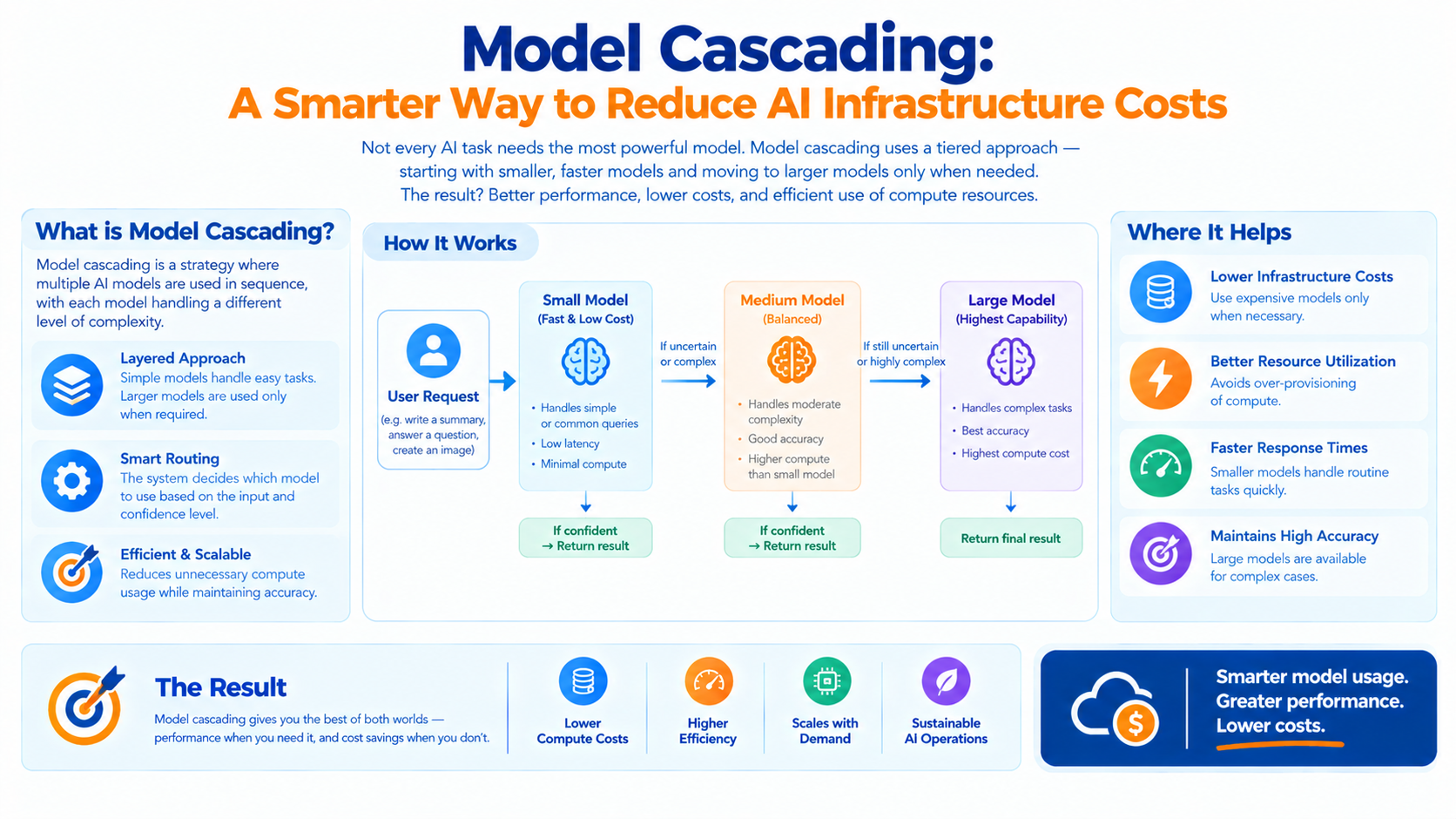
This is the problem model cascading solves. Instead of routing every request to the most capable model, a cascade tries the cheapest model that might work, checks whether the result is acceptable, and escalates only when it is not.
The economics are straightforward: if most requests can be handled by a cheaper model, and you only pay for the expensive model on the subset that needs it, your average cost per request drops dramatically.
How Model Cascading Works
A cascade is a sequential decision process. Each stage has a model and a quality check.
The basic flow:
-
The request arrives.
-
The cheapest model attempts it.
-
A quality check evaluates the response.
-
If the response passes, it is returned.
-
If the response fails, the request escalates to the next model.
-
The process repeats until a response passes or the most capable model is reached.
The key design decisions are which models to include, how to order them, and how to decide whether a response is good enough.
Why It Works
Cascading works because of a simple distributional fact: most requests are easy.
In most production workloads, the distribution of request difficulty is heavily skewed. A small fraction of requests require frontier-model capability. The majority can be handled by smaller, cheaper models.
If you route every request to the frontier model, you pay frontier prices for trivial requests. If you cascade, you pay frontier prices only for the requests that actually need it.
The arithmetic: If 70% of requests are resolved by a model that costs 10% as much as the frontier model, and 30% escalate, the average cost per request drops to roughly 37% of the frontier-only cost assuming the escalation check itself is cheap.
The exact savings depend on the distribution of request difficulty and the cost ratio between models. But the direction is consistent: cascading reduces cost.
The Components of a Cascade
Stage 1: The Cheap Model
The first stage uses the least expensive model that has a reasonable chance of handling the request. This may be a small language model, a fine-tuned task-specific model, or even a rule-based system for highly structured requests.
Design consideration: The cheap model should be fast. Latency matters, and if the first stage is slow, the cascade loses its responsiveness advantage.
Stage 2: The Quality Check
The quality check determines whether the cheap model's response is acceptable. This is the most important component of the cascade, and the hardest to design.
Approaches:
Confidence scoring. The model reports its confidence, and responses below a threshold escalate. This works when confidence is calibrated.
Self-evaluation. The model evaluates its own response against criteria. This is fast but imperfect models can be wrong about being wrong.
Cross-model evaluation. A separate model evaluates the response. This is more reliable but adds cost and latency.
Rule-based checks. Deterministic checks for format, length, required fields, and prohibited content. Fast and reliable for structural requirements.
Retrieval groundedness. For retrieval-augmented systems, check whether the response is supported by retrieved evidence.
Hybrid checks. Combine multiple approaches for example, a rule-based check for format plus a confidence threshold plus a groundedness check.
Design consideration: The quality check should be cheaper than the escalation it prevents. If the check costs as much as the expensive model, the cascade provides no savings.
Stage 3: Escalation
If the quality check fails, the request escalates to a more capable model. The process repeats until a response passes.
Design consideration: Limit the number of stages. A three-stage cascade (cheap, mid, frontier) captures most of the savings. More stages add complexity without proportional benefit.
Where Cascading Applies
Cascading is most effective for workloads with a skewed difficulty distribution and a reliable quality check.
Good Candidates
Customer support. Most inquiries are routine; a minority require complex reasoning.
Content classification. Most items are clearly in one category; a minority are ambiguous.
Data extraction. Most documents follow standard patterns; a minority are unusual.
Draft generation. Most drafts need only light editing; a minority need substantial rework.
Search and retrieval. Most queries are straightforward; a minority require query expansion or multi-step reasoning.
Poor Candidates
Tasks requiring frontier capability by definition. If every request needs the most capable model, cascading adds cost without benefit.
Tasks where the quality check is unreliable. If you cannot tell whether a response is good, you cannot cascade safely.
Tasks where latency is critical. Cascading adds a sequential step. If the first stage fails frequently, total latency increases.
Tasks where errors are catastrophic. If a wrong response from the cheap model causes serious harm, cascading without a reliable check is dangerous.
Cascade Routing Versus Classifier Routing
Cascading is one of two primary approaches to model routing. The other is classifier-based routing.
Cascade routing: Try the cheap model first; escalate based on response quality.
Classifier routing: Predict request difficulty before processing; route to the appropriate model.
| Aspect | Cascade Routing | Classifier Routing |
|---|---|---|
| Decision point | After the cheap model responds | Before any model processes |
| Signal | Response quality | Predicted request difficulty |
| Latency | Adds a step when escalation occurs | No additional step |
| Complexity | Requires a quality check | Requires a trained classifier |
| Adaptability | Adapts to actual response quality | Depends on classifier accuracy |
The two approaches can be combined: a classifier routes obviously simple requests to the cheap model, and a cascade handles the uncertain middle.
The Quality Check Problem
The reliability of the cascade depends entirely on the quality check. A check that approves bad responses defeats the purpose; a check that rejects good responses wastes the cheap model's work.
The trade-off:
| Check Behavior | Consequence |
|---|---|
| Too permissive | Bad responses reach users |
| Too strict | Everything escalates; no savings |
| Well calibrated | Savings with maintained quality |
The measurement: Track two metrics the rate at which the cheap model's responses are accepted, and the rate at which those accepted responses are later found to be inadequate. The gap between them reveals the check's accuracy.
Measuring Cascade Effectiveness
A cascade should be evaluated on cost, quality, and latency.
| Metric | What It Measures |
|---|---|
| Escalation rate | Proportion of requests that reach each stage |
| Cost per request | Average cost across all requests |
| Quality parity | Whether cascade quality matches frontier-only quality |
| Latency distribution | End-to-end latency including escalation |
| False acceptance rate | Bad responses approved by the check |
| False rejection rate | Good responses escalated unnecessarily |
The goal is quality parity at lower cost. If quality drops, the cascade is not working regardless of the savings.
Implementation Roadmap
Phase 1: Analyze (Weeks 1-2)
-
Profile your request distribution. What proportion of requests are simple, moderate, and complex?
-
Measure current cost per request for frontier-only routing.
-
Identify candidate models for the cheap and mid stages.
Phase 2: Build (Weeks 3-6)
-
Implement the cascade with two or three stages.
-
Build the quality check. Start with rule-based checks and confidence thresholds; add model-based checks if needed.
-
Instrument the cascade to capture escalation rates and outcomes.
-
Set thresholds for acceptance and escalation.
Phase 3: Validate and Tune (Weeks 7-10)
-
Measure quality parity against frontier-only routing.
-
Measure cost reduction.
-
Tune thresholds based on false acceptance and false rejection rates.
-
Monitor continuously as request distributions and models change.
Frequently Asked Questions
Q1: How much can cascading reduce costs?
It depends on the distribution of request difficulty and the cost ratio between models. If most requests can be handled by a model that costs 10% as much, savings can exceed 50%.
Q2: Does cascading reduce quality?
Not if the quality check is reliable. The goal is quality parity at lower cost. If quality drops, the check is too permissive.
Q3: What is the most important component?
The quality check. A cascade is only as good as its ability to determine whether a response is acceptable.
Q4: How many stages should a cascade have?
Two or three. A cheap model, optionally a mid-tier model, and a frontier model. More stages add complexity without proportional benefit.
Q5: How does cascading relate to classifier routing?
They are complementary. Classifier routing predicts difficulty before processing; cascading evaluates quality after. Combining them handles both obvious cases and uncertain ones.
Q6: How can Innovative AI Solutions help?
We help organizations design and implement model cascades from request profiling and model selection to quality check design and continuous tuning. Explore our services to see how we approach AI cost optimization. Based in Delhi, serving clients across India.
Why Delhi is a Great Hub for AI Cost Optimization
Delhi is emerging as a hub for enterprise AI adoption, backed by a thriving IT services ecosystem and growing pressure to control inference costs. As Indian enterprises scale AI applications, techniques like model cascading become essential for making AI economically sustainable.
What We Offer at Innovative AI Solutions
-
Request Profiling: We analyze your request distribution to identify cascade opportunities.
-
Cascade Design: We design the stages, models, and thresholds.
-
Quality Check Implementation: We build and calibrate the checks that make cascading safe.
-
Measurement: We track cost, quality, and latency against frontier-only baselines.
-
Continuous Tuning: We adjust thresholds as distributions and models evolve.
Final Thought
The shift is clear: from sending every request to the most expensive model to sending each request to the cheapest model that can handle it. Model cascading is not a compromise on quality it is a recognition that most requests do not need frontier capability, and paying for it on every request is waste. Organizations that implement cascading will reduce inference costs while maintaining the quality their users expect.
Contact Us:
Phone: +91 7464 099 059 / +91 9689967356
Email: info@innovativeais.com
Address: 904, 9th floor Pearls Best Heights-I, Netaji Subhash Place, Delhi-110034
Website: https://innovativeais.com
About the Author
Abhishek Kumar
Founder & CEO, Innovative AI Solutions
5+ years building AI, cloud, and enterprise systems. Based in Delhi, serving clients across India.