The Big Question
What happens when you can run a neural network on a device with less than 256 KB of RAM and a 100 MHz processor? When a hearing aid can filter background noise on-device, a factory sensor can detect bearing wear before failure, and an agricultural monitor can last months on a single battery—all without sending a single byte to the cloud?
This is the promise of TinyML: Machine learning at the extreme edge, where power is scarce, connectivity is unreliable, and memory is measured in kilobytes rather than gigabytes.
What Is TinyML?
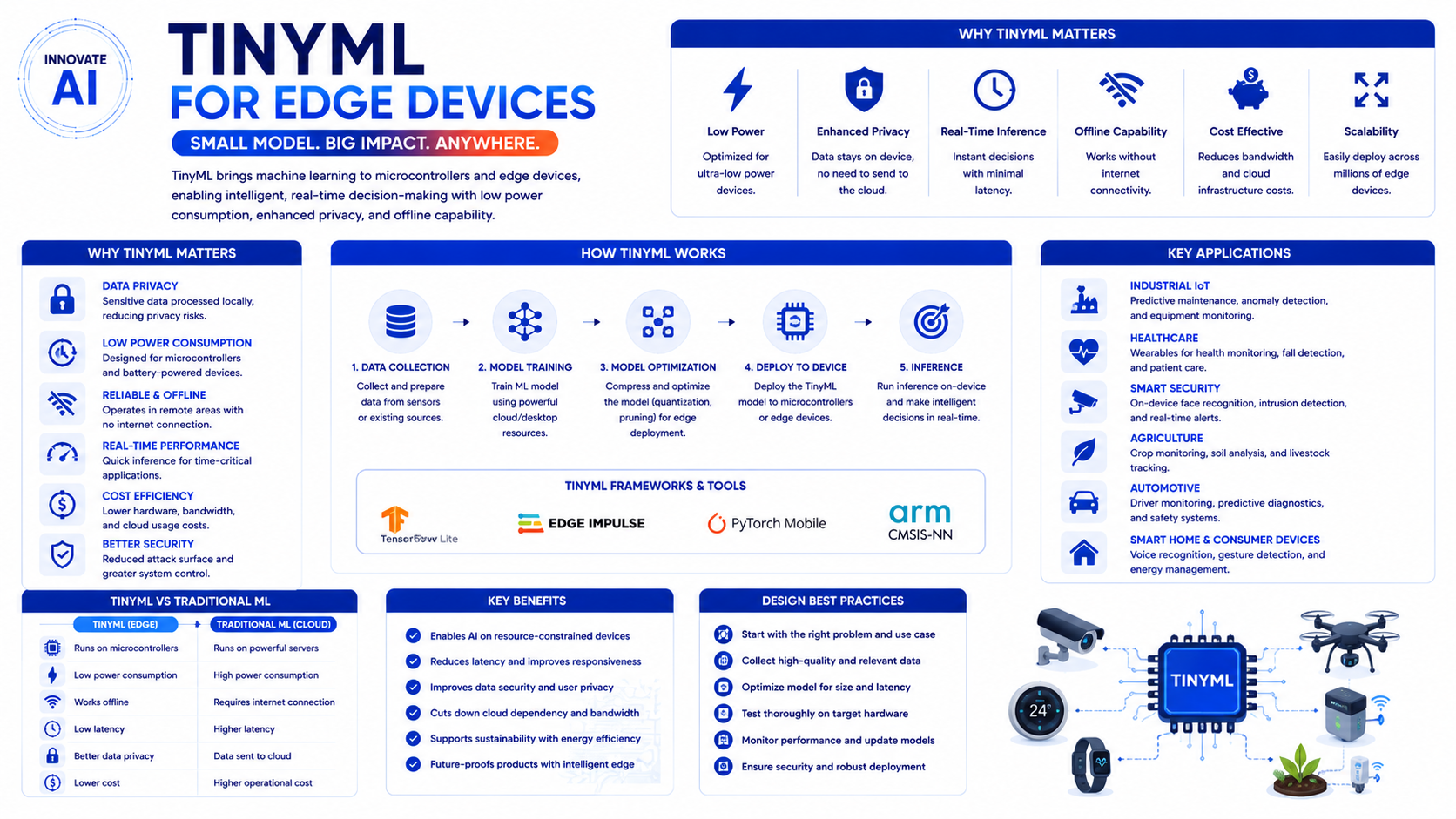
TinyML refers to the deployment of machine learning models on ultra-low-power, memory-constrained devices such as microcontrollers (MCUs), digital signal processors, and embedded systems with kilobytes of RAM and limited computational throughput . What distinguishes TinyML from conventional edge AI is its extreme resource efficiency—typically operating within power budgets of less than 1 mW and memory footprints under 256 KB while maintaining real-time inference capabilities .
Traditional machine learning systems rely on cloud servers for processing, introducing high latency, dependency on network connectivity, increased energy consumption, and elevated privacy risks . TinyML flips this model by performing all model inference locally, eliminating the need for data transmission and enabling real-time, privacy-preserving intelligence on devices that were previously too constrained to run any form of AI.
Between 2020 and 2024, TinyML research grew exponentially, averaging a 59.23% annual increase in publications across Electrical and Electronics Engineering, Computer Science, and Telecommunications .
Why TinyML Matters
The Constraints That Define the Edge
Microcontrollers used in TinyML deployments typically feature less than 1MB of memory, operate at clock speeds under 100 MHz, and consume milliwatts or even microwatts of power . These constraints dictate everything—the model architectures, the compression techniques, and the deployment strategies.
But working within these constraints unlocks new possibilities. TinyML devices can operate for months or years on a single battery, process data in real-time without latency, and keep sensitive information local—making them ideal for healthcare wearables, industrial sensors, and consumer IoT devices.
The Benchmark Reality
MLPerf Tiny, the industry-standard benchmark for ultra-low-power systems, provides a clear picture of what's possible. The v1.4 submission round included devices ranging from 60 MHz microcontrollers to vector-enabled RISC-V cores to dedicated neural processing units . The benchmark measures not just inference latency but energy consumption as a first-class metric—because in TinyML, battery life is often the binding constraint .
Reference models typically stay under 2M weights, and the entire stack—from model architecture to quantization paths to harness overhead—must fit within the resource-constrained envelope .
How TinyML Works
The Compression Toolkit
Deploying neural networks on constrained hardware requires aggressive model compression. Three techniques dominate :
Quantization reduces the numerical precision of model weights from 32-bit floating-point to 8-bit integers (or even lower). This decreases memory footprint, computational cost, and inference latency while maintaining acceptable accuracy. In practice, 8-bit post-training quantization can achieve 3-4× storage reduction, yielding deployable flash footprints of 286-536 KB within a 1 MB flash / 256 KB SRAM budget .
Pruning eliminates redundant weights and network connections, further reducing resource consumption. Pruning techniques, including static and activation-based methods, remove redundant weights or neurons to reduce memory usage, typically with minor accuracy loss—often necessary when SRAM limits prevent using the original model .
Lightweight Architectures like MobileNetV2, which employs depth-wise separable convolutions to reduce parameters, allow real-time vision models to be executed efficiently on embedded devices .
The Hardware Landscape
Microcontrollers used in TinyML deployments vary widely. The ARM Cortex-M4 platform (64 MHz, 1 MB flash, 256 KB SRAM) is a common choice for optimized TinyML applications . More powerful options include the ESP32-P4 with dual-core architecture, 32 MB PSRAM, and dedicated hardware accelerators . Some platforms are developing built-in AI accelerators, dedicated DSP units, and optimized memory hierarchies specifically for neural inference .
The Software Ecosystem
Open-source platforms like TensorFlow Lite for Microcontrollers (TFLM), Edge Impulse, and Arduino IDE enable rapid prototyping and deployment without expensive cloud infrastructure . Software libraries such as CMSIS-NN, uTVM, and STM32Cube.AI are tailored to squeeze maximum performance from these chips .
Real-World Applications
Healthcare: Continuous Monitoring on a Coin Battery
The healthcare domain has seen some of the most impactful TinyML deployments. A recent study demonstrated real-time ECG anomaly detection on low-power edge devices, achieving 92.3% accuracy while reducing power consumption to just 0.024 mW—enabling continuous, long-term health monitoring with minimal energy requirements .
This represents a paradigm shift for healthcare. Traditional ECG monitoring systems rely on centralized data processing, introducing high latency, elevated power consumption, and privacy concerns that make them suboptimal for wearable real-time health monitoring . TinyML enables real-time analysis directly on wearable devices, eliminating the need for constant data transmission and preserving the privacy of sensitive health data.
Additional healthcare applications include fall detection, chronic disease prediction using wearable sensors, and patient monitoring in rural health clinics where connectivity is limited .
Industrial IoT: Predictive Maintenance and Anomaly Detection
In industrial settings, TinyML enables predictive maintenance at the sensor level. Industrial vibration sensors can flag bearing wear before a machine fails, operating on milliwatt power budgets without requiring cloud connectivity .
Anomaly detection in time-series and image data is a primary use case. TinyML-enabled devices can detect anomalies at the data source, enabling real-time monitoring with low-latency responses and reduced communication overheads . For safety-critical environments like machine halls where network data transfer is best avoided, autonomous, self-sufficient systems that process everything locally are particularly valuable .
Environmental Monitoring: Smart Waste Sorting
A research study demonstrated TinyML-driven real-time waste sorting, automating waste classification into categories such as plastic, glass, metal, organic, and paper . The system processes data on-site, minimizing energy consumption and eliminating the latency and privacy issues associated with cloud-based processing.
Agricultural sensors lasting months on a single charge and environmental monitoring in underserved regions are additional applications enabled by TinyML's extreme power efficiency .
Autonomous Navigation: End-to-End TinyML
TinyNav, a research project from arXiv, demonstrates end-to-end autonomous navigation on an ESP32 microcontroller using a custom-trained, quantized 2D CNN. The 23k-parameter model processes a 20-frame sliding window of depth data to predict steering and throttle commands, achieving 30 ms inference latency—responsive enough for real-time obstacle avoidance .
This approach avoids computationally expensive 3D convolutions or recurrent layers, keeping the model small enough for constrained hardware. The research validates that responsive autonomous control can be deployed directly on highly constrained edge devices, reducing reliance on external compute resources .
Voice Assistants: Offline, Private, Low-Power
A smart voice assistant developed for the ARM Cortex-M55 platform demonstrates fully offline voice recognition using TinyML. The system uses Mel Frequency Cepstral Coefficients (MFCC) feature extraction and a lightweight neural network deployed via TensorFlow Lite for Microcontrollers, achieving high accuracy with minimal memory usage . Unlike cloud-based voice assistants, the system ensures reduced latency, improved data privacy, and no dependence on internet connectivity .
The Challenges
Data Scarcity and Sensor Sensitivity
Achieving high accuracy often requires that training data be captured using the exact same physical sensor hardware as the deployment environment—creating a significant challenge for real-world deployment at scale .
Model-Accuracy Trade-offs
Pruning and knowledge distillation demonstrate limited benefits under stringent memory and energy constraints. Quantization consistently enables feasible deployment with minimal accuracy loss, making it the most effective strategy for MCU deployment .
Explainability and Trust
TinyML invites new concerns, including algorithmic fairness, explainability, and responsible AI deployment in settings where user trust and system robustness are paramount .
Implementation Roadmap
Phase 1: Assessment (Weeks 1-4)
-
Define the use case: What problem are you solving? What sensor data is available? What's the latency requirement?
-
Evaluate constraints: What's the power budget? What connectivity is available? What's the deployment environment?
-
Select the hardware: What MCU meets the requirements? Consider ARM Cortex-M4, ESP32, or specialized AI accelerator platforms.
Phase 2: Model Development (Weeks 5-8)
-
Collect representative data: If possible, use the actual deployment hardware for data collection
-
Select a lightweight architecture: MobileNetV2, 1D CNN for time-series, or custom architectures
-
Apply compression: Start with quantization, then consider pruning. Validate accuracy vs. resource trade-offs
-
Use established frameworks: TensorFlow Lite for Microcontrollers, Edge Impulse, or vendor-specific tools
Phase 3: Deployment (Weeks 9-12+)
-
Deploy to hardware: Load the quantized model onto the target MCU
-
Validate in the target environment: Test with real sensor data and conditions
-
Measure performance: Track inference latency, energy consumption, and accuracy
-
Monitor and iterate: Plan for updates; models may need retraining as data patterns change
Frequently Asked Questions
Q1: What's the difference between TinyML and edge AI?
TinyML is a subset of edge AI that focuses on the extreme edge—devices with sub-256 KB memory, sub-100 MHz processors, and sub-milliwatt power budgets. Edge AI typically includes more capable devices like gateways and single-board computers .
Q2: Can TinyML devices be updated in the field?
Yes, but with constraints. Model updates require fitting new compressed models within memory limits, and the update process must be power-efficient. Some systems use federated learning approaches where devices exchange sub-models rather than raw data .
Q3: What's the accuracy trade-off?
Compressed models typically maintain 80-90%+ accuracy relative to full-precision models. A quantized MobileNetV2 for object detection maintained accuracy ≥0.85 on the Visual Wake Words dataset while fitting in 286-536 KB .
Q4: How long can TinyML devices run on battery?
Sub-milliwatt power budgets can enable month-to-year battery life. The ECG anomaly detection system achieved 0.024 mW power consumption, enabling continuous monitoring on coin batteries .
Q5: Can I run TinyML without cloud infrastructure?
Yes. The entire value proposition of TinyML is local, offline intelligence. Most applications never send data to the cloud, making them ideal for remote, privacy-sensitive, or latency-critical scenarios .
Q6: How can Innovative AI Solutions help?
We help organizations identify opportunities for TinyML deployment, design end-to-end systems from sensor to inference, and navigate the hardware-software trade-offs of constrained AI. Based in Delhi, serving clients across India.
Why Delhi is a Great Hub for TinyML Development
Delhi is emerging as a hub for embedded systems and IoT development, backed by a thriving electronics ecosystem and a growing pool of engineering talent. India's push for digital infrastructure, smart cities, and industrial automation creates unique opportunities for TinyML deployment across sectors like agriculture, healthcare, and manufacturing.
What We Offer at Innovative AI Solutions
-
TinyML Strategy: We help you identify opportunities where tinyML is the right solution
-
Hardware Selection: We help you choose the right MCU for your use case
-
Model Development: We help you design, train, and compress models for constrained hardware
-
Deployment Support: We help you deploy models to production
-
System Integration: We help you combine TinyML with IoT, sensor networks, and existing infrastructure
Final Thought
TinyML represents a fundamental shift in how AI is delivered—moving intelligence from the cloud to the edge, from high-power servers to low-power sensors, and from abstract algorithms to everyday, tangible use cases . It enables a new class of applications that were previously impossible: battery-powered devices that think, sensors that predict, and wearables that monitor—all without connectivity and all without compromising privacy.
The organizations that master TinyML now will be the ones that embed intelligence into the physical world—where it matters most.
Contact Us:
Phone: +91 7464 099 059 / +91 9689967356
Email: info@innovativeais.com
Address: Netaji Subhash Place, Pitampura, Delhi – 110034
Website: https://innovativeais.com
About the Author
Abhishek Kumar
Founder & CEO, Innovative AI Solutions
5+ years building AI and embedded systems for enterprises. Based in Delhi, serving clients across India.