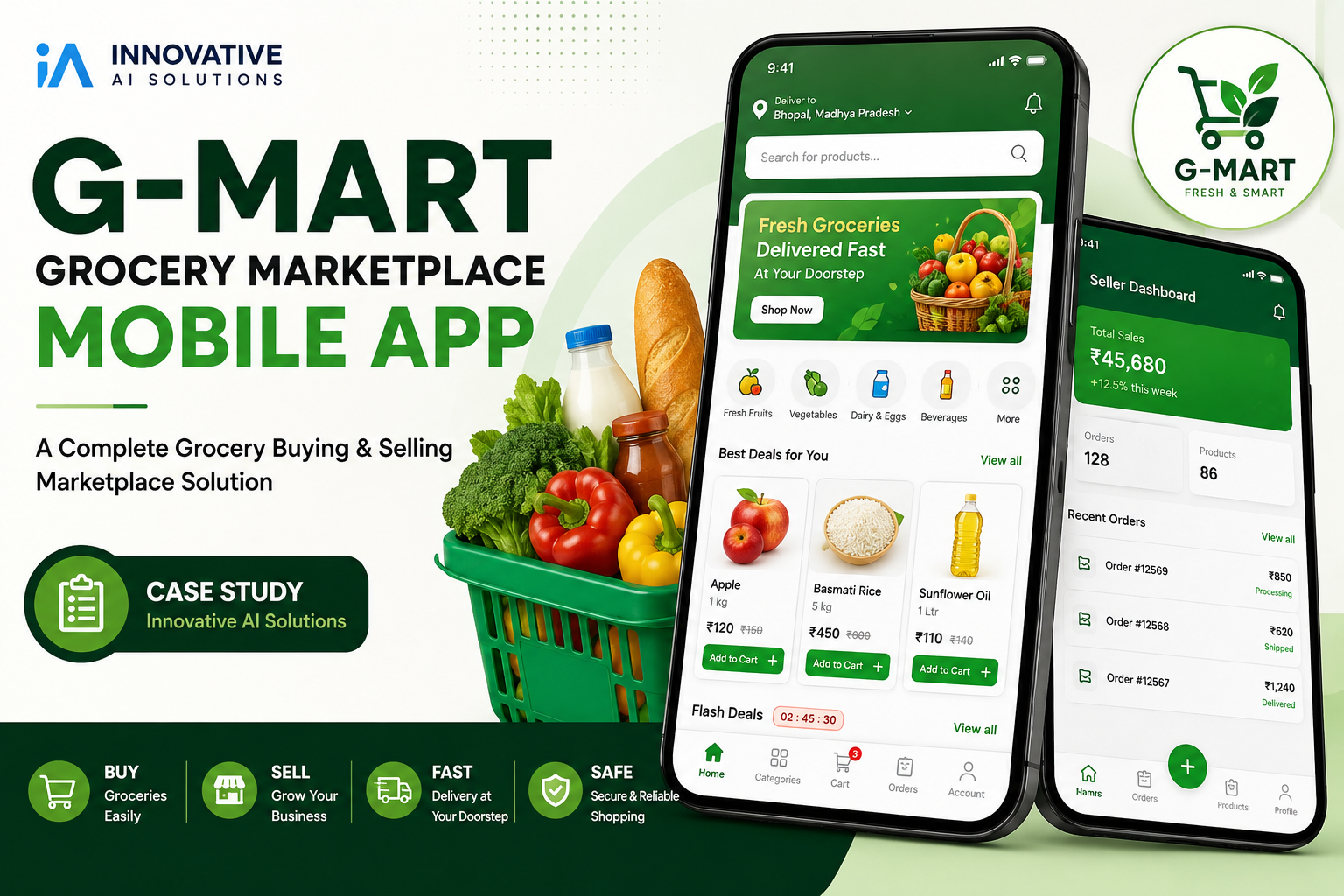
The grocery industry has rapidly moved toward digital commerce, creating new opportunities for businesses to connect customers with grocery products...
The grocery industry has rapidly moved toward digital commerce, creating new opportunities for businesses to connect customers with grocery products through mobile applications.
G-Mart was developed as a mobile-based grocery marketplace designed to provide a convenient platform for purchasing and selling grocery products.
The application brings customers and sellers together within a digital marketplace, allowing users to discover grocery products and purchase everyday essentials through a mobile-first experience.
For sellers, the platform provides an opportunity to present their grocery products to customers and participate in the digital marketplace.
Innovative AI Solutions approached the project with a focus on creating a scalable, user-friendly and business-oriented mobile application capable of supporting the core requirements of an online grocery marketplace.
The goal was not simply to create a product catalogue, but to develop a complete digital commerce experience where customers can discover products, select items, manage their purchases and interact with the marketplace through their mobile devices.
2. Executive Summary
G-Mart is a grocery buying and selling mobile application designed to simplify the process of purchasing everyday grocery products through a digital marketplace.
The application provides customers with a mobile interface through which they can explore available grocery products, view product information, add products to their shopping cart and proceed through the purchasing journey.
At the same time, the marketplace concept allows sellers to participate in the platform and offer grocery products to customers.
This creates a two-sided digital ecosystem:
Customers → Discover & Purchase Products
Sellers → List & Sell Products
The platform can be further extended with administrative management, order processing, payment integrations, delivery management, notifications, analytics and AI-powered automation.
The project demonstrates Innovative AI Solutions' capability to design and develop custom mobile commerce applications for businesses looking to establish or expand their digital presence.
3. The Business Challenge
Traditional grocery shopping requires customers to physically visit stores, search for products, compare options and complete purchases manually.
For grocery sellers, traditional retail also creates several limitations.
A physical store primarily serves customers within its immediate geographic area. Product discovery depends on customers visiting the store, while product management and sales operations are often handled through manual processes.
The growing adoption of smartphones created an opportunity to move this experience into a mobile environment.
G-Mart required a digital platform that could connect customers and sellers through a convenient mobile marketplace.
The key business requirements included:
- Creating a mobile-first grocery shopping experience
- Allowing customers to discover grocery products
- Providing sellers with a digital marketplace
- Making product discovery easier
- Simplifying the purchasing journey
- Creating a scalable marketplace architecture
- Supporting future integrations and functionality
- Providing a foundation for digital grocery commerce
The challenge was to bring these requirements together into a simple and intuitive mobile application.
4. Project Objectives
The primary objectives of the G-Mart project were:
Digital Grocery Marketplace
Create a mobile marketplace where grocery products can be presented and purchased digitally.
Customer Convenience
Make it easier for customers to discover and purchase grocery products from their mobile devices.
Seller Enablement
Provide a platform where sellers can participate in the grocery marketplace and offer their products to customers.
Simplified Shopping
Create a clear product discovery, selection and purchasing journey.
Scalable Architecture
Develop the application in a way that can support additional features and business requirements as the platform grows.
Better Digital Experience
Provide customers with a modern mobile shopping experience designed around convenience and usability.
5. Our Approach
Innovative AI Solutions approached G-Mart as a marketplace application rather than a simple grocery catalogue.
The application was structured around the two primary participants in the marketplace:
Customer
and
Seller
The customer side focuses on product discovery and purchasing, while the seller side focuses on product selling and marketplace participation.
This approach allows the platform to support both sides of the grocery ecosystem.
The overall concept can be represented as:
Seller
↓
Product Listing
↓
G-Mart Marketplace
↓
Product Discovery
↓
Customer
↓
Cart
↓
Purchase
This creates a connected digital commerce journey.
6. Customer Mobile Application
The customer-facing mobile application is the primary interface through which users interact with G-Mart.
The application is designed around a straightforward grocery shopping journey.
A typical customer journey follows:
Open App
↓
Browse Grocery Products
↓
Search / Explore
↓
View Product
↓
Add to Cart
↓
Review Cart
↓
Checkout
↓
Complete Purchase
The interface is designed to reduce unnecessary complexity and allow customers to move through the shopping journey efficiently.
7. User Account and Authentication
A grocery marketplace requires a reliable mechanism for identifying customers and maintaining their shopping information.
The customer application can support account-based access through an authentication system.
User authentication provides the foundation for features such as:
- Customer profiles
- Order information
- Saved details
- Shopping activity
- Personalized experiences
- Account management
A structured authentication layer also allows the platform to introduce additional functionality in the future.
8. Grocery Product Discovery
Product discovery is one of the most important parts of a grocery application.
Customers need to be able to quickly identify the products they are looking for.
G-Mart's marketplace concept allows grocery products to be organized and presented in a mobile-friendly environment.
Product discovery can include:
- Product categories
- Product listings
- Product names
- Product images
- Product information
- Pricing
- Availability information
The objective is to reduce the time between opening the application and finding the required grocery product.
9. Product Categories
Grocery marketplaces typically contain a large number of products.
Without categorization, finding products can become difficult.
A category-based product architecture makes it easier to organize grocery inventory.
Potential categories include:
- Fruits and Vegetables
- Dairy Products
- Beverages
- Snacks
- Bakery Products
- Staples
- Rice and Grains
- Pulses
- Cooking Essentials
- Personal Care
- Household Products
The exact category structure can be configured according to the marketplace's business model.
10. Product Details
A product detail experience gives customers the information they need before adding an item to their cart.
A product page can contain:
- Product name
- Product image
- Product description
- Price
- Available quantity
- Seller information
- Product category
- Other relevant product information
A clear product detail page helps customers make informed purchasing decisions.
11. Search Functionality
Search is particularly important for grocery marketplaces because customers often know exactly what product they want.
For example, a customer may search for:
"Rice"
"Milk"
"Cooking Oil"
"Biscuits"
"Tea"
"Detergent"
Instead of manually browsing multiple categories, the search functionality can allow users to reach relevant products more quickly.
Search can also be expanded in future versions with:
- Search suggestions
- Product synonyms
- Voice search
- AI-powered search
- Personalized recommendations
12. Shopping Cart
The shopping cart acts as the central point for managing selected grocery products before purchase.
Customers can review the products they have selected before proceeding to checkout.
The cart experience can include:
- Selected products
- Quantities
- Individual prices
- Total amount
- Product removal
- Quantity updates
- Order summary
A well-designed cart helps reduce purchasing errors and provides customers with a clear overview of their order.
13. Checkout Experience
The checkout process converts product selection into an actual purchase.
A streamlined checkout experience is essential for reducing unnecessary friction.
The checkout journey can include:
Cart Review
↓
Customer Information
↓
Delivery Information
↓
Order Summary
↓
Payment
↓
Order Confirmation
The exact checkout functionality can be expanded according to business requirements.
14. Grocery Selling Experience
One of the key aspects that differentiates G-Mart from a standard grocery shopping application is the marketplace concept.
The platform is designed around both buying and selling.
Sellers can participate in the digital ecosystem by offering grocery products through the marketplace.
The seller-side workflow can include:
Seller
↓
Product Management
↓
Product Listing
↓
Marketplace
↓
Customer Discovery
↓
Order
↓
Seller Processing
This creates a structured digital channel for grocery businesses.
15. Seller Product Management
A marketplace needs a structured product management system.
Seller functionality can include the ability to manage:
- Product name
- Product description
- Product images
- Product category
- Product price
- Product availability
- Product quantity
A structured product-management system allows the marketplace to maintain a consistent product catalogue.
16. Order Management
Order management connects customer purchases with sellers.
Once a customer places an order, the order needs to move through the appropriate processing stages.
A typical workflow is:
Order Placed
↓
Order Received
↓
Order Processing
↓
Order Prepared
↓
Order Dispatched
↓
Order Delivered
The exact status structure can be customized based on the operational model of the marketplace.
17. Delivery Management
Grocery commerce depends heavily on efficient order fulfilment.
The marketplace can support delivery-related workflows that connect orders with delivery operations.
Potential functionality includes:
- Delivery status
- Order dispatch
- Delivery assignment
- Delivery updates
- Customer notifications
- Order completion
For a future version, G-Mart can also be extended with live location tracking and delivery partner applications.
18. Payment Integration
Digital payments are an important component of modern e-commerce applications.
The G-Mart architecture can support integration with payment providers based on the business requirements and target market.
Possible payment capabilities include:
- Online payments
- Payment confirmation
- Transaction status
- Failed payment handling
- Order-payment association
- Payment records
The final payment gateway should depend on the client's selected payment provider.
19. Notifications
Notifications can keep customers informed throughout their shopping journey.
Important notification events may include:
- Order confirmation
- Payment confirmation
- Order processing
- Order dispatch
- Delivery updates
- Order completion
Push notifications can also be expanded in the future for promotional campaigns, offers and personalized product recommendations.
20. Admin Management
A grocery marketplace requires centralized administration to manage the overall ecosystem.
An administrative system can provide control over:
- Customers
- Sellers
- Products
- Categories
- Orders
- Payments
- Marketplace activity
- Platform settings
The admin layer acts as the central management system for the marketplace.
21. Marketplace Architecture
The overall G-Mart ecosystem can be represented as:
Customer Mobile App
↓
API Layer
↓
Business Logic
↓
Database
↓
Marketplace Data
↓
Seller Management
↓
Order Management
↓
Administration
This architecture creates separation between the mobile application and backend business logic.
It also provides a foundation for integrating additional applications and services in the future.
22. API Architecture
A mobile marketplace requires reliable communication between the mobile application and backend systems.
The API layer can manage operations such as:
- User authentication
- Product retrieval
- Product search
- Category retrieval
- Cart management
- Order creation
- Order status
- Seller operations
- Notifications
- Payment communication
A well-structured API architecture also makes it easier to connect future applications such as seller dashboards, delivery applications and third-party systems.
23. Data Management
The marketplace requires structured data management for different entities.
Important data entities may include:
- Users
- Sellers
- Products
- Categories
- Cart items
- Orders
- Order items
- Payments
- Addresses
- Notifications
Keeping these entities logically separated improves maintainability and scalability.
24. Mobile-First User Experience
Because G-Mart is designed as a mobile application, the user experience is centered around smartphone usage.
The interface needs to account for:
- Different screen sizes
- Touch interaction
- Mobile navigation
- Product image presentation
- Fast interactions
- Network conditions
- Simple checkout flows
The goal is to make grocery shopping convenient even when customers are using smaller mobile screens.
25. Performance Considerations
E-commerce applications can involve large product catalogues and frequent API requests.
Performance therefore becomes an important part of application development.
Potential optimization strategies include:
- Image optimization
- Efficient API responses
- Pagination
- Caching
- Lazy loading
- Optimized database queries
- Efficient state management
- Network request optimization
These techniques help create a smoother user experience as the marketplace grows.
26. Security
Security is an important consideration for any application handling customer accounts and commerce-related information.
The platform should use appropriate security practices for:
- Authentication
- Authorization
- API communication
- User data
- Payment communication
- Server-side validation
- Input validation
- Secure credential management
Sensitive information should never be exposed unnecessarily through the mobile application.
27. Scalability
A marketplace can grow significantly as more customers and sellers join the platform.
The G-Mart architecture can therefore be designed with future expansion in mind.
Potential future scaling areas include:
- More sellers
- Larger product catalogues
- Increased order volume
- Multiple geographic markets
- Delivery integrations
- Advanced analytics
- Personalized recommendations
- AI-powered customer support
The platform can evolve from a grocery marketplace into a broader digital commerce ecosystem.
28. Future AI Opportunities
G-Mart also provides opportunities for integrating artificial intelligence into the shopping experience.
Potential AI features include:
AI Shopping Assistant
Customers could describe what they need and receive product recommendations.
Personalized Recommendations
The system could recommend products based on customer behaviour and preferences.
AI Search
Customers could search using natural language instead of exact product names.
For example:
"I need healthy breakfast items under ₹500."
Demand Forecasting
AI could help sellers predict product demand.
Inventory Intelligence
AI could identify products that are likely to require restocking.
Customer Support AI
An AI assistant could answer common questions related to products, orders and delivery.
Sales Analytics
AI-powered analytics could identify trends across products, categories and customer behaviour.
These capabilities can be introduced progressively as the marketplace grows.
29. Business Benefits
The G-Mart platform provides a foundation for digital grocery commerce.
Key business benefits include:
- Digital product discovery
- Mobile-first shopping
- Seller participation
- Centralized marketplace management
- Structured product catalogue
- Digital ordering
- Scalable commerce architecture
- Opportunities for automation
- Future AI integration
The marketplace model can help grocery businesses move beyond traditional physical retail and establish a digital sales channel.
30. Challenges During Development
Developing a marketplace application involves multiple interconnected systems.
The primary challenges can include:
Managing Two-Sided Marketplace Requirements
Customers and sellers have different requirements.
The platform therefore needs to accommodate both experiences without making the application unnecessarily complex.
Product Catalogue Management
Grocery marketplaces can contain large numbers of products, requiring organized catalogue structures.
Order Processing
Orders must move correctly from customer purchase to seller fulfilment.
Mobile Performance
The application needs to remain responsive across different devices and network conditions.
Future Scalability
The architecture must be capable of supporting additional sellers, products and transactions.
31. Our Development Approach
Innovative AI Solutions follows a structured approach to custom application development.
Discovery
Understanding business requirements and marketplace workflows.
Planning
Defining application architecture, user journeys and core functionality.
UI/UX
Designing mobile interfaces around usability and simplicity.
Development
Building customer, seller and backend functionality.
Integration
Connecting APIs and required third-party services.
Testing
Testing functionality, usability, performance and compatibility.
Deployment
Preparing the application for production use.
Maintenance
Supporting future improvements, integrations and feature expansion.
32. Technology Architecture
The final technology stack should reflect the actual technologies used during implementation.
A modern G-Mart architecture can consist of:
Mobile Application
Cross-platform or native mobile development technology.
Backend
API-driven server architecture for business logic and marketplace operations.
Database
Structured database systems for customer, product, seller and order data.
Cloud Infrastructure
Scalable infrastructure for application deployment and backend services.
Third-Party Integrations
Payment, notification, mapping, analytics and other services can be integrated according to business requirements.
Specific technologies should be added to the published case study only after confirming the actual G-Mart implementation stack.
33. Quality Assurance
Quality assurance is critical for commerce applications because errors can directly affect customer experience and order processing.
Testing areas include:
- Authentication
- Product browsing
- Search
- Cart
- Checkout
- Order creation
- Seller functionality
- API responses
- Notifications
- Mobile responsiveness
- Error handling
- Security
- Performance
Testing helps ensure that the application provides a reliable experience across different user journeys.
34. The Complete Customer Journey
The G-Mart customer journey can be summarized as:
Open G-Mart
↓
Discover Grocery Products
↓
Search / Browse Categories
↓
View Product
↓
Select Quantity
↓
Add to Cart
↓
Review Cart
↓
Checkout
↓
Payment
↓
Order Confirmation
↓
Order Processing
↓
Delivery
↓
Order Completion
This streamlined journey creates the foundation for a convenient mobile grocery-shopping experience.
35. The Marketplace Journey
From the seller perspective:
Seller Joins Marketplace
↓
Adds Grocery Products
↓
Products Become Available
↓
Customers Discover Products
↓
Customer Places Order
↓
Seller Receives Order
↓
Order Processing
↓
Order Fulfilment
↓
Sale Completed
This two-sided structure is the foundation of the G-Mart marketplace.
36. Why Innovative AI Solutions
Innovative AI Solutions develops custom digital platforms designed around specific business requirements.
Our capabilities extend across:
- Mobile application development
- Custom software development
- E-commerce platforms
- Marketplace development
- API development
- AI solutions
- Cloud and DevOps
- Business automation
For businesses looking to build a custom marketplace or mobile commerce platform, our approach focuses on creating scalable technology rather than simply delivering a basic application.
Explore our Mobile App Development services to learn more about our application development capabilities.
37. Future Roadmap for G-Mart
The platform can be expanded with additional capabilities as the business grows.
Potential future features include:
AI Shopping Assistant
Natural-language product discovery and recommendations.
Voice Search
Customers can search for products using voice commands.
Personalized Recommendations
Product recommendations based on customer behaviour.
Loyalty Program
Rewards and benefits for returning customers.
Seller Analytics
Sales, product and performance analytics for sellers.
Advanced Delivery Tracking
Real-time delivery status and location tracking.
Promotional Engine
Offers, discounts and personalized promotions.
Subscription Orders
Recurring grocery orders for frequently purchased products.
Multi-Vendor Expansion
Support for a larger number of independent grocery sellers.
Advanced Business Intelligence
Dashboards for sales, customers, products and marketplace performance.
38. Project Impact
G-Mart demonstrates how traditional grocery commerce can be transformed into a digital marketplace experience.
The platform creates a bridge between:
Grocery Sellers
and
Digital Customers
through a mobile-first commerce ecosystem.
Instead of relying entirely on physical store interactions, businesses can use the platform to establish a digital product and sales channel.
The architecture also creates opportunities for future expansion into AI-powered personalization, automation, analytics and intelligent customer engagement.
39. Project Summary
| Category | Details |
|---|---|
| Project | G-Mart |
| Platform | Mobile Application |
| Business Model | Grocery Marketplace |
| Primary Users | Customers and Sellers |
| Industry | Grocery & E-commerce |
| Core Function | Buying and Selling Grocery Products |
| Product Discovery | Categories and Search |
| Commerce | Cart and Checkout |
| Marketplace | Seller Product Listings |
| Orders | Digital Order Management |
| Future Scope | AI, Analytics, Delivery and Automation |
| Development Type | Custom Mobile Application |
40. Conclusion
G-Mart represents a digital approach to grocery commerce by bringing buying and selling activities together within a mobile marketplace.
The application provides customers with a convenient way to discover and purchase grocery products while creating a digital platform for sellers to offer their products.
From product discovery and shopping cart management to marketplace operations and future AI capabilities, the platform provides a foundation that can evolve alongside the business.
The project also demonstrates the broader capabilities of Innovative AI Solutions in developing custom mobile applications and digital commerce platforms tailored to specific business requirements.
As the grocery industry continues to adopt digital commerce, platforms such as G-Mart can provide businesses with new opportunities to reach customers, streamline operations and build scalable digital sales channels.
41. Frequently Asked Questions
What is G-Mart?
G-Mart is a mobile grocery marketplace designed to allow customers to buy grocery products while enabling sellers to offer their products through the platform.
Is G-Mart a grocery delivery application?
G-Mart is designed around grocery buying and selling through a mobile marketplace. Delivery functionality can be implemented and expanded according to the business's operational requirements.
Can multiple sellers use the G-Mart platform?
Yes. The marketplace concept is designed to support seller participation and product listings.
Can G-Mart be customized?
Yes. A marketplace platform can be customized according to business requirements, including payments, delivery, seller management, analytics and additional integrations.
Can AI be integrated into a grocery marketplace?
Yes. AI can be used for product recommendations, intelligent search, customer support, demand forecasting, inventory intelligence and personalization.
Can G-Mart support a larger number of products?
The platform can be architected for scalability, allowing the product catalogue to expand as the marketplace grows.
Can sellers manage their products?
The seller ecosystem can support product management and marketplace participation based on the implemented seller functionality.
Can a grocery marketplace have its own mobile application?
Yes. A custom mobile application can provide customers with a dedicated shopping experience while connecting to backend marketplace services.
Can payment gateways be integrated?
Yes. Payment gateway integration can be implemented according to the target market and selected payment provider.
Can the platform include delivery tracking?
Yes. Delivery tracking can be integrated as part of the marketplace's logistics architecture.
42. Build Your Own Grocery Marketplace
Want to build a grocery marketplace like G-Mart?
Innovative AI Solutions can help businesses design and develop custom:
- Grocery Mobile Applications
- Multi-Vendor Marketplaces
- E-commerce Applications
- Seller Platforms
- Customer Applications
- Admin Dashboards
- API-Based Commerce Platforms
- AI-Powered Shopping Solutions
From product strategy and UI/UX to development, integrations, deployment and future AI enhancements, we can help transform your business idea into a scalable digital platform.
Build your custom grocery marketplace with Innovative AI Solutions.