The Big Question
What actually powers a modern business?
Not the website. Not the CRM. Not the accounting software. Those are tools. The real engine the thing that makes everything else possible is the underlying technology stack.
For decades, that stack was simple: servers, databases, and applications. You bought hardware, installed software, and hired people to maintain it. It was expensive, rigid, and slow to change.
That stack is dead.
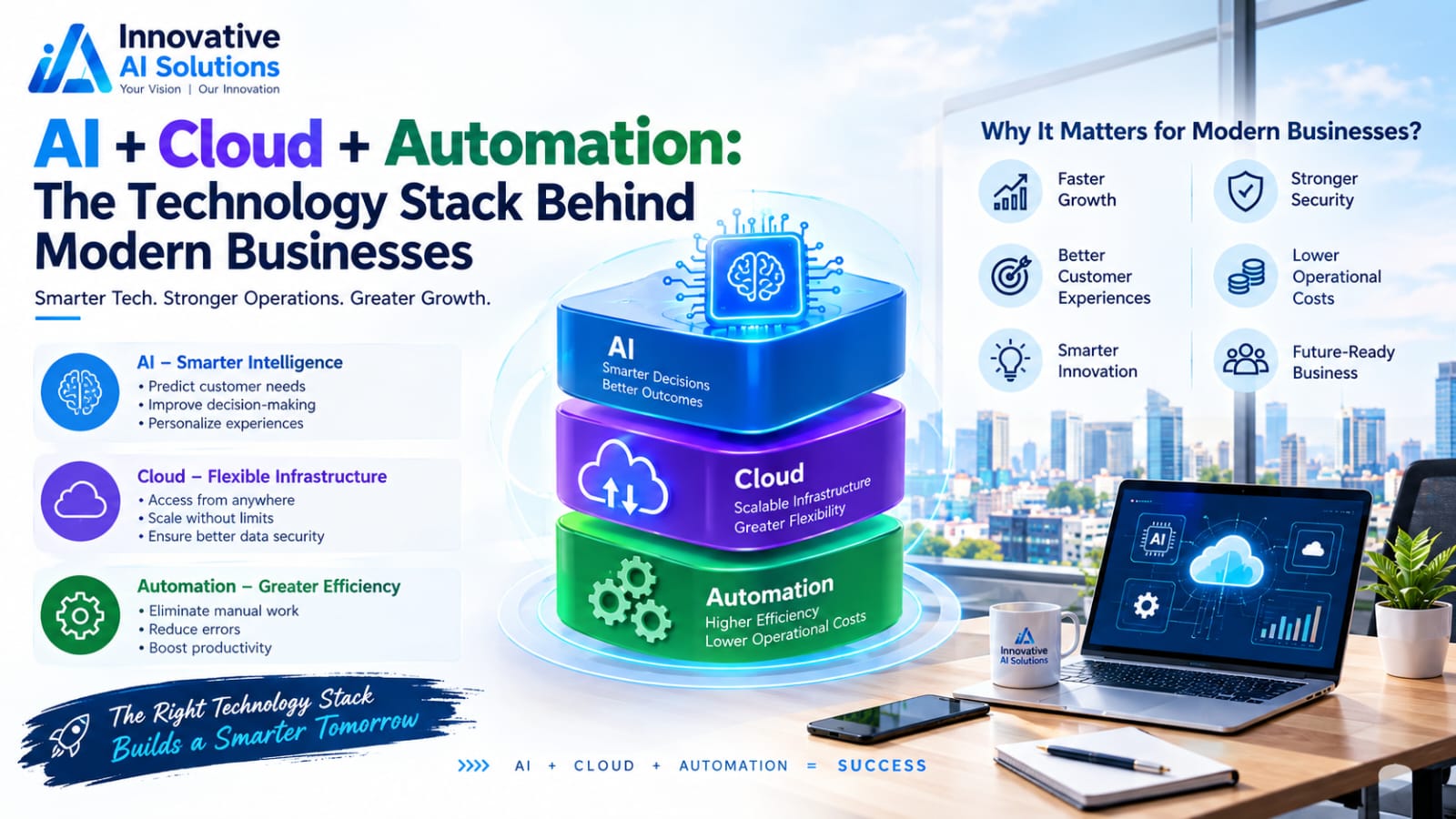
The modern business technology stack has three layers: AI, Cloud, and Automation. They work together. AI provides intelligence understanding, reasoning, and decision-making. Cloud provides infrastructure scalable compute, storage, and services. Automation provides execution taking actions, orchestrating workflows, and connecting systems.
Individually, each layer is powerful. Together, they create something greater than the sum of their parts. A business that uses cloud but not AI is leaving intelligence on the table. A business that uses AI but not automation is creating insights it can't act on. A business that uses automation but not cloud is building on a foundation that can't scale.
Indian enterprises understand this. According to SAP's Value of AI Report 2026, Indian organizations plan to invest US$25.9 million in AI, with spending expected to grow 45% over the next two years . Agentic AI investment is projected to increase fivefold .
But investment alone isn't enough. The businesses that thrive will be the ones that understand how these three layers connect.
Layer 1: AI — The Intelligence Layer
AI is the brain of the modern stack. It's what allows systems to understand, reason, and decide.
But "AI" is a broad term. For business purposes, it breaks down into three functional categories.
Generative AI creates content—text, images, code. It's what powers chatbots, content generation, and code assistants. Useful, but limited. It responds to prompts. It doesn't take action.
Predictive AI analyzes data to forecast outcomes. It's what powers demand forecasting, fraud detection, and lead scoring. It tells you what's likely to happen.
Agentic AI is the newest and most transformative. Unlike generative or predictive AI, agentic systems don't just respond or predict—they plan, execute, and adapt. They use tools. They access data across systems. They complete multi-step workflows with minimal human intervention .
The distinction matters. A chatbot that answers "What's your return policy?" is generative AI. A system that reads an invoice, checks it against a purchase order, flags a discrepancy, drafts a query to the vendor, and routes it for approval—without a human triggering each step—is agentic .
The adoption data is striking. IBM's Institute for Business Value found that by 2027, twice as many executives expect AI agents to make autonomous decisions within core business processes compared to today . In India, 67% of organizations are already piloting agentic AI use cases, and 85% believe the technology has significant potential .
But here's the gap: while 54% of Indian organizations are deploying AI agents, only 11% have moved to autonomous workflows . The hesitation is understandable. Letting AI act independently requires trust, governance, and safeguards that most organizations haven't built yet.
Layer 2: Cloud — The Infrastructure Layer
Cloud is the foundation. It provides the compute, storage, and services that AI and automation run on.
India's cloud market is booming. Gartner forecasts end-user spending on public cloud services in India to grow **28.1% to $17.5 billion in 2026**, up from $13.7 billion in 2025 .
But the nature of cloud spending is changing. The focus has shifted from migration to platform-led execution.
Infrastructure-as-a-Service (IaaS) is projected to grow 40%, driven by demand for AI-ready infrastructure GPUs, high-performance compute, and inference capacity . Platform-as-a-Service (PaaS) is the largest spending category at $6.4 billion, as enterprises rebuild their technology foundations to support AI-driven initiatives .
The architecture is also becoming more complex. Most Indian enterprises now operate hybrid cloud strategies placing workloads across public cloud, private cloud, and on-premises systems based on cost, performance, and compliance requirements.
For AI workloads specifically, this hybrid approach matters. Not every AI model runs best in public cloud. Sensitive data may need to stay on-premises. High volume inference may be cheaper on dedicated infrastructure. The cloud layer is no longer "one size fits all."
Layer 3: Automation — The Execution Layer
Automation is the hands of the stack. It's what turns intelligence and infrastructure into action.
Traditional automation was rigid. RPA (Robotic Process Automation) followed scripts. If the screen changed, the automation broke. It was brittle and expensive to maintain.
Modern automation is different. When combined with AI, it becomes intelligent automation—systems that can handle variation, make decisions, and adapt to changing conditions.
The most advanced form is agentic automation: AI agents that don't just follow rules but plan and execute complex workflows. These agents can access multiple systems, handle exceptions, and escalate to humans when needed.
The use cases are expanding rapidly. In software engineering, agents handle code review, test generation, and incident triage. In finance, they match invoices, reconcile accounts, and flag discrepancies. In healthcare, they manage clinical documentation, reducing documentation time by 40% .
Salesforce predicts that by 2027, AI will handle 50% of customer service cases in India, up from 30% today . Indian service professionals expect AI agents to improve business metrics, including a 16% increase in upsell revenue .
How the Three Layers Work Together
The real power of the modern stack isn't in any single layer. It's in the connections between them.
AI + Cloud: AI models need compute. Cloud provides it on demand. A business can train a model in the cloud, deploy it to production, and scale inference up or down based on demand—without buying a single GPU.
AI + Automation: AI provides the intelligence. Automation provides the execution. An AI model that predicts which leads will convert is useful. An automated workflow that takes that prediction and routes the lead to the right sales rep is transformative.
Cloud + Automation: Cloud provides the infrastructure. Automation provides the orchestration. Workflows can span multiple cloud services, connecting databases, APIs, and applications without manual intervention.
All Three Together: This is where agentic AI lives. An agent that reads a customer email (AI), accesses CRM data (Cloud), and updates the record, schedules a follow-up, and sends a confirmation (Automation)—that's the full stack working in concert.
The results are measurable. A healthcare provider deploying an agentic clinical documentation assistant cut documentation time by over 40%, saving roughly an hour per day per provider .
Cost of Building the Stack
What does it cost to build this stack for your business?
The answer depends on scope. Here's a realistic breakdown for Indian businesses.
Basic Stack (Cloud + Simple Automation)
Cloud infrastructure for a small application, plus basic workflow automation (Zapier, Make). No AI.
Typical cost: ₹50,000 to ₹2,00,000 setup. Monthly running cost: ₹10,000 to ₹40,000.
AI-Enhanced Stack (Cloud + AI + Automation)
Add a RAG chatbot for customer support, lead scoring model, and automated follow-up workflows.
Typical cost: ₹4,00,000 to ₹12,00,000. Monthly running cost: ₹40,000 to ₹1,00,000.
Agentic Stack (Cloud + Agentic AI + Intelligent Automation)
Multiple AI agents handling complex workflows—sales qualification, customer service, back-office operations—with human-in-the-loop escalation.
Typical cost: ₹15,00,000 to ₹50,00,000+. Monthly running cost: ₹1,00,000 to ₹3,00,000+.
Enterprise Stack
Multi-agent orchestration across departments, hybrid cloud architecture, enterprise-grade governance and security.
Typical cost: ₹50,00,000+. Monthly running cost: ₹3,00,000+.
The key insight: you don't need to build everything at once. Start with cloud. Add AI where it solves a real problem. Add automation where it saves time. Build the stack incrementally.
Pro Tips for Building Your Stack
After building these systems, here's what actually works.
Tip 1: Start with the Problem, Not the Technology
Don't ask "How can we use AI?" Ask "What's costing us time and money?" The answer will tell you which layer of the stack you need first.
Tip 2: Cloud First, But Not Cloud Only
Cloud provides scale and flexibility. But not every workload belongs in public cloud. Sensitive data may need on-premises. High-volume inference may be cheaper on dedicated infrastructure. Hybrid is the reality for most businesses.
Tip 3: Automate Before You Agentify
Don't jump straight to agentic AI. Start with simple automation. Learn what breaks. Understand your workflows. Then add intelligence.
Tip 4: Build Governance from Day One
Agentic AI requires trust. Trust requires governance audit trails, escalation paths, human oversight. Build these before you scale autonomy.
Tip 5: Measure Everything
Track cost per task. Track time saved. Track error rates. Without measurement, you can't optimize. Without optimization, the stack becomes expensive overhead.
Tip 6: Own Your Data and Integration Logic
Platform-native solutions are convenient but can lock you in. Build your integration layer so you can switch platforms without rebuilding everything.
Why Delhi is a Great Hub for AI Development
I run an AI company in Delhi. I'm biased. But there are real reasons why Delhi NCR is a powerhouse for building the modern stack.
Talent Density
Delhi-NCR is second only to Bengaluru in tech talent concentration. IIT Delhi, DTU, and NSIT produce thousands of graduates annually. Many specialize in AI, cloud, and automation.
Enterprise Client Base
Delhi is India's administrative and corporate capital. Large enterprises with complex technology requirements are here. For stack integration serving regulated industries, proximity matters.
Cost Advantage
Delhi offers a 20–30% cost advantage over Bengaluru and Mumbai. Office rents are lower. Salaries are competitive.
Time Zone Advantage
IST overlaps with US, UK, and Southeast Asian business hours. Real-time communication is possible without overnight shifts.
What We Offer
At Innovative AI Solutions, we've spent five years building AI systems that actually work. Not hype. Not buzzwords. Results.
Cloud Infrastructure
We design and deploy cloud architectures on AWS, Azure, and GCP. Scalable, secure, and cost-optimized.
AI Development
We build generative AI, predictive models, and agentic systems. From RAG chatbots to multi-agent orchestration.
Automation
We automate workflows invoice processing, lead qualification, customer support, and more. Intelligent automation that adapts.
Stack Integration
We connect the layers. AI that uses cloud services. Automation that triggers AI. Cloud that scales everything.
Ongoing Support
Stacks need tuning. We offer flexible support packages to keep your systems performing.
What Sets Us Apart
We focus on Small AI. Practical solutions. Right-sized for your actual problem. Affordable pricing. Fast delivery. And a team that actually cares about your success.
Frequently Asked Questions
Q1: What is the modern business technology stack?
The modern stack has three layers: AI (intelligence), Cloud (infrastructure), and Automation (execution). Together, they enable businesses to understand data, scale on demand, and execute workflows automatically.
Q2: How much does it cost to build this stack in India?
Basic stacks start at ₹50,000. AI-enhanced stacks range from ₹4,00,000 to ₹12,00,000. Agentic stacks cost ₹15,00,000 to ₹50,00,000+. Enterprise stacks run ₹50,00,000+.
Q3: What is agentic AI, and why does it matter?
Agentic AI refers to systems that plan, execute, and adapt not just respond to prompts. They use tools, access data, and complete multi-step workflows. It matters because it enables automation of complex processes that were previously impossible.
Q4: Do I need all three layers?
Not necessarily. Start with what solves your problem. A business with simple needs may only need cloud and basic automation. A business with complex workflows needs all three.
Q5: How is India's cloud market growing?
India's public cloud spending is projected to reach $17.5 billion in 2026, growing 28.1% year-on-year . IaaS is growing 40%, driven by AI-ready infrastructure demand .
Q6: What's the biggest barrier to agentic AI adoption?
Governance and trust. Only 11% of Indian organizations have moved to autonomous workflows . The hesitation is about letting AI act independently without proper safeguards.
Q7: How do AI and automation work together?
AI provides intelligence understanding, reasoning, decision-making. Automation provides execution taking actions, orchestrating workflows. Together, they create intelligent automation that can handle variation and adapt to changing conditions.
Q8: What are common use cases for this stack?
Customer service automation, sales qualification, back office processing (invoicing, reconciliation), healthcare documentation, supply chain optimization, and fraud detection.
Q9: How long does it take to build the stack?
Basic stacks: 4–8 weeks. AI-enhanced stacks: 8–16 weeks. Agentic stacks: 16–24 weeks. Enterprise stacks: 6–12 months.
Q10: What's the ROI of building this stack?
It depends on the use case. A customer service agent that handles 50% of queries could recover costs in 3–6 months. A sales automation stack that improves conversion rates could see ROI even faster.
Frequently Asked Questions (Continued)
Q11: Can I start with one layer and add others later?
Yes. That's exactly what we recommend. Start with cloud. Add AI where it solves a problem. Add automation where it saves time. Build incrementally.
Q12: What about data security?
We use encryption, secure APIs, and comply with data protection regulations. For healthcare clients, we ensure HIPAA compliance. For Indian businesses, we comply with DPDP Act requirements.
Q13: How do you handle governance for AI agents?
Confirmation-gated writes, immutable audit logs, escalation paths, and human in the loop routing. Agents operate within guardrails, not without them.
Q14: Who owns the code and the data?
You do. Full transfer. No exceptions.
Q15: Why should I choose Innovative AI Solutions?
Because we focus on results, not hype. Because we've delivered 100+ projects. Because we offer enterprise-grade solutions at startup-friendly prices. Because your code is always yours.
Contact Us
Ready to build your modern technology stack? Let's talk.
Phone:
+91 7464 099 059
+91 9689967356
Email:
info@innovativeais.com
Address:
9th Floor, Pearls Best Heights-I,
Head Office: 904, Netaji Subhash Place,
Delhi – 110034