The Big Question
What happens when the same technology that powers Bitcoin becomes the backbone of supply chain transparency, healthcare data sharing, and digital identity verification? When manufacturers, distributors, and retailers all see the same version of the truth—reducing fraud, eliminating counterfeit goods, and building trust across the value chain?
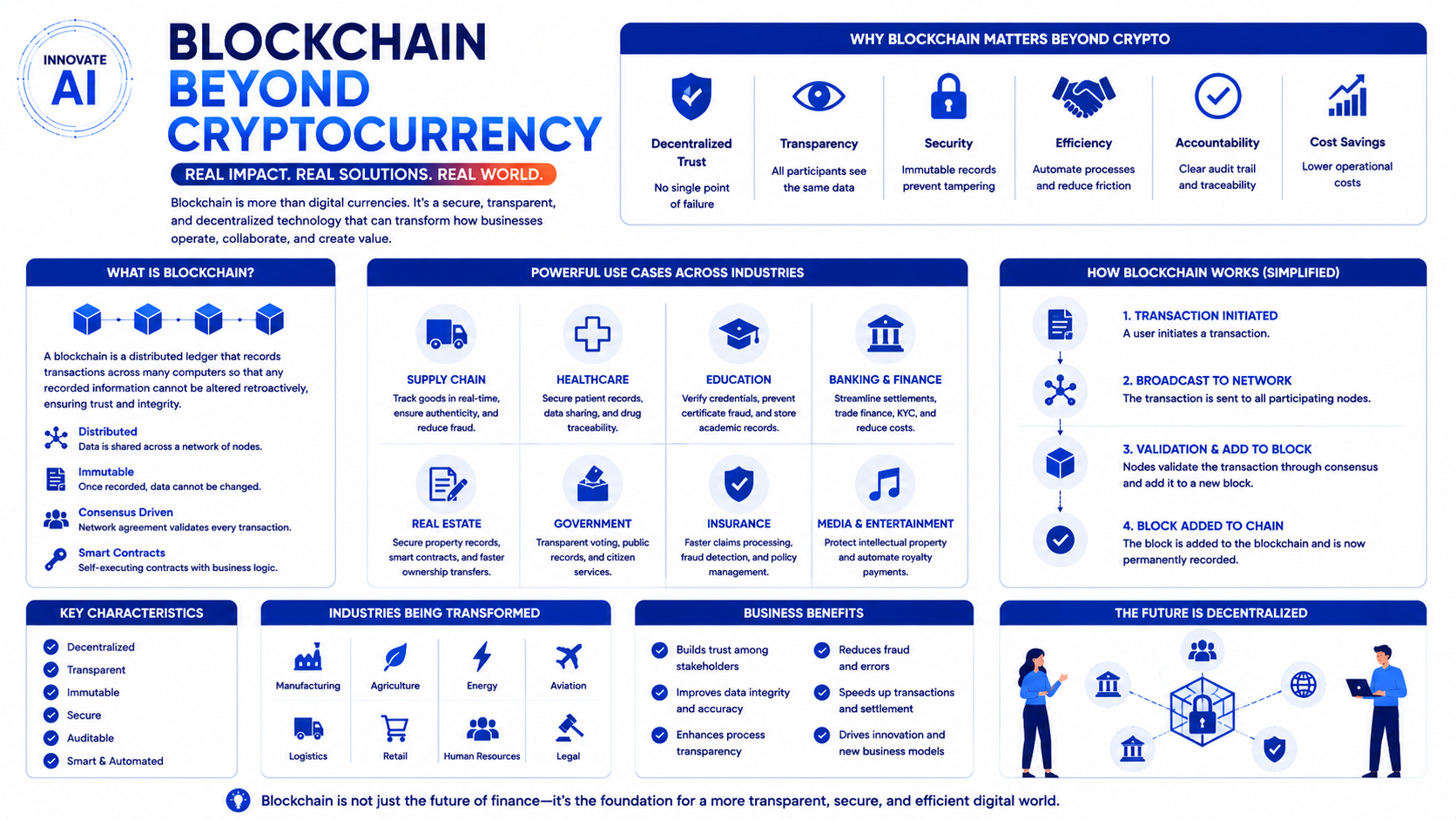
Blockchain has been described as "one of those things where it's probably man's greatest invention" , comparable to the invention of the internet. Yet understanding its potential requires looking beyond cryptocurrencies to the underlying technology that makes them possible: an immutable, transparent, and decentralized digital ledger .
What Makes Blockchain Valuable for Business
The Core Attributes
Blockchain's business value rests on several defining characteristics:
| Attribute | What It Means for Business |
|---|---|
| Immutability | Once data is recorded, it cannot be altered without detection—creating tamper-proof audit trails |
| Decentralization | Data is shared across multiple computers rather than controlled by a single entity, eliminating single points of failure and central authority |
| Transparency | All authorized participants can view the same information, creating a "shared version of the truth" |
| Smart Contracts | Self-executing agreements that automate operations when conditions are met |
As Jack Shaw, Executive Director of the American Blockchain Council, explains: "The real key to what blockchain is doing here is it's providing a shared version of the truth to multiple people" . That shared truth is what enables trust in transactions, supply chains, and data exchanges—without requiring a central authority or intermediary.
Permissioned vs. Public Blockchains
For enterprise applications, the choice of blockchain architecture matters significantly. Public blockchains like Bitcoin and Ethereum are permissionless and fully transparent, making them suitable for cryptocurrency but less appropriate for business data that requires confidentiality .
Private and consortium blockchains are designed for enterprise needs :
| Feature | Hyperledger Fabric and Similar Permissioned Blockchains |
|---|---|
| Participant Identity | Known, verified, and governed |
| Data Visibility | Configurable per channel—competitors can't see each other's prices |
| Transaction Finality | Immediate and deterministic |
| Regulatory Compliance | Built-in identity management and audit trails |
| Performance | 3,500+ transactions per second, compared to 15-30 TPS on public chains |
This makes permissioned blockchains suitable for finance, supply chain, healthcare, and government applications where privacy and compliance are non-negotiable .
Real-World Applications Beyond Finance
Supply Chain Management: Creating the "Shared Version of the Truth"
Supply chains have always suffered from a fundamental problem: participants at different tiers never had the same information. Manufacturers couldn't see if their suppliers' suppliers were experiencing disruptions. Retailers couldn't verify that cold chain conditions were maintained during transport. Every transaction was filtered through intermediaries, creating delays, costs, and opportunities for fraud .
Blockchain solves this by allowing all relevant players to share information across a distributed ledger. Everyone sees the information they're authorized to see, but no one can arbitrarily change it without detection .
Walmart's food trust network tracks produce from farm to store shelf. When contamination occurs, they can trace affected items in seconds instead of days—preventing unnecessary recalls and protecting public health .
Maersk and IBM's TradeLens digitizes global shipping documentation—bills of lading, customs declarations, and certificates of origin—flowing through blockchain channels and eliminating paper-based delays .
Tyson Foods and Grass Roots Farmers' Cooperative use blockchain platforms to track meat products from farm to plate, ensuring transparency and building consumer trust .
The Internet of Things (IoT) connection: When IoT sensors capture real-world data—temperature, location, handling conditions—and load it directly onto a blockchain, the data can't be manipulated. A truck driver can't claim the temperature was maintained when sensors prove otherwise .
The AI integration: AI systems can continuously monitor the flood of data from IoT sensors and blockchain records, identifying patterns and making recommendations that human teams couldn't process at scale .
Healthcare: Privacy-Preserving Data Sharing
Healthcare generates vast amounts of sensitive patient data that require secure management, accurate analysis, and strict privacy controls. Blockchain provides the foundation for tamper-proof patient records and seamless sharing across providers while maintaining consent and privacy .
Secure patient data management: Blockchain allows patients to control who accesses their medical records through verifiable credentials, sharing only what's necessary .
Pharmaceutical supply chain traceability: A decentralized blockchain framework developed for drug tracing uses self-sovereign identity (SSI) and zero-knowledge proofs to ensure authenticity while protecting privacy . When combined with smart contracts, the system automates verification and reduces the risk of counterfeit drugs entering the supply chain .
The SSI advantage: Unlike blockchain-only solutions that rely on identity-agnostic or centrally managed identity models, self-sovereign identity allows stakeholders—manufacturers, distributors, healthcare centers—to prove their eligibility without revealing unnecessary identity attributes. Identity validation happens off-chain; the blockchain anchors cryptographic proofs and immutable audit logs .
Clinical trial integrity: Blockchain can ensure the validity of pharmaceutical products by providing an immutable ledger tracking each phase of a drug's lifecycle, from production to the end consumer .
Energy: Decentralized Markets and Grid Optimization
Blockchain technology enables decentralized energy markets where consumers can trade energy peer-to-peer, optimizing grid efficiency and promoting renewable energy integration .
Peer-to-peer energy trading: Households with solar panels can sell excess energy directly to neighbors, with blockchain recording every transaction immutably.
Grid optimization: Smart contracts can automatically balance supply and demand, reducing waste and ensuring grid stability.
Integration with IoT and AI: As Jack Shaw describes, "blockchain and Internet of Things and AI [are] three legs of a stool" that can enable fully digital, valid transactions . IoT captures data; blockchain validates and verifies it; AI continuously monitors and recommends actions.
Government, Identity, and Digital Trust
Blockchain's ability to create tamper-proof records of authenticity has profound implications for government services and digital identity.
Digital identity verification: Decentralized identity systems allow individuals to prove who they are without revealing unnecessary personal information. This reduces fraud, streamlines authentication, and gives users control over their data.
Digital voting: Blockchain can create secure, transparent, and tamper-proof election processes, with each vote recorded immutably and verifiable by the voter.
Verifying news and media: As AI-generated content becomes indistinguishable from authentic media, blockchain can validate when a video or audio was actually recorded, who created it, and whether it has been manipulated—reducing both disinformation (intentional deception) and misinformation (unintentional sharing of false information) .
The Integration Power: AI + Blockchain + IoT
The most transformative applications of blockchain come when it's combined with other technologies. As the NASSCOM Community notes, "AI and blockchain are increasingly converging to redefine how enterprises manage data, automate workflows, strengthen security, and improve operational transparency" .
| Capability | How AI + Blockchain Works Together |
|---|---|
| Data Integrity | Blockchain provides immutable records; AI trains on verified data with reduced risk of manipulation |
| Smart Contract Automation | AI can analyze conditions and trigger blockchain-based smart contracts automatically |
| Transparent Decision-Making | Blockchain creates audit trails for AI model training, decision logic, and data access |
| Decentralized Data Sharing | Blockchain enables secure cross-organizational data exchange; AI accesses broader, trustworthy datasets |
Real-world financial services: AI systems analyze transaction patterns in real-time for fraud detection; blockchain provides immutable transaction records for verification and compliance. Smart contracts can automate lending and settlement .
Industrial manufacturing: IoT devices capture equipment data; blockchain stores it immutably; AI analyzes patterns to predict maintenance needs and optimize operations .
Adoption Challenges
Despite blockchain's potential, widespread adoption faces significant hurdles. A Delphi study on blockchain technology adoption identified several inhibitors across technological, organizational, and environmental dimensions :
| Challenge | What It Means |
|---|---|
| Integration Complexity | Aligning blockchain's decentralized architecture with centralized legacy systems is difficult |
| Skill Shortages | Blockchain expertise remains scarce across industries |
| Regulatory Uncertainty | Compliance requirements are evolving and inconsistent across jurisdictions |
| Scalability Limitations | Enterprise workloads can exceed blockchain's transaction throughput capabilities |
| Interoperability Constraints | Different blockchains don't easily communicate with each other |
| Key and Password Management | Complex private key management creates usability and security challenges |
Rishi Mittal, founder of Mycelium Networks, notes that much of the backtracking on blockchain was due to the infamous collapse of FTX: "It happened over two or three months. Everybody just removed it from all of their stuff, but it's extremely important technology" .
The advice for businesses: Max Avery, president of Stand with Crypto Arkansas, advises that companies "need to start getting their mind around what that might look like, and so that way, when the time inevitably comes, they'll be able to move a little bit faster" .
Implementation Roadmap
Phase 1: Foundation (Weeks 1-4)
-
Identify the problem: What business problem requires a "shared version of the truth" across multiple parties?
-
Assess multi-party need: Do you have multiple organizations that don't fully trust each other but need to share a single source of truth? If not, a traditional database may be sufficient.
-
Choose the right architecture: Private, consortium, or hybrid? Hyperledger Fabric dominates enterprise deployments, but alternatives exist .
-
Define governance: Who can join the network? What roles exist? What data is shared with whom?
Phase 2: Pilot (Weeks 5-8)
-
Start small with a bounded pilot: One supply chain, one healthcare network, one department
-
Focus on one specific problem: Don't try to solve everything at once. Choose one use case where blockchain's immutability and transparency create clear value.
-
Engage partners early: Get multiple parties involved from the start—adoption fails when stakeholders aren't convinced
-
Establish identity management: Verified digital identities are foundational to any enterprise blockchain
Phase 3: Scale (Weeks 9-12+)
-
Build on success: Expand the pilot to additional participants or use cases
-
Integrate with other systems: Connect blockchain to existing enterprise systems
-
Consider AI + IoT integration: The real value compound when technologies combine
-
Plan for interoperability: Ensure the system can connect to other blockchain networks as needed
Frequently Asked Questions
Q1: What's the difference between blockchain and cryptocurrency?
Cryptocurrency is an application of blockchain technology—not the technology itself. Blockchain is the underlying digital ledger that records transactions immutably. It can track supply chains, secure patient data, and verify digital identities without any cryptocurrency involved .
Q2: Why should an enterprise use blockchain instead of a traditional database?
Traditional databases are controlled by a single entity—the owner can change data without detection. Blockchain creates a "shared version of the truth" across multiple organizations, where no single party can manipulate records without others knowing. This enables trust without intermediaries .
Q3: What industries are adopting blockchain today?
Supply chain management (Walmart, Maersk, Tyson Foods), healthcare (pharmaceutical traceability, patient data management), financial services (trade finance, tokenization, fraud prevention), energy (peer-to-peer trading), and government (digital identity, voting, news verification) .
Q4: Is blockchain ready for enterprise production?
Yes. Platforms like Hyperledger Fabric are running critical business processes today . However, adoption often stalls due to governance challenges, integration complexity, and organizational readiness—not technical limitations .
Q5: What's the role of AI in blockchain?
AI and blockchain are converging to create intelligent decentralized systems. Blockchain provides trust and data integrity; AI provides analysis, automation, and decision-making. Together, they enable fraud detection, automated smart contracts, and transparent AI decision trails .
Q6: How can Innovative AI Solutions help?
We help organizations evaluate, design, and implement blockchain solutions for enterprise use cases—from supply chain traceability and healthcare data sharing to digital identity and AI-blockchain integration. Based in Delhi, serving clients across India.
Why Delhi is a Great Hub for Blockchain Innovation
Delhi is emerging as a hub for blockchain and AI innovation, backed by a growing tech ecosystem and government support for emerging technologies. Indian enterprises are actively exploring blockchain for supply chain transparency, pharmaceutical traceability, and digital identity, particularly as regulatory frameworks evolve. Organizations that build blockchain capabilities now will be well-positioned to lead in the next wave of digital trust.
What We Offer at Innovative AI Solutions
-
Blockchain Strategy: We help you identify the right use cases, choose the appropriate architecture, and design a governance model
-
Proof of Concept Development: We help you build bounded pilots that demonstrate value before scaling
-
Integration with AI and IoT: We help you create intelligent decentralized systems that combine blockchain, AI, and IoT
-
Enterprise Adoption: We help you navigate the organizational, cultural, and technical challenges of scaling blockchain
-
Governance Design: We help you establish identity management, access control, and compliance frameworks
Final Thought
Blockchain is not a single technology—it's a foundational infrastructure layer that enables trust in the digital economy. As Rishi Mittal, founder of Mycelium Networks, put it: "It's like the wheel. It's like fire. It's one of those things where it's probably man's greatest invention" .
The organizations that succeed with blockchain won't be those chasing the latest hype. They'll be those that identify specific problems where a "shared version of the truth" across multiple parties creates value—and then build from there.
The shift is clear: from centralized trust to decentralized truth, from intermediaries to shared ledgers, from opacity to transparency.
Contact Us:
Phone: +91 7464 099 059 / +91 9689967356
Email: info@innovativeais.com
Address: Netaji Subhash Place, Pitampura, Delhi – 110034
Website: https://innovativeais.com
About the Author
Abhishek Kumar
Founder & CEO, Innovative AI Solutions
5+ years building AI and blockchain systems for enterprises. Based in Delhi, serving clients across India.