The Big Question
What happens when your cloud bill grows faster than your business? When a forgotten test environment or an over-provisioned instance quietly adds thousands to your monthly spend? When your organization is data-rich but cost-poor unable to explain where the money is going or whether it's delivering value?
Cloud cost optimization answers these questions. It's not about cutting blindly—it's about aligning infrastructure spend with business outcomes, eliminating waste, and building a culture where engineers consider cost implications alongside performance and reliability.
The Cloud Waste Problem
Industry estimates suggest organizations waste nearly 30% to 32% of their total cloud spend, amounting to $200 billion to $230 billion annually . This waste hides in predictable places: idle compute, oversized instances, always-on environments that should be shut down, forgotten storage volumes, and underutilized commitments .
The good news is that most of this waste is avoidable. The challenge is that optimization is not a one-time project it's an ongoing operating model . The easy wins have already been captured by many organizations, leaving a high volume of smaller opportunities that take more effort to identify and implement .
The Foundation: Visibility First
Implement a Cloud Cost Visibility Layer
Before you can optimize, you need to see where the money is going. The first step is establishing granular visibility into cloud spend .
Key practices:
-
Enforce mandatory tagging policies by team, project, environment, and business unit
-
Integrate cloud billing data into a centralized FinOps dashboard
-
Use native tools like AWS Cost Explorer, Azure Cost Management, and GCP Billing as starting points
Organizations report that implementing proper visibility alone can surface 20% to 25% of spend that teams were unaware of idle resources, forgotten test environments, and orphaned snapshots .
Normalize Multi-Cloud Data
If you're operating across multiple providers, you need a unified view. Each provider has its own billing format, pricing model, and discount structure . Without normalization, waste in one provider is often invisible to teams primarily working in another .
The FinOps Foundation's FOCUS (FinOps Open Cost and Usage Specification) standard helps normalize cost data across vendors, enabling consistent reporting and allocation .
Rightsizing: Matching Resources to Demand
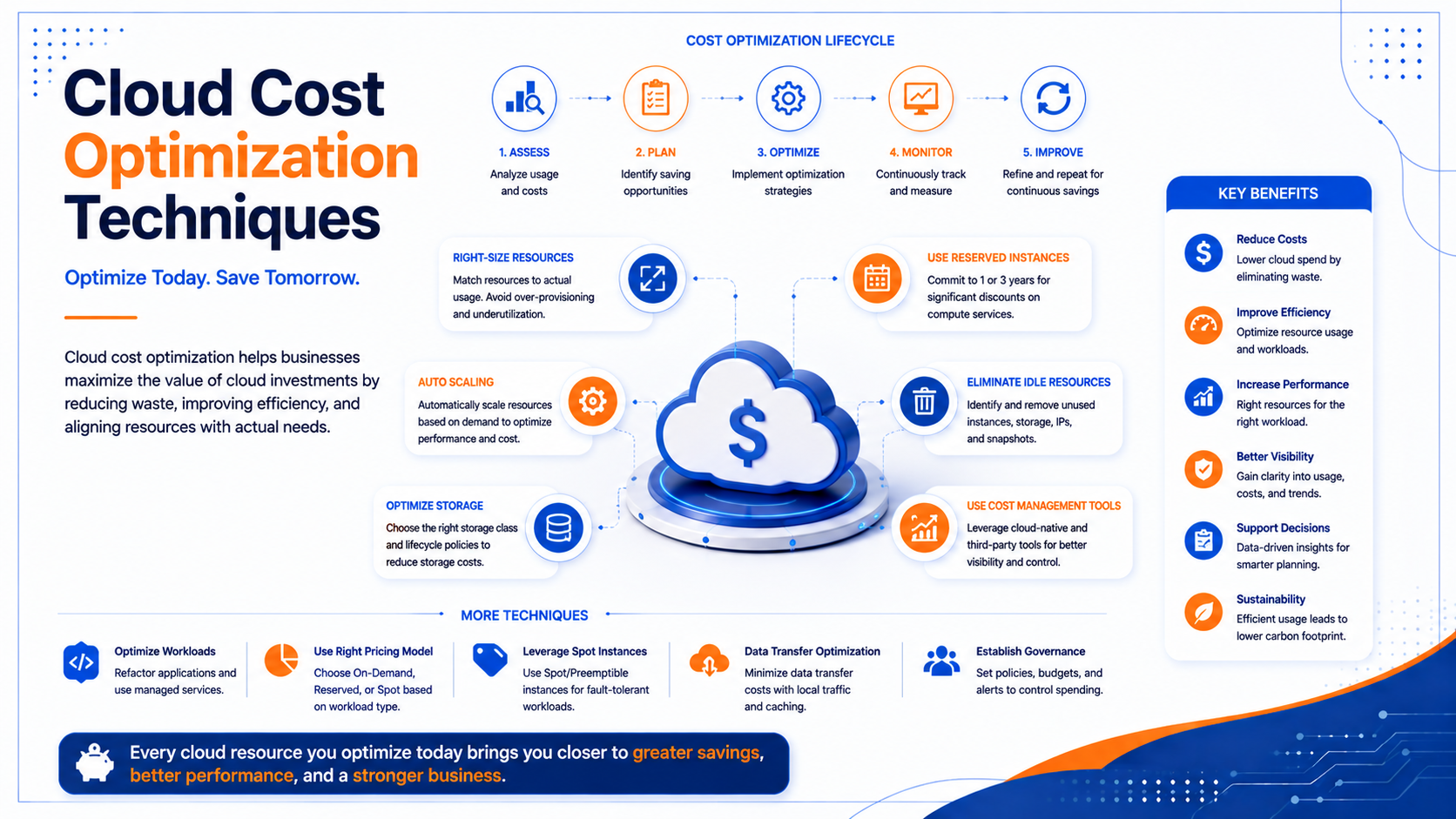
Rightsizing is the practice of matching cloud resources to actual workload requirements neither over-provisioned nor under-provisioned . It's often the most immediate source of savings.
Make Rightsizing Continuous
Many organizations rightsize once and forget it. The more effective approach is to embed rightsizing into monthly operations . Use automated tools like AWS Compute Optimizer, Azure Advisor, or GCP Recommender to flag over-provisioned resources weekly .
The key principle: Provision for average plus buffer, not theoretical worst case. Worst-case scenarios should be handled by scaling logic, not permanent overcapacity .
Real example: In one organization, the API tier averaged 18% CPU during business hours and under 10% overnight. By implementing auto-scaling groups targeting 60% CPU and reducing baseline capacity from 12 instances to 6 per region, the team saved roughly $38,000 monthly with zero impact on reliability .
Right-Size at the Container Level
In Kubernetes environments, teams often request far more cores than clusters actually use sometimes close to double . Rightsizing container requests can free significant capacity. A single core can cost $10 to $40 depending on the pricing model, so the savings add up quickly .
Commitments: Reserved Capacity and Savings Plans
Commitment-based discounts Reserved Instances (RIs) and Savings Plans on AWS, Azure Reservations, and GCP Committed Use Discounts offer 40% to 72% savings over on-demand pricing .
Commit Strategically, Not Emotionally
The trap is committing based on current architecture instead of future intent . Instead:
-
Identify truly steady workloads (typically 60% to 70% of baseline)
-
Commit only against predictable usage, not capacity you might not need
-
Leave burst capacity on demand
Regularly review commitment utilization. What made sense six months ago may no longer align with current demand .
Leverage Spot and Preemptible Instances
For fault-tolerant, stateless workloads like batch processing, CI/CD pipelines, ML training jobs, and dev/test environments, spot instances (AWS) and preemptible VMs (GCP) deliver 60% to 90% cost reductions .
The trade-off: The cloud provider can reclaim capacity on short notice. Design architectures to handle interruptions gracefully .
Storage Optimization: Beyond Compute
Cloud storage costs are often overlooked. Storage waste hides in several places: data stored in expensive hot tiers when it's rarely accessed, forgotten snapshots, and orphaned volumes .
Implement Lifecycle Policies
Automated lifecycle policies move infrequently accessed data from hot to cool or cold storage tiers S3 Intelligent-Tiering, Azure Blob Archive, or GCP Archive storage .
The math matters: Moving millions of small files can cost more in transition fees than the storage savings the move was supposed to generate . Always calculate object count and transition fees before automating large-scale tier migrations.
Reduce Egress Costs
Egress data leaving a cloud provider's network regularly becomes the single largest variable cost for multi-cloud operations .
Practical strategies to reduce egress :
-
Use CDNs for content delivery (Google Cloud CDN egress to North America starts at $0.08/GiB vs. $0.12/GiB for direct VPC egress)
-
Prefer direct interconnect options (AWS Direct Connect outbound rates start at $0.02/GB, well below standard internet egress tiers)
-
Audit data flows to eliminate redundant cross-region transfers
-
Co-locate workloads that exchange large data volumes in the same region or availability zone
FinOps Culture: The Human Factor
The cultural shift matters as much as the technical one . When teams see their actual cloud spend attributed to their budget, behavior changes quickly .
Build Cost-Aware Engineering
Make cost data visible to every team. Celebrate teams that reduce waste. Include cost efficiency as a standing item in architecture reviews . Engineers should start asking cost questions at design time rather than after deployment .
Showback Before Chargeback
Many organizations want to jump straight to chargeback allocating costs back to the teams that generated them. The logic is correct, but chargeback without visibility is punishment without understanding . Start with showback: giving teams a clear view of what they're spending without the financial hit. Once teams understand their spending, chargeback becomes a natural extension of existing accountability .
Centralized Policy, Federated Action
Governance fails in two ways: pure centralization creates a bottleneck, while pure federation creates chaos . The solution is centralized policy with federated action: set the rules once centrally, and let individual teams own their budgets and make decisions within a governance framework .
The AI Cost Challenge
AI has become a core operating cost in 2026. In the 2026 State of FinOps report, 98% of respondents reported managing some form of AI spend up from just 31% two years ago .
AI Cost Management
AI costs are different from traditional cloud costs. Inference costs vary by model, prompt length, and the number of API calls an application makes . A product team can accumulate material spend before anyone notices .
Key practices for AI cost management:
-
Enforce usage limits before models move into production
-
Guide model selection based on cost-to-value fit rather than capability alone
-
Introduce token budgets, spend alerts, and policy-driven controls
-
Track unit economics: cost per inference, cost per active user, cost per feature
The dual AI dynamic means organizations are both managing AI costs and using AI to automate forecasting, anomaly detection, and rightsizing recommendations .
Common Mistakes to Avoid
Treating Optimization as a One-Time Project
A cleanup done once loses effectiveness within a quarter as workloads shift and new services launch . Optimization is continuous by nature.
Cutting Blindly Instead of Optimizing
Optimization means matching resources to real demand, not simply removing them. If you shrink or delete a resource a workload genuinely needs, you trade a cost problem for a reliability problem .
Setting Governance Thresholds Too Tight
Over-strict budgets and alerts kill the experimentation that justified moving to cloud in the first place .
Ignoring Tagging
Inconsistent tags and unallocated shared costs make accurate cost attribution impossible .
Implementation Roadmap
Phase 1: Foundation (Weeks 1-4)
-
Establish visibility: Implement tagging policies and a centralized FinOps dashboard
-
Audit current spend: Identify waste patterns across compute, storage, and networking
-
Define KPIs: Connect cloud costs to business outcomes cost per customer, cost per transaction, cost per feature
Phase 2: Optimization (Weeks 5-8)
-
Rightsize resources: Use native tools to identify and resize over-provisioned instances
-
Implement lifecycle policies: Automate storage tiering and cleanup of unused resources
-
Apply commitments: Purchase RIs or Savings Plans for predictable baseline workloads
-
Enable spot instances: For fault-tolerant workloads
Phase 3: Governance and Culture (Weeks 9-12+)
-
Implement showback: Share cost data with engineering teams
-
Establish governance policies: Set provisioning approvals, tagging standards, and budget alerts
-
Build cost-aware culture: Include cost efficiency in architecture reviews
-
Plan for chargeback as maturity grows
Frequently Asked Questions
Q1: How much cloud spend is wasted?
Industry estimates suggest organizations waste 30% to 32% of their total cloud spend amounting to $200 billion to $230 billion annually .
Q2: What's the difference between showback and chargeback?
Showback reports costs back to business units for awareness without financial impact. Chargeback actually bills costs back to business units. Most organizations start with showback and progress to chargeback as their FinOps practices mature .
Q3: What are the most effective cloud cost optimization strategies?
The most effective strategies combine unified visibility, tagging, rightsizing, commitment management, and unit economics—treated as a connected system rather than fragmented efforts .
Q4: How do I optimize AI costs?
Track token usage, implement spend alerts and usage limits before production, guide model selection based on cost-to-value fit, and monitor unit economics like cost per inference .
Q5: How can Innovative AI Solutions help?
We help organizations design, build, and operationalize cloud cost optimization programs from visibility and rightsizing to FinOps culture and AI cost governance. Based in Delhi, serving clients across India.
Why Delhi is a Great Hub for FinOps Innovation
Delhi is emerging as a hub for cloud and FinOps innovation, backed by a thriving IT services ecosystem and global delivery centers. As Indian enterprises accelerate cloud adoption, the need for cost discipline has become critical. Organizations that implement FinOps best practices now will avoid the cost shocks that plague less disciplined cloud adopters.
What We Offer at Innovative AI Solutions
-
Cloud Cost Strategy: We help you design a cloud cost optimization roadmap aligned with business goals
-
FinOps Implementation: We help you establish visibility, governance, and culture
-
AI Cost Management: We help you track and optimize AI and GPU spend
-
Multi-Cloud Governance: We help you manage cost across AWS, Azure, and GCP
Final Thought
The shift is clear: from managing cloud bills to managing technology value. Organizations that build a culture of cost-aware engineering, continuous optimization, and data-driven decision-making will be the ones that maximize value from their cloud investments.
Contact Us:
Phone: +91 7464 099 059 / +91 9689967356
Email: info@innovativeais.com
Address: Netaji Subhash Place, Pitampura, Delhi – 110034
Website: https://innovativeais.com
About the Author
Abhishek Kumar
Founder & CEO, Innovative AI Solutions
5+ years building AI, cloud, and enterprise systems. Based in Delhi, serving clients across India.
Related services: to apply this in your business, explore our cloud services and RAG development.