The Big Question
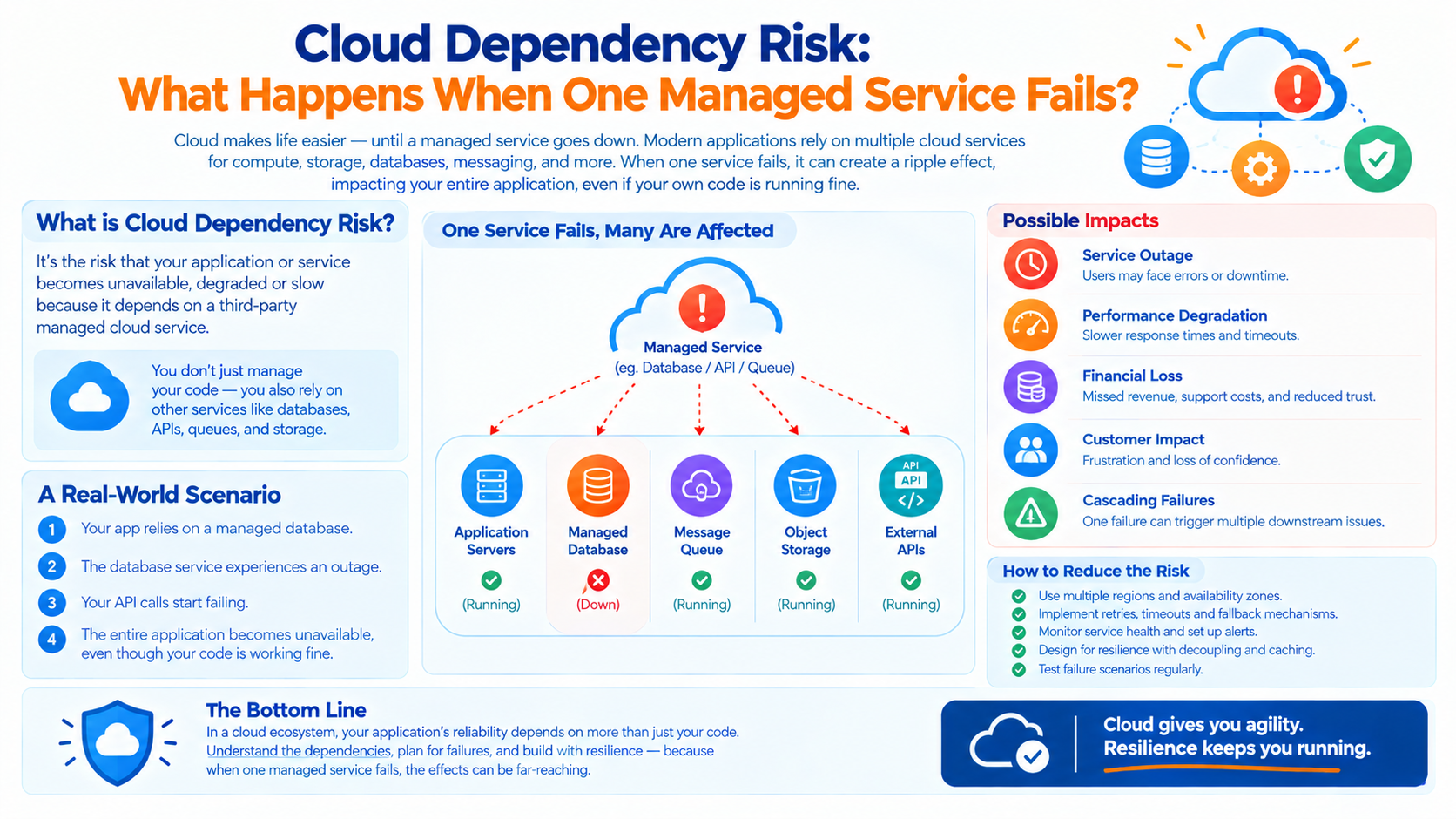
What happens when your identity provider goes down and no one can log in? When your managed queue experiences elevated latency and your entire event-driven architecture backs up? When a regional outage takes your managed database offline and your application has no fallback?
Managed services reduce operational burden and increase reliability for most of the time. But they concentrate risk: when they fail, everything built on them fails simultaneously. The question is not whether a managed service will fail it is what happens when it does.
Why Dependency Risk Accumulates
Cloud dependency risk does not appear suddenly. It builds incrementally, through a series of individually reasonable decisions.
Managed Services Are Faster Than Building
The default choice is almost always the managed service. It is faster to adopt than building and operating your own. The decision is correct in isolation and it creates a dependency.
Dependencies Are Invisible in Architecture Diagrams
A service that calls an identity provider looks like a box on a diagram. It does not show that the application cannot authenticate users without it. Dependency depth is rarely visualized.
Shared Dependencies Concentrate Risk
When multiple services depend on the same managed service, that service becomes a single point of failure for the entire system. The blast radius grows with adoption.
Failure Modes Are Not Understood
Teams often assume a managed service is either working or not. In practice, managed services fail in partial ways: elevated latency, intermittent errors, degraded throughput, regional unavailability, and API changes.
Contracts Do Not Guarantee Availability
Service level agreements provide credits, not uptime. A 99.9% SLA permits more than eight hours of downtime per year. For a critical dependency, that is significant.
The Categories of Dependency
Not all dependencies carry the same risk. Classifying them clarifies where to invest in resilience.
| Dependency Type | Examples | Failure Impact |
|---|---|---|
| Identity | Auth providers, SSO, IAM | Complete authentication failure |
| Data | Managed databases, object storage | Data access failure, potential loss |
| Messaging | Queues, event buses, streams | Workflow stoppage, backlog |
| Compute | Container platforms, serverless | Application unavailability |
| Networking | DNS, CDN, API gateways | Routing failure, unreachability |
| Observability | Logging, metrics, tracing | Loss of visibility during incident |
| Third-party APIs | Payments, communications, maps | Feature-specific failure |
The critical insight: dependencies fail in different ways, and each requires a different mitigation.
How Managed Services Actually Fail
Understanding failure modes is the prerequisite for designing resilience.
Complete Unavailability
The service is entirely unreachable. This is the easiest failure to detect and the simplest to design for if you have a fallback.
Partial Degradation
The service responds, but slowly or with errors. This is harder to detect and often worse than complete failure, because timeouts and retries amplify the problem.
Regional Failure
The service is unavailable in one region but available in others. Multi-region architectures can survive this; single-region architectures cannot.
Control Plane Failure
The control plane used to create, modify, or delete resources fails while the data plane continues to operate. Applications keep running, but you cannot change anything during the outage.
API and Behavior Changes
The provider changes behavior, deprecates fields, or introduces breaking changes. Applications that depended on the previous behavior fail.
Quota and Rate Limiting
The service throttles requests because you have exceeded a quota. Under load, this can cause cascading failures.
Cascading Failure
One managed service fails, causing applications to retry aggressively, which overwhelms dependent services, which fail in turn.
Why "It Is Managed" Is Not a Resilience Strategy
Managed services are operated by the provider, but their reliability is a shared responsibility.
What the provider is responsible for:
-
Infrastructure availability
-
Service uptime within SLA
-
Security of the service itself
What the customer is responsible for:
-
How the application behaves when the service is unavailable
-
Configuration of timeouts, retries, and circuit breakers
-
Whether the application has fallbacks
-
Whether quotas are appropriate
-
Whether the dependency is replaceable
The provider guarantees best effort within an SLA. The customer guarantees the application's behavior. These are different commitments.
Designing for Dependency Failure
1. Classify Dependencies by Criticality
Not every dependency requires the same resilience investment. Classify each by what happens when it fails.
Questions to ask:
-
Can the application function without this dependency?
-
For how long?
-
What is the business cost of an hour of unavailability?
-
Is there a fallback, and how quickly can it be activated?
2. Design for Graceful Degradation
Applications should reduce functionality when dependencies fail, not cease to function.
Patterns:
-
Serve cached data when a data source is unavailable
-
Queue writes when a downstream service is down
-
Disable non-essential features when a dependency degrades
-
Show staleness indicators rather than failing silently
3. Implement Timeouts, Retries, and Circuit Breakers
Uncontrolled retries turn a dependency failure into a cascading failure.
The pattern:
-
Timeouts: Every call has a maximum wait. No call waits indefinitely.
-
Retries with backoff: Failed calls retry with exponential backoff and jitter.
-
Circuit breakers: After repeated failures, stop calling the dependency and use a fallback.
4. Avoid Synchronous Dependencies on the Critical Path
Where possible, remove managed services from the synchronous request path. Use queues to decouple the request from the work.
The pattern: A user request writes to a queue and returns immediately. A worker processes the queue asynchronously. If the downstream service is slow, the user is unaffected.
5. Maintain Fallbacks for Critical Dependencies
For dependencies whose failure would cause complete unavailability, maintain a fallback.
Examples:
-
Secondary identity provider for authentication
-
Read replica in another region for data access
-
Alternate queue provider or local buffering
The trade-off: Fallbacks add complexity and cost. They are justified only for dependencies whose failure is unacceptable.
6. Understand Provider Failure Modes
Read the provider's documentation on failure modes, limits, and outage procedures. Know what happens during a control plane outage, how quotas are enforced, and what the escalation path is.
7. Test Dependency Failure
You do not know whether your fallback works until you test it. Inject dependency failures in controlled experiments and observe whether the application degrades gracefully.
The Multi-Provider Question
A common response to dependency risk is to use multiple providers for the same capability.
When it helps: For critical dependencies where a single provider outage is unacceptable, multi-provider strategies provide genuine resilience.
When it does not: Multi-provider strategies add significant complexity. Data must be replicated, behavior must be consistent, and operational burden increases. For many dependencies, the cost exceeds the benefit.
The practical guidance: Multi-provider is justified for a small number of truly critical dependencies. For others, design for graceful degradation within a single provider.
The Concentration Risk of Shared Dependencies
Some dependencies are shared across many services. When these fail, the blast radius is organization-wide.
Common shared dependencies:
-
Identity and authentication
-
DNS
-
Service mesh control plane
-
Central logging and metrics
-
Configuration management
The mitigation: Treat shared dependencies as critical infrastructure. They require the highest level of resilience investment, because their failure affects everything.
Implementation Roadmap
Phase 1: Inventory (Weeks 1-4)
-
List all managed service dependencies.
-
Classify each by criticality. What fails if this fails?
-
Identify shared dependencies. Which are used across many services?
-
Document failure modes for each critical dependency.
Phase 2: Harden (Weeks 5-10)
-
Implement timeouts and retries for every dependency call.
-
Add circuit breakers for dependencies that can degrade.
-
Remove synchronous dependencies from critical paths where possible.
-
Build fallbacks for dependencies whose failure is unacceptable.
-
Configure appropriate quotas and monitor usage.
Phase 3: Validate (Weeks 11-14)
-
Test dependency failure through controlled injection.
-
Verify graceful degradation works as designed.
-
Test failover for critical dependencies with fallbacks.
-
Document recovery procedures for dependency outages.
Frequently Asked Questions
Q1: Are managed services less reliable than self-managed?
Generally more reliable for routine operations, but they introduce concentrated dependency risk. The provider is better at running the service; the customer is responsible for how the application behaves when the service fails.
Q2: Do SLAs protect me from dependency risk?
No. SLAs provide service credits, not availability. A 99.9% SLA permits more than eight hours of downtime per year.
Q3: Should I use multiple providers for critical dependencies?
Only for a small number of truly critical dependencies. Multi-provider strategies add significant complexity and cost. For most dependencies, graceful degradation is more practical.
Q4: What is the most important resilience control?
Timeouts and circuit breakers. Uncontrolled retries are the primary cause of cascading failures during dependency outages.
Q5: How do I test dependency failure?
Inject failures in controlled experiments—block access to the dependency, introduce latency, or simulate errors. Observe whether the application degrades gracefully.
Q6: How can Innovative AI Solutions help?
We help organizations assess dependency risk, design resilient architectures, and validate resilience through failure testing. Explore our services to see how we approach cloud architecture. Based in Delhi, serving clients across India.
Why Delhi is a Great Hub for Cloud Resilience Engineering
Delhi is emerging as a hub for cloud-native and reliability engineering, backed by a thriving IT services ecosystem and a growing base of organizations running critical systems on managed services. As Indian enterprises scale their cloud footprints, understanding and mitigating dependency risk becomes a competitive requirement.
What We Offer at Innovative AI Solutions
-
Dependency Assessment: We inventory managed service dependencies and classify criticality.
-
Resilience Design: We implement timeouts, retries, circuit breakers, and fallbacks.
-
Decoupling: We help move dependencies off the synchronous critical path.
-
Failure Testing: We validate resilience through controlled dependency failure injection.
-
Multi-Provider Strategy: We help determine where multi-provider is justified and where it is not.
Final Thought
The shift is clear: from assuming managed services are always available to designing for the moment they are not. Cloud dependency risk is structural it grows with adoption and concentrates with sharing. Organizations that classify dependencies, implement graceful degradation, and test failure will survive the outage when it comes. Those that treat "it is managed" as a resilience strategy will discover the limits of that assumption at the worst possible time.
Contact Us:
Phone: +91 7464 099 059 / +91 9689967356
Email: info@innovativeais.com
Address: 904, 9th floor Pearls Best Heights-I, Netaji Subhash Place, Delhi-110034
Website: https://innovativeais.com
About the Author
Abhishek Kumar
Founder & CEO, Innovative AI Solutions
5+ years building AI, cloud, and enterprise systems. Based in Delhi, serving clients across India.