The Big Question
There is a fundamental difference between running applications in the cloud and building applications for the cloud. Most businesses that migrated to cloud infrastructure in the past decade did the former.
This is called lift-and-shift moving an existing monolithic application from on-premises servers to a cloud VM without changing its architecture. The code stays the same. The dependencies stay the same. The scaling model stays the same manual, vertical, and slow .
The problem emerges when the business needs to grow. A lift-and-shifted application still scales by buying a bigger VM. It still requires downtime for major releases. It still has a single point of failure. It runs in the cloud, but it does not exploit the cloud .
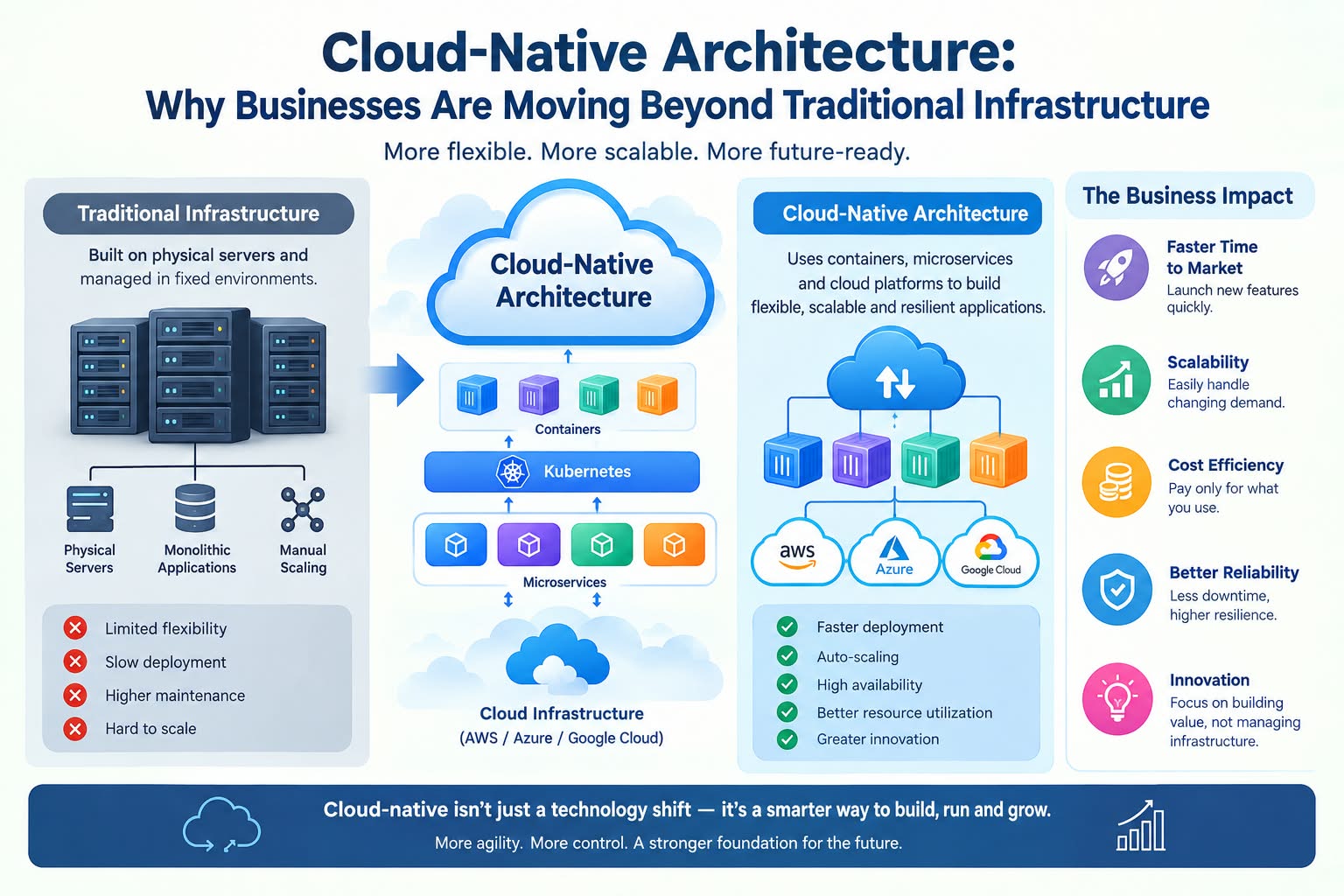
Cloud-native architecture changes the fundamental assumptions. Applications are broken into microservices small, loosely coupled services that each own one business capability. They run in containers that package everything needed to execute, ensuring consistency across environments. They are managed through DevOps practices that unify development and operations. And they flow through CI/CD pipelines that automate testing and deployment .
The Cloud Native Computing Foundation (CNCF) frames cloud-native around these four pillars, with Kubernetes as the orchestration layer, service meshes like Istio for networking, and Infrastructure as Code tools like Terraform for reproducible environments .
The business outcomes are concrete. The CNCF Maturity Model documents organizations reducing infrastructure spend by 25%, lowering development costs by 10%, and shipping 10% more features per quarter after adopting cloud-native approaches .
Cost Based on Organization Type
Cloud-native adoption costs depend on organization size, existing infrastructure, and migration strategy. Here is the 2026 Indian market landscape:
| Organization Type | Typical Annual Investment (India) | What It Covers |
|---|---|---|
| Startup / Small Team | ₹8,00,000 – ₹25,00,000 | Kubernetes cluster, CI/CD pipeline, containerization, monitoring |
| Mid-Market Enterprise | ₹25,00,000 – ₹1,00,00,000 | Multi-cluster orchestration, service mesh, platform engineering |
| Large Enterprise / GCC | ₹1,00,00,000 – ₹5,00,00,000+ | Multi-cloud landing zones, FinOps governance, 24/7 SRE |
| Regulated Industry | ₹5,00,00,000+ | Compliance automation, data residency, dedicated platform team |
Real-world India reference points:
A Pune-based IT-ITeS GCC migrated 120 microservices (Node.js, Python, Java) from on-premises VMs to Amazon EKS, reducing compute costs by ₹1.8 crore per year and mean time to deploy (MTTR) to 12 minutes .
For a GCC running 50 microservices on EKS, typical AWS costs run ₹45-65 lakhs per month for 2 EKS clusters (15 production + 8 staging nodes), RDS databases, load balancers, and data transfer. Spot instances and reserved capacity reduce this to ₹28-40 lakhs per month. A mature GCC optimizes further via auto-scaling and serverless (Lambda, Fargate) for non-critical services .
The India region premium: AWS costs in Asia Pacific (Mumbai) run approximately 5-9% higher than US East (N. Virginia). An m6i.large on-demand instance costs $0.0960/hour in Virginia versus $0.1010/hour in Mumbai a 5.21% premium. S3 Standard storage costs $0.023/GB in Virginia versus $0.025/GB in Mumbai an 8.70% premium .
Breakdown by Developer Type (2020-2026)
Cloud-native development requires specialized skills in Kubernetes, Infrastructure as Code, and platform engineering. The Indian talent market offers a range of options:
| Developer Type | Hourly Rate (India) | Monthly Cost (Fully Loaded) | What They Deliver |
|---|---|---|---|
| Mid-Level DevOps | $20 – $35/hr | $1,450 – $2,275 | Single cloud, CI/CD pipelines, container basics |
| Senior DevOps | $35 – $50/hr | $2,405 – $3,580 | Multi-cloud, Kubernetes, Infrastructure as Code |
| Lead / Architect | $50 – $70/hr | $3,690 – $5,695 | Platform design, cost governance, team leadership |
| General Developer | $20 – $50/hr | $2,500 – $8,000 | Application code, API integration, feature development |
India's structural advantage: A senior DevOps engineer in the US costs $11,500 to $15,000 per month in salary alone before benefits and payroll tax. Even at the top of the Lead/Architect range, India sits at roughly one-third to one-half the equivalent US fully loaded cost .
Skills that command premiums:
-
Kubernetes and container orchestration: Engineers who can design, deploy, and operate production Kubernetes clusters at scale command a 30-50% premium. Experience with service meshes (Istio), GitOps workflows (ArgoCD, Flux), and multi-cluster management is extremely scarce .
-
Terraform and Infrastructure as Code: Deep expertise in module design, state management at scale, and policy-as-code adds 20-35% to compensation .
City tier variation: Tier 1 cities (Bengaluru, Delhi NCR, Mumbai) set the baseline. Tier 2 (Pune, Hyderabad, Chennai) runs 10-15% lower. Tier 3 (Jaipur, Kochi, Indore) runs 20-30% lower. But remote international roles have compressed these gaps significantly .
Why Prices Changed in 2026
Three forces have reshaped cloud-native economics.
First, the upgrade clock became a finance problem. Kubernetes clusters left on old versions incur extended support charges. A single EKS cluster on version 1.33 costs an extra $0.50 per hour $360 per month, or $4,380 per year. This is trivial for one cluster and material across a fleet of twenty environments where non-production clusters are the ones nobody upgrades .
Serverless runtimes have their own deadlines. AWS has bulk-aligned Lambda runtimes onto shared deprecation schedules. Amazon Linux 2 reached end of life on 30 June 2026, pulling Python 3.10, Python 3.11, and provided.al2 runtimes into a cohort where function creation blocks on 1 February 2027 and function updates block on 3 March 2027. Blocked updates do not stop a function running they stop you deploying a fix during an incident, which is a worse position to be in .
Second, FinOps discipline became mandatory. The Flexera 2024 State of the Cloud Report found that organizations with formalized FinOps practices see an average of 33% improvement in cloud cost efficiency . GCCs running cloud-native platforms on AWS report reducing AWS bills by 35-40% through right-sizing RDS instances, reserving compute, and blending spot/on-demand without performance impact .
Third, platform engineering emerged as the operating model. The pattern across successful cloud-native adoptions is consistent: small teams own critical parts of the business domain, operate in decoupled domains of expertise, and take responsibility for deployment, monitoring, and on-call support. As AppDirect's team put it after their Kubernetes journey: "We asked engineers to expand their horizons. We moved from a culture limited to 'pushing code in a branch' to exciting new responsibilities outside of the code base" .
Pro Tips to Save Money in 2026
1. Right-size before you reserve. AWS Trusted Advisor and Cost Explorer identify savings opportunities. Right-sizing RDS instances, reserving compute, and blending spot/on-demand can reduce AWS bills by 35-40% without performance impact . Do not commit to reserved capacity until you have actually optimized the workload.
2. Use spot instances for non-critical workloads. GCCs running EKS use Managed Node Groups that auto-scale from 5 to 50 nodes based on load, with Spot instances delivering 70% cost savings for non-critical workloads .
3. Implement tagging strategy from day one. Tag resources by project, client, and cost center. This enables detailed billing and makes cost visibility possible as scale grows. FinOps practices depend on knowing who owns what .
4. Consider serverless for non-critical services. AWS Lambda and Fargate eliminate infrastructure management for workloads that do not need persistent compute. A mature GCC optimizes further by moving non-critical services to serverless .
5. Follow the sun for platform coverage. GCCs with 24/7 follow-the-sun DevOps coverage across GMT, IST, and US time zones reduce mean time to deploy and maintain uptime above 99.95%. The cost of 24/7 coverage is offset by faster incident response and reduced downtime .
6. Treat cluster version drift as a scheduled maintenance task. The cheapest way to handle Kubernetes upgrades is on a schedule you set. A cluster left on extended support costs $360 per month. Across twenty environments, that is $86,400 per year in avoidable charges .
Questions to Ask Before Hiring
Before you commit budget to any cloud-native engagement, ask these questions.
1. "What's your migration strategy rehost, replatform, or refactor?" Gartner's 5 Rs describe the migration ladder. Rehost is fastest and least disruptive. Refactor delivers the most cloud-native benefit but requires the most investment. The right answer depends on your application, not the vendor's preference .
2. "How do you handle Kubernetes version upgrades and extended support costs?" A team that has managed clusters across multiple versions understands the finance problem. Ask about their upgrade cadence and how they avoid extended support charges .
3. "What's your FinOps practice?" Cloud-native without cost governance becomes expensive. Ask for specific savings achieved for previous clients and the mechanisms they used .
4. "How do you handle state management across microservices?" The hardest problem in cloud-native is data. Ask about consistency, latency, and how they handle distributed transactions .
5. "Show me a production cloud-native platform you built in the last 12 months." Portfolios show architecture diagrams. Production systems expose real scaling, real monitoring, and real cost optimization.
Why Delhi is a Great Hub for Cloud-Native Development
Delhi-NCR has become a serious destination for cloud-native work, and the reason isn't just cost.
The region hosts a dense cluster of Global Capability Centers (GCCs) 35% of NCR's GCCs constitute the largest cluster of global financial captives in the region. These GCCs run cloud-native platforms on AWS, with multi-account landing zones, managed EKS, Infrastructure as Code with Terraform, and fully automated CI/CD pipelines now considered table-stakes .
The talent density keeps improving. Bengaluru leads in DevOps compensation due to its concentration of cloud-native startups and hyperscaler GCCs. Hyderabad has seen rapid growth thanks to major expansions by Amazon, Microsoft, and Oracle. Pune's automotive and enterprise IT sectors create steady demand for DevOps professionals with industry-specific expertise .
Delhi's GCCs are pioneering cloud-native AWS architectures that rival tier-1 global tech companies in sophistication and cost efficiency. Success hinges on strong governance (AWS Config, CloudTrail), skilled teams (AWS certifications), and 24/7 operational discipline .
The time zone advantage matters too. A Delhi-based team can sync with Middle East morning, European afternoon, and US East Coast evening covering the full global support window.
What We Offer
At Innovative AI Solutions, we treat cloud-native adoption as a business transformation, not a technology project.
Our approach:
-
Migration Assessment First. We map your applications against Gartner's 5 Rs and recommend the right strategy for each workload. Not everything should be refactored.
-
Kubernetes Platform Engineering. EKS clusters with managed node groups, auto-scaling, and spot instance blending. Your platform scales with demand without manual intervention.
-
FinOps Governance. Tagging strategies, cost visibility, and right-sizing. We target 35-40% AWS bill reduction without performance impact.
-
CI/CD Pipeline Automation. Automated testing, deployment, and rollback. Deployment frequency moves from quarterly to daily.
-
Observability by Default. Prometheus, Grafana, and structured logging. You see what your platform is doing, when it fails, and why.
-
Retained Operations. 24/7 monitoring, incident response, and version upgrades. Your platform doesn't rot because someone forgot the upgrade calendar.
Our principle is simple: small steps, fast iteration, data speaks.
Frequently Asked Questions
Q: What is cloud-native architecture in simple terms?
Cloud-native architecture means building applications specifically designed to run in cloud environments. Instead of one large monolithic application, you build small, independent services (microservices) that run in containers, deploy automatically through CI/CD pipelines, and scale based on demand. The Cloud Native Computing Foundation defines four pillars: microservices, containers, DevOps, and CI/CD .
Q: What's the difference between cloud-hosted and cloud-native?
Cloud-hosted means running a traditional application on cloud infrastructure without changing its architecture. Cloud-native means designing the application for the cloud from day one. Cloud-hosted scales vertically (bigger VM). Cloud-native scales horizontally (more instances). Cloud-hosted deploys quarterly with downtime. Cloud-native deploys daily without downtime .
Q: How much does cloud-native adoption cost in India?
For a mid-market enterprise, cloud-native adoption runs ₹25 lakhs to ₹1 crore annually depending on scale. A GCC running 50 microservices on EKS spends ₹45-65 lakhs per month on AWS, reduced to ₹28-40 lakhs with spot instances and reserved capacity .
Q: How long does cloud-native migration take?
Rehost (lift-and-shift): weeks. Replatform (swap components): months. Refactor (rewrite for cloud-native): 6-18 months for a typical enterprise application. Most organizations follow an incremental path, not a big-bang transformation .
Q: Will cloud-native reduce my infrastructure costs?
Not automatically. Cloud-native enables cost reduction, but FinOps discipline is required. Organizations with formalized FinOps practices see 33% improvement in cloud cost efficiency. GCCs report 35-40% AWS bill reduction through right-sizing, spot instances, and reserved capacity without performance impact .
Frequently Asked Questions (Extended)
Q: What is the biggest challenge in cloud-native adoption?
Complexity. Distributed systems introduce challenges in state management, security, and observability. The growing demand for specialized skills in cloud-native technologies often results in personnel gaps. Managing data consistency and latency among microservices adds another level of complexity .
Q: What is the Kubernetes upgrade problem?
Kubernetes clusters left on old versions incur extended support charges. A single EKS cluster on version 1.33 costs an extra $0.50/hour $4,380 per year. Across twenty environments, that is $86,400 in avoidable charges. Serverless runtimes have similar deprecation deadlines .
Q: What's the first step I should take tomorrow?
Assess your current architecture. Pick one application. Determine whether it should be rehosted, replatformed, or refactored. Start with the workload that would benefit most from cloud-native capabilities. Not with a strategy document about cloud-native transformation.
Contact Us:
Phone: +91 7464 099 059 / +91 9689967356
Email: info@innovativeais.com
Address: 9th Floor, Pearls Best Heights-I, Head Office: 904, Netaji Subhash Place, Delhi, 110034