The Big Question
What happens when a team promises 99.99% uptime without calculating what that requires? When every service is held to the same standard regardless of whether users would notice the difference? When reliability work competes with feature work and always loses because it has no budget?
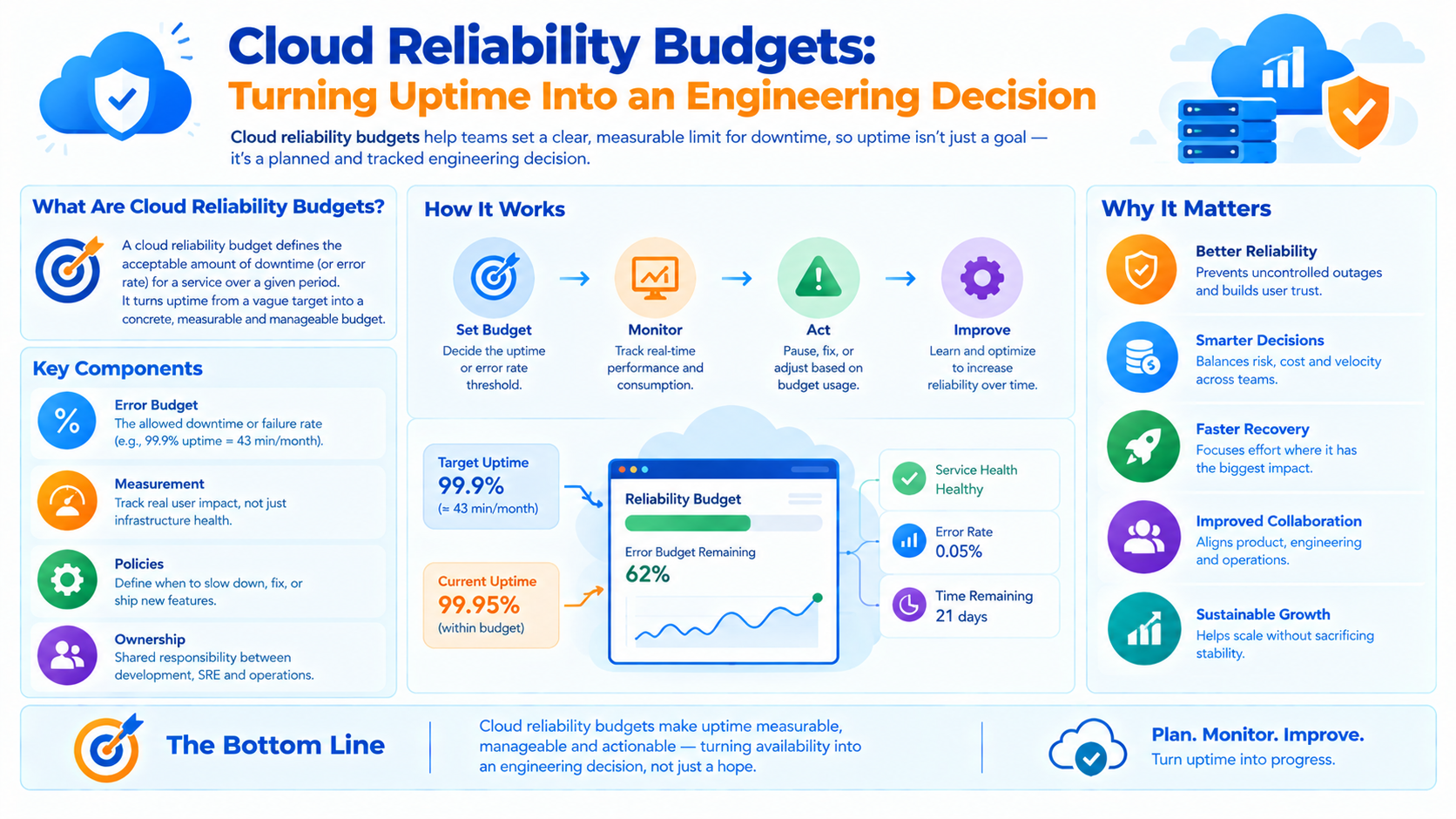
Reliability budgets solve these problems by making reliability explicit, measurable, and bounded.
What a Reliability Budget Actually Is
A reliability budget is the amount of unreliability a service is allowed to have over a defined period.
The construction:
-
Define a target: 99.9% availability
-
Invert it: 0.1% unavailability
-
Convert to time: 43.2 minutes per month
-
That is the budget
The budget is the inverse of the target. If you promise 99.9% availability, you have 0.1% to spend. Spending it means the service was unavailable. Not spending it means you had reliability you did not need or reliability you did not use.
The insight: Reliability is not a binary. It is a quantity that can be measured, allocated, and spent.
The Arithmetic of Uptime
The numbers matter, and most teams do not know them.
| Availability | Downtime per Year | Downtime per Month |
|---|---|---|
| 99% | 3.65 days | 7.2 hours |
| 99.5% | 1.83 days | 3.6 hours |
| 99.9% | 8.76 hours | 43.2 minutes |
| 99.95% | 4.38 hours | 21.6 minutes |
| 99.99% | 52.6 minutes | 4.32 minutes |
| 99.999% | 5.26 minutes | 26 seconds |
Each additional nine costs disproportionately more. Moving from 99.9% to 99.99% reduces allowed downtime by a factor of ten—and typically requires a corresponding increase in redundancy, automation, and operational maturity.
The question every team should ask: Does our users' experience actually change between 99.9% and 99.99%? If not, the additional investment buys nothing.
What the Budget Is Spent On
The budget is consumed by anything that reduces availability.
Planned work:
-
Deployments that cause brief interruptions
-
Database migrations that require downtime
-
Infrastructure changes that introduce temporary risk
Unplanned events:
-
Incidents and outages
-
Dependency failures
-
Performance degradation severe enough to affect users
The key distinction: Planned work that consumes budget is a deliberate trade-off. Unplanned events that consume budget are failures.
Tracking both reveals whether the budget is being spent intentionally or lost accidentally.
The Budget Policy
A budget is only useful if it changes behavior. The policy defines what happens when the budget is consumed.
A typical policy:
| Budget State | Action |
|---|---|
| Healthy | Feature velocity prioritized; reliability work proceeds at normal pace |
| Warning threshold (50% consumed) | Reliability review; investigate sources of budget consumption |
| Critical threshold (75% consumed) | Feature releases paused; reliability work prioritized |
| Exhausted (100% consumed) | All non-essential change frozen until the budget recovers |
The purpose: The policy makes the trade-off explicit and automatic. Instead of debating whether to prioritize reliability, the budget decides.
Why Budgets Change the Conversation
From Aspiration to Arithmetic
"We want high reliability" becomes "we have 43.2 minutes per month." The second is measurable and actionable.
From Blame to Analysis
When an incident consumes budget, the conversation shifts from "who caused this?" to "how much did this cost, and what should we do about it?"
From Invisible Work to Budgeted Work
Reliability work is often invisible until something breaks. A budget makes it visible it is the mechanism that recovers spent budget.
From Uniform Standards to Appropriate Standards
Not every service needs 99.99%. A budget forces the question: what does this service actually require?
From Fear to Informed Risk
Deployments consume budget. Instead of avoiding change out of fear, teams make informed decisions about when and how to spend.
The Tension Between Reliability and Velocity
Reliability budgets surface a genuine tension.
Higher reliability requires: More redundancy, more testing, more automation, slower change.
Higher velocity requires: Faster change, more frequent deployment, more risk.
The budget resolves the tension: It defines how much risk is acceptable. Within the budget, velocity is encouraged. When the budget is exhausted, velocity is paused.
This is the essential insight: reliability and velocity are not in conflict. They are balanced by a shared resource the budget.
Setting the Right Target
The hardest question is not how to implement a budget but what target to set.
Considerations:
User expectation. What do users actually notice? A brief degradation may be invisible. An outage is not.
Business impact. What does downtime cost? A consumer app and a trading platform have very different economics.
Architecture reality. What is achievable with current architecture? A target that requires a rebuild is not a target it is a project.
Cost of the next nine. What would it cost to move from 99.9% to 99.99%? Is the benefit worth the cost?
The common failure: Setting the target based on industry norms rather than actual requirements. Many services claim 99.99% and deliver 99.5% because the target was aspirational, not engineered.
Measuring the Budget
Budgets require measurement. Without measurement, the budget is theoretical.
What to measure:
-
Availability per service, measured from the user's perspective
-
Incidents and their durations
-
Planned work that causes unavailability
-
Dependency failures that affect availability
How to measure:
-
Synthetic monitoring from outside the system
-
Real user monitoring for actual experience
-
Incident records with accurate durations
The measurement principle: Measure from the user's perspective, not from the infrastructure's. A service that is "up" but unreachable to users is down.
Where Budgets Apply
Reliability budgets are most valuable for services where availability matters and can be measured.
Good candidates:
-
Customer-facing APIs
-
User-facing applications
-
Critical internal services
-
Infrastructure components
Poor candidates:
-
Internal tools where downtime is tolerable
-
Services without clear user impact
-
Experimental systems
The practical guidance: Start with your most critical services. Expand as the practice matures.
Implementation Roadmap
Phase 1: Define (Weeks 1-3)
-
Identify services that warrant budgets. Which services have measurable user impact?
-
Set targets based on actual requirements. What do users need, not what is conventional?
-
Define measurement approach. From the user's perspective.
-
Define the policy. What happens when the budget is consumed?
Phase 2: Instrument (Weeks 4-6)
-
Implement availability measurement.
-
Track incidents and their durations.
-
Track planned work that causes unavailability.
-
Build dashboards showing budget consumption.
Phase 3: Operate (Weeks 7-12+)
-
Apply the policy consistently. The budget decides, not the loudest voice.
-
Review budget consumption in incident reviews.
-
Adjust targets based on experience.
-
Expand to additional services.
Frequently Asked Questions
Q1: What is a reliability budget?
A reliability budget is the amount of unreliability a service is allowed over a period the inverse of its availability target. It defines how much downtime is acceptable.
Q2: How is it different from an SLA?
An SLA is a contractual commitment with financial consequences. A reliability budget is an internal engineering tool that governs decisions about change and reliability work.
Q3: What happens when the budget is exhausted?
Per the policy: feature releases pause, and reliability work is prioritized until the budget recovers. The budget enforces the trade-off automatically.
Q4: Should every service have a reliability budget?
No. Services with measurable user impact and clear availability requirements benefit most. Internal tools and experimental systems generally do not.
Q5: How do I set the right target?
Based on user expectations, business impact, architectural reality, and the cost of the next nine. Not on industry norms.
Q6: How can Innovative AI Solutions help?
We help organizations define reliability targets, implement measurement, and establish budget policies. Explore our services to see how we approach reliability engineering. Based in Delhi, serving clients across India.
Why Delhi is a Great Hub for Reliability Engineering
Delhi is emerging as a hub for cloud-native and reliability engineering, backed by a thriving IT services ecosystem and a growing base of organizations running critical customer-facing systems. As Indian enterprises scale their platforms, turning reliability into an engineering decision becomes a competitive requirement.
What We Offer at Innovative AI Solutions
-
Reliability Target Design: We help you set targets based on actual requirements.
-
Measurement Implementation: We build user-perspective availability measurement.
-
Budget Policy Design: We define thresholds and enforcement.
-
Operational Integration: We connect budgets to incident review and release decisions.
-
Continuous Tuning: We help you adjust targets as the system and its users evolve.
Final Thought
The shift is clear: from treating reliability as an aspiration to treating it as a budget. Reliability budgets make the trade-off between reliability and velocity explicit, measurable, and enforceable. Organizations that adopt them will make better decisions about where to invest and when to slow down. Those that rely on good intentions will keep promising nines they never engineer.
Contact Us:
Phone: +91 7464 099 059 / +91 9689967356
Email: info@innovativeais.com
Address: 904, 9th floor Pearls Best Heights-I, Netaji Subhash Place, Delhi-110034
Website: https://innovativeais.com
About the Author
Abhishek Kumar
Founder & CEO, Innovative AI Solutions
5+ years building AI, cloud, and enterprise systems. Based in Delhi, serving clients across India.