The Big Question
What if the most valuable data your organization already owns is the data you're not using? What if the insights that could transform your business are sitting in forgotten folders, unanalyzed logs, and archived emails—costing you money to store while competitors figure out how to monetize theirs?
This is the dark data paradox. You're spending millions to store data that delivers zero value, exposing yourself to compliance risks, and missing strategic opportunities, all at the same time. The organizations that solve this paradox will have a significant competitive advantage.
What Is Dark Data?
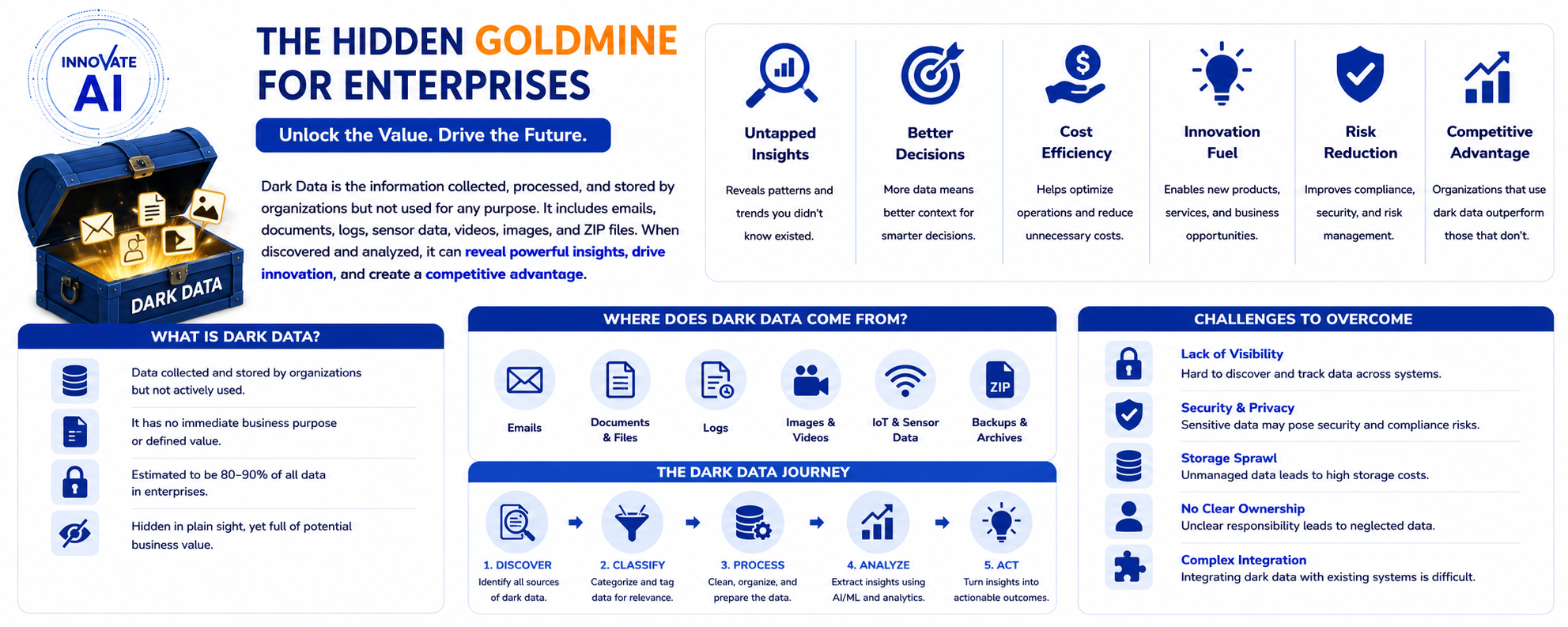
Dark data refers to information that organizations collect, process, and store during routine operations but never use for analytics, business relationships, or monetization . Gartner defines it as "the information assets organizations collect, process and store during regular business activities, but generally fail to use for other purposes" .
The term draws an analogy to dark matter in physics—it makes up the majority of the universe but is invisible to us . Similarly, dark data often comprises most of an organization's information assets, sitting dormant and unseen.
Key distinction: Dark data isn't "bad" data or inaccurate information. It's simply untapped potential . According to industry estimates, an alarming 55% or more of enterprise data is dark—stored but never used for analysis or business decisions . Almost one in three organizations report that 75% or more of their stored data is dark or obsolete .
Examples of Dark Data
Dark data appears in many forms across enterprise environments :
| Data Type | Examples |
|---|---|
| Documents & Files | Old presentations, Word docs, PDFs, spreadsheets from completed projects |
| Communications | Email archives, chat logs, customer service transcripts |
| System Data | Server logs, application logs, network journals |
| Sensor & IoT Data | Manufacturing equipment data, environmental sensors |
| Media Files | Security footage, call recordings, images |
| Legacy Data | Data from discontinued systems, former employee files, old backups |
| Archived Data | Data kept for compliance but never accessed |
Why Data Goes Dark
Data doesn't intentionally go dark. It accumulates through a combination of organizational, technical, and governance gaps :
1. Lack of Awareness and Strategy: Without a clear data strategy, data accumulates without purpose. Organizations lose track of what they collect as data volume explodes across cloud services, SaaS tools, and legacy systems .
2. Data Silos: When departments operate independently, they create isolated data pockets. Marketing databases, sales CRMs, and operations systems function as separate islands—each holding data that could benefit other teams but remains trapped within departmental walls .
3. Missing Metadata and Documentation: Data without context is effectively invisible. When datasets lack business definitions, ownership details, and lineage information, users can't determine if the data is relevant, trustworthy, or safe to use .
4. Legacy Systems: Older databases often lack APIs, documentation, or compatible formats. Instead of modernizing or integrating them, organizations leave the data behind—where it becomes dark .
5. Cheap Storage Creates "Collect Everything" Mentality: With cloud storage costs dropping, companies adopted a "collect everything" mentality, assuming they'd find value later. This approach creates massive data lakes that become data swamps, where information pours in faster than it can be organized .
6. Improperly Managed Business Processes: Dark data accumulates through processing the same data by multiple stakeholders, in multiple systems, or through changes in applications and IT systems .
7. Regulatory Retention Requirements: Regulations often force long-term data retention. Over years, these archives swell with unused data that still poses risk .
The Hidden Costs and Risks of Dark Data
Financial Costs
Research indicates that enterprises waste up to $2.5 million annually storing dark data they never use . Organizations paying for large-scale cloud storage could be spending hundreds of thousands per year on data that provides no business value . Removing redundant, obsolete, and trivial data can reduce infrastructure costs by up to 25% .
Security and Compliance Risks
Dark data creates unmonitored vulnerabilities. You cannot protect what you don't know you have . Unmanaged dark data often contains sensitive information—PII, financial data, intellectual property—hidden in forgotten systems, inadequately protected and increasingly targeted by attackers .
The compliance risk is equally serious. Data privacy regulations like GDPR, CCPA, and HIPAA require organizations to know where personal data lives, how it's processed, and when it's deleted. Dark data makes accurate reporting, retention, and subject access requests nearly impossible .
Real-world example: A British law firm was fined after hackers stole 32GB of personal information that had not been adequately secured, paying $78,000 in penalties for failing to protect electronically held information .
Missed Strategic Opportunities
The biggest cost is the value you're not getting. Dark data contains hidden patterns about customer behavior, operational inefficiencies, and revenue opportunities . As over 90% of data generated by sensors goes unused , organizations making decisions based on only a fraction of available information are giving competitors who activate their dark data a significant advantage .
The Opportunity: Why Dark Data Matters Now
The timing for tackling dark data has never been better. Modern AI and machine learning can finally process unstructured information at scale that was previously impossible to analyze .
The AI connection: AI systems perform better when trained on relevant, governed data . Your dark data contains unique, proprietary information that competitors don't have—making it your most defensible asset in the AI era.
The competitive imperative: While you're making decisions with incomplete information, your competitors who activate their dark data are pulling ahead with a more complete picture of their business .
How to Discover and Activate Dark Data
Step 1: AI-Powered Discovery and Classification
Manual sifting through terabytes of forgotten data is impossible at scale. AI becomes your most powerful tool for discovery and classification .
-
AI-powered data discovery tools automatically scan all data sources, from cloud warehouses to disconnected spreadsheets
-
Machine learning algorithms can automatically classify dark data at scale, reducing manual classification effort by over 80%
-
Natural language processing (NLP) can extract meaning from unstructured text, analyze sentiment in emails, identify mentions of people, products, or places in chat logs
Step 2: Data Catalogs and Metadata Management
A comprehensive data catalog serves as your central nervous system for data discovery and management. It automatically documents new data sources, adds business context like ownership and purpose, and tracks data lineage .
Step 3: Advanced Analytics and Activation
Once discovered, dark data needs to be analyzed and made available for AI initiatives :
-
Pattern recognition and anomaly detection can automatically sift through billions of rows to find trends and anomalies you would otherwise miss
-
Predictive analytics from historical dark data can forecast future trends based on years of dormant information
-
Natural language querying makes dark data accessible to everyone, not just data teams, through conversational analytics interfaces
Step 4: Governance Framework
Activating dark data without proper governance is risky. A strong framework includes :
-
Data catalog to map all data including what was once dark
-
Access controls and security policies balancing accessibility with protection
-
Retention and lifecycle management with clear policies for data retention and disposal
Implementation Roadmap
Phase 1: Discovery (Weeks 1-4)
-
Form a cross-functional task force with IT, legal/compliance, and line-of-business units
-
Conduct a comprehensive data audit across your entire data estate
-
Prioritize by business impact—classify datasets by alignment to revenue, compliance, or customer experience
-
Assign data stewards within each business domain responsible for ongoing data quality and accessibility
Phase 2: Classification and Governance (Weeks 5-8)
-
Deploy AI-powered discovery tools to automatically scan all data sources
-
Implement data catalog to create a searchable, governed inventory of all data assets
-
Define metadata and ontology by identifying 15-20 most important business entities (clients, contracts, regulations, etc.)
-
Establish access controls and security policies
Phase 3: Activation and Monetization (Weeks 9-12+)
-
Apply advanced analytics and AI to analyze activated dark data
-
Build monetization use cases: internal optimization, product enhancement, data-as-a-service, customer personalization
-
Integrate with AI initiatives—feed activated dark data into AI pipelines
-
Measure impact: cost savings, revenue generated, insights discovered
Frequently Asked Questions
Q1: What is dark data?
Dark data is information organizations collect, process, and store during routine operations but never use for analytics, business relationships, or monetization . It's not bad data—it's untapped potential.
Q2: How much enterprise data is dark?
Over 55% of enterprise data is considered dark . Nearly one in three organizations report that 75% or more of their stored data is dark or obsolete .
Q3: What are the risks of dark data?
Security breaches (data you can't protect), compliance violations (you don't know what personal data you have), wasted storage costs (up to $2.5 million annually), and missed strategic opportunities .
Q4: How can AI help with dark data?
AI-powered tools can discover and classify dark data at scale, apply natural language processing to unstructured data, and enable natural language querying that makes dark data accessible to everyone .
Q5: How much can organizations save?
Removing redundant, obsolete, and trivial data can reduce infrastructure costs by up to 25% . Organizations can save hundreds of thousands annually by eliminating storage costs for unused data .
Q6: How can Innovative AI Solutions help?
We help organizations discover, classify, activate, and monetize dark data—from assessment and tool selection to implementation and governance. Based in Delhi, serving clients across India.
Why Delhi is a Great Hub for Dark Data Innovation
Delhi is emerging as a hub for data governance and AI innovation, backed by a thriving tech ecosystem and government support for digital transformation. With India's DPDP Act and regulatory framework requiring data provenance and governance, organizations that tackle dark data now will be well-positioned to lead in India's AI-driven economy.
What We Offer at Innovative AI Solutions
-
Dark Data Strategy: We help you assess your data estate and design a discovery roadmap
-
AI-Powered Discovery: We help you deploy tools that find and classify dark data automatically
-
Data Catalog Implementation: We help you build a governed inventory of all data assets
-
Governance and Compliance: We help you establish access controls, retention policies, and compliance frameworks
-
Activation and Monetization: We help you turn dark data into revenue and AI fuel
Final Thought
Dark data is simultaneously your biggest liability and your biggest opportunity. It's costing you money to store, exposing you to security and compliance risks, and hiding insights that could transform your business. Modern AI makes it possible to discover, classify, and activate this data at scale.
The organizations that tackle dark data now will have a significant competitive advantage in the AI era. Those that don't will continue spending millions on data that delivers zero value while competitors pull ahead.
Contact Us:
Phone: +91 7464 099 059 / +91 9689967356
Email: info@innovativeais.com
Address: Netaji Subhash Place, Pitampura, Delhi – 110034
Website: https://innovativeais.com
About the Author
Abhishek Kumar
Founder & CEO, Innovative AI Solutions
5+ years building AI and data systems for enterprises. Based in Delhi, serving clients across India.