The Big Question
What happens when an AI assistant is asked about your product and it cannot find a clear answer because your content is locked in images, buried in interactive components, or written in language meant to persuade rather than inform? When a human visitor lands on the same page and finds it clear and useful, but the AI sees nothing?
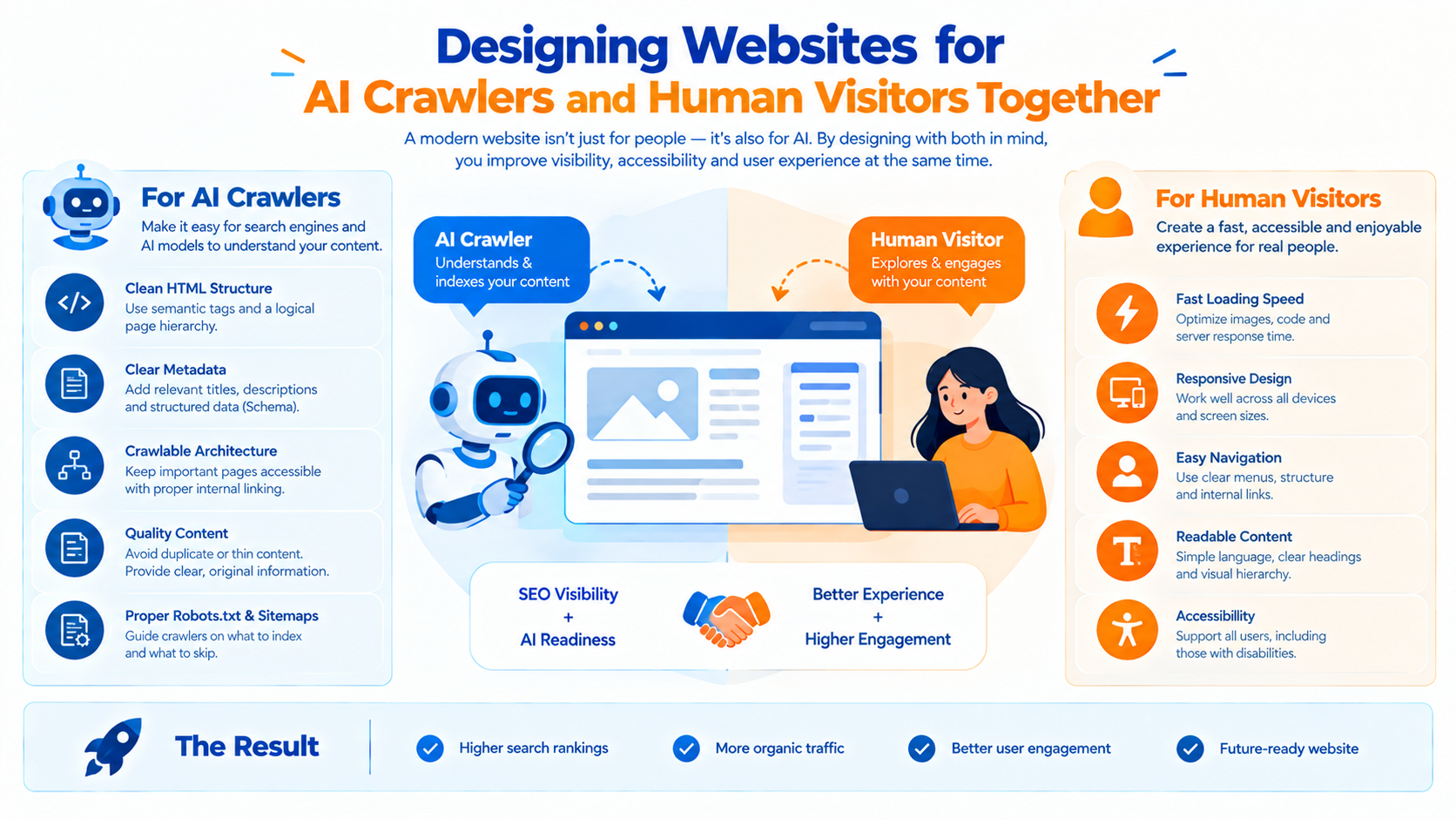
The audience for a website is no longer just people. It includes systems that read content and generate answers. Designing for only one audience means failing the other.
Who Is Reading Your Website Now
Three distinct audiences now consume web content, each with different needs.
| Audience | What They Do | What They Need |
|---|---|---|
| Human visitors | Read, navigate, convert | Clarity, structure, relevance, speed |
| Search engine crawlers | Index for ranking | Semantic HTML, metadata, links, performance signals |
| AI crawlers and assistants | Extract facts, ground responses | Structured content, explicit statements, clean markup |
The first two audiences have been served for decades. The third is new, and most sites are not designed for it.
How AI Crawlers Differ From Search Crawlers
Search crawlers index pages to rank them in results. AI crawlers extract content to generate or ground answers. The difference in purpose creates different requirements.
Search crawlers care about: Page authority, keyword relevance, link structure, freshness signals.
AI crawlers care about: Factual clarity, explicit statements, structured data, unambiguous meaning.
The practical consequence: A page optimized for search may not be optimized for AI extraction. A page with strong authority and good rankings may still be unusable as a source for AI-generated answers because its content is not structured or explicit.
What AI Crawlers Need
Semantic HTML
AI crawlers rely on HTML structure to understand what content is. Headings, paragraphs, lists, tables, and semantic elements tell the system what each piece of content represents.
What breaks it:
-
Content rendered only via JavaScript that does not execute for crawlers
-
Content placed in images without text alternatives
-
Layout achieved with divs that carry no semantic meaning
What works:
-
Semantic HTML that reflects content structure
-
Text content available in the initial HTML response
-
Headings used for hierarchy, not for styling
Explicit Statements
AI systems extract facts. Content that states facts clearly is more usable than content that implies them.
What breaks it:
-
Marketing language that avoids specific claims
-
Facts spread across multiple sentences
-
Answers that require inference
What works:
-
Direct statements of fact
-
Specific numbers, dates, and names
-
Explicit answers to common questions
Structured Data
Structured data makes explicit what HTML conveys implicitly. Schema markup, JSON-LD, and structured formats help AI systems understand entities and relationships.
What breaks it:
-
No structured data at all
-
Structured data that contradicts visible content
-
Structured data that is incomplete or malformed
What works:
-
Consistent structured data across the site
-
Schema types appropriate to the content
-
Alignment between structured data and visible content
Clean Markup
AI crawlers parse HTML. Messy markup produces messy extraction.
What breaks it:
-
Nested tables used for layout
-
Content hidden in collapsed accordions that crawlers do not expand
-
Excessive inline styling that obscures structure
What works:
-
Clean, well-structured HTML
-
Content available without interaction
-
Minimal markup between content and its structure
Where This Conflicts With Human Design
Designing for AI crawlers and human visitors can conflict.
| Human Need | AI Need | The Tension |
|---|---|---|
| Visual storytelling | Explicit text | Images and video are not extractable |
| Interactive exploration | Static content | Tabs and accordions hide content from crawlers |
| Persuasive language | Factual statements | Marketing language is harder to extract |
| Personalization | Consistent content | Dynamic content varies per visitor |
| Visual hierarchy | Semantic hierarchy | Visual prominence and semantic structure differ |
Most sites resolve these tensions in favor of humans which is reasonable, since humans are the ones who convert. But the cost is invisibility to AI systems.
Designing for Both
The goal is not to choose between audiences. It is to serve both.
Make Content Available Without Interaction
If content is hidden behind tabs, accordions, or "read more" links, ensure it is available in the HTML even if hidden visually.
The practice: Render all content in the HTML, use CSS to control visibility, and avoid JavaScript-only rendering for critical content.
State Facts Explicitly
Write the sentence you want an AI system to extract. Do not bury it in three paragraphs of context.
The practice: Include explicit answers to common questions. State prices, specifications, and capabilities directly.
Use Structure Consistently
Headings, lists, and tables help both humans and machines. Use them for their semantic meaning.
The practice: One H1 per page. Logical heading hierarchy. Lists for sequences and options. Tables for structured data.
Provide Structured Data
Schema markup is not optional for sites that want to be understood by AI systems.
The practice: Implement schema for products, articles, FAQs, organizations, and any other relevant type. Keep it consistent with visible content.
Keep Text in Text
Content in images is invisible to crawlers. If it matters, it should be text.
The practice: Use text for all content that should be extractable. Use images for decoration, not for information.
Avoid Purely Dynamic Content
Content that varies per visitor cannot be extracted consistently.
The practice: Serve the same core content to all visitors. Personalize presentation, not substance.
Maintain a Fast, Accessible Site
AI crawlers, like search crawlers, are affected by performance and accessibility.
The practice: Fast response times, accessible markup, and reliable availability all contribute to crawlability.
The Robots Question
Should you allow AI crawlers to access your site?
The arguments for allowing:
-
AI assistants can answer questions about your products
-
Your content can be cited and surfaced in AI responses
-
Visibility in AI systems is becoming a discovery channel
The arguments against:
-
Content may be used to train competing systems
-
Attribution may be lost
-
Traffic that once came to your site may bypass it
The practical middle: Control access by purpose. Allow extraction for assistants that cite sources. Block crawlers that train models without attribution. Use robots.txt, terms of service, and technical controls.
This is an evolving area. Organizations should make deliberate decisions rather than accepting defaults.
Implementation Roadmap
Phase 1: Assess (Weeks 1-2)
-
Check whether AI crawlers can read your site. Test with crawler simulators and check server logs for AI crawler user agents.
-
Identify content that is invisible. Images, JavaScript-rendered content, and hidden elements.
-
Review structured data. Is it present, complete, and consistent?
Phase 2: Improve (Weeks 3-6)
-
Make critical content available in HTML.
-
Add or improve structured data.
-
State facts explicitly in headings, summaries, and FAQ sections.
-
Fix semantic HTML issues.
-
Move content out of images.
Phase 3: Govern (Weeks 7-10)
-
Decide crawler policy deliberately. Which AI crawlers are allowed?
-
Monitor AI crawler access.
-
Test how AI systems describe your content.
-
Review periodically as the landscape evolves.
Frequently Asked Questions
Q1: Is designing for AI crawlers the same as SEO?
No. SEO optimizes for ranking in search results. AI optimization makes content extractable and unambiguous for systems that generate answers.
Q2: Will optimizing for AI crawlers hurt human experience?
Not if done correctly. Semantic HTML, explicit content, and structured data help humans too. The conflicts arise from visual and interactive design choices, which can be reconciled.
Q3: Should I block AI crawlers?
It depends on your strategy. Blocking prevents your content from being used in AI responses. Allowing increases visibility but may reduce direct traffic. Decide deliberately.
Q4: How do I know if AI crawlers can read my site?
Check server logs for AI crawler user agents. Test with tools that simulate crawler behavior. Verify that critical content appears in the raw HTML.
Q5: What structured data matters most?
Schema types that match your content: Product, Article, FAQ, Organization, LocalBusiness. Consistency between structured data and visible content is essential.
Q6: How can Innovative AI Solutions help?
We help organizations design websites that serve human visitors, search crawlers, and AI systems together from semantic HTML and structured data to crawler policy and monitoring. Explore our services to see how we approach web engineering. Based in Delhi, serving clients across India.
Why Delhi is a Great Hub for Web Engineering
Delhi is emerging as a hub for web and product engineering, backed by a thriving developer ecosystem and a large base of organizations building content-rich sites. As AI assistants become a primary discovery channel for Indian users, designing for both human and machine audiences becomes a competitive requirement.
What We Offer at Innovative AI Solutions
-
Crawlability Assessment: We test whether AI systems can read and extract your content.
-
Semantic HTML Remediation: We fix structural issues that block extraction.
-
Structured Data Implementation: We add and validate schema markup.
-
Content Restructuring: We make content explicit and extractable without compromising human experience.
-
Crawler Policy Design: We help you decide which AI crawlers to allow and how to enforce it.
Final Thought
The shift is clear: from designing for humans and search engines to designing for humans, search engines, and AI systems. These audiences have different needs, but the needs are not in fundamental conflict. Semantic structure, explicit content, and structured data serve all three. Organizations that design for all audiences will be visible everywhere their customers look. Those that design only for humans will be invisible to the systems increasingly answering their customers' questions.
Contact Us:
Phone: +91 7464 099 059 / +91 9689967356
Email: info@innovativeais.com
Address: 904, 9th floor Pearls Best Heights-I, Netaji Subhash Place, Delhi-110034
Website: https://innovativeais.com
About the Author
Abhishek Kumar
Founder & CEO, Innovative AI Solutions
5+ years building AI, cloud, and enterprise systems. Based in Delhi, serving clients across India.