The Big Question
What comes after digital transformation?
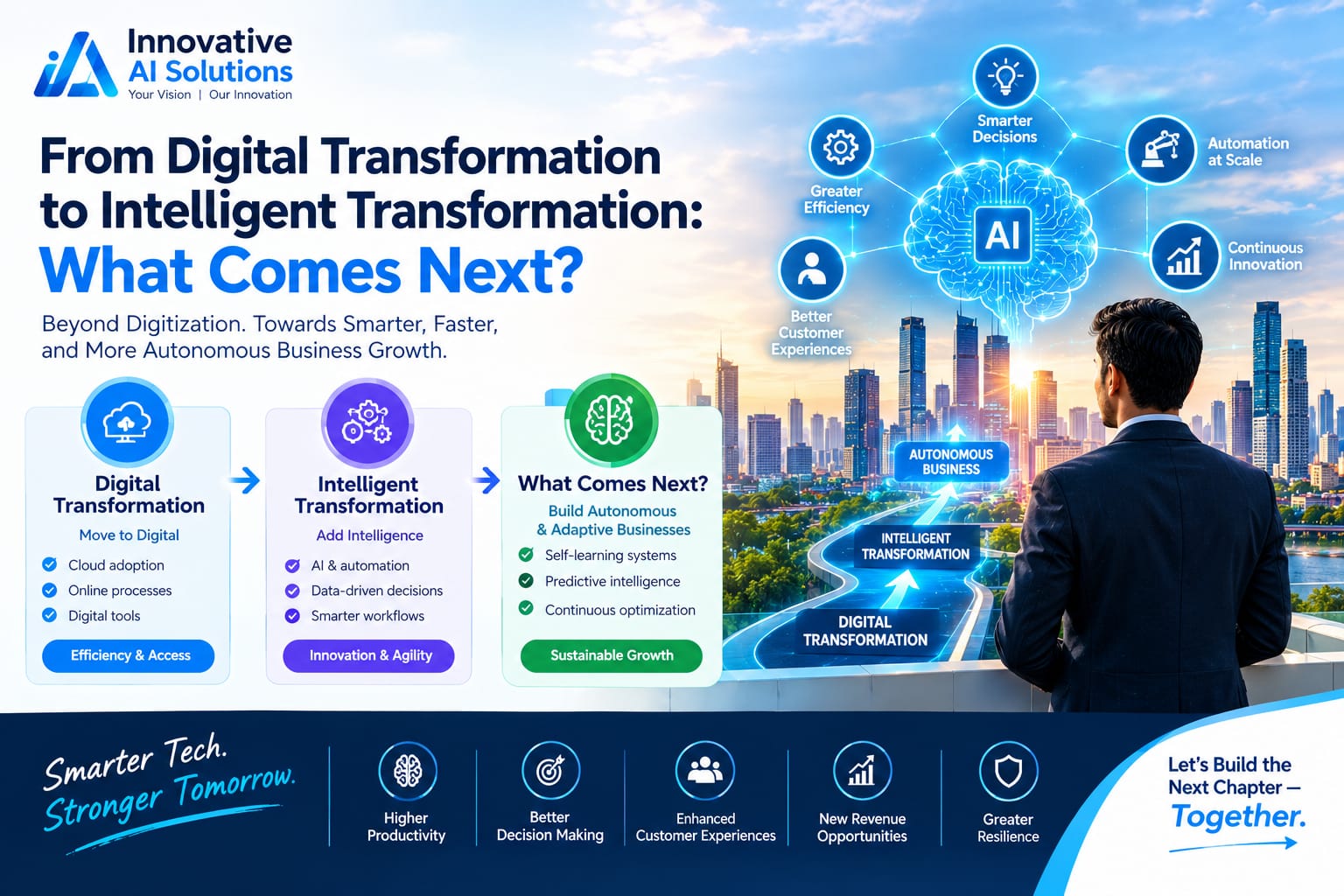
For the past decade, the answer to "how do we modernize?" was always the same: digital transformation. Move to the cloud. Replace legacy systems. Automate manual processes. Build new channels for customer engagement.
These investments delivered real value. Faster cycle times. Better visibility. Lower costs. But they also revealed a fundamental limitation: digitizing a flawed process doesn't fix the flaw it just makes inefficiency run faster .
The next phase isn't digital. It's intelligent.
Intelligent transformation is about evolving enterprises into systems services that can sense, reason, make decisions, and take action with minimal friction . The driving force is the emergence of AI agents autonomous software systems that don't just answer questions but plan steps, invoke tools, and complete end-to-end workflows .
This isn't a small shift. It changes what enterprises are, how they operate, and what "work" even means.
What Digital Transformation Delivered—and What It Missed
Digital transformation focused on efficiency. It asked: "How do we do this faster, cheaper, with fewer manual steps?"
The answers were cloud migration, process automation, modern applications, services,and improved customer interfaces . These delivered tangible benefits: accelerated cycle times, increased transparency, reduced costs .
But digital transformation had a blind spot. It improved how work was executed without fundamentally changing how decisions were made .
A digital dashboard showed you data. A digital workflow moved tasks between people. A digital system recorded transactions. But the intelligence the judgment, the prioritization, the decision-making remained human.
Boston Consulting Group's research found that only 5% of companies qualify as truly "future-built" organizations, with AI integrated across core functions. 60% are still experimenting or struggling to realize meaningful AI value .
The gap isn't technology. It's that most organizations took an "AI-on-top" approach layering tools onto existing systems without redesigning how work actually flows .
What Intelligent Transformation Actually Means
Intelligent transformation is not "digital transformation with AI added." It's a fundamentally different operating model.
Digital transformation created systems of record (ERP, CRM) and systems of insight (business intelligence, analytics). These systems told you what happened and what might happen .
Intelligent transformation adds a third layer: systems of action. These are agentic capabilities that execute tasks across functions not just recommending, but doing .
The difference is concrete. In the digital era, a customer service system logged tickets and surfaced them to agents. In the intelligent era, an AI agent resolves the ticket end-to-end—accessing data, taking action, and escalating only exceptions to humans .
The model shifts from people using software to people supervising agents .
BCG's framework describes the endpoint: an "AI-first organization" where AI handles most process work, while humans focus on designing, maintaining, and overseeing the systems .
Why This Shift Is Happening Now
Three forces are converging.
First, agentic AI is maturing. Large language models can now reason, plan, and use tools. Frameworks for orchestration have emerged. Multi-agent systems are moving from research to production .
Second, the data foundation is finally ready. In India, data readiness for AI jumped from 42% to 63% in a single year—the highest year-on-year growth globally. 63% of organizations are now data-ready for AI .
Third, the investment is flowing. Indian enterprises plan to invest US$25.9 million in AI, growing 45% over two years. 67% are piloting agentic AI use cases. 85% believe it has moderate-to-very-high potential .
The gap between experimentation and execution is closing. But the hard part redesigning work, building governance, transforming the workforce is just beginning.
What Comes Next: The Five Stages
The Conference Board's research offers a practical framework for the shift .
Stage 1: Start with the desired business outcome. Not "where can we use AI?" but "what outcome do we need to improve?" Deploying agents because the technology exists is a recipe for wasted investment .
Stage 2: Redesign and allocate work before deploying agents. Break workflows into tasks. Decide what AI handles, what humans handle, and where they collaborate. Consider quality, judgment, accountability, and consequences of errors. People remain accountable for results, even when agents act autonomously .
Stage 3: Build the infrastructure, governance, and budget agents require. The full cost of operating an agent extends far beyond model fees. In one illustrative model, direct AI-model use represented just 9.4% of an agent's recurring monthly cost . Permissions, monitoring, maintenance, and human supervision make up the rest.
Stage 4: Measure what people and agents produce together. Track whether redesigned work improves quality, speed, cost, or outcomes—not just whether an agent completed a task. Time freed by AI isn't automatically a gain; the organization must demonstrate how that time was used .
Stage 5: Decide where the gains go. Verified gains can reduce costs, enable growth without equivalent hiring, or support reinvestment. Leaders must communicate how gains affect jobs and staffing .
The New Enterprise Stack
Intelligent transformation requires a new technology architecture. CIO.com describes a pragmatic stack emerging :
Experience layer: Copilots and role-based agent interfaces within work tools.
Reasoning and orchestration: Policies, routing, human-in-the-loop approvals, and monitoring.
Knowledge layer: Retrieval from curated internal content with permissions and provenance.
Tool layer: APIs, RPA, workflow engines, and systems of record enabling agent actions.
Governance and risk: Evaluation, security, compliance, and auditability by design.
This stack is fundamentally different from the digital era. In the digital stack, applications were central. In the intelligent stack, agents are the connective tissue orchestrating across systems, data, and decisions .
Salesforce's Dreamforce 2026 announcements reflect this. AIforce isn't an app you open; it's a layer that brings Salesforce data, workflows, and permissions into wherever people work laude, Slack, or an AI coworker within Salesforce itself .
The interface becomes simpler. The architecture behind it becomes more complex.
What This Means for Indian Businesses
India is uniquely positioned and uniquely challenged.
The strengths: 55% of Indian organizations have dedicated AI leaders, the highest globally. 71% have AI strategies aligned with business goals. 74% are satisfied with current AI ROI .
The gaps: Only 22% have processes for testing, auditing, and assessing AI-related risks. 54% are deploying AI agents, but just 11% have moved to autonomous workflows. 74% struggle with incomplete data; 67% with low-quality data .
The workforce tension: 80% believe maximizing AI value requires workforce transformation beyond upskilling. Yet nearly 8 in 10 are not convinced their training can keep pace with AI advancements .
The message is clear: India has the ambition and the investment. The next leap depends on governance, data quality, and workforce readiness .
The Uncomfortable Truth
Intelligent transformation amplifies both productivity and risk .
Agents can deliver substantial gains. They can also introduce new vulnerabilities: prompt injection, data leakage, unsafe actions, and excessive reliance on generated outputs .
The organizations that succeed will treat agents like other critical systems establishing guardrails, enforcing least-privilege access, mandating approvals for sensitive actions, and maintaining traceability of data and actions .
This is not a technology problem. It's an operating model problem.
BCG's research on AI transformation found a 10/20/70 rule: 10% of effort goes to algorithms, 20% to technology and data, and 70% to people, organization, and processes . Most organizations get this backwards. They focus on models and tools, then wonder why adoption stalls.
The future belongs to enterprises that embed AI into operations, not just experiments . Sustainable value comes from integrating AI into the way work is designed and delivered .
Frequently Asked Questions
Q1: What is intelligent transformation?
Intelligent transformation is the evolution of enterprises into systems that can sense, reason, make decisions, and take action with minimal friction. It goes beyond digital transformation's focus on efficiency to reshape how decisions are made and how value flows through the organization .
Q2: How is intelligent transformation different from digital transformation?
Digital transformation digitizes processes and improves efficiency. Intelligent transformation redesigns processes around AI agents that can plan, execute, and adapt. Digital transformation created systems of record and insight. Intelligent transformation adds systems of action .
Q3: What are AI agents?
AI agents are autonomous software systems capable of achieving goals by orchestrating workflows and leveraging tools such as APIs, applications, and databases. They don't just answer questions; they plan steps, invoke tools, and complete end-to-end workflows .
Q4: Why is intelligent transformation happening now?
Three forces: agentic AI is maturing, data readiness has improved dramatically (India jumped from 42% to 63% in one year), and investment is accelerating (Indian enterprises plan $25.9M in AI investment, growing 45% over two years) .
Q5: What's the biggest barrier to intelligent transformation?
People, organization, and process—not technology. BCG's research shows 70% of transformation effort should go to these areas. Only 22% of Indian enterprises have AI risk assessment processes. 80% say workforce transformation beyond upskilling is required .
Q6: What is the new enterprise stack for intelligent transformation?
Five layers: experience (copilots, agent interfaces), reasoning and orchestration (policies, human-in-the-loop), knowledge (retrieval with permissions), tools (APIs, workflow engines), and governance (evaluation, security, auditability) .
Q7: How do you measure ROI in intelligent transformation?
Track outcomes, not activity. Did quality improve? Did speed increase? Did cost decrease? Time freed by AI isn't automatically a gain—demonstrate how it was used. Distinguish cash savings, avoided future costs, and higher-value work .
Q8: What is the 10/20/70 rule?
BCG's framework for AI transformation: 10% of effort on algorithms, 20% on technology and data, and 70% on people, organization, and processes. Most organizations invert this and struggle with adoption .
Q9: Where do gains from intelligent transformation go?
Verified gains can reduce costs, enable growth without equivalent hiring, support reinvestment, or deliver benefits to employees and customers. Leaders must communicate how gains affect jobs and staffing .
Q10: How do you protect early-career talent?
When AI takes over routine work, organizations risk eliminating tasks through which employees build judgment. Replace that learning deliberately through mentoring, rotations, supervised practice, and progressively complex work .
Frequently Asked Questions (Continued)
Q11: What is the difference between AI agents and chatbots?
Chatbots answer questions. AI agents execute workflows. They plan multi-step tasks, use tools, access databases, and complete actions end-to-end. Mahindra Finance's Samur.AI verifies documents, flags exceptions, and provides rationale for human review .
Q12: What's the role of governance in intelligent transformation?
Governance is the foundation that allows scale. Responsible AI where decisions are explainable and auditable isn't a hurdle; it's what enables an enterprise to trust agents with consequential work .
Q13: How is India positioned for intelligent transformation?
India ranks second globally in strategic AI investment. 55% have dedicated AI leaders (highest globally). 67% are piloting agentic AI. But only 22% have AI risk processes, and 80% say workforce transformation is needed .
Q14: What happens to middle managers in intelligent transformation?
They shift from information routers to judgment brokers. AI handles coordination. Humans handle exceptions, judgment, and oversight. The role becomes more complex and strategically important, not less .
Q15: What's the first step for my business?
Start with a desired business outcome, not a technology. Redesign the workflow before deploying agents. Decide what AI handles, what humans handle, and where they collaborate. Measure outcomes, not activity .
Contact Us
Phone:
+91 7464 099 059
+91 9689967356
Email:
info@innovativeais.com
Address:
9th Floor, Pearls Best Heights-I,
Head Office: 904, Netaji Subhash Place,
Delhi – 110034