The Big Question
Every application starts simple. A single server, a single database, a single deployment. It works. Then traffic grows. Then you add a second server. Then a third. Then you realize you have a fleet of servers that nobody fully understands, each configured slightly differently, each a potential point of failure.
This is the problem Kubernetes was built to solve.
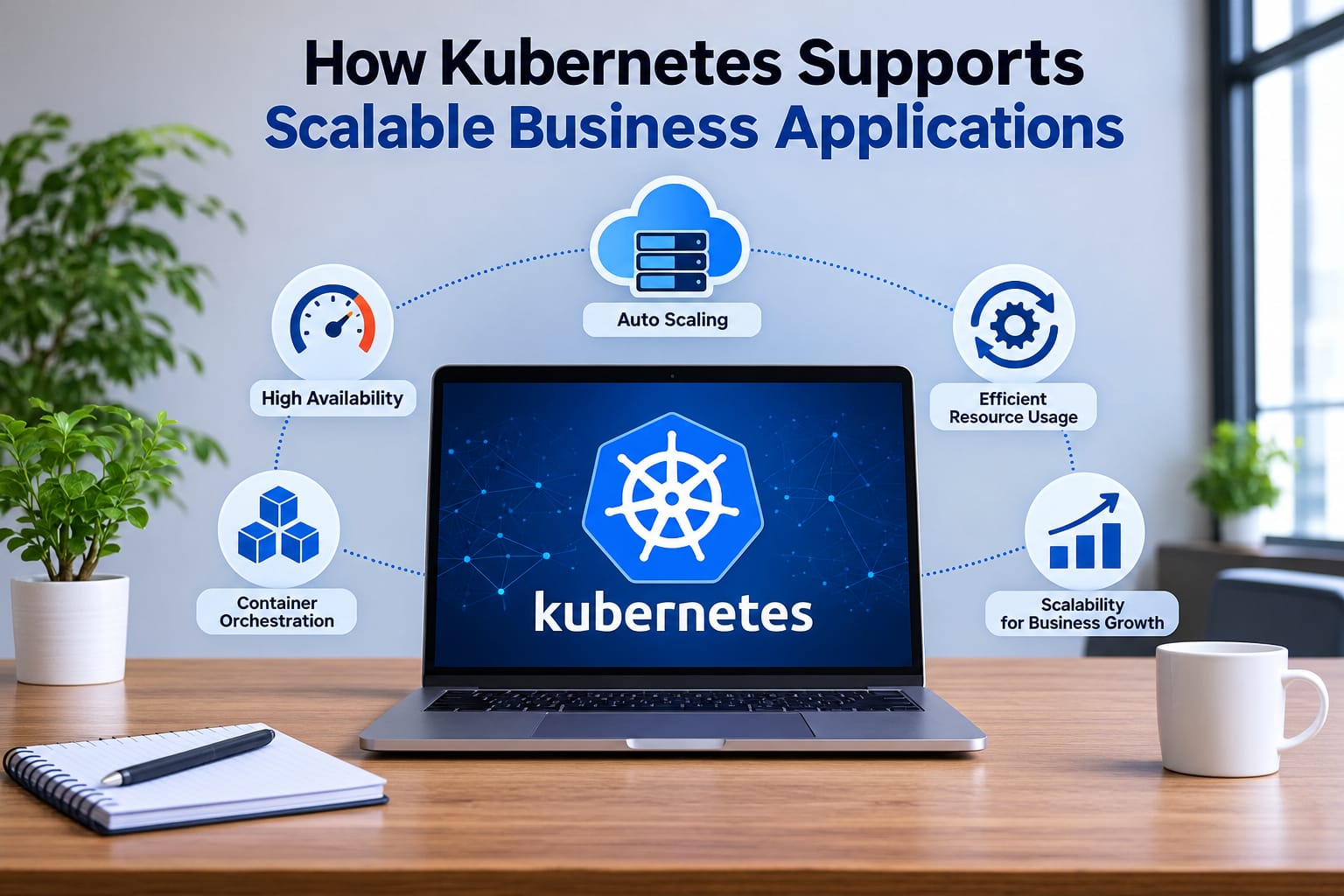
Kubernetes is an open-source platform for automating the deployment, scaling, and management of containerized applications . Instead of manually configuring servers, you describe the desired state of your application how many replicas, how much CPU and memory each needs, how they communicate and Kubernetes works continuously to make reality match that description .
The core capabilities that matter for scalability are built in:
Service discovery and load balancing. Kubernetes gives Pods their own IP addresses and a single DNS name for a set of Pods, and can load-balance across them. No need to modify your application to use an unfamiliar service discovery mechanism .
Horizontal scaling. Scale your application up and down with a simple command, with a UI, or automatically based on CPU usage .
Self-healing. Kubernetes restarts containers that crash, replaces entire Pods where needed, reattaches storage in response to wider failures, and can integrate with node autoscalers to self-heal even at the node level .
Automated rollouts and rollbacks. Kubernetes progressively rolls out changes to your application, monitoring application health to ensure it doesn't kill all your instances at the same time. If something goes wrong, it rolls back for you .
The business impact is measurable. Prowise, a Netherlands-based education technology company, moved from virtual machines to Kubernetes and saw deployment time drop from half an hour of preparations and half an hour deploying to a couple of seconds. They went from quarterly releases to monthly releases, then to deploying every hour .
AppDirect, a cloud commerce platform, reduced time to deploy a new version from 4 hours to a few minutes. Today, they see 1,600 deployments per week, compared to 1-30 before .
Cost Based on Application Type
Kubernetes costs depend on your cluster architecture, region, and how well you optimize resource usage. Here's the 2026 Indian market landscape:
| Application Type | Monthly Cost (India) | What It Covers |
|---|---|---|
| Startup / MVP | ₹25,000 – ₹75,000 | Single EKS cluster, 2-3 nodes, basic monitoring |
| Growth-Stage SaaS | ₹1,50,000 – ₹4,00,000 | Multi-environment (prod/staging/dev), autoscaling, load balancers |
| Enterprise / Multi-Region | ₹5,00,000 – ₹15,00,000+ | Multi-cluster, service mesh, 24/7 SRE, compliance |
The Mumbai region premium: AWS costs in Asia Pacific (Mumbai) run approximately 5.21% higher than US East (N. Virginia) for compute, and 8.70% higher for S3 Standard storage. But data transfer out runs 21.4% higher at the first 10 TB per month, and 60% higher above 150 TB which is where the real cost difference sits .
The EKS control plane fee: $0.10 per cluster per hour, or approximately ₹6,060 per month per cluster in Mumbai. This is region-flat, exactly the same in Mumbai as in N. Virginia .
The hidden waste problem: EKS bills for Indian Series A-C SaaS companies hide 40-55% waste underneath clean-looking Cost Explorer line items. Cost Explorer groups EKS node costs under "EC2 - Other" or a flat instance line. A pod running idle at 2% CPU on an m6i.2xlarge looks identical to a fully-packed node on the bill. Without a Kubecost or OpenCost layer, nobody sees which workload is wasting what .
Breakdown by Cost Optimization Lever
Kubernetes costs are not fixed. They are a function of how well you optimize. Here are the levers that matter most:
| Optimization Lever | Typical Savings | What It Involves |
|---|---|---|
| Karpenter vs Cluster Autoscaler | 15-25% on node costs | Better bin-packing, aggressive consolidation, cheapest compatible instance selection |
| Spot instance adoption | 18-30% on affected compute | Stateless workloads at 70-90% Spot; instance family diversity to reduce interruptions |
| Pod requests right-sizing | 20-40% | Setting requests based on actual P95 usage instead of Stack Overflow defaults |
| Cluster consolidation | ₹36,000-54,000/month | Reducing from 7-12 clusters to 3 (prod/staging/dev) saves control-plane fees alone |
| Load balancer consolidation | Variable | Single ALB with path-based routing instead of per-Ingress ALBs at ₹1,840/month each |
The Karpenter math in INR: For a 60-pod workload on m6i.2xlarge with Cluster Autoscaler and On-Demand pricing, monthly cost runs approximately ₹4.8 lakh at ~55% bin-pack efficiency. The same workload on Karpenter with mixed m/c/r instance families and On-Demand pricing runs ₹3.6 lakh a 25% reduction .
Breakdown by Developer Type (2020-2026)
Kubernetes expertise is in high demand in India, and the talent market reflects it:
| Role | India Hourly Rate | What They Deliver |
|---|---|---|
| Kubernetes Developer (Freelance) | $16 – $25/hr | Basic deployments, Helm charts, CI/CD integration |
| Senior DevOps / SRE | $35 – $65/hr | Multi-cluster management, Karpenter, service mesh |
| Platform Engineer | $50 – $90/hr | Internal developer platforms, governance, FinOps |
| Kubernetes Architect | $70 – $110/hr | Enterprise architecture, multi-region, compliance |
India's structural advantage: Senior cloud engineers with Kubernetes expertise bill at 60-80% less than US rates. India's cloud native community is one of the largest in the world, with 2.25 million developers approximately 11% of the global total .
The platform engineering shift: Among Indian backend developers, Kubernetes usage reached 42%, surpassing reported container adoption at 39% the opposite of the global pattern. This reflects the widespread use of managed Kubernetes services, where developers work at the orchestration layer while the underlying container infrastructure is handled by the platform .
Why Prices Changed in 2026
Three forces have reshaped Kubernetes economics.
First, the EKS calendar became a finance problem. Kubernetes clusters left on old versions incur extended support charges. A single cluster on version 1.33 costs an extra $0.50 per hour $360 per month, or $4,380 per year. That is trivial for one cluster and material across a fleet of twenty environments where the non-production clusters are the ones nobody upgrades .
The EKS upgrade policy is EXTENDED by default, and billing starts at the beginning of the day standard support ends, in UTC. AWS states you cannot disable extended support once a cluster has entered it. Disabling it beforehand means the cluster is automatically upgraded to the next Kubernetes version at end of standard support. Choose the forced upgrade or the fee, in advance .
Second, Karpenter changed the cost optimization calculus. Karpenter bin-packs better, consolidates nodes aggressively, and picks the cheapest compatible instance family. A well-tuned Karpenter typically cuts node costs 15-25% versus Cluster Autoscaler on the same workload .
Third, platform engineering emerged as the operating model. The pattern across successful Kubernetes adoptions is consistent: small teams own critical parts of the business domain, operate in decoupled domains of expertise, and take responsibility for deployment, monitoring, and on-call support. As AppDirect's team put it after their Kubernetes journey: "We asked engineers to expand their horizons. We moved from a culture limited to 'pushing code in a branch' to exciting new responsibilities outside of the code base" .
Pro Tips to Save Money in 2026
1. Consolidate clusters ruthlessly. We routinely see Series B startups with 7-12 clusters (per-env + per-team + per-region) when 3 would do. Consolidating to prod/staging/dev saves ₹36,000-54,000/month on control-plane alone .
2. Adopt Karpenter over Cluster Autoscaler. Karpenter bin-packs better, consolidates nodes aggressively, and picks the cheapest compatible instance family. The 15-25% node cost reduction is real and immediate .
3. Right-size pod requests. Most Indian SaaS stacks have requests set 3-5x higher than P95 usage because the default was copied from a Stack Overflow answer in 2021. VPA recommendations (off-policy) flag the gap. This is the single biggest win .
4. Use Spot for stateless workloads. Stateless workloads should be 70-90% Spot. Most Series A stacks we audit are at 0-30%. Gap = 18-30% savings on affected compute .
5. Diversify instance families for Spot. A Karpenter NodePool with only m6i is brittle on Spot. Add c6i, r6i, m5, c5, r5 to the diversification set; Spot interruption drops from 8% to under 3% .
6. Clean up idle namespaces. A dev-feature-123 namespace that a dev stood up six months ago, with a ₹40,000/month footprint. Quota + TTL + weekly sweep .
7. Consolidate load balancers. Every Ingress creating its own ALB. Consolidate to a single ALB with path-based routing. ALB in Mumbai costs ₹1,840/month per LB plus LCU charges .
Questions to Ask Before Hiring
Before you commit budget to any Kubernetes engagement, ask these questions.
1. "What's your Karpenter vs Cluster Autoscaler strategy?" Karpenter typically cuts node costs 15-25% versus Cluster Autoscaler. If they're still using Cluster Autoscaler, ask why .
2. "How do you handle cluster version drift?" A cluster left on extended support costs $360/month. Across twenty environments, that is $86,400/year in avoidable charges. The right answer involves scheduled upgrades, not reactive ones .
3. "What's your pod requests right-sizing process?" Most stacks have requests set 3-5x higher than actual usage. The right answer involves VPA recommendations and continuous tuning .
4. "How do you handle multi-cluster management?" Multi-cluster introduces complexity in networking, observability, and policy. The right answer involves a clear strategy for when to use one cluster versus many .
5. "Show me a production Kubernetes deployment you built that includes cost optimization." Portfolios show architecture diagrams. Production systems expose real bin-packing efficiency, real Spot adoption, and real cost per workload .
Why Delhi is a Great Hub for Kubernetes Development
Delhi-NCR has become a serious destination for Kubernetes work, and the reason isn't just cost.
The region hosts a dense cluster of Global Capability Centers (GCCs) running cloud-native platforms on AWS, Azure, and GCP. These organizations operate at scale multi-account landing zones, managed EKS clusters, and fully automated CI/CD pipelines are table stakes. Kubernetes is not an optional feature; it is the foundation.
India's cloud native community is one of the largest and fastest-growing in the world. The CNCF and SlashData report estimates 2.25 million cloud native developers in India as of Q1 2026, with hybrid cloud adoption at 44% the most popular deployment model among Indian developers .
The talent density keeps improving. With a steady pipeline of Kubernetes engineers, platform specialists, and SREs, Delhi offers a combination of cost and capability that's hard to match. And the time zone advantage matters: a Delhi-based team can sync with Middle East morning, European afternoon, and US East Coast evening.
What We Offer
At Innovative AI Solutions, we treat Kubernetes as an engineering discipline, not a tool deployment.
Our approach:
-
Cost Audit First. We map your cluster architecture, pod requests, Spot adoption, and load balancer sprawl. You cannot optimize what you haven't measured.
-
Karpenter Migration. We replace Cluster Autoscaler with Karpenter, targeting 15-25% node cost reduction through better bin-packing and aggressive consolidation .
-
Right-Sizing with VPA. We set pod requests based on actual P95 usage, not Stack Overflow defaults. This is the single biggest cost win.
-
Spot Strategy. We design NodePools with instance family diversity to reduce Spot interruption below 3% while capturing 70-90% Spot coverage for stateless workloads .
-
Cluster Consolidation. We help you reduce cluster sprawl from 7-12 clusters to the 3 you actually need saving ₹36,000-54,000/month on control-plane fees alone .
-
Retained Operations. Monitoring, version upgrades, and cost tuning. Your Kubernetes doesn't rot because someone forgot the upgrade calendar.
Our principle is simple: small steps, fast iteration, data speaks.
Frequently Asked Questions
Q: What is Kubernetes in simple terms?
Kubernetes is an open-source platform for automating the deployment, scaling, and management of containerized applications. Instead of manually configuring servers, you describe the desired state of your application how many replicas, how much CPU and memory and Kubernetes works continuously to make reality match that description .
Q: How much does Kubernetes cost in India?
For a startup with a single EKS cluster and 2-3 nodes: ₹25,000-₹75,000/month. For growth-stage SaaS with multi-environment setup: ₹1,50,000-₹4,00,000/month. For enterprise multi-region: ₹5,00,000-₹15,00,000+/month. The Mumbai region runs 5.21% higher for compute and 8.70% higher for S3 storage than US East .
Q: What's the biggest Kubernetes cost mistake?
Not optimizing pod requests. Most Indian SaaS stacks have requests set 3-5x higher than P95 usage because the default was copied from a Stack Overflow answer years ago. Right-sizing alone can cut costs 20-40% .
Q: Should I use Karpenter or Cluster Autoscaler?
Karpenter. It bin-packs better, consolidates nodes aggressively, and picks the cheapest compatible instance family. A well-tuned Karpenter typically cuts node costs 15-25% versus Cluster Autoscaler on the same workload .
Q: What happens if I don't upgrade my Kubernetes version?
A cluster on extended support costs an extra $0.50/hour $360/month, or $4,380/year**. Across twenty environments, that is **$86,400/year in avoidable charges. The EKS upgrade policy is EXTENDED by default, and you cannot disable it once entered .
Frequently Asked Questions (Extended)
Q: How many clusters should I run?
We routinely see Series B startups with 7-12 clusters (per-env + per-team + per-region) when 3 would do (prod/staging/dev). Consolidating saves ₹36,000-54,000/month on control-plane fees alone .
Q: What is the biggest hidden cost in EKS?
EKS bills for Indian Series A-C SaaS companies hide 40-55% waste underneath clean-looking Cost Explorer line items. Cost Explorer groups EKS node costs under "EC2 - Other" or a flat instance line. It doesn't know which namespace, team, or service used the capacity .
Q: How does Kubernetes help with scalability?
Kubernetes provides horizontal scaling (adding more Pods), self-healing (restarting failed containers, replacing Pods), service discovery and load balancing, and automated rollouts and rollbacks. These capabilities are built in, not bolted on .
Q: What's the first step I should take tomorrow?
Run a cost audit. Check three things: How many clusters are you running? What's your Spot adoption percentage? What's your pod requests vs actual usage ratio? If you have more than 3 clusters, low Spot adoption, or requests 3x above usage, you're leaving money on the table. Fix those three things first. Not with a strategy document about Kubernetes optimization.
Contact Us:
Phone: +91 7464 099 059 / +91 9689967356
Email: info@innovativeais.com
Address: 9th Floor, Pearls Best Heights-I, Head Office: 904, Netaji Subhash Place, Delhi, 110034
904, Netaji Subhash Place, Delhi, 110034