he Big Question
AWS bills are not like other bills. They don't scale linearly with what you build. They scale with what you forget to turn off.
A 2026 FinOps Foundation survey found that 98% of practitioners now manage AI-related spend, up from just 31% two years ago . But the same report contained a quieter, more important finding: the easy wins are gone. Most teams have already cleaned up the obvious waste. What remains are smaller, harder-to-capture savings that require continuous ownership, not a one-time cleanup .
So where does the remaining waste hide?
In untagged resources. You can't optimize what you can't see. If 40% of your EC2 instances have no Project or Environment tag, you have no idea which team owns them, which workload they serve, or whether they can be shut down. The first step of cost reduction isn't saving money. It's gaining visibility.
In purchase model mismatches. Running steady-state workloads on On-Demand pricing is the single most common expensive mistake in AWS. A database that runs 24/7 for three years pays the full hourly rate every hour unless someone commits to a Savings Plan or Reserved Instance .
In workloads that were never rightsized. AWS Compute Optimizer analyzes 14 days of utilization data and regularly identifies instances running at 10-15% CPU. These aren't underperforming because they're broken. They're overprovisioned because someone sized them for a launch spike two years ago and never revisited the decision .
The core principle of performance-preserving cost reduction is simple: don't cut capacity. Cut waste. Eliminate idle resources, fix the pricing model, and make sure the resources you keep are matched to actual demand not imagined demand.
Cost Based on Cloud Workload Type
The cost of reducing AWS costs depends on what kind of environment you're optimizing. Here's what the 2026 market looks like for cost optimization engagements:
| Workload Type | Monthly Savings Potential | Typical One-Time Optimization Cost | Ongoing Cost |
|---|---|---|---|
| Startup / MVP | $500 – $3,000/mo | $1,500 – $4,000 | 10-20% of savings |
| Mid-size SaaS | $3,000 – $15,000/mo | $4,000 – $12,000 | 10-15% of savings |
| Enterprise / Multi-account | $15,000 – $100,000+/mo | $12,000 – $50,000+ | 5-10% of savings |
| AI/ML-heavy workloads | $5,000 – $50,000+/mo | $8,000 – $30,000 | 15-20% of savings |
A few key points:
The ROI is usually immediate. A basic rightsizing and purchase model review typically pays for itself within the first billing cycle. If a consultant can't demonstrate that the savings in month one exceed their fee, the engagement isn't worth it.
AI workloads are the new wild west. 98% of FinOps teams now manage AI spend, but pricing models for AI are far less transparent than traditional infrastructure . Token consumption, GPU utilization, and training costs can spike unpredictably. If your AWS bill includes SageMaker or Bedrock, you need visibility into those costs specifically, not just your EC2 and RDS line items.
Ongoing cost is not optional. The biggest mistake companies make is treating cost optimization as a one-time project. Purchase commitments expire. Workloads change. New services get spun up without tags. Without continuous ownership, savings decay within 90 days .
Breakdown by Optimization Lever (2020-2026 Rates)
The cost of implementing each optimization lever varies by who does the work and how much automation you use. Here's the 2026 talent and tooling landscape:
| Optimization Lever | DIY Cost | Agency Cost | Time to Implement | Typical Savings |
|---|---|---|---|---|
| Rightsizing (Compute Optimizer) | Free (tool) | $2,000 – $5,000 | 1-2 weeks | 15-25% |
| Savings Plans / RI coverage | Free (analyst time) | $3,000 – $8,000 | 1 week | 30-50% |
| Scheduling (stop/start non-prod) | Free (Quick Setup) | $1,500 – $3,000 | 2-3 days | 50-70% on non-prod |
| Graviton migration | $5,000 – $15,000 | $10,000 – $30,000 | 2-6 weeks | 19-45% on compute |
| Storage lifecycle policies | Free (config) | $1,500 – $4,000 | 2-3 days | 20-40% on S3/EBS |
| Tagging & governance | $2,000 – $6,000 | $5,000 – $15,000 | 2-4 weeks | Enables all other savings |
The India advantage is structural here too. A senior cloud engineer in Delhi costs 60-70% less than their US counterpart, and the FinOps discipline is maturing rapidly across Indian SaaS and enterprise companies. A dedicated cost optimization engagement from a Delhi-based team typically runs $40-$80 per hour, compared to $150-$300 in the US.
But for AWS cost work specifically, tool fluency matters more than hourly rate. A team that knows Compute Optimizer, Cost Explorer, and the AWS pricing models deeply will finish in days what takes a generalist weeks.
Why Prices Changed in 2026
Three shifts have reshaped AWS cost optimization economics:
First, AI-powered cost analysis became free. In June 2026, AWS launched "Analyze with Amazon Q" in Cost Explorer. You can now click a button on any cost report and get an instant explanation of cost drivers, anomalies, and optimization opportunities powered by Amazon Q Developer, at no additional cost . This doesn't replace a FinOps engineer, but it dramatically reduces the time required to find the savings. The bottleneck has shifted from analysis to execution.
Second, commitment models got more flexible but more complex. Savings Plans, Reserved Instances, and Spot all offer significant discounts up to 72%, 72%, and 90% respectively . But the decision of which to use, for how much, and for how long requires more sophistication than ever. Over-committing creates financial risk. Under-committing leaves money on the table. The winning teams layer all three: Savings Plan for the baseline, RIs for stable resources, Spot for interruptible workloads .
Third, Graviton migration crossed the adoption threshold. Graviton-based instances now deliver ~19% cheaper per vCPU on on-demand pricing across compute, general-purpose, and memory-optimized families . ARM nodes grew 3.5x faster than x86 between Q2 2024 and Q4 2025. This is no longer an experimental optimization. It's a mainstream cost lever but it requires multi-arch container images and compatibility checks before you flip the switch .
The result: the tools to find savings are cheaper and more powerful than ever. The execution still requires human judgment.
Pro Tips to Save Money in 2026
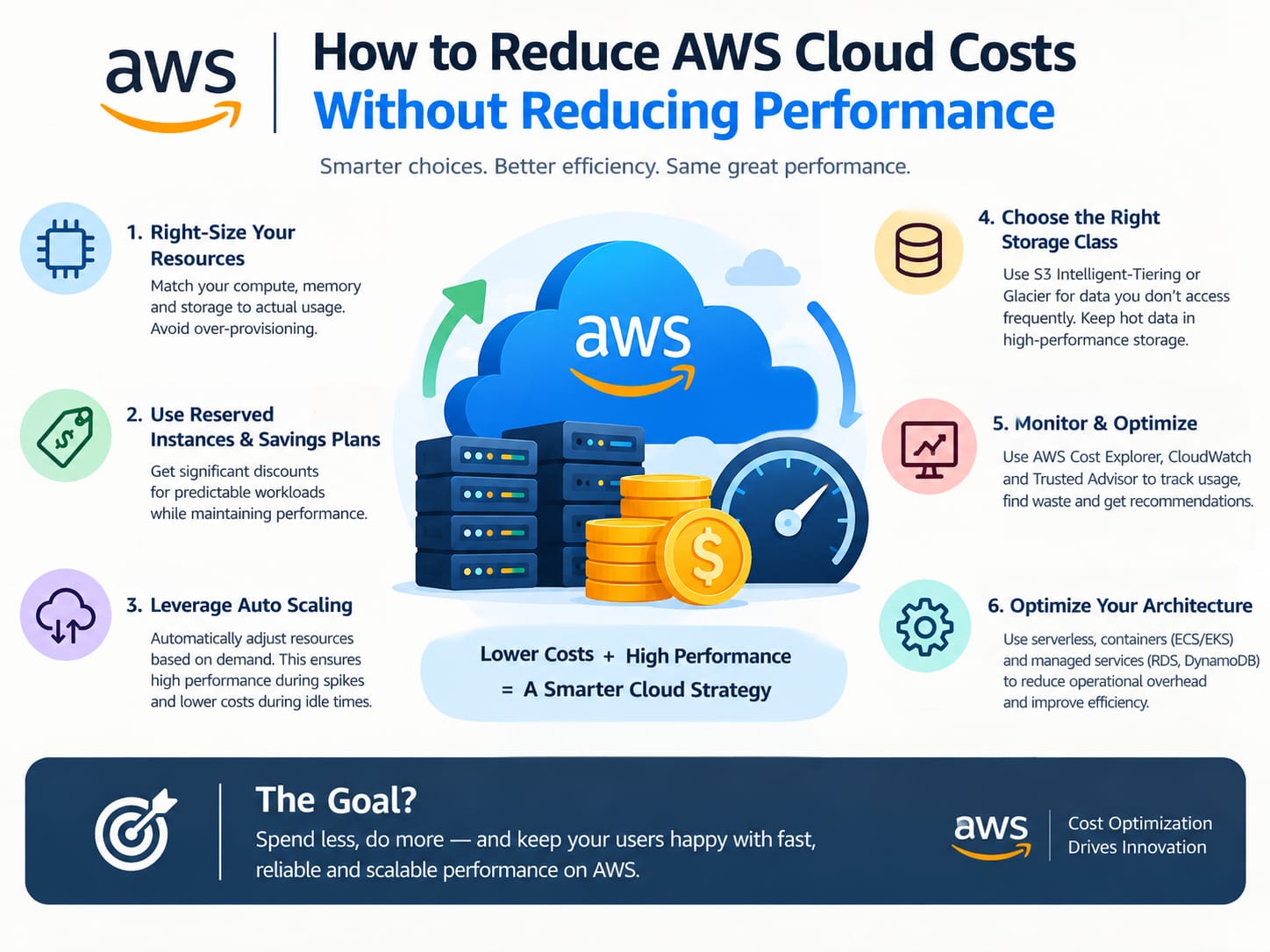
1. Turn on Compute Optimizer before you do anything else. It's free, it analyzes 14 days of utilization data, and it regularly identifies instances running at 10-15% CPU. AWS claims up to 25% cost reduction from rightsizing alone . You can't argue with free.
2. Cover 70-80% of your baseline with a Savings Plan. The FinOps community rule of thumb is to cover 70-80% of steady-state compute with a Compute Savings Plan and leave the rest flexible . This captures the majority of the discount without over-committing. Start with 30% if you're nervous even partial coverage produces real savings in the first billing cycle .
3. Schedule non-production instances to stop overnight. AWS Systems Manager Quick Setup can automatically stop and start tagged EC2 instances on a schedule. Running instances 10 hours a day, 5 days a week instead of 24/7 saves 70% on those instances . There is no cost to use Quick Setup. This is the highest-ROI, lowest-effort optimization available.
4. Tag everything. Then enforce it. You cannot optimize what you cannot attribute. Build a tagging standard (Project, Environment, owner) and enforce it with Service Control Policies. Untagged resources should be treated as unaudited spend. This costs almost nothing to implement and enables every other optimization .
5. Migrate interruptible workloads to Spot. Batch jobs, CI/CD runners, ML training, and stateless web tiers can run on Spot at up to 90% off On-Demand . The two-minute interruption warning is manageable with checkpointing and auto-scaling. The key rule: diversify across multiple instance families and Availability Zones so a single pool reclaim doesn't take you down .
Questions to Ask Before Hiring
Before you hand your AWS cost optimization project to anyone, ask these questions.
1. "What's our current Savings Plan coverage percentage?" This is the single most important number in AWS cost management. If they can't answer it in the first meeting, they haven't looked at your account. Coverage below 60% is an immediate opportunity .
2. "How will you ensure savings don't degrade after the engagement ends?" Cost optimization is not a one-time project. Ask for a 90-day sustainment plan with specific metrics and ownership. If they don't have one, your savings will evaporate .
3. "Show me a Graviton migration you've done." Graviton offers real savings, but migration has real blockers DaemonSets without ARM64 images, native dependencies, and performance-sensitive workloads that need testing. A team that hasn't done it before will learn on your dime.
4. "How do you handle AI/ML cost visibility?" If your bill includes SageMaker, Bedrock, or GPU instances, the optimization approach is different. Token consumption, training runs, and inference endpoints have their own cost drivers. A team that only knows EC2 and RDS will miss the fastest-growing line item on your bill .
5. "What's NOT included in this engagement?" An honest partner lists exclusions immediately. Architecture redesigns, application refactoring, and multi-account restructuring are separate projects. If they're vague, you'll find out the hard way.
Why Delhi is a Great Hub for Cloud Cost Optimization
Delhi-NCR has become a serious destination for AWS cost optimization work, and the reason isn't just cost.
The region hosts a dense cluster of SaaS companies, fintech platforms, and enterprise IT services firms all running significant AWS footprints. Cost optimization teams here see the full spectrum of workloads: steady-state databases, spiky consumer apps, batch ML pipelines, and multi-account enterprise structures. That pattern recognition compounds.
And the FinOps discipline is maturing fast in India. The 2026 State of FinOps report showed that 78% of FinOps teams now report to CTOs or CIOs, a sign that cost management is moving from back-office cleanup to architecture-level decision support . Indian teams are adopting this shift quickly.
The time zone advantage matters too. A Delhi-based cost optimization team can sync with US morning and European afternoon, which means faster turnaround on commitment decisions and rightsizing reviews.
What We Offer
At Innovative AI Solutions, we treat AWS cost optimization as an engineering discipline, not a monthly report.
Our approach:
-
Visibility Audit. We tag, map, and attribute every dollar in your account. Untagged resources get flagged. Shared costs get allocated. You cannot optimize what you cannot see.
-
Rightsizing & Scheduling. We run Compute Optimizer, identify overprovisioned resources, and configure automated scheduling for non-production instances. This alone typically captures 15-25% in the first month .
-
Commitment Strategy. We analyze your usage patterns and build a layered purchase model: Savings Plan for baseline, RIs for stable resources, Spot for interruptible workloads. The goal is 70-80% coverage without over-committing .
-
Continuous Governance. Cost optimization isn't a project. We build the tagging policies, budget alerts, and review cadences that keep savings from decaying.
Who this fits: Teams with AWS bills above $10,000/month who suspect they're paying for resources they don't need, at prices they didn't have to pay.
Frequently Asked Questions
Q: How much can I actually save without hurting performance?
Most teams find 25-40% savings from rightsizing, purchase model optimization, and scheduling alone without touching architecture or performance. The savings come from eliminating waste, not cutting capacity . For context, running non-production instances only during business hours saves 70% on those instances .
Q: Is Graviton migration worth the effort?
For most workloads, yes. Graviton instances are ~19% cheaper per vCPU on on-demand pricing, and AWS claims up to 40% better price-performance . The migration requires multi-arch container images and compatibility testing, but the savings compound. Start with stateless services and expand from there.
Q: What's the single most common AWS cost mistake?
Running steady-state workloads on On-Demand pricing. If you have instances that run 24/7 for months, you're paying the full hourly rate every hour. A Savings Plan or Reserved Instance commitment is almost always cheaper .
Q: How often should we review our AWS costs?
Weekly for anomalies (use Cost Explorer's anomaly detection), monthly for purchase model coverage, and quarterly for architecture-level decisions. The teams that save the most are the ones that review continuously, not the ones that do a big cleanup once a year .
Q: Can we do this ourselves with AWS's free tools?
Yes, for the basics. Compute Optimizer, Cost Explorer, and Quick Setup are free and powerful. But the tools tell you what to change. They don't tell you how to change it without breaking production, or how to build the governance that keeps savings from decaying. That's where experience pays for itself.
Frequently Asked Questions (Extended)
Q: What's the risk of over-committing to a Savings Plan?
Over-committing means paying for compute you don't use. If your usage drops say, you migrate a workload to Lambda or shut down a product line you're still on the hook for the committed spend. The mitigation is to start conservative (30-50% coverage) and increase as your usage patterns stabilize .
Q: Does Spot work for production workloads?
Yes, for stateless workloads that can tolerate a two-minute interruption. Containerized workloads on EKS or ECS handle Spot interruptions especially well. Never use Spot for databases, stateful services, or anything that can't recover from sudden node loss .
Q: How do we handle AI/ML cost spikes?
Set budget alerts specifically for SageMaker, Bedrock, and GPU instances. Tag training jobs and inference endpoints by project. The FinOps Foundation's 2026 report identified granular AI cost monitoring as the #1 tooling request from practitioners because AI spend is volatile and hard to attribute .
Contact Us:
Phone: +91 7464 099 059 / +91 9689967356
Email: info@innovativeais.com
Address: 9th Floor, Pearls Best Heights-I, Head Office: 904, Netaji Subhash Place, Delhi, 110034