The Big Question
What happens when you need to answer a question about your cloud environment and the only way to get an answer is to open five consoles and run three scripts? When you need to know which resources are exposed to the internet, which are untagged, which have not been accessed in ninety days, or which are using deprecated configurations?
Infrastructure as Code tells you what you intended to deploy. It does not tell you what is actually running. The gap between intent and reality is where most operational surprises live.
Infrastructure as Data closes that gap by treating the live state of your environment as a first-class dataset.
The Limits of Infrastructure as Code
Infrastructure as Code is a foundational practice. It provides reproducibility, version control, review processes, and the ability to reconstruct environments. It has earned its place in every modern cloud practice.
Its limits, however, are structural.
It describes intent, not reality. A Terraform configuration describes what should exist. Whether it does exist and whether it matches is a separate question. Drift, manual changes, and out-of-band provisioning all break the connection between code and reality.
It is fragmented across tools. Terraform state, Kubernetes manifests, Helm charts, cloud provider inventories, IAM policies, and network configurations each describe a slice of the environment. No single view shows the whole.
It is not queryable. You cannot run a query across all your infrastructure asking "which resources are internet-facing and also contain regulated data?" You can only answer such questions by writing custom scripts, one question at a time.
It is organized around deployment, not understanding. Infrastructure as Code is optimized for the act of creating and changing resources. It is not optimized for reasoning about what exists.
The result is that most organizations can deploy reliably but cannot answer basic questions about their own environments without significant effort.
What Infrastructure as Data Means
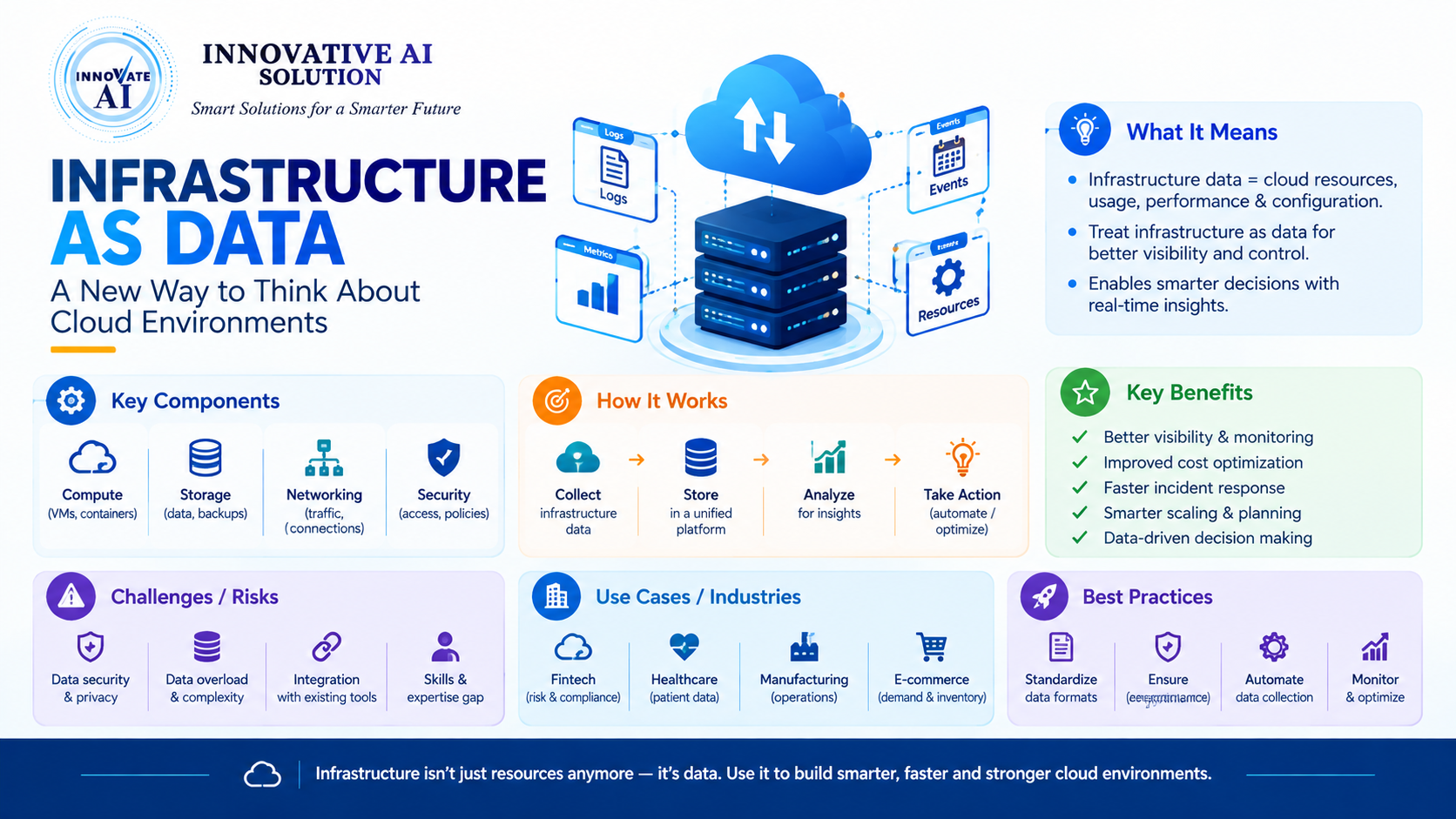
Infrastructure as Data is the practice of continuously collecting the actual state of every resource in your environment across clouds, accounts, regions, and platforms and storing it as structured, queryable data that can be analyzed, joined, and monitored.
The core idea is straightforward: if you can query your infrastructure the way you query a database, you can answer questions that are currently impractical.
The distinction in practice:
| Question | Infrastructure as Code | Infrastructure as Data |
|---|---|---|
| What did we deploy? | Yes | Yes |
| What is actually running? | Partially | Yes |
| Which resources are exposed? | Requires custom scripting | A query |
| Which resources are unused? | No | A query |
| How has the environment changed over time? | Git history only | Full state history |
| Which resources contain regulated data? | No | A join |
Infrastructure as Data does not replace Infrastructure as Code. It complements it by providing the observational layer that code alone cannot supply.
What Gets Collected
The dataset is built from multiple sources, normalized into a consistent schema.
Cloud provider inventories. Native inventory services list resources across accounts and regions compute, storage, networking, databases, IAM, and more.
Configuration state. The actual configuration of each resource, not just its existence. Security group rules, bucket policies, encryption settings, network ACLs.
Relationships. What depends on what. Which service accounts can access which resources. Which resources are attached to which networks. Which services call which APIs.
Access and usage data. Who or what accessed each resource, when, and how often.
Cost and utilization. How much each resource costs and how heavily it is used.
Security findings. Vulnerabilities, misconfigurations, and policy violations associated with each resource.
Ownership and metadata. Tags, owners, environments, business units, data classifications.
Change history. What changed, when, and by whom.
Each source is incomplete on its own. The value comes from joining them into a unified view of the environment.
Why This Changes What You Can Do
Once infrastructure is a dataset, the questions you can answer change.
Security and Exposure Analysis
-
Which resources are internet-facing and also have weak authentication?
-
Which storage buckets are public and contain data classified as sensitive?
-
Which IAM roles have administrative privileges but have not been used in 90 days?
-
Which resources are exposed but have no owner?
These questions require joining exposure data, configuration data, classification data, and usage data. They are impractical without a unified dataset.
Cost and Utilization Analysis
-
Which resources cost the most and are used the least?
-
Which teams own the highest-spending resources?
-
Which resources have grown in cost faster than their usage?
Cost data alone answers some of this. Joined with ownership and usage data, it answers far more.
Compliance and Audit
-
Which resources handle regulated data, and are they configured to policy?
-
Which resources lack required tags or ownership?
-
What changed in the environment during a specific window?
Audit questions are fundamentally queries against a historical record of state.
Lifecycle Management
-
Which resources have no owner?
-
Which resources have not been accessed in a defined period?
-
Which resources are approaching deprecated configurations?
This is the discovery mechanism for forgotten resources continuous, queryable, and comprehensive.
Incident Response
-
What was the state of this resource when the incident began?
-
What else was connected to it?
-
What changed in the minutes before the failure?
Incident response depends on having a historical, queryable record of environment state.
How It Is Implemented
Continuous Collection
Collection must be continuous, not periodic. Resources are created and changed constantly, and a quarterly snapshot is obsolete the moment it is taken.
Sources: Cloud provider APIs, Kubernetes APIs, agent-based collectors, security tools, cost APIs, and identity providers.
Normalization
Data from different sources must be normalized into a consistent schema. A "compute instance" on one cloud is not identical to a "compute instance" on another, but both must be represented consistently enough to be compared and queried.
The challenge: Every provider has its own resource model, naming conventions, and configuration semantics. Normalization is the work that makes the dataset useful.
Relationship Modeling
Resources do not exist in isolation. The dataset must capture relationships: which resources belong to which applications, which identities can access which resources, which networks connect which services.
This is naturally represented as a graph, and graph queries become a primary interface to the dataset.
Historical Storage
Current state is useful. Historical state is powerful. Storing the state of the environment over time enables change analysis, incident reconstruction, and trend detection.
Query Interfaces
The dataset must be queryable in ways that match how engineers think. SQL for tabular analysis, graph queries for relationship traversal, and natural language interfaces for ad-hoc questions are all valuable.
Integration with Action
Discovery is only useful if it leads to action. The dataset should feed into workflows remediation, cost optimization, compliance reporting, and lifecycle management.
The Relationship to Existing Practices
Infrastructure as Data does not replace existing practices. It connects them.
With Infrastructure as Code: Code defines intent. Data reveals reality. Comparing the two is how drift is detected.
With Cloud Security Posture Management: CSPM tools detect misconfigurations in individual resources. Infrastructure as Data provides the broader context—relationships, ownership, usage that turns a finding into a prioritized action.
With FinOps: Cost data is one input. Joined with ownership, usage, and configuration, it becomes a complete picture of resource value.
With Observability: Application observability tracks what services do. Infrastructure as Data tracks what infrastructure exists. Together they provide a complete operational picture.
With Governance: Compliance requires evidence. A queryable record of environment state is the evidence.
Implementation Roadmap
Phase 1: Collect (Weeks 1-4)
-
Identify all sources. Cloud providers, Kubernetes clusters, identity providers, security tools, cost systems.
-
Aggregate inventories into a central store.
-
Establish a normalization schema that can represent resources across providers.
-
Begin continuous collection rather than periodic snapshots.
Phase 2: Enrich (Weeks 5-8)
-
Add configuration data to each resource record.
-
Model relationships between resources, identities, and networks.
-
Join with cost and usage data.
-
Join with security findings.
-
Add ownership and classification metadata.
Phase 3: Query and Act (Weeks 9-12+)
-
Build query interfaces for common questions.
-
Establish continuous monitoring for resources outside expected patterns.
-
Integrate with remediation workflows.
-
Store historical state for change analysis and incident response.
Frequently Asked Questions
Q1: How is Infrastructure as Data different from Infrastructure as Code?
Infrastructure as Code describes the intended state of the environment. Infrastructure as Data describes the actual state. Code is about deployment; data is about understanding.
Q2: How is it different from a CMDB?
A CMDB is typically updated manually or through integrations that capture only registered resources. Infrastructure as Data is collected continuously from the environment itself, capturing everything that exists including resources that were never registered.
Q3: Isn't this just Cloud Security Posture Management?
CSPM focuses on misconfigurations in individual resources. Infrastructure as Data provides the broader dataset relationships, ownership, usage, cost that contextualizes those findings and supports questions beyond security.
Q4: What is the hardest part of implementing this?
Normalization. Every cloud provider models resources differently, and building a schema that consistently represents resources across providers is substantial work. It is also the work that makes everything else possible.
Q5: Do I need a graph database?
Not necessarily, but relationship queries are central to the value. Graph databases make relationship traversal natural, but a relational store with well-modeled join tables can achieve much of the same result.
Q6: How can Innovative AI Solutions help?
We help organizations build Infrastructure as Data capabilities from multi-source collection and normalization to relationship modeling, query interfaces, and integration with remediation. Based in Delhi, serving clients across India.
Why Delhi is a Great Hub for Cloud Data Innovation
Delhi is emerging as a hub for cloud-native and enterprise data innovation, backed by a thriving IT services ecosystem and a large base of organizations operating multi-cloud environments. As Indian enterprises scale their cloud footprints and face increasing regulatory expectations around visibility and control, treating infrastructure as queryable data becomes a practical necessity.
What We Offer at Innovative AI Solutions
-
Infrastructure Data Strategy: We help you identify sources, define schemas, and design the collection architecture.
-
Multi-Source Collection: We implement continuous collection across clouds, clusters, and tools.
-
Normalization and Modeling: We build the schema and relationship model that makes the dataset queryable.
-
Query Interfaces: We provide SQL, graph, and natural language access to infrastructure data.
-
Integration with Action: We connect the dataset to remediation, cost, and compliance workflows.
Final Thought
The shift is clear: from describing what you intended to deploy to understanding what is actually running. Infrastructure as Code gave us reproducible environments. Infrastructure as Data gives us legible ones. The organizations that build this capability will be able to answer questions about their own environments that currently require weeks of effort and they will answer them continuously, in seconds.
Contact Us:
Phone: +91 7464 099 059 / +91 9689967356
Email: info@innovativeais.com
Address: 904, 9th floor Pearls Best Heights-I, Netaji Subhash Place, Delhi-110034
Website: https://innovativeais.com
About the Author
Abhishek Kumar
Founder & CEO, Innovative AI Solutions
5+ years building AI, cloud, and enterprise systems. Based in Delhi, serving clients across India.