The Big Question
What if you could understand exactly how every process in your organization actually runs—not how you think it runs, but the real, messy, human-driven reality? What if AI could watch thousands of employee actions, identify every bottleneck, and tell you exactly where automation would deliver the highest ROI?
Traditional process discovery relied on interviews and manual observation—time-consuming, subjective, and impossible at enterprise scale. Intelligent Process Discovery changes everything by turning AI loose on your actual operational data.
What Is Intelligent Process Discovery?
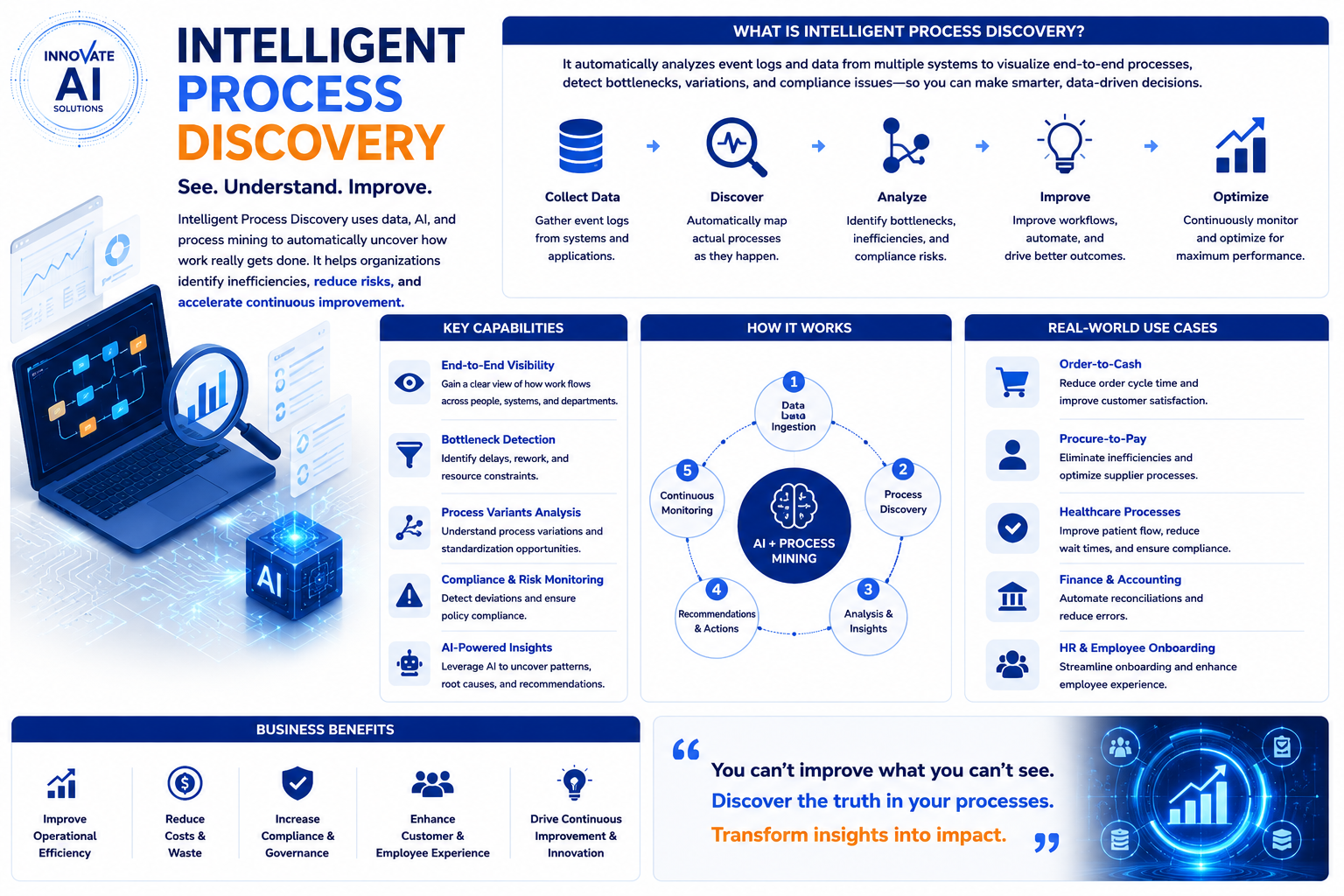
Intelligent Process Discovery uses AI and machine learning to automatically identify and analyze workflows, tasks, and bottlenecks within an organization. Unlike traditional discovery methods that rely on manual data collection and observation, AI-driven discovery sifts through vast amounts of data in real time, identifying patterns and insights that human analysts miss.
AI algorithms analyze log files, transactional data, and user interactions to create detailed maps of how processes actually perform. This gives businesses a clear, data-driven understanding of their operations, leading to more accurate process models and more effective optimization strategies. Machine learning ensures these models are continuously updated and refined as new data is generated—making Process Discovery a dynamic, ongoing effort rather than a one-time event.
The Evolution: From Manual Discovery to Hyperautomation
Process discovery has evolved significantly. It now integrates with Robotic Process Automation (RPA) platforms, enabling organizations to rapidly identify and automate suitable processes. This integration is a key part of hyperautomation initiatives, where the goal is not just individual process improvements but a complete transformation of business operations.
How It Works: The Technology Stack
Automated Capture and Analysis
Process discovery solutions use desktop analytics and adaptive machine learning to analyze employee actions at scale. A strong solution will analyze desktop activity—keystrokes, mouse selections, applications used, pages visited, field entries, and time required to complete tasks.
The tool stores data from millions of employee desktops, then categorizes and structures the untagged data to find meaningful sequences that can be sorted and tagged to classify employee actions with automation potential.
Process Intelligence: The Next Generation
Gartner defines Process Intelligence as the evolution beyond simple process mining. It combines development and runtime software tools to analyze, model, and monitor business processes. Key capabilities include:
| Component | What It Does |
|---|---|
| Process Mining | Extracts event data from systems to automatically discover process models and identify deviations |
| Task Mining | Analyzes low-level UI interactions (keystrokes, clicks, data entries) at the individual user level |
| KPI Analysis | Provides dashboards, simulation, scenario testing, and predictive models for operational decision support |
| Process Modeling | Creates contextual models, customer journey maps, and operating models |
| Process Monitoring | Delivers real-time dashboards, automated alerts, root cause analysis, and event stream processing |
The GenAI Layer
GenAI is transforming process discovery capabilities:
| Capability | What It Does |
|---|---|
| Automated Process Narratives | Generates detailed, narrative descriptions of discovered processes, making them easier for stakeholders to understand |
| Intelligent Anomaly Detection | Identifies anomalies beyond simple statistical deviations by understanding context and purpose |
| Predictive Process Modeling | Creates "process twins"—digital models that simulate how processes might evolve under different scenarios |
| Automated Improvement Suggestions | Proposes specific process improvements based on discovered processes and best practices |
Results: What Organizations Are Achieving
Vale: 89% Faster Discovery, $5M in Savings
Global mining company Vale used Automation Anywhere's AI-powered Process Discovery to analyze 370,000 employee actions and uncover five key processes for automation.
Results:
-
Discovery time reduced from 3 months to 10 days—89% faster
-
121,000+ hours freed annually
-
$5 million in annual savings
-
370,000 employee actions analyzed rapidly and automatically
Manufacturing: 25% Faster Development
A multinational tech company implemented an AI-driven Process Discovery tool to analyze its software development lifecycle. The system identified bottlenecks in code review and testing, suggesting improvements that led to a 25% reduction in overall development time and a 35% reduction in post-release issues.
Public Sector: 50% Faster Permits
A large city authority employed AI-powered Process Discovery to streamline citizen services. Analysis of permit applications, waste management, and other processes identified redundant steps and digitization opportunities. Remediations resulted in a 50% reduction in building permit processing time and 35% improvement in service response times.
Healthcare: 25% Shorter ER Waits
A large hospital network used machine learning algorithms to analyze patient flow through emergency departments. The system uncovered bottlenecks in examining and treatment processes, leading to targeted improvements that reduced average wait times by 25% and increased patient satisfaction scores by 20%.
Banking: 40% Faster Loan Processing
A global bank employed AI-driven Process Discovery to optimize its loan approval process. The system identified redundant steps and automation opportunities, resulting in a 40% reduction in loan processing time and a 50% decrease in manual errors.
Implementation Roadmap
Phase 1: Discovery and Assessment (Weeks 1-4)
-
Define objectives: What problems are you trying to solve? What questions need answers?
-
Select high-impact areas: Start with processes that have the greatest potential for ROI
-
Assess data readiness: Ensure event logs are complete and of sufficient quality
-
Choose a platform: Leading providers include Automation Anywhere, Celonis, Microsoft, ServiceNow, and UiPath
Phase 2: Analysis and Prioritization (Weeks 5-8)
-
Deploy the discovery tool to capture data from the selected processes
-
Analyze discovered patterns: Identify bottlenecks, deviations, and inefficiencies
-
Score and rank opportunities: Use ROI, feasibility, and strategic alignment criteria
-
Validate findings with process owners and frontline employees
Phase 3: Automation and Improvement (Weeks 9-12+)
-
Design automation workflows for selected processes
-
Implement improvements using RPA, AI agents, or process redesign
-
Monitor outcomes using continuous process intelligence
-
Scale to additional departments and repeat
Frequently Asked Questions
Q1: How is Intelligent Process Discovery different from traditional process mapping?
Traditional mapping relies on interviews and observation. Intelligent Process Discovery uses AI to analyze actual operational data—keystrokes, mouse clicks, system logs—providing objective, data-driven insights at scale that manual methods cannot achieve.
Q2: How fast can I see results?
Vale reduced discovery time from 3 months to 10 days—89% faster. Results depend on process complexity and data readiness, but leading implementations show value in weeks, not months.
Q3: What's the difference between process mining and task mining?
Process mining analyzes event logs from enterprise systems (CRM, ERP) to discover how processes flow across the organization. Task mining analyzes individual user interactions at the desktop level—keystrokes, mouse clicks, data entries—to identify inefficiencies and automation opportunities at the individual task level.
Q4: Do I need clean data to start?
Data quality is a common challenge. However, process discovery tools can help identify data quality issues and guide remediation. Start with a small pilot to validate data fidelity before full deployment.
Q5: How can Innovative AI Solutions help?
We help organizations design, implement, and scale Intelligent Process Discovery programs—from platform selection and data readiness assessment to pilot execution and enterprise-wide scaling. Based in Delhi, serving clients across India.
Why Delhi is a Great Hub for Process Innovation
Delhi is emerging as a hub for process automation and operational intelligence, backed by a thriving IT services ecosystem and government support for digital transformation. Indian enterprises are increasingly adopting process discovery as a core capability for operational excellence and competitive advantage.
What We Offer at Innovative AI Solutions
-
Process Discovery Strategy: We help you identify high-value processes and design a discovery roadmap
-
Platform Selection: We help you choose between Automation Anywhere, Celonis, ServiceNow, UiPath, and other platforms
-
Implementation: We help you deploy discovery tools and integrate with automation platforms
-
Governance: We help you establish data quality, security, and compliance frameworks
-
Scaling: We help you expand from pilots to enterprise-wide process intelligence
Final Thought
Intelligent Process Discovery is the bridge between operational complexity and strategic advantage. Organizations that master it will identify opportunities competitors miss, automate faster, and operate more efficiently. The technology is proven, the results are documented, and the ROI is clear.
Contact Us:
Phone: +91 7464 099 059 / +91 9689967356
Email: info@innovativeais.com
Address: Netaji Subhash Place, Pitampura, Delhi – 110034
Website: https://innovativeais.com
About the Author
Abhishek Kumar
Founder & CEO, Innovative AI Solutions
5+ years building AI and automation systems for enterprises. Based in Delhi, serving clients across India.